
Early 2000s slang is the informal language people used from about 2000 to 2005, a mix of hip-hop words, AIM abbreviations, gaming terms, and TV catchphrases that defined how millennials talked before social media took over.
If you grew up with a chunky desktop computer in the corner of the room, a dial-up tone that blocked the phone line, and a MySpace page you decorated for hours, you already know this language. You said BRB when dinner was ready, called something sick when it was great, and told your friends to peace out at the end of the night. If you missed that era, this guide catches you up. It covers what early 2000s slang meant, where each wave of words came from, how people actually used them, and which ones are still alive today.
One thing to clear up first: early 2000s slang is not the same as all 2000s slang. The decade had two halves. The early half, roughly 2000 to 2005, ran on AIM, MSN Messenger, MySpace, MTV, and flip phones. The late half, roughly 2006 to 2009, ran on early Facebook, YouTube, and the first iPhones. The words were different, the platforms were different, and the jokes landed differently. This article sticks to the early half, and if you want the full decade, our guide to 2000s slang covers the wider picture.
Table of Contents
- What Is Early 2000s Slang?
- The Words Everyone Was Saying
- Where Did Early 2000s Slang Come From?
- Early 2000s Slang vs Late 2000s Slang
- How People Used These Words in Real Life
- Which Early 2000s Words Survived (and Which Died)
- Myths About Early 2000s Slang
- Should You Use Early 2000s Slang Now?
- FAQs About Early 2000s Slang
- Sources and Further Reading
What Is Early 2000s Slang?
Early 2000s slang is the casual vocabulary that spread among teenagers and young adults in the first half of the 2000s, roughly 2000 to 2005. It mixed street language from hip-hop, shortcuts invented for instant messaging, gaming terms from forums and LAN parties, and catchphrases lifted straight from TV shows and movies. Most of it was spoken out loud at school and typed into AIM windows late at night, and the two settings fed each other constantly.
The era had a shape you can still recognize. Phones had physical keypads, so typing was slow and every character cost effort, which pushed people toward short forms like LOL and BRB. Home internet ran on dial-up, so you went online in sessions instead of living there all day. MTV still played music videos, and a single song or show could push a phrase into every school in the country within a week. That mix of slow typing, scheduled internet time, and huge shared pop culture moments is what made early 2000s slang feel so specific. The words were short, loud, and built to travel fast.
The slang also carried the mood of the moment. The early 2000s were loud, shiny, and a little over the top: low-rise jeans, frosted tips, trucker hats, and ringtones you paid real money for. The language matched. Words like bling, crunk, and booyah are big, bouncy words, and they sound like the era they came from. At the same time, the internet was teaching a whole generation to write in abbreviations, and that habit never really went away.
The Words Everyone Was Saying
The early 2000s did not have one slang. It had several slang streams running at the same time, and most people dipped into all of them. A teenager in 2003 might say fo shizzle in the hallway, type TTYL on AIM, call someone a noob in a game, and quote a movie at lunch. The groups below follow those streams, because that is how the words actually lived.
Hip-Hop and MTV Words
Bling (or bling bling): flashy jewelry or expensive-looking accessories. Babbel traces the phrase “bling bling” to the 1999 song of the same name from the New Orleans label Cash Money Records, with B.G. as the main rapper. It blew up in the early 2000s and became the default word for anything shiny and expensive. Example: “Check the bling on that chain.”
Crunk: a wild, high-energy good time, usually tied to partying and to the crunk style of hip-hop. Her Campus lists it as basically a synonym for having a good time, with the note that it could mean sober fun or not sober fun. Example: “Let’s get crunk tonight.”
Fo shizzle: a playful way to say “for sure,” popularized through hip-hop and Snoop Dogg. It was half a real phrase and half a joke even at the time, which is why it still works as a nostalgia line today. Example: “Fo shizzle, I’ll be there.”
Baller: someone cool, rich, or impressive, or a way to describe something awesome. Her Campus places it in the early to mid 2000s as a general word for cool and exciting. Example: “That car is baller.”
Dawg: a friendly word for a friend or another person, usually said warmly. Her Campus gives the example “What’s up, dawg?” and notes it was a way to address someone you felt good about. Example: “My dawg just got tickets.”
Homeskillet (or homeslice): another friendly term for a close friend, used the same way as dawg but sillier. Her Campus records “Wassup, homeskillet?” as the classic greeting. Example: “Homeskillet, you have to see this.”
Poppin’: cool, exciting, or happening. Her Campus ties it to Lil Mama’s song “Lip Gloss” and defines it simply as cool. Example: “This party is poppin’.”
Word: a small word that meant “I understand,” “I agree,” or “that’s awesome,” depending on tone. Her Campus notes it worked like “okay” or “awesome” depending on context. Example: “Word? You actually got the tickets?”
AIM, MSN, and Texting Shortcuts
LOL: laughing out loud. The most famous abbreviation of the era, and the one that survived best. SlangAura notes it became one of the most recognizable internet abbreviations of the period. Example: “That video was so funny LOL.”
BRB: be right back. People typed it when they stepped away from the computer, and SlangAura points out it became closely tied to AIM and MSN Messenger. Example: “BRB, dinner’s ready.”
OMG: oh my God, or oh my gosh. It existed before the 2000s, but texting and instant messaging made it a reflex. Example: “OMG, you actually won!”
TTYL: talk to you later. The standard sign-off at the end of an AIM conversation. Example: “I have to go. TTYL!”
IDK: I don’t know. A quick way to answer without typing the full phrase. Example: “IDK what time they’re coming.”
BFF: best friends forever. It showed up in texts, MySpace bios, and photo captions all through the decade. Example: “She’s my BFF.”
Peeps: short for people, meaning your friends or your crew. Her Campus puts it nicely: peeps walked so besties could run. Example: “These are my peeps.”
‘Rents: a short, cute way to say parents. Her Campus lists it among the era’s favorites and suggests trying it on your family to see how they react. Example: “The ‘rents are out tonight.”
Gaming and Forum Words
Noob (or n00b): someone new and inexperienced, especially in a game or online community. Babbel traces it to a shortening of “newbie” and notes the hacker collective Cult of the Dead Cow helped coin the leet-speak style it came from. In the early 2000s it was a way to separate internet old-timers from newcomers. Example: “Give him a chance. He’s still a noob.”
Owned: what you said when you beat someone badly, especially in a game. Her Campus gives the classic line: “Yeah, dude, I owned you at Mario Kart!” Example: “You just got owned.”
You got served: a cousin of owned, used the same way after a win or a comeback. Her Campus describes it as serving someone their own busted ego on a tarnished silver platter. Example: “You got served.”
Pwned: a gaming spelling of owned, meaning thoroughly defeated or embarrassed. SlangAura lists it among the internet slang that defined the era. Example: “You just got pwned!”
GG: good game, said at the end of a match. It is one of the few gaming terms from the era that never left. Example: “GG, that was close.”
AFK: away from keyboard, the gaming version of BRB. Example: “AFK for five minutes.”
TV and Movie Catchphrases
That’s hot: a way to say something is good, cool, or sexy, made famous by Paris Hilton on The Simple Life, which started in 2003. Babbel explains that Hilton built a whole persona around the phrase, and that she later said the “dumb blonde” character was not her real self. Example: “That’s hot.”
Fetch: very cool or fashionable, from the movie Mean Girls. Her Campus notes the joke directly: yes, people were trying to make fetch happen. Example: “That jacket is so fetch.”
Wassup?: a drawn-out “what’s up,” turned into a symbol of the era by a Budweiser ad campaign. Babbel traces it to Charles Stone III’s 1998 short film True, then the Budweiser commercials that ran from 1999 until 2002 and got parodied everywhere after. Example: “Wassuuuuup?”
I see what you did there: a joking way to say you caught someone’s pun or clever twist. Babbel credits its original popularity to a 1996 Friends episode, where Phoebe says it to Joey, and notes it then lived on message boards and forums through the 2000s. Example: “I see what you did there.”
Talk to the hand: a sassy way to say you are done with a conversation, usually with a hand flipped out. Her Campus lists it as a clever way to say you will not be dealing with it any longer. Example: “Talk to the hand.”
Take a chill pill: a sarcastic way to tell someone to relax, often used when someone was stressing out. Her Campus describes it as passive-aggressive by design. Example: “Take a chill pill, it’s just a game.”
School Hallway and Mall Words
Chillax: a blend of chill and relax, meaning calm down or take it easy. Babbel notes the earliest appearances were in the mid-1990s, including Company Flow’s 1996 song “Vital Nerve,” and that it allegedly first appeared in film in the 2003 horror movie Final Destination 2. Example: “Chillax, we have plenty of time.”
Sketchy: not trustworthy or suspicious. Babbel explains it started as a word for something incomplete, like a sketch, and shifted to its suspicious meaning in the late 1990s before lodging itself in the youth vocabulary of the 2000s. Example: “That guy only texts at 3 a.m.? Sketchy.”
Sick: excellent or awesome, the opposite of its literal meaning. SlangAura gives the classic example: “Those shoes are sick.” The meaning depended completely on context. Example: “That concert was sick.”
Awesome: extremely good or impressive. It was already an old word, but the 2000s made it a default reaction to everything good. Example: “That movie was awesome.”
Epic: unusually impressive, dramatic, or memorable. SlangAura notes it became especially common in online communities and gaming. Example: “That concert was epic.”
Legit: short for legitimate, meaning genuine, trustworthy, or very good. Example: “That new website is legit.”
Stoked: excited, a more relaxed version of ecstatic. Her Campus compares being stoked about skipping homework with being ecstatic about a birthday. Example: “I’m so stoked for Friday.”
Sweet: an exclamation of happiness when good news lands. Her Campus gives the example: “I just found $20 on the ground! Sweet!” Example: “Sweet, we got the last table.”
Peace out: a fun way to say goodbye, ideally with a peace sign. Example: “Peace out, see you tomorrow.”
Bounce: to leave a place or a situation. Her Campus gives the example “Let’s bounce” as a replacement for “Let’s blow this popsicle stand.” Example: “This party is dead. Let’s bounce.”
Booyah: an exclamation of excitement or triumph, comparable to “holla” or “eureka.” Example: “Booyah! I got the job.”
Holla: a call for attention or excitement, and “holla at me” meant give me a call. Her Campus links it to Gwen Stefani’s “Hollaback Girl” era. Example: “Holla at me later.”
Trashed: drunk or messed up, a harder version of crunk. Her Campus defines it as a synonym for crunk, except definitely not sober. Example: “He got trashed at the party.”
Biotch: a playful, softened take on a much ruder word, popular in comedies of the era. Her Campus points to the movie 13 Going On 30 as a place you would have heard it. Example: “Don’t be such a biotch about it.”
Where Did Early 2000s Slang Come From?
Early 2000s slang did not come from one place. It came from at least five places at once, and each one fed the others. Hip-hop gave the era its loudest words. Instant messaging gave it the shortcuts. Gaming gave it the insults. TV and movies gave it the catchphrases. And school hallways mixed all of it together until nobody remembered where a word started. The diagram below maps those five streams.
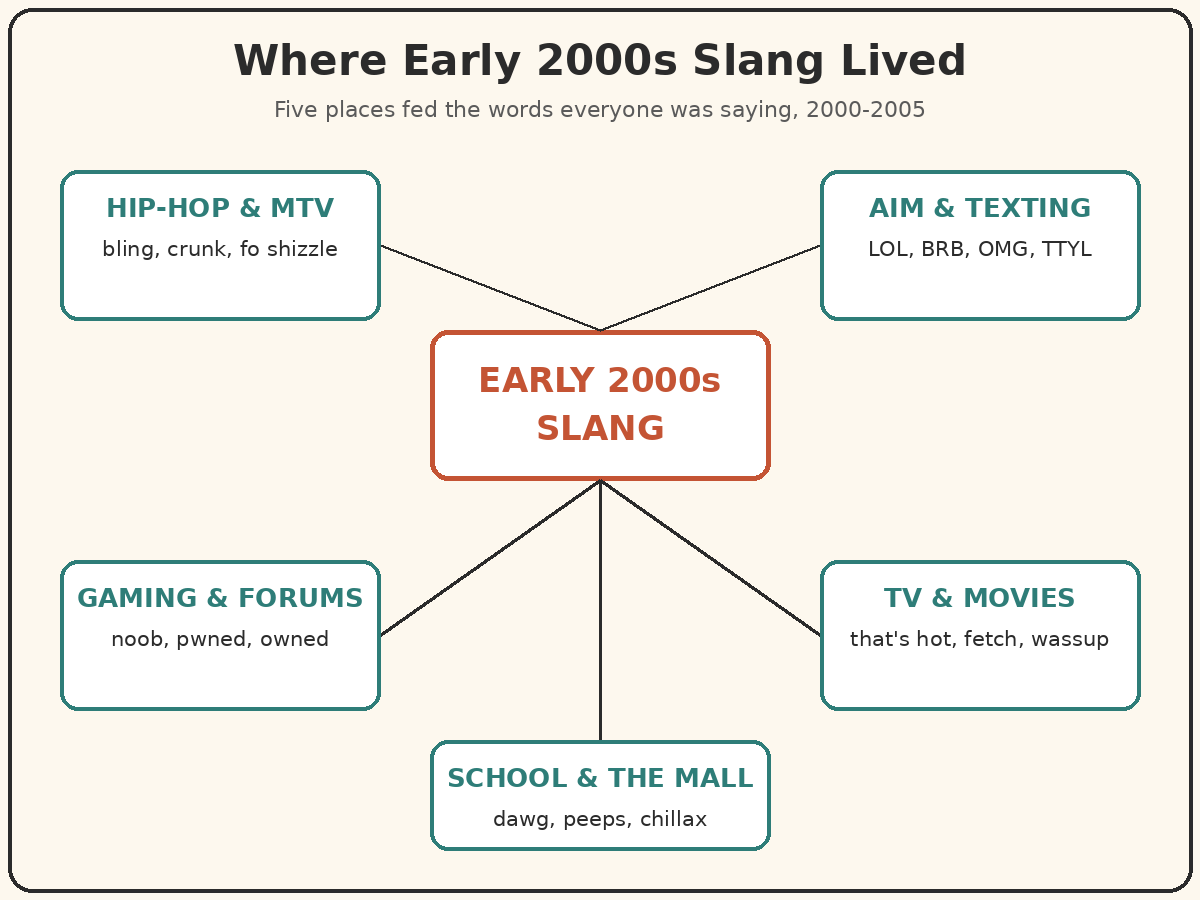
Hip-hop was the biggest single engine. Rap was the dominant pop music of the early 2000s, and MTV played its videos all day, so words like bling and crunk traveled from songs into school hallways within weeks. Babbel points out that bling bling started as a 1999 Cash Money Records song and then became mainstream through the decade, and that it peaked around 2007 before fading. That path, from a rap lyric to a national catchphrase to a dated word, is the classic life cycle of early 2000s slang.
The internet was the second engine, and it worked differently. AIM and MSN Messenger rewarded short messages because typing on a keyboard in 2002 was slower and clunkier than it is now, and phone keypads made texting even slower. Abbreviations like LOL, BRB, and TTYL saved real time, and they spread because everyone online needed them. SlangAura notes that the technology shaped the language directly: AIM and MSN encouraged short messages, SMS made people shorten words because of character limits, and MySpace created new ways to express personality online. Gaming added its own layer, with words like noob and pwned that started in forums and LAN parties and leaked into everyday talk.
TV and movies were the third engine, and they worked through repetition. A catchphrase on a hit show got repeated in living rooms across the country the next day. Paris Hilton’s “that’s hot” on The Simple Life is the clearest case: one person, one show, one phrase, and suddenly everyone was saying it. The Budweiser “wassup” ads did the same thing from the commercial side, running from 1999 to 2002 and getting parodied in movies and sitcoms for years after. That is why so much early 2000s slang feels tied to specific shows and ads: the words arrived with the pictures attached.
Early 2000s Slang vs Late 2000s Slang
The two halves of the decade sound different once you line them up. Early 2000s slang is louder, longer, and more tied to TV and music. Late 2000s slang is shorter, more internet-native, and more tied to early social media. The table below shows the split.
| Early 2000s (2000 to 2005) | Late 2000s (2006 to 2009) | What changed |
|---|---|---|
| bling, crunk, fo shizzle | swag, YOLO (late), like a boss | Hip-hop words got shorter and more attitude-driven |
| LOL, BRB, OMG, TTYL | LMAO, ROFL, WTF, TBH | Abbreviations got louder and more emotional |
| AIM, MSN Messenger, MySpace | Facebook, YouTube, early Twitter | The home platform moved from chat windows to feeds |
| noob, pwned, owned | epic fail, troll, FTW | Gaming slang merged with meme culture |
| that’s hot, fetch, wassup | that’s what she said, leave Britney alone | Catchphrases came from viral videos, not just TV |
| flip phones, dial-up, AIM away messages | iPhone (2007), broadband, Facebook walls | The internet stopped being a place you visited |
The biggest difference is the platform. In the early 2000s, the internet was a place you went to, usually after school, on a shared family computer. You signed on, you talked to your friends, you signed off. By the late 2000s, the internet was starting to follow you around. That shift changed the slang: early 2000s words were built for chat windows and hallways, while late 2000s words were built for status updates and comment sections. If you want the full decade in one place, our guide to 2000s slang covers both halves together.
How People Used These Words in Real Life
The words only make sense in context, so here is what a normal day sounded like. Morning at school: “Yo, dawg, did you see the game last night? That dunk was sick.” Lunch: “My ‘rents are out tonight, let’s bounce to Jake’s after school.” AIM at 9 p.m.: “hey. brb, mom needs the phone. OMG did u hear about Sarah?? TTYL.” Gaming after homework: “Dude, you just got owned. GG.” Each setting had its own words, and switching between them was automatic. Nobody thought about it, which is exactly how slang works when it is alive.
The tone mattered as much as the words. “Word” could mean agreement, surprise, or respect, and only your voice told people which one. “That’s hot” was often sarcastic, said about something that was clearly not hot at all. “Sketchy” was a judgment call, a way to flag something off without explaining why. And “chillax” was almost always said to someone who was visibly not chill, which was the whole joke. If you use these words now, the tone is what sells them. Say them flat and they sound like a list. Say them with the right energy and people hear the era.

Which Early 2000s Words Survived (and Which Died)
Some early 2000s words never left. LOL, OMG, and BFF are still everywhere, and GG is still the standard sign-off in gaming. Awesome, legit, and sick survived too, because they were useful words that fit into normal speech without sounding like a costume. SlangAura makes the same point: words like LOL, OMG, BFF, IDK, legit, chill, and awesome remain recognizable and are still used in casual communication today. They survived because they solved a real problem, usually speed or emphasis, and they did not depend on a specific show or song to make sense.
Other words died with the moment that made them. Fo shizzle, biotch, and booyah sound like jokes now, and they mostly get used as jokes. Bling faded once the word became a punchline, and Babbel notes it peaked around 2007 and fell mostly out of use after that. That’s hot died with The Simple Life, and wassup died with the Budweiser campaign that carried it. The pattern is simple: words tied to a specific celebrity, show, or ad have a short life, while words tied to a real need, like typing faster or saying “I agree,” stick around for decades. That is also why the cool and awesome guides on this site still get read: those words outlived the decade that made them famous.
Myths About Early 2000s Slang
Myth: Millennials invented all of it
Not true. Many of the most famous early 2000s words existed long before the decade started and simply became visible then. SlangAura flags this directly: one common mistake is assuming every popular word from the 2000s was created by millennials, when many expressions existed earlier and just became more visible during the period. Chillax showed up in the mid-1990s, “I see what you did there” came from a 1996 Friends episode, and bling bling was a 1999 song. The early 2000s popularized these words, but it did not invent all of them.
Myth: It was all texting abbreviations
Also not true. Texting was one stream, but the era also had spoken slang, gaming terms, music words, and TV catchphrases. SlangAura notes the same mistake: treating all 2000s slang as texting abbreviations misses the spoken slang, gaming terms, music expressions, and internet language that ran alongside it. A kid in 2003 used LOL online and crunk at a party, and those were two different skills.
Myth: Every millennial talked the same way
No. Age, location, friend group, music taste, and gaming habits all shaped which words a person used. SlangAura points out that someone who was a teenager in 2003 had a different experience from someone who was a teenager in 2009, and the same was true inside a single year: a gamer, a hip-hop fan, and a theater kid in the same school used overlapping but different vocabularies. Early 2000s slang was a shared pool, not a uniform script.
Myth: The words were meaningless filler
The words did real work. BRB and TTYL managed conversations, owned and pwned settled status in games, and sketchy warned friends about people and places. Each word carried social information, and using the wrong one in the wrong group marked you as an outsider. That is true of all slang, and it was true here too.
Should You Use Early 2000s Slang Now?
Yes, in the right settings, and with a light touch. Early 2000s slang works best as nostalgia: a throwback caption, a joke with friends who lived through the era, a themed party, or a comment on a retro post. LOL, OMG, awesome, and legit work anywhere because they never really died. Words like fo shizzle, biotch, and booyah work as deliberate jokes, and everyone in the room will understand the joke is the word itself.
There are limits. Do not use early 2000s slang to sound current, because it will do the opposite: it marks you as someone quoting a past era, which is fun in a nostalgic context and awkward in a serious one. Do not use the rougher words, like biotch or trashed, around kids, at work, or with people you do not know well, because the tone does not always travel. And do not stack five of them in one sentence, because that turns a natural reference into a costume. One throwback word in a normal sentence lands better than a whole paragraph of them. The same rule applies to the decade guides on this site: our 1990s slang and 1970s slang guides are fun to read for the same reason, as a trip back, not as a script for today.
FAQs About Early 2000s Slang
What slang was popular in the early 2000s?
The most popular early 2000s slang included bling, crunk, fo shizzle, that’s hot, chillax, sketchy, sick, and epic, plus texting shortcuts like LOL, BRB, OMG, TTYL, IDK, and BFF, and gaming words like noob, pwned, and owned. The exact list depended on your friend group, your music taste, and whether you spent more time on AIM or on a console.
What years count as the early 2000s?
Most people mean roughly 2000 to 2005 when they say early 2000s. The split is not official, but it fits the technology: dial-up, AIM, MSN Messenger, flip phones, and MTV ruled the first half, while broadband, Facebook, YouTube, and the iPhone defined the second half. If someone says “early 2000s slang,” they usually mean the AIM and MTV era, not the Facebook era.
What does “that’s hot” mean in 2000s slang?
“That’s hot” meant something was good, cool, or sexy, and it was popularized by Paris Hilton on The Simple Life, which started in 2003. People also used it sarcastically, saying it about something that was clearly not hot at all. Hilton later said the “dumb blonde” character she played on the show was not her real self, and she even trademarked the phrase.
What does “bling” mean?
Bling means flashy jewelry or expensive-looking accessories. The phrase “bling bling” comes from a 1999 song of the same name by Cash Money Records artists, with B.G. as the main rapper. It became the default early 2000s word for anything shiny and expensive, then faded after peaking around 2007.
Is LOL from the early 2000s?
LOL became famous in the early 2000s, but it is older than the decade. It spread through AIM, MSN Messenger, and early texting because it saved time and worked in any conversation. Unlike most early 2000s slang, it never died, and it is still one of the most recognized abbreviations online today.
What is the difference between early 2000s slang and 90s slang?
Early 2000s slang is more internet-driven than 90s slang. The 90s gave us words from TV, movies, and hip-hop, while the early 2000s added a whole layer of abbreviations and gaming terms from AIM, MSN, and forums. The two decades overlap a lot: chillax and “I see what you did there” both started in the 90s and peaked in the early 2000s. For the full 90s picture, see our 1990s slang guide.
Do people still use early 2000s slang?
Some of it, yes. LOL, OMG, BFF, awesome, legit, sick, and GG are still in daily use. The rest mostly survives as nostalgia: people say fo shizzle or that’s hot as a joke, to signal the era, not because it is current slang. The words that solved a real problem, like typing faster, survived. The words tied to one show or song mostly did not.
Sources and Further Reading
- Babbel on the 2000s slang that defined the decade, with origin stories for bling bling, chillax, noob, sketchy, that’s hot, and wassup
- SlangAura on millennial slang from the 2000s, with grouped word lists, a 2000s vs Gen Z comparison, and FAQs
- Her Campus on 30 early 2000s words and phrases worth bringing back, with one-line meanings and examples
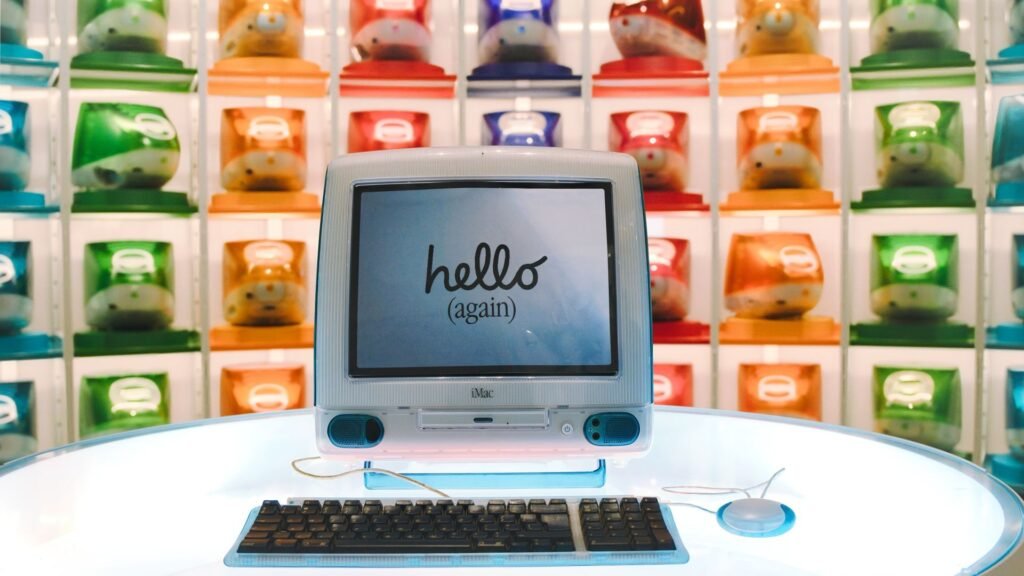
- Ruben Boekeloo’s photo of colorful iMac G3 computers on Pexels, used as the featured image
- Viktorya Sergeeva’s photo of a retro CRT computer setup on Pexels, used in the article body