


In slang, “fye” is a phonetic spelling of “fire,” pronounced “fye” (rhyming with “tie”), and it means something is excellent, exciting, or extremely good, so calling a song, an outfit, a meal, or a person “fye” is a quick way to say it is top tier.
You have probably seen it sitting alone in a comment section, sometimes with a fire emoji riding next to it. Someone drops a new track, and the first reply is just “fye.” A friend posts a fit check, and the comments fill with “that fit is fye.” Nobody is talking about actual flames. The word is praise, pure and simple, and it carries a little more swagger than plain “fire” because of the way it is spelled.
That spelling is the whole story. “Fye” looks like a typo until you say it out loud in a Southern accent, and then it clicks. This guide covers the fye meaning in text and online, where the word came from, how it differs from “lit,” “gas,” and “hard,” when it works, when it flops, and what to say back when someone calls you fye.
Table of Contents
- What Does FYE Mean in Slang?
- Where Did FYE Come From?
- FYE vs Fire, Lit, Gas, and Hard: How They Differ
- Who Says FYE, and Where Does It Show Up?
- What Does FYE Mean in Text, on TikTok, and on Snapchat?
- Real Examples of FYE in Texts and Comments
- What to Say When Someone Calls You FYE
- Myths About FYE, Corrected
- When NOT to Use FYE
- FAQs About FYE Slang
- Sources and Further Reading
What Does FYE Mean in Slang?
FYE means “fire” in slang, and it works as an adjective for anything excellent, hot, or exciting. It is pronounced “fye,” one syllable, rhyming with “tie” or “pie.” You use it the same way you would use “fire”: a song is fye, a fit is fye, a plate of food is fye. The word is always positive, always casual, and it lands best as a short burst of praise rather than a long sentence.
The simplest way to think about it is that “fye” is “fire” with the spelling bent to match how the word sounds in Southern American English. Dictionary.com defines fye as a slang expression used to describe someone or something that is excellent or in a state of excitement, and its entry traces the spelling to the way r sounds drop in Southern and African American English, so “fire” comes out sounding like “fi-yuh.” Once you hear it that way, the spelling stops looking strange.
Most of the time, “fye” shows up in one of three jobs. First, as a compliment on quality: “This beat is fye.” Second, as a compliment on looks: “Your fit is fye.” Third, as a standalone reaction, often with fire emojis: “FYE.” That third use is the one that confuses people the most, because a single word with no sentence around it still carries a full meaning. It is the comment-section version of a chef’s kiss, a fast way to say “this is great” without typing a paragraph.
The word also has a second gear as an intensifier. Dictionary.com notes that fye is frequently paired with the slang intensifier “ass,” as in “this is a fye ass beat” or “check out this fye ass new joint.” That pattern is common in hip-hop lyrics and casual speech, and it cranks the praise up a notch. You will also see “straight fye,” where “straight” does the same job, pushing the compliment from good to undeniable. I have seen “straight fye” under everything from sneaker photos to barbecue plates, and it always reads the same way: not just good, but the real deal.
One thing worth clearing up early is that “fye” is not an acronym in slang use. It is not F.Y.E. with periods, and it does not stand for anything when someone uses it to praise a song. That matters because FYE does exist as an acronym in other worlds, and mixing them up is the most common misunderstanding around the word. The disambiguation section later in this guide sorts those out.
How Do You Pronounce FYE?
Say it as one syllable: “fye,” rhyming with “tie,” “pie,” and “guy.” Dictionary.com gives the pronunciation as “fi-yuh,” which reflects the Southern delivery, with the vowel stretched a little and the r softened away. In fast speech it collapses into a single sharp syllable. Nobody says “F-Y-E” letter by letter when they mean the slang word. If you hear someone spell it out, they are talking about something else, like a store or an acronym.
What Kind of Word Is FYE?
Grammatically, “fye” is an adjective most of the time, sitting right where “amazing” or “excellent” would sit. “That movie was fye” works the same as “that movie was amazing.” It can also act as a standalone exclamation, which is how it appears in so many comments. It is not a verb, and you would not say “I am going to fye this song.” Keep it in its lane as praise, and it sounds natural.
Where Did FYE Come From?
FYE comes from African American English spoken in the American South, where “fire” is pronounced in a way that sounds like “fye,” and the spelling followed the sound from speech into lyrics, then into texting and social media. There is no single inventor and no exact birth date, but the trail runs from Southern hip-hop through early internet slang dictionaries to TikTok comments today.
The root word did most of the work first. “Fire” has been slang for excellent for a long time, and the idea of heat meaning quality is one of the oldest moves in slang: hot, lit, flames, and heat all play the same game. “Fye” is what happens when a community that already says “fire” starts writing it the way it sounds. The spelling “fye” and its cousins “fyah” and “fiyah” have floated around lyrics, tweets, and forum posts for years, and each one leans on the same pronunciation trick.
Dictionary.com dates the paper trail with care. Its fye entry notes that the earliest Urban Dictionary entry using the spelling “fye” is from 2003, and uses of the word on Twitter go back to about 2008. The entry also says some people believe the slang dates back to the 1970s, pointing to origins in states like Georgia, Tennessee, and Florida, though its exact origins are unclear. That honesty matters. A lot of slang sites state a clean origin year as fact, and the real story is messier: the word was spoken in the South long before anyone wrote it down in a dictionary.
Georgia gets named a lot in this story. 7ESL traces the term to Georgia, saying the Southern accent there makes “fire” sound like “fye,” and other guides point to Atlanta hip-hop as the engine that pushed the word outward. Atlanta makes sense as a hub, since the city has shaped so much of modern rap vocabulary, and the artists who popularized the word, from Outkast and Lil Wayne to Young Thug and Future, are named in several guides as the voices that carried it into mainstream ears. I would treat any single-artist credit with caution, since slang spreads through scenes rather than press releases, but the Southern hip-hop link is consistent across every serious source I opened.
The word then rode the same wave as the rest of internet slang. Vine culture in the mid-2010s gave it a visual stage, and TikTok in the 2020s turned it into a comment-section staple. Dictionary.com notes that fye experienced an uptick in popularity in the mid-to-late 2010s, which lines up with the moment short video and reaction comments took over. Today it is recognized far beyond the South, though it still feels most at home in hip-hop and Black American English contexts.
The Southern Pronunciation Behind the Spelling
The spelling only makes sense if you know the sound. In many Southern accents, and in African American English, the r at the end of “fire” softens or disappears, and the vowel opens up. “Fire” becomes something close to “fi-yuh” or just “fye.” Writing it as “fye” is not laziness. It is a deliberate choice that carries the sound of the speaker into text, the same way “yall” carries a Southern contraction or “finna” carries a Southern phrase. The spelling is the accent, written down.
FYE in Hip-Hop Lyrics
Hip-hop is where “fye” earned its reputation. Rappers have used the word for years to describe beats, verses, cars, clothes, and nights out, and the word fits rap cadence well: short, punchy, one syllable, easy to land at the end of a line. When a lyric calls a beat fye, it is doing two jobs at once, praising the music and signaling membership in the culture that made the word. That double job is why the word traveled so well. People borrow it to borrow the energy.
FYE vs Fire, Lit, Gas, and Hard: How They Differ
FYE and “fire” mean the same thing, since fye is just a stylized spelling of fire, while “lit,” “gas,” and “hard” are close cousins with different shades: lit leans toward energy and parties, gas leans toward music and food, and hard leans toward toughness and impact. They all praise something, but they praise different parts of it, and swapping them blindly can change what your sentence means.
Think of it like a shelf of hot sauces. They are all hot, but each one hits a different note. The table below lays out the differences so you can pick the right word for the moment instead of guessing.
| Term | Meaning | Tone | Where It Is Used Most | Example |
|---|---|---|---|---|
| FYE | Excellent, hot, amazing | Playful, stylish, hip-hop rooted | Comments, captions, texts about music, fits, food | “That new album is fye.” |
| Fire | Excellent, amazing | Direct, universal, plain | Everywhere, all ages, all platforms | “This track is fire.” |
| Lit | Exciting, high energy, fun | Party energy, hype, wild | Parties, concerts, nights out, events | “That party was lit.” |
| Gas | Really good, impressive | Laid back, confident, street | Music, food, cars, fits | “That burger was gas.” |
| Hard | Tough, impressive, hits hard | Bold, intense, serious | Music, sports, style, performances | “That verse goes hard.” |
The closest pair is fye and fire, and the difference is mostly flavor. “Fire” is the plain, universal version that anyone can use anywhere. “Fye” is the stylized version, and using it signals that you know the culture behind the spelling. If you are unsure which one fits, “fire” is the safe pick. If you want the extra attitude, “fye” is the pick.
“Lit” is the one people confuse with fye most often, and the confusion is easy to clear up. Lit is about energy and atmosphere: a party is lit, a concert is lit, a night out is lit. Fye is about quality: a song is fye, a fit is fye, a meal is fye. A party can be both lit and fye, but the words are pointing at different things, the vibe versus the quality. A quiet, perfect meal can be fye but it would sound odd to call it lit.
“Gas” overlaps with fye more than lit does, since both words praise quality, but gas has a narrower home turf. It shows up most around music, food, and cars, and it carries a cooler, more laid-back tone. Fye is broader and more excitable. “Hard” sits further apart again, because it praises impact and toughness rather than pure quality. A verse can be hard because it hits, and fye because it is excellent, and the same verse can be both.
If you want a deeper tour of the whole praise-word family, our guide to dope slang covers another classic hype word, and our roundup of slang words that mean cool lines up more than 25 of these terms side by side so you can see where each one fits.
Who Says FYE, and Where Does It Show Up?
FYE is said most by Gen Z and younger millennials, hip-hop fans, and Southern US speakers, and it shows up in TikTok and Instagram comments, captions, group chats, and texts, usually aimed at friends, followers, artists, or anyone whose work or look deserves praise. It is a peer-to-peer word, passed between people who share the same feeds, and it rarely appears in formal or professional settings.
The diagram below maps the whole picture in one glance: who says it, where it shows up, who it is aimed at, and what it praises.
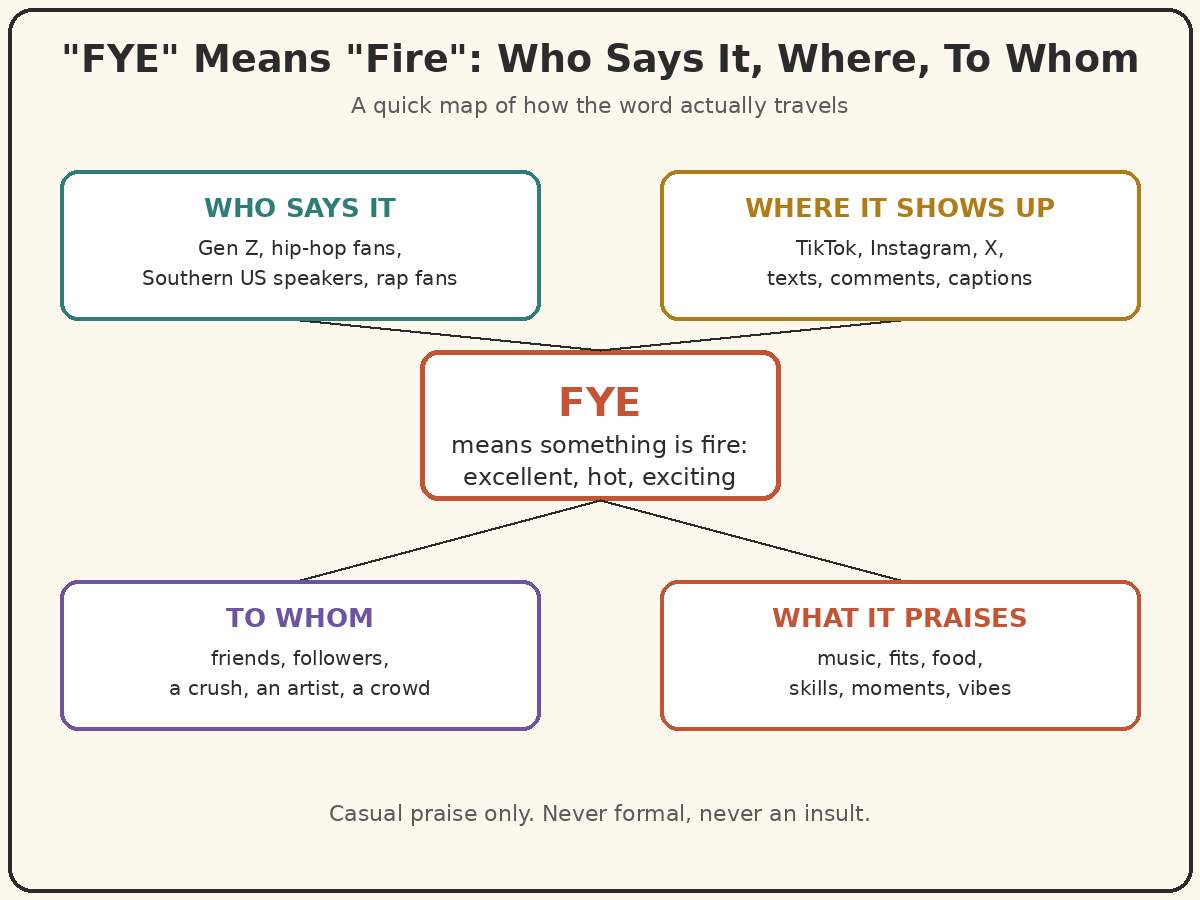
Start with the speakers. The word grew out of African American English and Southern hip-hop, and those communities still use it most naturally. From there it spread to Gen Z more broadly, the same way “lit” and “drip” did, through music, memes, and comment sections. Today you will hear it from teenagers in group chats, from sneaker fans under fit pics, from food lovers under restaurant reels, and from rap fans under new drops. It is youth slang first, and older speakers tend to stick with “fire” or “amazing” instead.
Then look at the places. TikTok is the word’s natural habitat now, in comments under edits, transitions, and music clips, where a one-word reaction is all a viewer needs. Instagram runs close behind, in comments under fits, reels, and food photos. X is where the word lives in reactions to memes, clips, and sports highlights. Snapchat and Discord carry it too, in quick compliments on stories and gaming hype. The pattern is consistent: fast, visual, expressive platforms where praise has to fit in a few characters.

The audience matters as much as the speaker. “Fye” is almost always aimed at someone the speaker likes or admires: a friend whose outfit is on point, an artist whose new song slaps, a crush whose photo just landed, a restaurant that nailed the meal. It is praise aimed upward or sideways, never downward. You do not call your boss’s presentation fye, and you do not call a stranger’s bad news fye. The word needs a target worth celebrating.
What gets praised is broad. Music sits at the top of the list, since a beat, a verse, or a whole album can all be fye. Fashion follows close behind, with fits, kicks, and drip all fair game, and our guide to fit slang explains the outfit word that pairs with fye so often. Food is a big one too, from a burger to a full barbecue spread. Skills, art, photos, videos, parties, and whole vibes round out the list. If it impressed you, it can be fye.
What Does FYE Mean in Text, on TikTok, and on Snapchat?
In text and on TikTok, FYE means “fire,” a compliment that something is excellent, and on Snapchat it can also mean “For Your Entertainment,” a tag for content shared just for fun. The platform decides which meaning applies, and the sentence around the word usually makes it obvious, so context is the real dictionary here.
In texts and group chats, fye is almost always the fire meaning. A friend sends a song link and you reply “fye.” Someone shares a photo of their new sneakers and you say “those are fye.” The word is short enough to fire off without breaking the flow of a conversation, and it carries more warmth than a thumbs-up emoji. It also works as a reaction to a story or a status, a quick way to say you noticed and you liked it.
On TikTok, the word lives in the comments. Edits, transitions, and aesthetic videos collect “fye” the way other videos collect hearts. A creator posts a fit transition, and the top comments are a wall of “fye” and fire emojis. The word also appears in captions, where a creator might write “new fit fye” to signal confidence without sounding like they are bragging too hard. The playfulness of the spelling softens the flex, turning a boast into a wink.
On Instagram, the pattern is similar but a little more visual. “Fye” shows up under outfit posts, reels, and food photos, often with the fire emoji attached. It is a public compliment, and because it is public, it also works as social proof: a photo with ten “fye” comments reads as a photo people loved. That is part of why the word spread so fast on visual platforms. It is praise and a signal at the same time.
Snapchat is where the second meaning appears. On Snapchat, FYE can stand for “For Your Entertainment,” a tag people attach to content shared purely for laughs or shock value, a little like saying “enjoy this, it is just for fun.” This use is older and rarer than the fire meaning, and it usually shows up when someone is sharing something silly or outrageous. If the word sits next to a funny video with no compliment in sight, the entertainment meaning is the likely one. If it sits next to a song, a fit, or a photo, it means fire.
FYE as an Acronym: For Your Entertainment, Fiscal Year End, and the Store
Outside slang, FYE is a busy acronym, and knowing the other meanings keeps you from misreading it. “For Your Entertainment” is the most common alternative, used as a tag for fun content. “First Year Experience” is a college program name. “Fiscal Year End” is an accounting term. “For Your Enjoyment” and “For Your Enlightenment” show up too. None of these is the slang meaning, and none of them is what someone means when they comment “fye” under your photo.
There is also the store. FYE, short for For Your Entertainment, was a US chain of entertainment stores selling music, movies, and pop culture goods. If someone says “I am going to FYE,” they mean the shop, not the slang word. The store and the slang share letters by coincidence, and the store’s name comes from the same “for your entertainment” phrase. Context makes the difference every time: a sentence about shopping is the store, a sentence about a song is the slang.
Real Examples of FYE in Texts and Comments
Seeing the word in real sentences is the fastest way to learn it, so here are examples drawn from the kinds of messages and comments where fye actually lives. Each one shows a different job the word does, from praising music to hyping a friend.
Music is the classic case. “That new album is fye, I can not stop playing it.” “This beat is fye, it has been stuck in my head all day.” “The way she handled that verse was fye.” In each one, the word sits where “amazing” would sit, and the sentence would still work if you swapped the words. The difference is tone: “fye” sounds like a fan talking, not a reviewer writing.
Fashion runs a close second. “Your kicks are fye, where did you get them?” “Her outfit is straight fye, she is killing it today.” “New fit fye.” The last one is worth noting because it drops the verb entirely, which is common in captions and comments. “New fit fye” is three words doing the work of a full sentence, and everyone in the comments understands it.
Food gets the same treatment. “This burger is fye, I am definitely coming back here.” “The barbecue last night was fye.” “Slow cooked turkey and spinach balls, fye, I promise you juicy goodness in every bite.” That last line is a real Instagram caption quoted in the Dictionary.com entry, and it shows how naturally the word fits food talk.
Then there is the standalone reaction, the one-word comment. “FYE.” “Fye.” “FYE.” with three fire emojis after it. No sentence, no context, just praise. This is the most common use on TikTok and Instagram, and it works because the thing being praised is right there in the post. The comment does not need to explain itself.
Finally, the intensifier pattern: “Check out this fye ass song.” “This is a fye ass beat.” These lines come straight from the examples Dictionary.com gives, and they show the word cranked to full volume. The extra word is coarse, so save this version for close friends and casual settings, not for a comment your grandmother might read.
Example Conversations
Two friends texting about a new song. Friend 1: “Did you hear the new single?” Friend 2: “Yeah, that beat is fye.” Short, warm, done. Nobody needs a paragraph when one word carries the verdict.
A comment under a fit photo. “Fit on point, fye!” The commenter is praising the outfit and the confidence behind it in four words. The poster reads it as a compliment, not as a critique, because the word only points one way: up.
A group chat after a party. Friend 1: “Last night was crazy.” Friend 2: “The whole night was fye.” Here the word stretches to cover an experience, not just a thing, and it works because the night earned the praise.
What to Say When Someone Calls You FYE
When someone calls you or your work fye, say thank you and match their energy: “Appreciate it,” “Thank you,” “Means a lot,” or a fire emoji back all work, and the best reply is short, warm, and in the same casual register they used. You do not need a speech. The compliment was quick, so the reply should be quick too.
Here are replies that fit different situations. If a friend compliments your outfit, “Appreciate you” or “Thank you, you got taste” both land well. If someone praises your music or art, “Means a lot, thank you” or “Glad you liked it” keeps the conversation warm without overdoing it. If a stranger drops “fye” under your post, a fire emoji or a simple “Thank you” is enough. You are acknowledging the praise, not starting a debate.
If you want to return the energy, you can flip it back: “You got taste” tells the commenter their judgment is good, and it turns a one-way compliment into a small exchange. “Fr? Means a lot” adds a touch of surprise and gratitude, which reads as genuine. What you should not do is over-explain or get formal. Replying to “your fit is fye” with a paragraph about where you bought each item misses the point. The word was a high five, so answer with a high five.
One more note: if someone calls you fye and you are not sure whether they mean your looks or your work, look at what they are replying to. A comment under a selfie is about you. A comment under a song is about the song. Either way, it is a compliment, so take it as one and move on.
Myths About FYE, Corrected
Short words collect tall tales, and fye has picked up a few. This section takes the most common misunderstandings and corrects them, so you do not repeat a mistake that sounds confident and is wrong.
Myth: FYE Is a Typo for Fire
Wrong. The spelling is deliberate. “Fye” is a stylized spelling that matches how “fire” sounds in Southern American English, and people choose it on purpose for the flavor it adds. Calling it a typo misses the whole point, which is that the spelling carries the sound and the culture of the speaker. A typo is an accident. “Fye” is a choice.
Myth: FYE Is an Acronym
Wrong in slang use. FYE is an acronym in other worlds, for “For Your Entertainment,” “First Year Experience,” and “Fiscal Year End,” but the slang word is not an abbreviation of anything. It is a respelling of “fire.” If someone tells you FYE stands for something in slang, they are mixing up the slang word with the acronym that happens to share its letters.
Myth: FYE Is Offensive or Negative
Wrong. FYE is not offensive, and it always carries a positive meaning. Every source I opened agrees on this: the word is praise, full stop. The only risk is a tone mismatch, where someone unfamiliar with hip-hop slang reads it as strange or out of place. That is a misunderstanding, not an insult, and it is fixed by context, not by avoiding the word.
Myth: FYE and Lit Mean Exactly the Same Thing
Wrong, though they are close. Lit is about energy and atmosphere, the feeling of a party or a night out. Fye is about quality, the excellence of a song, a fit, or a meal. A party can be lit without being fye, and a quiet meal can be fye without being lit. They overlap, but they are not twins.
Myth: FYE Is Only for Music
Wrong. Music is where the word is most at home, but it praises anything impressive: outfits, food, skills, photos, parties, and people. If you limit it to songs, you miss most of how people actually use it. The word follows quality wherever quality shows up.
Myth: FYE Is Brand New TikTok Slang
Wrong. The word has been around for years, with the earliest Urban Dictionary entry using the spelling “fye” dated to 2003 and Twitter uses going back to about 2008, according to Dictionary.com. TikTok made it more visible, but TikTok did not invent it. The word is older than the app, and its roots run back through Southern hip-hop to speech patterns older still.
When NOT to Use FYE
Do not use FYE in formal writing, work emails, school assignments, or serious conversations, and do not use it to describe something bad, sad, or sensitive. The word is casual praise, and it only works when the setting is casual and the target deserves praise. Outside those lines, it lands wrong.
Work is the clearest no. A work email, a report, a presentation, or a message to a client should never contain “fye.” It reads as unprofessional, and it can make the reader wonder whether you are taking the work seriously. The same goes for academic writing. A teacher marking an essay will not be impressed by slang, no matter how good the song you are describing is.
Serious moments are another no. Do not call bad news fye, do not use it in a condolence message, and do not drop it into a conversation about something painful. The word is pure positivity, and positivity aimed at the wrong target reads as careless. A funeral, a hospital visit, and a difficult conversation are all places where “fye” has no business being.
Overuse is a softer problem, but it is real. If every song, every photo, and every meal is fye, the word stops meaning anything. People notice when praise becomes automatic, and the word loses its punch. Save it for the things that actually impress you, and it will keep its weight. Our guide to awesome slang makes the same point about praise words in general: they work because they are selective.
There is also a question of audience. If you are talking to someone who does not know the word, “fye” can confuse them, and they might hear it as a typo or a strange noise. With older relatives, formal contacts, or anyone outside the slang’s home turf, plain “amazing” or “excellent” does the same job without the risk. And if you are not part of the culture the word comes from, use it lightly and naturally, never as a costume. The word is open to everyone, but it sounds best when it is used with respect for where it came from, not as a joke.
Finally, do not use fye sarcastically to mock something bad. The word is always positive, so using it to mean the opposite will confuse people, and sarcasm with slang often reads as mean rather than clever. If something is bad, say so plainly.
FAQs About FYE Slang
What does FYE mean in slang?
FYE means “fire” in slang, describing something excellent, amazing, or extremely good. It is a phonetic spelling of “fire” that comes from Southern American English and African American English, and people use it to praise music, outfits, food, skills, or anything impressive. The word is always positive and always casual.
How do you pronounce FYE?
Pronounce FYE as one syllable, “fye,” rhyming with “tie” and “pie.” Dictionary.com gives the pronunciation as “fi-yuh,” reflecting the Southern delivery where the r in “fire” softens away. Never spell it out letter by letter when you mean the slang word.
Is FYE offensive?
No, FYE is not offensive. It is a compliment that always carries a positive meaning. The only issue is tone: using it in a formal or professional setting can look out of place, and someone unfamiliar with the slang might misunderstand it. The word itself is never an insult.
Is FYE the same as fire?
Yes, FYE and “fire” share the same meaning, since fye is a stylized spelling of fire. The difference is flavor: “fire” is the plain, universal version anyone can use, while “fye” is the stylized version that signals familiarity with hip-hop and Southern slang culture. Use “fire” when you want to play it safe.
What does FYE mean on Snapchat?
On Snapchat, FYE usually means “fire,” the same compliment as everywhere else, but it can also stand for “For Your Entertainment,” a tag for content shared just for fun. The sentence around the word tells you which meaning applies: praise for a song or photo means fire, while a silly video tagged for laughs leans toward the entertainment meaning.
Where did FYE come from?
FYE comes from African American English spoken in the American South, where “fire” is pronounced in a way that sounds like “fye.” Dictionary.com notes the earliest Urban Dictionary entry using the spelling “fye” is from 2003, with Twitter uses going back to about 2008, and the word gained wider popularity in the mid-to-late 2010s through hip-hop and social media.
Can I use FYE in a caption?
Yes, FYE works well in captions, especially under outfit photos, music clips, and food posts. A caption like “new fit fye” or “this beat is fye” reads as confident and playful. Keep it casual, save it for things that genuinely impress you, and skip it in formal or professional posts.



Pingback: Gen Z Slang Quiz: 20 Questions to Test Your Fluency