


Dominican slang phrases are the full, ready-made expressions Dominicans actually say in conversation, from greetings like “que lo que” to everyday lines like “dame un chin” and “toy quillao,” and they only make sense when you hear the whole phrase, not just one word at a time. A single word list will tell you that vaina means thing and chin means a little, but it will not tell you how to open a chat, how to answer a friend, how to say you are broke without sounding formal, or how to spot when a friendly phrase has turned into a warning. This guide fills that gap. It covers the phrases you will hear on the street, in a colmado, in a group chat, in dembow lyrics, and in Dominican homes abroad, with the literal meaning, the real meaning, a natural reply, and the tone to watch for.
If you already know the common Dominican words, think of this as the next level. Words are the ingredients. Phrases are the finished sentences people trade back and forth all day. You will learn which phrases are safe for a learner, which ones belong only with close friends, and which ones you should understand but not copy until you know the room. You will also see how Dominican pronunciation reshapes phrases in fast speech, why the same phrase can sound warm in one mouth and sharp in another, and how to answer without freezing up when someone greets you with a burst of Spanish you did not expect.
Contents
- Quick Answer: Phrases, Not Just Words
- How Dominican Phrases Actually Sound in Fast Speech
- Greetings That Open Every Conversation
- Phrases for Friends and Hanging Out
- Phrases for Feelings, Trouble, and Reactions
- Phrases for Money, Food, and Daily Life
- Dominican Phrase vs Standard Spanish: A Side-by-Side Table
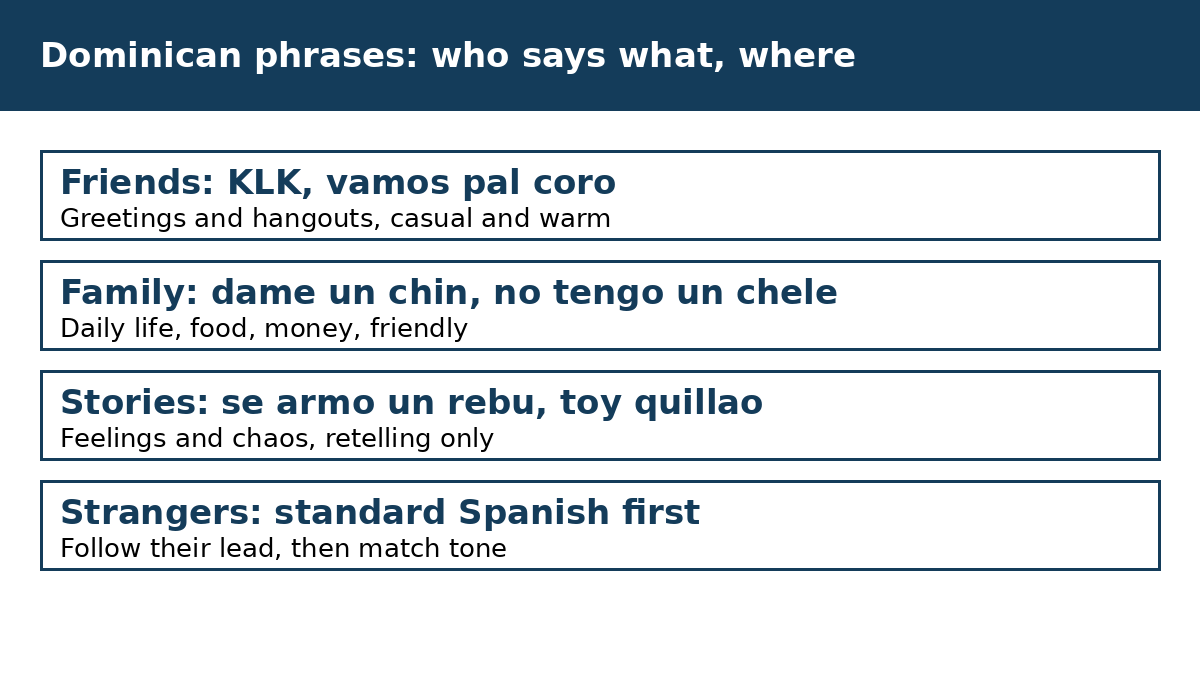
- Who Says These Phrases, Where, and to Whom
- What to Reply When You Hear These Phrases
- When NOT to Use These Phrases
- Myths vs Facts About Dominican Phrases
- Frequently Asked Questions About Dominican Slang Phrases
- Sources and Further Reading
Quick Answer: Phrases, Not Just Words
Dominican slang phrases are short, fixed expressions built from everyday Dominican Spanish, and most of them do a social job, not just a dictionary job. A greeting checks the relationship, a money phrase signals how broke or comfortable someone feels, and a reaction phrase tells you whether the speaker is annoyed, joking, or ready to leave. The literal translation is often the least useful part, because shortened words, dropped sounds, and tone carry half the meaning.
That is why this guide treats each phrase as a small scene: who says it, what it really means, what a natural reply sounds like, and where it can go wrong. Learn the greetings first, then the friend phrases, then the feeling phrases. The rest will fall into place faster once you can open and close a conversation without translating word by word in your head.
How Dominican Phrases Actually Sound in Fast Speech
Dominican Spanish in casual conversation is fast, warm, and heavily shortened, and that is the first thing that throws learners off. SlangStation notes that Dominican slang includes shortened expressions and everyday terms that can sound very different from standard Spanish, and that context and tone decide the meaning. You will hear that pattern in almost every phrase below.
Three shortcuts explain most of what you hear. First, estoy often becomes toy, so “estoy quillao” sounds like “toy quillao” and “estoy jarto” sounds like “toy jarto.” Second, a final s often softens or disappears, so “todo bien” can sound like “to bien” and “estamos listos” can sound like “ehtamoh lihtoh.” Third, a d between vowels often drops, so “cansado” can sound like “cansao” and “quillado” becomes “quillao.” None of this is sloppy Spanish. It is the normal relaxed sound of the dialect, and Dominicans switch toward fuller forms in formal settings without thinking about it.
For a learner, the trick is to listen for the phrase shape, not every letter. If you hear something like “klk,” “toy,” and “chin” in one short exchange, you are hearing a greeting, a state of being, and a small amount, even if the sounds blur together. Do not try to copy the fastest version on day one. Say the fuller form clearly, and native speakers will still understand you. Speed comes from hearing the phrases in real conversations, not from forcing it.
Greetings That Open Every Conversation
Greetings do more work in Dominican conversation than in many other varieties of Spanish. A greeting is a vibe check, a show of closeness, and an invitation to talk. Use the wrong one with the wrong person and you can sound too familiar. Use the right one with a friend and the whole conversation relaxes in seconds.
Que lo que, and its short form KLK
Literal meaning: what is what, or what is going on. Real meaning: what is up, hey, how is it going. This is the most famous Dominican greeting, and SlangStation lists it alongside vaina, jevi, and chin as one of the first terms a listener notices. In text it is almost always KLK. In speech it runs together as one quick burst: keh-lo-keh.
A natural reply is “todo bien” or the shortened “to bien,” often followed by “y tu” or, with a close friend, “y lo mio,” which playfully asks what about me, or what is in it for me. Do not answer KLK with a long life story. It is an opening, not a request for a report. A short, warm answer keeps the door open.
Dime a ver
Literal meaning: tell me to see. Real meaning: tell me what is happening, go on, I am listening. This greeting leans a little more toward catching up than KLK does. It says you have time for the news, not just a hello. A friend who has not seen you in a while might open with “dime a ver” and expect a quick update, a piece of gossip, or a story about the weekend.
Reply with a short headline first, then the detail if they ask. “Dime a ver, que paso” is a common fuller version, and it works as both a greeting and a nudge to keep talking. With a stranger or in a formal setting, stick to “hola, como estas” instead. “Dime a ver” belongs to the friendly zone.
Que lo que, mi loco, and que lo que, manin
Literal meaning: what is up, my crazy one, or what is up, my guy. Real meaning: a warm, male-to-male friend greeting, close in feeling to “what is up, bro.” Loco here is not an insult when it is used this way between friends. Manin works the same way, as a term for a close male friend. SlangStation lists manin as bro or close friend, and loco as a casual form of address whose tone decides the meaning.
Do not use “mi loco” with someone you just met, with an older stranger, or with a woman unless you already have that kind of joking friendship and you know it lands well. The phrase is friendly only inside a relationship that already allows teasing. With close friends it is one of the warmest greetings in the whole set.
Phrases for Friends and Hanging Out
Friend phrases are where Dominican slang feels most alive, because they describe the group itself, the plan, and the mood of the night. Learn these and you will understand group chats far better, even if you never say half of them yourself.
Vamos pal coro, and hacer un coro
Literal meaning: let us go to the choir, or to make a choir. Real meaning: let us go hang out with the crew, or to spend time together as a group, usually with music, food, and drinks. Coro is one of the most useful Dominican social words, and in phrase form it is always about people, never about singing. “Tenemos un coro esta noche” means we have a hangout tonight, and “vamos pal coro” is the invitation itself.
If someone invites you with this phrase, the reply is simple: say yes or no, and ask where and when. “Dale, vamos” means let us go. “No puedo hoy” means you cannot make it today. Do not translate coro as choir in this setting, or you will miss the whole plan.
Toy en coro, and estamos en teteo
Literal meaning: I am in the group, and we are in a party. Real meaning: I am hanging out with friends right now, and we are at a lively party or street party. Teteo is the stronger word of the two. It points to loud music, dancing, and a crowd, and it is strongly tied to urban youth culture and dembow. “Anoche habia un teteo” means there was a big party last night.
These phrases also work as a soft excuse. If a friend texts “toy en coro” and answers slowly, they are telling you they are busy having fun, not ignoring you on purpose. Reply with something light, like “disfruta” or enjoy, and catch up later.
No me vengas con cotorra
Literal meaning: do not come to me with parrot talk. Real meaning: do not give me a long excuse, a smooth story, or a sales pitch. Cotorra is persuasive talk, chatter, or a spiel, and this phrase cuts it off with humor or irritation, depending on tone. Between friends it is often playful. Said sharply, it is a warning that the speaker is not buying the story.
If someone says this to you, the smart reply is to get to the point. Drop the long setup, say what you actually want, and let them decide. Trying to talk your way past “no me vengas con cotorra” usually makes it worse.
Phrases for Feelings, Trouble, and Reactions
Feeling phrases are the ones learners misunderstand most, because the literal words point one way and the real feeling points another. A phrase about being fried has nothing to do with cooking. A phrase about a mess has nothing to do with cleaning. Context, face, and voice do the real translating here.
Toy quillao, and toy quilla
Literal meaning: I am nailed or stuck, in a loose sense. Real meaning: I am angry, annoyed, or upset. The masculine form is “toy quillao” and the feminine form is “toy quilla.” You will also hear “tiene un quille,” which means someone has a grudge or a burst of anger going on. This is everyday Dominican emotional language, not formal Spanish, and it is far more common in speech than any textbook word for angry.
Do not use it to describe a stranger’s mood unless you are sure, and do not say it lightly to a boss or teacher. With friends it is a clear, honest signal: something upset me, and I am not hiding it. A good reply is to ask what happened, calmly, and give them room to explain.
Toy jarto, and toy frito
Literal meaning: I am full, and I am fried. Real meaning: “toy jarto” means I am fed up, tired of something, or full after eating, depending on the scene, while “toy frito” means I am exhausted, broke, or finished, again depending on the scene. Food, tiredness, and money share these phrases, which is exactly why learners get confused. The sentence around the phrase tells you which one it is.
“Toy jarto de eso” means I am fed up with that. “Toy jarto, no quiero mas” after a meal means I am full. “Toy frito, no tengo ni un chele” means I am broke and wiped out. Listen for the words after the phrase. They almost always clear up the meaning.
Se armo un rebu, and que vaina
Literal meaning: a mess got armed, and what a thing. Real meaning: a commotion, fight, or confused situation broke out, and what a situation or what a pain. Rebu is noise, conflict, and disorder rolled into one word, and “se armo un rebu” is the classic way to start a story about chaos. “Que vaina” is the sigh that goes with it, and it can sound amused, annoyed, or tired, all from the same two words.
Both phrases are great for understanding stories, and both are risky to copy in a serious setting. Use them with friends when retelling something funny or wild. In a formal report or a complaint, use plain, neutral Spanish instead.
Me dieron un boche
Literal meaning: they gave me a scolding. Real meaning: I got told off, strongly. A boche is more than a reminder. It is a serious telling-off, often from a parent, a teacher, or a boss. “Me dieron un boche por llegar tarde” means I got in trouble for arriving late, and the phrase carries the sting of it.
This is a phrase for retelling, not for confronting. Telling a friend “me dieron un boche” invites sympathy and a story swap. Saying it to the person who scolded you would sound like you are arguing back, so keep it for the retelling.
Phrases for Money, Food, and Daily Life
Daily life phrases are the most practical part of Dominican slang, because they show up in markets, colmados, kitchens, and bus stops. They are also the safest ones for a learner to use, since most of them are friendly and concrete.
Dame un chin, and espera un chin
Literal meaning: give me a chin, and wait a chin. Real meaning: give me a little bit, and wait a little while. Chin is the Dominican way to ask for a small amount of anything: food, water, time, or space. SlangStation defines chin as a little bit, and in phrase form it is even more useful, because it softens the request. “Dame un chin de agua” sounds friendlier and more natural than a bare demand.
“Un chin chin” makes it even smaller, almost like “just a tiny bit.” Use these phrases freely in casual settings. They are polite in the Dominican sense: short, warm, and easy to grant.
No tengo un chele, and estoy en olla
Literal meaning: I do not have a cent, and I am in the pot. Real meaning: I am broke, or in serious money trouble. Chele is a small coin word that survives in the phrase even though the coin itself is long gone, and “no tengo un chele” is the classic way to say you have nothing left. “Estoy en olla” is stronger and more expressive than simply saying you have no money. It paints the picture of an empty pot.
Both phrases are honest and a little humorous when friends use them with each other, but they are still personal. Do not use them to joke about someone else’s money. Use them about yourself, and people will usually laugh with you and offer help, food, or a plan.
Voy en guagua, and voy a coger un concho
Literal meaning: I am going by guagua, and I am going to take a concho. Real meaning: I am taking the bus, and I am taking a shared taxi. Guagua is the Caribbean bus word, and SlangStation confirms that in the Dominican Republic it commonly means bus, even though the same word means something else in other countries. Concho is the shared taxi that runs a set route and picks up passengers along the way, and riding one is a very Dominican daily experience.
These phrases are gold for a visitor. They get you on the right transport without a long explanation, and drivers and fellow passengers will understand you at once. Just be ready for the ride itself, which is usually crowded, loud, and full of conversation.
Vamos a comer pica pollo, and dame una fria
Literal meaning: let us eat fried chicken, and give me a cold one. Real meaning: let us get Dominican fried chicken, usually from a pica pollo spot, and give me a very cold beer, usually a Presidente served frosted. Pica pollo is not just any fried chicken. It is a specific late-night, takeaway style that Dominicans love, and the phrase itself is an invitation. A fria is a cold beer by default, and in a colmado or bar you rarely need to name the brand.
Order with these phrases and you will sound like you know the local routine. Just remember that “una fria” assumes you are old enough to drink and in a setting where alcohol is normal. In a family lunch or a work setting, ask for a soda or water by name instead.
Dominican Phrase vs Standard Spanish: A Side-by-Side Table
The table below shows why word-by-word translation fails with Dominican phrases. The standard Spanish version is correct, but it sounds textbook formal. The Dominican phrase is what friends actually say, and the tone column tells you why the difference matters.
| Dominican phrase | Standard Spanish equivalent | Real English meaning | Tone and setting |
|---|---|---|---|
| Que lo que | Como estas | What is up | Friendly, informal, friends and peers |
| Dame un chin | Dame un poco | Give me a little | Casual, polite in informal settings |
| Toy quillao | Estoy enojado | I am angry | Informal, emotional, friends and family |
| No tengo un chele | No tengo dinero | I am broke | Informal, personal, often humorous |
| Vamos pal coro | Vamos a reunirnos con amigos | Let us hang out with the crew | Friendly, social, young and casual |
| Se armo un rebu | Hubo un alboroto | A commotion broke out | Storytelling, informal, expressive |
Notice how the Dominican version is almost always shorter. That is not an accident. Dominican conversation values speed, rhythm, and shared understanding. A short phrase that everyone in the group already knows beats a long, precise sentence every time.
Who Says These Phrases, Where, and to Whom
Dominican slang phrases live in informal life first, and that shapes everything about them. Young people use them heavily in texting, TikTok, Instagram, WhatsApp, and group chats, and SlangStation notes the same pattern for Dominican slang in general. Older speakers use many of the same phrases too, especially the older ones like “dame un chin” and “no tengo un chele,” which have been part of Dominican speech for a long time.
The map looks like this in practice. With close friends and family, almost everything in this guide is fair game, including the teasing phrases. With coworkers you know well, the greetings and daily life phrases work, but the anger and party phrases can wait until you know the relationship. With strangers, shopkeepers, and officials, start with standard Spanish and a smile, then follow their lead. If they greet you with KLK, you can answer in kind. If they keep it formal, stay formal.
Diaspora communities matter here too. Dominicans in New York, Boston, Miami, Madrid, and Puerto Rico keep these phrases alive, mix them with English, and pass them to children who may speak more English than Spanish. That is why you will see KLK in an English group chat, hear “toy quillao” in a Spanglish story, and read Dominican phrases in song lyrics far from the island. The phrases travel because the community travels.
Music is the other great carrier. Dembow, bachata, merengue, and reggaeton all use Dominican phrases, and a phrase that starts in a song can spread to millions of listeners in a week. That speed is a strength and a warning at once. A phrase can feel fresh in a song and dated in conversation a year later, so listen to how people around you use it before you copy it everywhere.
What to Reply When You Hear These Phrases
Most learners freeze not because they do not know the phrase, but because they do not know the reply. Here is a short reply kit that covers the phrases in this guide, and it will carry you through most casual conversations.
When you hear KLK, answer “todo bien, y tu” and keep it short. When you hear “dime a ver,” give a one-line update and let them ask for more. When you hear “vamos pal coro,” answer yes or no and ask where and when. When you hear “toy quillao,” ask what happened and listen, because the person is telling you they need room, not a joke. When you hear “dame un chin,” hand over a little and smile, because the request is deliberately small.
When you hear “no tengo un chele,” do not lecture about money. A light reply like “tranquilo, yo invito” if you can, or “estamos iguales” if you are in the same boat, keeps the friendship warm. When you hear “se armo un rebu,” ask “que paso” and let them tell the story. Dominican storytelling loves a good rebu tale, and the best reply is attention, not a correction.
One more reply rule matters more than any single phrase: match the energy, not the exact words. If the greeting is short, keep your reply short. If the story is funny, laugh. If the phrase is angry, stay calm. People forgive a learner who misses a word. They notice much faster when a reply feels cold, formal, or out of step with the moment.
When NOT to Use These Phrases
Knowing when to hold back is what separates a respectful learner from someone who just collects slang. Some phrases in this guide are warm and safe. Others carry a sting that only works inside a trusted relationship, and a few should stay in your listening vocabulary for a long time before they enter your speaking vocabulary.
Do not use “mi loco,” “pariguayo,” or “tiguere” as labels for people you do not know well. Between friends they can be teasing or admiring. Aimed at a stranger they can sound like an insult, a challenge, or a judgment about character. The same rule covers “no me vengas con cotorra” with a boss, a teacher, or an official. It can sound like you are accusing them of lying, even if you only meant to hurry the conversation along.
Do not use strong exclamations like “cono” in formal settings, at work, in a classroom, or with older people you do not know well. Friends may use it casually, but SlangStation warns that it is a strong exclamation and may not fit a formal workplace or professional conversation. When in doubt, leave it out. Standard Spanish is always a safe fallback, and nobody will think less of you for using it.
Do not use party and money phrases to stereotype Dominicans, either. Saying “toy en teteo” every time you talk about the Dominican Republic, or joking about being broke with “estoy en olla” to every Dominican you meet, turns a living language into a costume. Use the phrases when they fit a real moment with real people. That is how respect and fluency grow together.
Myths vs Facts About Dominican Phrases
Myth: Dominican slang is just bad Spanish
Fact: Dominican Spanish is a full, rule-governed variety of Spanish with its own pronunciation patterns, vocabulary, and phrase habits. Dropping a final s or shortening estoy to toy is a systematic sound pattern, not a mistake, and Dominicans shift toward fuller forms in formal settings just as speakers of other varieties do.
Myth: Every Dominican uses every phrase every day
Fact: Age, region, family, social group, and life abroad all change which phrases a person uses. SlangStation makes the same point about Dominican slang in general: not every speaker uses every word the same way. A phrase that is daily language in Santo Domingo might be rare in Santiago, and a phrase your friend loves might sound old to their younger cousin.
Myth: If you learn the words, you know the phrases
Fact: Phrases change meaning as a whole. “Toy frito” is not about cooking, “estoy en olla” is not about a pot, and “vamos pal coro” is not about a choir. You have to learn the phrase as a unit, with its reply and its setting, or the words alone will mislead you.
Myth: Dominican phrases are the same as Puerto Rican or Cuban phrases
Fact: The Caribbean shares a lot, including guagua, coro, and many food words, but the details differ. Our guides to Cuban slang and Puerto Rican slang show where the islands overlap and where they split. “Que lo que” is strongly Dominican in feeling, even if neighbors understand it, and “tiguere” carries a specifically Dominican mix of admiration and warning.
Myth: You should copy every phrase you hear in a song
Fact: Songs compress, exaggerate, and rhyme, and some song phrases are meant to shock or boast, not to be copied in daily talk. Enjoy the music, learn the phrases that show up in ordinary conversation too, and leave the rest as listening vocabulary until you are sure how they land in real life.
Frequently Asked Questions About Dominican Slang Phrases
What is the most common Dominican slang phrase?
Que lo que, usually shortened to KLK in text, is the most common Dominican greeting phrase. It means what is up, and the standard reply is todo bien, often followed by y tu.
What does dame un chin mean in Dominican slang?
Dame un chin means give me a little bit. Chin means a small amount, and the phrase softens a request for food, drink, time, or help, so it sounds friendly rather than demanding.
Is Dominican slang rude or offensive?
Most Dominican slang phrases are not rude on their own, but tone, relationship, and setting decide. Friendly phrases like KLK, dame un chin, and vamos pal coro are safe with friends, while labels for people and strong exclamations can offend strangers, so standard Spanish is the safer choice with people you do not know well.
What does toy quillao mean?
Toy quillao means I am angry or annoyed. Toy is the shortened form of estoy, and quillao describes a person who is upset, with toy quilla as the feminine form.
How is Dominican slang different from standard Spanish?
Dominican slang uses shortened forms, dropped sounds, and fixed phrases that standard Spanish does not, and it gives ordinary words new meanings in context. The grammar underneath is still Spanish, but the phrases, the speed, and the social rules are distinctly Dominican, which is why a phrase guide helps more than a word list alone.
Can I use Dominican slang phrases if I am not Dominican?
Yes, if you use them respectfully, in the right setting, and with people who welcome it. Start with greetings and daily life phrases, listen before you copy the teasing ones, and avoid using slang to stereotype. Most Dominicans appreciate a learner who tries, especially when the effort comes with good manners.
Where can I learn more Dominican words and phrases?
Start with our broader guide to Dominican slang words and phrases, then compare it with how to say cool in Spanish, region by region and our guide to what cool means in slang. Together they show which Dominican expressions are local, which are shared across the Caribbean, and which travel into English slang too.
Sources and Further Reading
SlangStation explains Dominican slang as informal language from the Dominican Republic and lists que lo que, vaina, jevi, chin, and guagua among the first terms a listener notices, with tone and context deciding the meaning. Our own published guide to Dominican slang covers the single words behind many of these phrases in more depth, including coro, teteo, boche, and tiguere.


Pingback: Gringo Meaning Slang: What Does Gringo Mean? Is It Offensive?
Pingback: Hawaiian Slang: 40+ Words, Phrases, and Pidgin Explained