


Gringo is a Spanish and Portuguese word for a foreigner, most often an English-speaking person from the United States, and its tone can run from friendly to insulting depending on who says it, where, and how.
If you have ever traveled through Mexico, watched a Spanish-language show, or scrolled through comments on a video about life abroad, you have probably run into this word. It pops up in market stalls, in song lyrics, in group chats, and in jokes between friends. Some people wear it like a nickname. Others hear it as a jab. I first noticed how slippery the word is when a friend who had just come back from a trip to Oaxaca told me the locals had called him “el gringo” with a grin, and he had no idea whether to laugh or feel called out. That confusion is the whole story of this word, and this guide works through it piece by piece: the real definition, the honest origin story, how the meaning shifts from country to country, whether it counts as an insult, and what to say when someone calls you one.
Table of Contents
- What Does “Gringo” Mean?
- How to Pronounce “Gringo” and Get the Forms Right
- Where Did “Gringo” Come From? The Origin Story
- What “Gringo” Means in Different Countries
- Gringo vs Gabacho, Güero, Yanqui, and Extranjero
- Is “Gringo” Offensive?
- When NOT to Use “Gringo”
- Gringo in Text, Social Media, and Pop Culture
- How to Use “Gringo” Naturally, and What to Say Back
- Myths and Common Mistakes About “Gringo”
- Frequently Asked Questions About “Gringo”
- Sources and Further Reading
What Does “Gringo” Mean?
Gringo is an informal Spanish and Portuguese word for a foreigner, and in most of Latin America it points at a person from the United States, or more loosely at any English-speaking visitor. Merriam-Webster defines it as, often disparagingly, a foreigner in Spain or Latin America, especially one of English or American origin, and more broadly as a non-Hispanic person. That short dictionary entry hides a lot of variety, though, because the word behaves differently in Mexico City than it does in São Paulo, and differently again in a friendly chat than in an argument.
At its simplest, gringo is a label for an outsider. A shopkeeper in Mexico might say it about the tourist asking for directions in English. A Brazilian football commentator might use it for any foreign player on the pitch, whatever country he comes from. A Latino teenager in the United States might use it for a white classmate, or even, jokingly, for a Latino friend who speaks little Spanish. The word carries a picture with it: someone who does not quite belong to the local scene, often someone who speaks English first and Spanish second, and sometimes someone with fair skin or light hair. Which part of that picture matters most depends on the country, and that is why a one-line definition never quite settles it.
The word also works as an adjective. You can hear “una película gringa” for an American movie, or “un restaurante gringo” for a place that serves American-style food. In that form it just means “American” or “foreign,” with no person attached. It can even name a dish: in Mexican cooking, a gringa is a flour tortilla filled with al pastor pork and cheese, heated on a griddle. Some say the name comes from the white flour tortilla, a small detail that shows how deeply the word has sunk into everyday life.
One more thing worth knowing up front: the word is gendered, like most Spanish nouns. A man is a gringo, a woman is a gringa, and a group is gringos or gringas. Get that ending wrong and Spanish speakers will still understand you, but getting it right is the fastest way to sound like you know what you are doing.
Gringo meaning in text and online
In text messages, comments, and social media, gringo works the same way it does out loud, just faster and looser. Someone might write “the gringos are back in town” when tourist season starts, or “my gringo friend finally learned to order tacos in Spanish” as a joke. The meaning in text is rarely about a dictionary definition. It is about pointing at the outsider in the room, and the tone of the rest of the sentence does the heavy lifting. A laughing emoji next to it means something very different from the same word dropped in the middle of a heated thread.
What gringo does not mean
Gringo does not have one fixed target. It is not a nationality on a passport, and it is not always about the United States. In some places it means any foreigner at all. In others it describes a look, fair skin and light hair, even when the person is a local. And in the United States it can be turned inward, aimed at a Latino person who seems disconnected from their own roots. If you assume it always means “American,” you will misread it about half the time, so the country and the context matter more than the word itself.
How to Pronounce “Gringo” and Get the Forms Right
Gringo is pronounced GREEN-go in English, with the stress on the first syllable, while the Spanish pronunciation is closer to GREEN-goh, with a tapped or lightly rolled r and a soft, open o at the end. The International Phonetic Alphabet writes it as /ˈɡɾiŋ.ɡo/, and once you hear a native speaker say it, the rhythm sticks. Say “green,” then add “go,” and keep it short and light rather than drawing it out.
The forms follow normal Spanish gender and number rules, and they are simple enough to learn in a minute. A man is el gringo, a woman is la gringa, a mixed group or a group of men is los gringos, and a group of women is las gringas. The gender always matches the person being described, not the person speaking. If you are talking about yourself, use the form that matches you, and if you are talking about a group, the masculine plural covers a mixed group.
Two related words show up a lot alongside gringo, and they are handy to know. Gringolandia is a playful nickname for the United States, and you will also hear it used for tourist-heavy strips in Mexico where American visitors gather. Engringarse is a verb that means acting like a gringo, though it shows up in dictionaries more often than in real conversation. Neither word is rude on its own. Both are the kind of thing people say with a smile.

Where Did “Gringo” Come From? The Origin Story
The most widely accepted explanation is that gringo grew out of the Spanish word griego, meaning Greek, which Spanish speakers used the way English speakers use the phrase “it is all Greek to me” for speech they could not understand. Dictionaries record the word as an alteration of griego, from Latin Graecus, and the earliest written record of it in Spanish comes from a 1787 dictionary, the Diccionario castellano con las voces de Ciencias y Artes, compiled by Esteban de Terreros y Pando. That is a long way from the stories most people hear about the word, and the gap between the record and the legend is part of what makes this word so interesting.
The 1787 dictionary entry is specific and vivid. It says that in Málaga, a port city in southern Spain, people called foreigners gringos when they spoke Spanish with a heavy accent that made them hard to follow. In Madrid, the same word was aimed at Irish foreigners in particular. So from the very start, gringo was less about where a person came from and more about how they sounded. A person whose Spanish was strange to local ears was speaking “Greek,” and the word for that strange speech slowly became a word for the stranger.
Linguists who have traced the change say it probably happened in two small steps: griego lost a vowel to become grigo, and then an n slipped in to make gringo. That extra n is the kind of sound change that shows up elsewhere in Spanish, so the path is plausible even if no one can prove every step. Other scholars have suggested the word could come from peregrino, the Spanish word for pilgrim or traveler, or from the language of the Romani people of Spain, but the griego theory is the one most dictionaries and language writers land on. The honest version is that the origin is likely, not certain, and anyone who tells you otherwise is selling confidence the evidence does not support.
The “Green Go” story, and why it is almost certainly wrong
Ask someone on the internet where gringo came from and you will probably hear a story about the Mexican-American War of 1846 to 1848. The tale comes in a few flavors. In one, American soldiers sang “Green Grow the Lilacs” or “Green Grow the Rushes, O” as they marched, and Mexicans picked up the first two words. In another, locals shouted “Green, go home!” at soldiers in green uniforms. Both versions are catchy, both get repeated constantly, and both fall apart the moment you check the dates. The word was already in a Spanish dictionary in 1787, decades before the war and before there was a Spanish-speaking Mexico in the modern sense. As the language site ThoughtCo puts it plainly, there is no truth to the urban legend, since the word originated in Spain long before the Mexican-American War.
That does not make the story useless. It survives because it feels right: it ties a strange word to a dramatic moment in history, and it gives people a story they can retell at a dinner table. But a good story is not the same as a true one, and the real origin, a word for speech you cannot understand, is stranger and more interesting than the legend. The word started as a comment on how someone talked, and only later became a comment on who someone was.
How gringo crossed into English
The first recorded use of gringo in English comes from John Woodhouse Audubon’s Western Journal of 1849 to 1850, in which Audubon wrote that his party was hooted at and called “Gringoes” while passing through Cerro Gordo in Veracruz. Merriam-Webster also lists 1849 as the first known use in English. From there the word spread through travel writing, border towns, and eventually film and music, until it became one of the best-known Spanish words in English. It is a rare case of a slang term that crossed languages without losing its shape: the spelling and the sound are nearly the same in both.
What “Gringo” Means in Different Countries
The meaning of gringo changes with the map, so the same word can point at an American in Mexico, any foreigner at all in Brazil, a European immigrant in Argentina, or a fair-skinned local in Peru. This is the section most short guides skip or flatten into one line, and it is the one that saves you from embarrassing mistakes. The table below gives the quick version, and the notes after it fill in the texture.
| Country or region | Who is usually called a gringo | Typical tone |
|---|---|---|
| Mexico | People from the United States, or fair-skinned foreigners | Usually neutral, sharper in an argument |
| Brazil | Almost any foreigner, whatever their nationality or skin color | Generally neutral |
| Argentina | Historically European immigrants, often Italians; now also Americans | Neutral to affectionate in rural areas |
| Chile | People from the United States, sometimes other English speakers | Depends on the speaker and the moment |
| Peru and Bolivia | Fair-skinned or blond foreigners, and sometimes Americans | Descriptive more than hostile |
| Spain | Rarely used; locals prefer guiri for tourists | Old-fashioned when it appears |
| United States | Anglo Americans, or a Latino seen as out of touch with their roots | Playful to pointed, and disputed |
Mexico: the classic case
In Mexico, gringo is reserved most of all for people from the United States, and it is deeply rooted in the culture. It shows up in novels like The Old Gringo by Carlos Fuentes, in songs by Molotov and Los Tigres del Norte, and in everyday talk from Tijuana to Mérida. The word can also stretch to cover fair-skinned foreigners in general, and it can be aimed at a Mexican American who speaks little Spanish or seems distant from their roots. Most of the time it lands as a plain label. When it stings, the sting usually comes from the situation, not the syllables: a raised voice, a complaint about behavior, a reminder that the speaker thinks you do not respect the place. For a closer look at how Spanish slang travels across the Caribbean, see our guide to Cuban slang and what it means, which covers another word whose meaning shifts with the island it lands on.
Brazil: the widest meaning
Brazil uses gringo in the broadest way of any country. There it simply means a foreigner, with no link to skin color, hair, or nationality. Sports media call foreign footballers gringos even when they come from other South American countries, and tourists are called gringos whether they arrive from Europe, Africa, or elsewhere in Latin America. A Black foreign visitor in Brazil can be called a gringo without anyone thinking twice, which would be unusual in Mexico. If you only know the Mexican meaning, Brazil will surprise you, and that surprise is a good reminder that the word belongs to the place you hear it in.
Argentina: an immigrant word
In Argentina, especially in rural areas, gringo has an older flavor. It was used for the non-Spanish European immigrants who built farming colonies in the country, Swiss, German, Polish, and above all Italian settlers. Because Italians were the largest group, the word in Argentine slang, lunfardo, came to point at Italians first. Today you will still hear it in the countryside with that old meaning, while in the cities it has drifted closer to the familiar American sense. It is one of the clearest signs that gringo started life as a word for any outsider, not for one nationality.
Spain and the United States: two edges
In Spain itself, gringo is rare in daily speech. Spaniards have their own word for the obvious foreign tourist, guiri, and gringo sounds imported or old-fashioned when it appears. In the United States, the word lives mostly in Latino communities, where it usually points at Anglo Americans. Americans sometimes use it about themselves, half joking, and it can also be aimed at another Latino person who is seen as not culturally Latino, for instance someone who speaks little Spanish. That inward use catches a lot of people off guard, but it follows the same logic as the rest of the word: gringo marks the person who seems like an outsider to the group doing the talking.
Learning how one Spanish word bends across borders is a good way into the wider world of Spanish slang, and our guide to Dominican phrases and their meanings shows how a whole set of expressions can belong to one island and nowhere else. The pattern is the same: the words travel, but the local meaning stays local.
Gringo vs Gabacho, Güero, Yanqui, and Extranjero
Gringo is the broadest and most widely known of these words, while gabacho is harsher, güero is about looks rather than nationality, yanqui is political, and extranjero is the polite, formal term. People mix these words up constantly, and using the wrong one can change the temperature of a conversation fast. The comparison below lays out what each word actually does.
| Term | Meaning | Tone | Where you hear it | Example |
|---|---|---|---|---|
| Gringo | A foreigner, usually from the United States or the English-speaking world | Neutral to mildly mocking, sometimes affectionate | All of Latin America, Brazil, the US | “El gringo nos preguntó por la playa.” |
| Gabacho | An American, or the United States itself | Often derogatory, sharper than gringo | Mexico, Guatemala, El Salvador | “Se fue al gabacho a trabajar.” |
| Güero | A light-skinned or blond person, local or foreign | Warm, friendly, often a term of endearment | Mexico | “¡Oye, güero, ven acá!” |
| Yanqui | A person from the United States | Neutral in some places, political and hostile in others | Latin America, especially in political talk | “Los yanquis llegaron al pueblo.” |
| Extranjero | A foreigner, in the standard dictionary sense | Neutral and formal | Everywhere Spanish is spoken | “Es un extranjero que vive aquí.” |
Gabacho: the one to be careful with
Gabacho is the closest cousin to gringo, and the easiest to get wrong. It started in Spain as a dismissive word for French people, from the Occitan word gavach, meaning someone who speaks badly, and in Mexico it became a deprecatory word for Americans. Lingopie notes that it carries stronger negative connotations than gringo, especially in Mexico, and that “el gabacho” can even mean the United States itself, as in “Voy para el gabacho,” meaning “I am going to the US.” Friends might toss it around as a joke, but it can turn hostile fast, so it is not a word to pick up from a stranger and repeat. If gringo is a nudge, gabacho is a shove.
Güero: a compliment in disguise
Güero works on a different axis entirely. It describes light skin or blond hair, and it can be aimed at locals as easily as at visitors. Market vendors in Mexico call out “¡Oye, güero!” to get attention, and it reads as friendly rather than descriptive. The word comes from huero, meaning empty, which once described an egg that did not hatch, and it drifted over time into a word for fair coloring. Unlike gringo, it carries almost no political charge, and Mexicans use it as a term of endearment, sometimes even for dark-skinned friends as a joke. If someone calls you güero, smile. If someone calls you gabacho, listen to the tone.
Yanqui and extranjero: the formal ends of the scale
Yanqui, borrowed from the English Yankee, points at Americans too, but it shows up most in political speech, where it can sound like a slogan. “Yanqui, go home” is the classic example, and it carries a charge that gringo rarely does. Extranjero sits at the other end: it is the standard, neutral word for a foreigner, the one you would use in a form, a news report, or a polite introduction. If you want to describe someone from another country without any slang at all, extranjero is the safe choice, and it is the word to use when you are unsure how gringo will land.
Is “Gringo” Offensive?
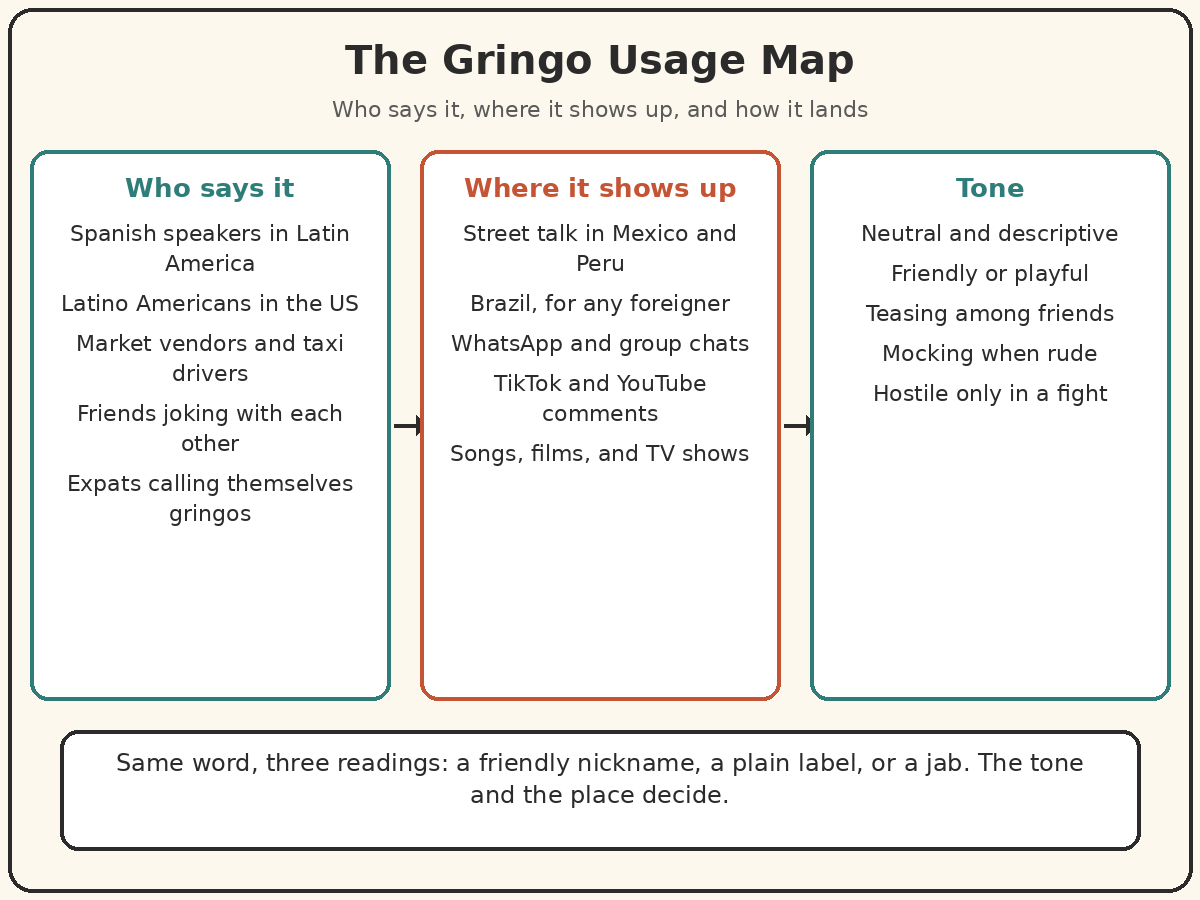
It depends, and anyone who gives you a flat yes or no is skipping the part that matters: gringo is usually neutral or friendly in Latin America, it can turn insulting when the tone or the situation turns hostile, and in the United States its offensiveness is openly disputed. That is not a dodge. It is what the evidence actually shows, and the disagreement itself is part of the story.
Start with the dictionaries, because they split on this. Merriam-Webster labels the word “often disparaging.” Cambridge Dictionaries Online notes that the word is usually considered offensive. Dictionary.com calls it sometimes disparaging and offensive, often used facetiously. The Real Academia Española, the authority on the Spanish language, lists the meanings by region without branding the word an insult. So the same word is a slur in one dictionary and a plain label in another, and that split maps neatly onto the two languages: in Spanish it is mostly a descriptive word, while in English it often reads as a dig.
Columnist Alicia Shepard wrote about this exact disagreement, arguing that even though gringo is defined as a neutral term in Spanish, in English it can be interpreted as an insult and should be avoided in careful journalism. Writer Gustavo Arellano took the other side, calling the term technically a slur but saying its power to offend nowadays is minimal, and treating efforts to ban it as an attempt to cancel a piece of Mexican culture. Both views are on the record, and neither one has won. That is the honest state of play.
In daily life across Latin America, the word is usually not an insult at all. Expats call themselves gringos, friends use it as a nickname, and nobody in a market in Oaxaca is trying to start a fight when they say it. Dictionary.com makes the same point, noting that the term is occasionally used by gringos themselves, who jokingly self-identify with it. The line is crossed when the word is aimed at someone to belittle them, when it is spat out in an argument, or when it is used to mock someone for not understanding the language or the culture. Tone, volume, and the relationship between the two people do the deciding, not the letters of the word.
A useful test is to flip the situation around. If a stranger on the street calls you gringo with a smile and offers directions, it is a label. If someone says it slowly, loudly, and right after you did something rude, it is an insult. And if you are the one saying it, ask yourself whether you would say it to that person’s face, in that tone, in front of their friends. If the answer is no, you have your answer about whether it would land badly.
When NOT to Use “Gringo”
Do not use gringo in formal settings, in writing, in arguments, or as a label for a stranger whose reaction you cannot predict, and never use it to mock someone for their Spanish or their background. The word is casual by nature, and casual words have places they do not belong.
Keep it out of formal writing, job applications, news reports, and official documents, where extranjero or estadounidense does the job without the slang. Do not use it to describe a colleague or a client you do not know well, since you cannot be sure how they hear it. Do not use it in the middle of a disagreement, because even a neutral word turns into a weapon when the room is already tense. And do not use it as a punchline about someone’s accent or their failure to speak Spanish. That is the exact use that makes the word sting, and it is the use that turns a descriptive label into a put-down.
There is one more boundary that matters. If someone tells you they do not like being called gringo, believe them and stop. You do not need to agree with their reading of the word to respect it. The same rule applies in reverse: if you are called gringo and you do not like it, you are allowed to say so plainly, without making a speech about it. A simple “I would rather you used my name” works better than a debate about dictionaries.
None of this means the word is banned from your vocabulary. Among friends, in travel writing, in jokes where everyone is in on it, and in casual conversation in Latin America, it is part of the local color. The rule is simple: use it where it is welcome, and leave it alone where it is not.
Gringo in Text, Social Media, and Pop Culture
Gringo shows up constantly in pop culture, from a 2018 dark comedy film called Gringo to songs by Molotov and Los Tigres del Norte, and on social media it works as a quick tag for the outsider in any travel story or joke. That visibility is a big reason English speakers know the word at all. You do not need to speak Spanish to have heard it, because film and music carried it across the border decades ago.
On screen, the word often marks the American abroad. The 2018 film Gringo, a dark comedy about an American businessman who gets kidnapped in Mexico, puts the label right in the title, and Dictionary.com notes the film as a recent example of the word in mainstream use. In Breaking Bad, Spanish-speaking characters use the word for the American characters around them, usually as a plain identifier rather than a direct insult. The effect is the same in both cases: the word tells the audience who the outsider is, in a single syllable, without a line of explanation.
In music, the word has real bite. Molotov’s “Frijolero” uses it in a confrontational way, while Los Tigres del Norte’s “Somos Más Americanos” turns it into a statement about identity and belonging. The children’s song “El Raton Vaquero” by Francisco Gabilondo Soler uses it playfully, which shows the full range in one sweep: the same word can be a punch, a flag, or a joke, depending on who is singing it.
Online, the word behaves like most slang does. In travel vlogs and expat videos, creators call themselves gringos in their titles and thumbnails, and their audiences pick it up in the comments. On TikTok and X, it shows up in jokes about tourists who order the wrong thing, wear the wrong clothes, or try to pay in dollars where pesos are expected. It also shows up in the comments under those jokes, where Spanish speakers correct the pronunciation or argue about whether the joke was fair. If you want to see how fast slang spreads in comment threads, compare this with our guide to what chat means in slang, which tracks a word that lives almost entirely in messages and comment sections.
One pop-culture detail that trips people up is the food. A gringa is a real dish, a flour tortilla with al pastor pork and cheese, and ordering one in Mexico is completely normal. Nobody at the taco stand is insulting anyone. It is just lunch, and it is a good example of how a word can lose its edge entirely once it becomes part of the menu.
How to Use “Gringo” Naturally, and What to Say Back
Use gringo the way locals do: as a casual, descriptive label among people who know each other, in the right country, with the right tone, and never as a way to mock someone. That is the whole method, and the examples below show what it looks like in practice.
Everyday examples that sound natural
Here are sentences you might actually hear, with what they mean in plain English. “¿Eres gringo?” means “Are you American?” and it is usually a friendly question, not a challenge. “Una gringa me preguntó cómo llegar” means “A foreign woman asked me for directions,” and it is just a way to describe someone in a story. “Nuestro amigo gringo ya habla muy bien español” means “Our gringo friend speaks great Spanish now,” and it is a compliment wrapped in a label. “McDonald’s es un restaurante gringo” means “McDonald’s is an American restaurant,” and it shows the word working as an adjective. None of these sentences is rude. The word is doing the same job a name or a job title would do: it tells the listener who is being talked about.
What to say when someone calls you gringo
The best reply depends on the tone, and the tone is usually obvious. If it is friendly, the easiest move is to laugh and go along with it. A simple “Sí, soy gringo, ¿y qué?” or “Guilty as charged” keeps things light and shows you are not rattled. If you are learning Spanish, you can turn it into a joke about yourself, which usually earns more goodwill than getting defensive. If the tone is hostile, you do not owe anyone a clever comeback. A calm “No pasa nada” or a plain change of subject works better than an argument about the word. And if the person is a friend who uses it as a nickname, you can return the favor with a nickname of your own, as long as it is one they actually like.
One thing to avoid is correcting strangers on the spot. Telling someone in a market that gringo is offensive, or that it is not, is a lecture nobody asked for, and it rarely ends well. If you are curious, ask a friend later, in private, how the word sounded to them. That is how you learn the local rules without making a scene.
Using gringo in your own Spanish
If you are learning Spanish and want to use the word yourself, start by listening first. Notice who says it, who they say it to, and whether anyone laughs. Then try it in a low-stakes setting, with friends, about yourself, or about a public figure, before you aim it at a stranger. Pair it with the right form, gringo for a man, gringa for a woman, and keep your tone light. And if you are ever unsure, extranjero is always there as the safe, neutral fallback. It never offends anyone, and it buys you time while you learn the local temperature of the slang.
Myths and Common Mistakes About “Gringo”
The biggest myths about gringo are that it always means American, that it is always an insult, and that it comes from the “Green Go” story, and all three are wrong in ways that matter. The table below corrects each one, and the notes after it cover the mistakes people make most often when they use the word.
| Myth | Fact |
|---|---|
| Gringo always means “American.” | In Mexico it usually does, but in Brazil it means any foreigner, and in Argentina it once meant European immigrants. |
| Gringo is always offensive. | It is often neutral or friendly in Latin America, and it only becomes insulting with a hostile tone or intent. |
| The word comes from “Green Go” in the Mexican-American War. | The word was already in a Spanish dictionary in 1787, decades before the war, and most linguists trace it to griego, meaning Greek. |
| Only white people get called gringo. | In Brazil, foreign visitors of any background are called gringos, and the word can also describe fair-skinned locals in some countries. |
| Gringo is a modern internet word. | It was first recorded in English in 1849, and it has been in Spanish dictionaries since the 18th century. |
| You can use it anywhere in the Spanish-speaking world. | In Spain it is rare, and locals use guiri for tourists instead, so the word can sound out of place there. |
Three mistakes to avoid
The first mistake is assuming the Mexican meaning travels with you. It does not. The word you learned in Cancún will mean something slightly different in São Paulo, and something different again in Buenos Aires. The second mistake is using it in writing or at work, where slang always reads more harshly than it sounds out loud. The third mistake is treating it as a joke at someone else’s expense. A word that is funny when you aim it at yourself can feel very different when it is aimed at you, and that is true for gringo as much as for any other label. If you are building up your Spanish slang vocabulary, our guide to cool in Spanish slang is a good next stop, since it covers words that are safe to use in almost any casual setting.
Frequently Asked Questions About “Gringo”
What does “gringo” mean in slang?
Gringo is an informal Spanish and Portuguese word for a foreigner, most often a person from the United States or another English-speaking country. In some countries it means any foreigner at all, and in others it describes a fair-skinned person. The exact meaning depends on the country, the speaker, and the tone, so it is best understood as a label for an outsider rather than a fixed nationality.
Is “gringo” offensive?
Not always, and usually not in Latin America, where it is often neutral, friendly, or even affectionate. It becomes offensive when it is said with a hostile tone, used to mock someone, or thrown at a person during an argument. Dictionaries disagree about it, with Merriam-Webster calling it often disparaging, while Spanish sources treat it as a plain descriptive word, and in the United States its offensiveness is openly disputed.
Does “gringo” only refer to Americans?
No, though in Mexico it usually does. In Brazil it refers to almost any foreigner, whatever their nationality. In Argentina it historically described European immigrants, especially Italians. In Peru and Bolivia it can describe a fair-skinned or blond person, local or foreign. The American meaning is the most common one, but it is not the only one.
Where did the word “gringo” come from?
The most widely accepted explanation is that it developed from the Spanish word griego, meaning Greek, which was used for speech that could not be understood, much like the English phrase “it is all Greek to me.” The word was first recorded in a Spanish dictionary in 1787, where it described foreigners in Málaga who spoke Spanish with a heavy accent. The popular “Green Go” story from the Mexican-American War is considered a folk etymology, not a proven origin.
What is the difference between gringo and gabacho?
Gringo is the broader, softer word for a foreigner, while gabacho is a sharper, more derogatory term for an American used mainly in Mexico and Central America. Gabacho can also mean the United States itself, as in “Voy para el gabacho.” Friends may use it jokingly, but it carries more hostility than gringo, so it is not a word to use lightly with strangers.
What is a gringa, and what is the female form of gringo?
Gringa is the feminine form of gringo, used for a woman or girl, and gringas is the plural for a group of women. The word also names a Mexican dish, a flour tortilla filled with al pastor pork and cheese, which some say is named for the white flour tortilla. In everyday speech, though, gringa simply means a female foreigner, usually from the United States.
Can Americans call themselves gringos?
Yes, and many do, often jokingly. Expats living in Latin America commonly refer to themselves as gringos, and travel creators use the word in their video titles and social media posts. Self-use reads as lighthearted in most cases, and it is one of the clearest signs that the word is not always an insult. If you use it about yourself with a smile, people usually smile back.
Sources and Further Reading
- Merriam-Webster defines gringo as, often disparagingly, a foreigner in Spain or Latin America, especially of English or American origin, and traces it to an alteration of the Spanish griego, with the first known use in English in 1849.
- Dictionary.com traces the term to the 1787 Castilian Dictionary, where Esteban de Terreros y Pando defined it as a word used in Málaga for foreign, heavily accented speakers of Spanish, and notes the griego connection and the later spread of the word in Mexico after 1846.
- ThoughtCo explains that the origin likely comes from griego, the Spanish word for Greek, that the first known written English use was in 1849, and that the “Green Grow the Lilies” story has no truth to it, and lists the Real Academia Española definitions by region.
- Wikipedia covers the etymology, the false etymologies tied to the Mexican-American War, and the regional usage in Argentina, Brazil, Chile, Mexico, and the United States, including the 1787 dictionary quotation and the first English use in Audubon’s Western Journal.
- Lingopie compares gringo with gabacho, güero, and guiri, explains the gender and plural forms, and notes that gabacho carries stronger negative connotations than gringo in Mexico.
- English Study Online gives a country-by-country table for the meaning of gringo, a pronunciation guide, and a direct answer on whether the word is offensive, along with the griego origin and the “Green Go” folk etymology.