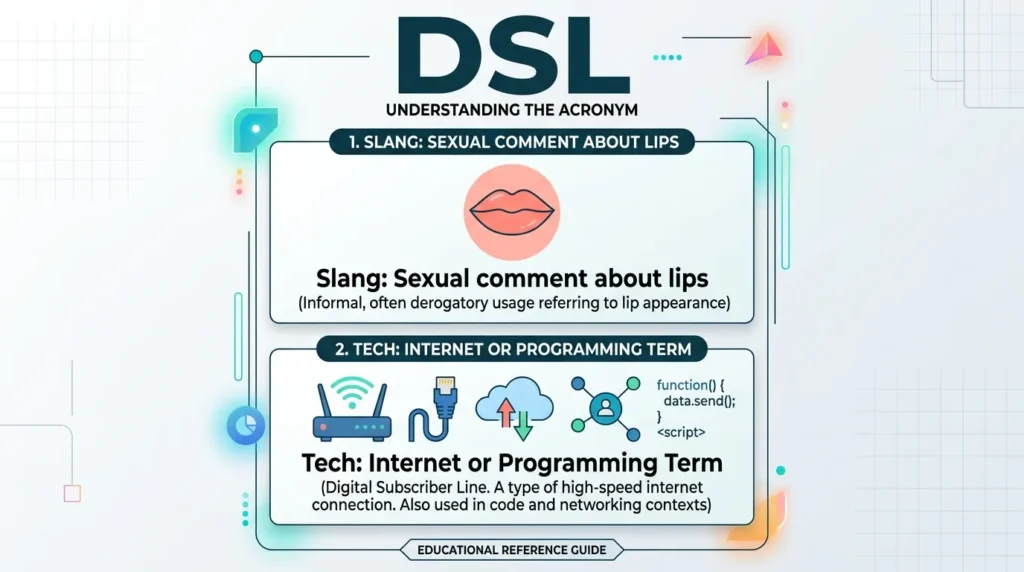

In slang, DSL most commonly stands for “dick-sucking lips.” It is a vulgar, sexually suggestive expression used to describe someone with full or attractive lips. You may see it in texts, private messages, comments, memes, or casual online conversations.
DSL does not always have a sexual meaning. In technology, it commonly means Digital Subscriber Line, an internet connection technology, while programmers may use DSL for domain-specific language. Context therefore matters: a comment about someone’s appearance probably uses the slang meaning, while a conversation about internet service or coding almost certainly does not.
| Quick Answer | Details |
|---|---|
| Most common slang meaning | Dick-sucking lips |
| What it describes | Full or attractive lips in a sexualized way |
| Typical context | Texting, social media, jokes, flirting, casual conversation |
| Tone | Sexual, vulgar, teasing, or flirtatious |
| Formality | Very informal |
| Work or school appropriate? | Usually no |
| Other common meaning | Digital Subscriber Line |
| Programming meaning | Domain-specific language |
| Pronunciation | Usually said as the individual letters: D-S-L |
What Does DSL Mean in Slang?
The most common slang meaning of DSL is “dick-sucking lips.” It refers to lips that someone considers full, prominent, attractive, or sexually appealing. The phrase makes a direct sexual reference, so it is considerably more explicit than simply calling someone attractive.
For example:
“She has DSL.”
In that sentence, the speaker is probably commenting on the person’s lips in a sexual way.
The slang does not literally tell you anything about a person’s sexual behavior or experience. It describes how the speaker perceives someone’s appearance. Assuming anything further about the person would go beyond what the slang itself actually communicates.
That distinction matters because the expression can easily become objectifying when it is used about someone without their consent.
Quick Meaning by Context
| Context or Platform | Likely Meaning | Example | Usage Level |
|---|---|---|---|
| Texting about someone’s appearance | Dick-sucking lips | “He said I have DSL.” | Common slang use |
| TikTok, Instagram, or Snapchat comments | Dick-sucking lips | “Those DSLs though.” | Context-dependent |
| Flirting or dating conversation | Dick-sucking lips | “You definitely got DSL.” | Context-dependent |
| Internet-service discussion | Digital Subscriber Line | “My DSL connection is slow.” | Standard technical use |
| Programming discussion | Domain-specific language | “We built a DSL for this task.” | Technical |
| General professional conversation | Depends on subject | “Does the system support DSL?” | Context-dependent |
The slang meaning does not substantially change from one social platform to another. A TikTok comment, Instagram message, Snapchat chat, or regular text mentioning someone’s lips usually points to the same sexual slang definition.
What Does DSL Mean in Text?
In casual texting, DSL normally means “dick-sucking lips” when the conversation involves appearance, attraction, dating, or someone’s mouth or lips.
For example:
Friend 1: “Why did he comment DSL on my picture?”
Friend 2: “He was making a sexual comment about your lips.”
But the subject of the conversation can completely change the interpretation.
Compare:
“Your new photo really shows the DSL.”
This likely uses the slang meaning.
“The apartment only has DSL available.”
This almost certainly refers to internet service.
The letters alone are therefore not enough. The words around them are usually the best clue.
Also Read: What Does PSA Mean in Text, Chat, and Social Media?
What Does DSL Mean on TikTok, Snapchat, and Instagram?
On TikTok, Snapchat, Instagram, and similar social platforms, DSL can appear in comments about a person’s face, selfies, makeup, or lips. In that setting, it generally carries the same vulgar sexual meaning used in texting rather than a special platform-specific definition.
You might encounter comments such as:
“Definitely DSL.”
or
“Those are some DSLs.”
Both are likely sexual comments about the person’s lips.
Social media can make the expression appear lighter because it may be surrounded by jokes, emojis, or playful reactions. That does not remove its sexual meaning.
What Does “DSLs” Mean?
DSLs is a pluralized form of the slang expression. People may use it when referring to someone’s lips collectively.
For example:
“She got DSLs.”
The meaning is essentially the same as saying someone “has DSL.”
You may also see DSL’s, although the apostrophe is unnecessary when someone simply wants to make the abbreviation plural.
Is “DSL Lips” Redundant?
Technically, yes.
Because the L already stands for “lips,” saying “DSL lips” expands to something like “dick-sucking lips lips.”
However, people often use redundant expressions when they do not know every word represented by an acronym or when repeating the noun makes the meaning clearer. Similar patterns occur with many everyday abbreviations.
How Context Changes the Meaning of DSL
DSL is particularly easy to misunderstand because its non-slang meanings are well established.
Look for these clues.
1. Someone’s appearance is being discussed
If the conversation mentions a selfie, makeup, attractiveness, someone’s mouth, or physical appearance, the slang interpretation is likely.
“That lipstick makes your DSL stand out.”
Here, the comment is clearly about lips.
2. Internet service is being discussed
If you see words such as router, broadband, modem, connection, download, telephone line, provider, or internet, DSL probably means Digital Subscriber Line. DSL technology transmits internet data through telephone-line infrastructure.
“We still use DSL at my parents’ house.”
There is no sexual meaning here.
3. Programming is being discussed
Among software developers, DSL can mean domain-specific language, a programming language or notation designed for a particular domain or specialized purpose.
“We’re creating a DSL for configuring the application.”
Again, the meaning is completely technical.
4. The comment contains flirty or suggestive language
Flirting, suggestive emojis, comments about kissing, or sexual jokes make the slang interpretation more likely.
“Okayyy those DSLs 😏”
The emoji strengthens the sexual or flirtatious reading.
5. The conversation is professional
In a workplace discussion involving networking, coding, software, or telecommunications, assuming the sexual meaning would usually make little sense.
The safest rule is simple: interpret DSL according to the subject of the conversation, not according to the acronym alone.
Also Read: FOMO Meaning in Text, Social Media, and Everyday Slang
Other Genuine Meanings of DSL
Digital Subscriber Line
Outside slang, Digital Subscriber Line is one of the best-known meanings of DSL. It refers to technology used to provide internet access through telephone-line infrastructure.
Example:
“DSL isn’t available at my new address.”
This is a standard telecommunications meaning and has nothing to do with slang.
Domain-Specific Language
In software development, DSL can stand for domain-specific language.
A domain-specific language is designed for a particular area or set of tasks rather than general-purpose programming.
Example:
“The team created a small DSL for defining workflows.”
This meaning is common in programming discussions but unlikely in ordinary social-media comments.
Other Specialized Uses
DSL can represent additional specialized terms in particular industries, scientific fields, products, and project names. These meanings are much less relevant when someone specifically searches for DSL meaning slang.
Rather than memorizing every possible expansion, look first at the topic being discussed.
Tone and Emotional Meaning
DSL may look like a simple three-letter abbreviation, but the phrase behind it carries a strong tone.
Flirty
Between adults who already have a comfortable flirtatious relationship, someone might use DSL as a sexually suggestive compliment.
“Not gonna lie, you’ve got DSL.”
Even in this context, it is much more explicit than saying “nice lips.”
Teasing
Friends may use the acronym jokingly, especially when talking about selfies or exaggerated poses.
“Girl, that lip gloss gave you DSL 😂.”
The laughing emoji can make the comment feel playful, but the underlying phrase remains sexual.
Crude
Used by a stranger or in a public comment, DSL can sound crude because it reduces someone’s appearance to a sexual function.
Objectifying
The expression can also feel objectifying because it describes a physical feature according to an imagined sexual act.
This is why the relationship between the speakers matters as much as the literal definition.
Also Read: Mexican Slang: Common Words, Meanings, and How to Use Them
Real Conversation Examples
Between friends
Alex: “Someone commented DSL under my picture.”
Jamie: “They’re talking about your lips. It’s sexual slang.”
Dating conversation
Taylor: “He told me I have DSL.”
Morgan: “Yeah, that’s a pretty explicit compliment about your lips.”
Social media
Comment: “The DSLs are crazy 😭”
Meaning: The commenter is making a sexualized remark about the person’s lips.
Internet conversation
Sam: “Why is the internet so slow?”
Chris: “We’re still using DSL.”
Meaning: Digital Subscriber Line.
Programming conversation
Developer 1: “Should we create another DSL for these configuration rules?”
Developer 2: “Only if the existing syntax can’t handle them.”
Meaning: Domain-specific language.
Ambiguous message
“Do you have DSL?”
Without context, this could be confusing. A person discussing home internet may mean Digital Subscriber Line, while someone making a suggestive personal comment could mean the slang expression.
Grammar and Language Role
DSL is an initialism, meaning people normally pronounce each letter separately:
D-S-L
In slang, it generally behaves like a noun or descriptive label.
Common constructions include:
- “She has DSL.”
- “Those are DSLs.”
- “He said I had DSL.”
- “That picture is giving DSL.”
Capitalization is flexible online. You might see:
DSL
dsl
DSLs
dsls
The capitalization normally does not change the meaning.
Because the final letter already means “lips,” DSLs is often used informally when someone wants to talk about the lips as a pair.
How to Reply When Someone Says DSL
How you respond depends on your relationship with the person and whether you welcome the comment.
If you do not know what they mean
“What does DSL mean?”
There is nothing wrong with asking. Acronyms are highly context-dependent.
If you are comfortable with the compliment
“I’ll take that as a compliment 😂.”
This keeps the exchange playful without escalating it.
If you want clarification
“Do you mean the slang version?”
This works particularly well when the context is ambiguous.
If the comment makes you uncomfortable
“I’d rather you not make sexual comments about me.”
A direct boundary is clearer than trying to joke away something you dislike.
If it appears in a professional conversation
Respond to the professional meaning unless the surrounding context clearly indicates otherwise.
“Are you referring to Digital Subscriber Line or a domain-specific language?”
Similar and Commonly Confused Terms
| Term | Meaning | Main Difference | Typical Context |
|---|---|---|---|
| DSL | Dick-sucking lips | Explicit sexual comment about lips | Slang, flirting, social media |
| DSL | Digital Subscriber Line | Internet technology | Telecommunications |
| DSL | Domain-specific language | Specialized programming language | Software development |
| DSLs | Pluralized slang or technical abbreviation | Meaning depends on context | Social or technical |
| ADSL | Asymmetric Digital Subscriber Line | A specific type of DSL technology | Internet and networking |
The biggest mistake is assuming that DSL always means the slang phrase. Technical conversations use the same letters completely differently.
The reverse mistake also happens. Someone may see “DSL” under a selfie and assume the person is talking about internet service when the surrounding context clearly points to slang.
Who Uses the Term?
The slang use of DSL appears mainly in casual online conversation, social media, jokes, flirting, and discussions about physical appearance. It has circulated online since at least the mid-2000s and has continued appearing in newer social-media contexts.
It would be inaccurate to describe DSL as belonging exclusively to one generation or one social platform. Internet slang frequently moves between communities, age groups, messaging apps, memes, and offline conversation.
The technical meanings, meanwhile, are used by completely different groups. Telecommunications discussions favor Digital Subscriber Line, while software developers may use domain-specific language.
Also Read: New York Slang: 30 NYC Words and Phrases Explained
Origin and Evolution of DSL Slang
The exact creator or original spoken use of the slang expression is uncertain.
However, online examples show the abbreviation being used with its sexual meaning by the mid-2000s, meaning it predates many of the social platforms where people encounter it today.
It later continued circulating through online jokes, social-media posts, comments, and renewed curiosity about older internet slang.
This makes DSL a useful example of slang that may feel new to a person encountering it for the first time even though the expression itself has existed online for many years.
Is DSL Offensive, Rude, or Inappropriate?
DSL is vulgar and sexually explicit.
The acronym hides the explicit words, but abbreviating them does not change the underlying meaning.
Whether someone considers it offensive depends heavily on:
- Who is saying it
- Who they are saying it about
- Their relationship
- Whether sexual comments are welcome
- Whether the conversation is private or public
- The tone of the message
Among adults who are already flirting, the term may be received as a provocative compliment.
Coming from a stranger, coworker, classmate, or someone who has not been invited to make sexual comments, it can easily sound disrespectful or objectifying.
Is DSL appropriate at work?
Usually not when used in its slang sense.
It is explicitly sexual and therefore unsuitable for normal professional communication.
The technical meanings of DSL are completely appropriate when relevant to the work.
Is DSL appropriate at school?
The slang meaning is generally inappropriate for classroom or formal school use because the full phrase contains explicit sexual language.
Is DSL profanity?
The phrase contains crude sexual wording rather than a conventional swear word alone. Calling it vulgar sexual slang is more precise than treating it as a harmless abbreviation.
Real-World Interpretation
The most useful thing to understand about DSL is that the acronym softens the appearance of the phrase without really softening its meaning.
Someone unfamiliar with it may see three harmless-looking letters. A person who knows the slang immediately hears the explicit phrase behind them.
That gap can create awkward situations, particularly in public comments where one person thinks they are giving a playful compliment while the recipient experiences it as an unwanted sexual remark.
Context tells you what DSL means. Relationship and consent tell you whether using it is appropriate.
Frequently Asked Questions
What does DSL mean in slang?
In slang, DSL most commonly stands for “dick-sucking lips.” It is a vulgar sexual expression describing someone’s lips, usually because the speaker considers them full or sexually attractive. It may appear in texts, comments, jokes, flirting, and casual online conversations.
What does DSL mean from a guy?
If a guy says someone has DSL while discussing their appearance, he is probably making a sexually suggestive comment about their lips. It may be intended as flirting or a compliment, but it can also come across as crude or objectifying depending on the relationship and whether that kind of comment is welcome.
What does DSL mean on TikTok?
On TikTok, DSL commonly carries the same slang meaning as it does elsewhere: “dick-sucking lips.” It can appear in comments about selfies, lips, makeup, or physical attractiveness. It is not a separate TikTok-specific definition.
What does DSL mean on Snapchat?
In a Snapchat conversation about someone’s appearance, DSL usually refers to the same sexually suggestive slang phrase about lips. If the conversation instead involves internet connections or technology, it may mean Digital Subscriber Line. The surrounding topic is the easiest way to distinguish them.
Is DSL a compliment?
It can be intended as a sexual compliment because the speaker is usually expressing attraction to someone’s lips. That does not guarantee the recipient will experience it positively. Because the expression is explicit and objectifying, an unsolicited DSL comment may instead come across as uncomfortable or disrespectful.
What does DSL mean in internet terminology?
In telecommunications, DSL means Digital Subscriber Line, a technology for providing internet connectivity over telephone-line infrastructure. This meaning is unrelated to sexual slang.
What does DSL mean in programming?
In programming, DSL commonly stands for domain-specific language, meaning a language designed for a particular problem area or specialized set of tasks rather than broad general-purpose programming.
Is DSL inappropriate to say?
The slang version can be inappropriate because its full form is sexually explicit. It may be acceptable within a consensual adult conversation where that tone is welcome, but it is generally unsuitable for work, school, formal communication, or unsolicited comments about someone’s appearance.
Conclusion
In slang, DSL most commonly means “dick-sucking lips,” a vulgar and sexually suggestive description of someone’s lips. It appears in texts, social-media comments, jokes, and flirting, but the same acronym has completely unrelated technical meanings.
When someone’s appearance, lips, or attraction is being discussed, the slang definition is likely. When the topic is broadband or software, DSL probably means Digital Subscriber Line or domain-specific language instead. The practical rule is to read the surrounding conversation before interpreting the acronym, and remember that the slang version can sound much more explicit than its three letters initially suggest.


Pingback: Australian Slang: 50 Aussie Words and Phrases Explained
Pingback: 90s Slang: Popular Words and Phrases From the 1990s
Pingback: Toronto Slang: Popular Words, Meanings, and Examples
Pingback: 80s Slang: 50 Popular Words & Phrases Explained
Pingback: Bougie Meaning: Slang Definition, Examples & Pronunciation
Pingback: 4th Hole Meaning: What Does 4th Hole Mean in Slang?