


Crossfaded means being drunk and high at the same time, usually from alcohol and cannabis whose effects overlap.
If you saw the word in a text, a caption, or a song lyric, this guide explains it in plain language. People search for what does crossfaded mean because the word sounds simple, but the state is messy. Below you will find the crossfaded definition, how it is used in text and online, how it compares with drunk, high, faded, and greening out, and what to do when someone has had too much.

What Crossfaded Means at a Glance
Crossfaded means a person is drunk and high at the same time, most often from drinking alcohol and using cannabis together, so the two sets of effects blend instead of staying separate. The word names the combined state, not just one drink or one hit on its own.
Think of it as an overlap. Alcohol can loosen inhibitions and blur judgment. Cannabis can change perception and sense of time. Together, people often describe a heavier, woozier feeling than either one alone would give.
Spelling varies: crossfaded, cross-faded, and cross faded all point to the same idea. Getting crossed is a related phrase. Triple faded points to three substances at once, which carries higher risk.
Crossfading vs crossfaded
Crossfading is the act, and crossfaded is the state. Crossfading means mixing alcohol and cannabis in one session. Crossfaded means feeling both effects at once. They went out crossfading, and by midnight they were crossfaded.
Crossfaded vs Drunk, High, and Faded
Crossfaded is the combined state of being drunk and high together, while drunk means alcohol alone, high means cannabis alone, and faded is a broader slang word for intoxicated that can cover either one or both. The table below keeps the differences clear.
| Term | Meaning | Tone | Where used | Example |
|---|---|---|---|---|
| Crossfaded | Drunk and high together, usually alcohol plus cannabis | Casual, often joking, but the state can be heavy | Texts, party talk, captions | I got crossfaded and had to sit down early. |
| Drunk only | Impaired by alcohol alone | Plain, can be funny or serious | Everyday speech, texts | He was drunk and kept repeating the story. |
| High only | Effects of cannabis alone | Casual, often relaxed | Texts, music talk | She got high and watched a film. |
| Faded | Intoxicated in general, often cannabis, sometimes both | Laid back, vague | Lyrics, captions, texts | We got faded listening to the album. |
| Greening out | Sick from too much cannabis, pale, dizzy, or nauseous | Warning tone, uneasy | Texts, party talk | He greened out and needed water. |
Faded is the loosest word here. It can mean high, drunk, or both. Greening out is narrower and more serious, and it is a sign to slow down and get help from a sober friend. Do not treat it as a joke version of crossfaded.
Crossfaded vs drunk only and high only
Drunk only points to alcohol, and high only points to cannabis. Crossfaded adds the other substance, which can make balance, nausea, and poor judgment more likely. If a post mentions drinks and smoking together, crossfaded is usually the word meant.
Where Crossfaded Comes From
Crossfaded borrows its image from audio, where a crossfade blends one track into another, and it builds on faded, an older slang word for being intoxicated, to name the blend of alcohol and cannabis effects. The metaphor stuck because it sounds like what it describes.
In music production, one song fades out as the next fades in, and for a few seconds both are audible. Slang took that picture: one effect fades in while the other is still present. Faded already meant intoxicated, most often from cannabis. Adding cross narrowed the meaning to the combination.
What Being Crossfaded Feels Like
People commonly describe being crossfaded as feeling drunk and high at once, with dizziness, heaviness, foggy thinking, nausea, and a stronger urge to sit or lie down than either substance alone tends to bring. Reports vary a lot, and the same person can feel fine one night and rough the next.
Balance feels off. Thoughts feel slow or scattered. People say the room spins when they stand up fast. Amount, pace, food, sleep, setting, and tolerance all shape the experience. A breezy caption can hide a rough hour.
Patrick and Lee surveyed 807 young adults aged 18 to 23 in Seattle, and 60.4% said they had been cross-faded. In the same study, 87.2% had heard of the term, and 78.1% rated the state as moderately or very risky. Most defined it as using alcohol and marijuana together or being drunk and high.
Signs the night has turned rough
Rough signs include repeated vomiting, trouble staying awake, confusion, very slow breathing, and pale or clammy skin. These signs call for prompt care. The safety section below lists warning signs in full.
Why Alcohol and Cannabis Hit Harder Together
Alcohol and cannabis hit harder together because alcohol can raise how much THC reaches the blood and how fast it arrives, while cannabis can mask how drunk a person feels, so the combined effect is stronger and harder to judge than either alone.
Archangel Centers summarizes research on cross-faded use, including Hartman and colleagues from 2015. Drinking before inhaling cannabis raised median peak blood THC from 42.2 to 67.5 micrograms per litre at the higher dose. The same dose led to more THC in the blood when alcohol came first.
The reverse pattern is also reported. Cannabis first can dull the sense of drunkenness, so a person may keep drinking. Order does not make either sequence safe. It only changes which warning signals get muted first.
The same Archangel Centers summary cites Chihuri and colleagues from 2017, who found adjusted odds of fatal crash involvement of 25.09 for alcohol and marijuana together, compared with 16.33 for alcohol alone and 1.54 for marijuana alone. Do not drive after either substance, and do not ride with an impaired driver.
Cannabis can suppress vomiting, which can hide a warning sign of alcohol poisoning. Friends may miss a cue that would prompt help. Watch breathing, wakefulness, and skin colour alongside vomiting.
Crossfaded in Lyrics and on Social Media
In lyrics and social posts, crossfaded works as shorthand for a late-night, blurred mood where drinking and cannabis overlap, and writers use it to set a scene fast without spelling out the whole night. It names a mood, not a full story.
Music helped the word travel. In hip hop and R&B, faded and crossfaded sit beside late drives and house parties. Don Toliver uses crossfaded in lyrics built around being lost in the moment and catching a vibe. Listeners pick it up as a vibe word for their own posts.
Online, it appears in captions, comments, and memes. Tone shifts with context. A caption with laughing emojis reads as a joke. A 2 a.m. text asking for water reads as a request for help. Check the sentence around the word before deciding what the writer means.
Who Says Crossfaded, Where, and to Whom
Crossfaded is mainly used by teens and young adults in casual peer settings, in texts and social posts to friends who already know the slang, and it is rarely used with parents, teachers, bosses, or other formal listeners. The listener is almost always a peer.
The core speakers are young adults talking to each other: students, young workers, music fans, and party groups. It fits the Seattle survey age range, 18 to 23, and the places where slang spreads fastest: group chats, house parties, festivals, and comment threads.
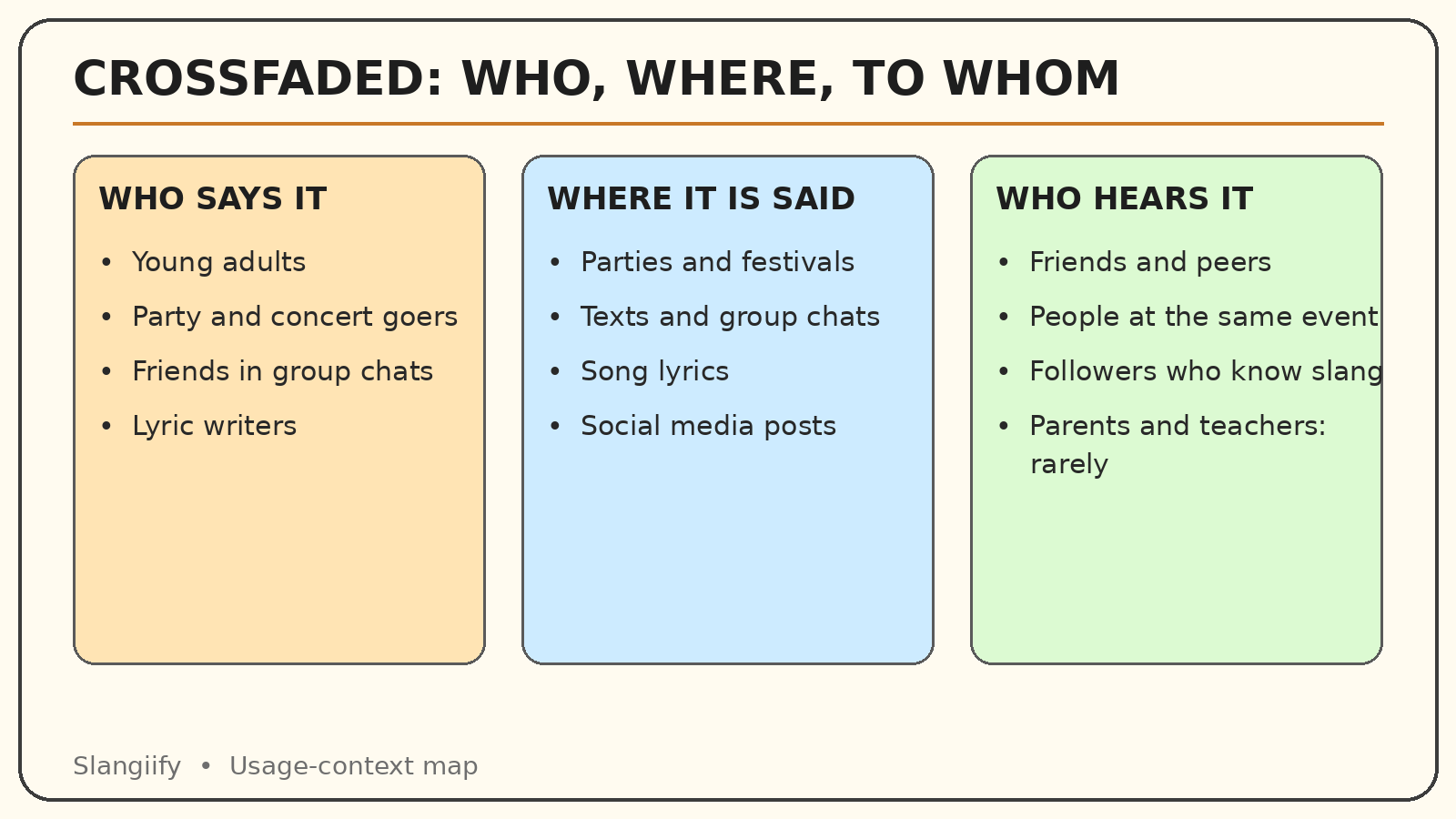
Where it is said, and to whom
Texts and group chats lead, followed by captions, comments, and memes. At a party it is a status update. The next morning it is a recap. In a lyric it is mood. Parents and employers are not the intended audience, since the word hides detail behind slang.
How People Use Crossfaded in a Sentence
People use crossfaded as an adjective after a linking verb, most often in the form I am crossfaded or I got crossfaded, and as a short status update in texts, captions, and spoken party talk. The word needs no object after it.
It behaves like drunk or tired: I am crossfaded. I got crossfaded last night. We were so crossfaded we left early. You do not need to name both substances each time, because the word already carries both.
Text, caption, and related slang
In text it often arrives with a short add-on, like I am crossfaded, come get me. Tone is harder to read in text, so ask a follow-up question if you are unsure whether the sender needs help. Related words are not synonyms: what crack means in slang covers a stimulant, what crank means in slang covers another stimulant term, and what fein means in slang describes craving a substance, not the combined state itself.
What to Say and Do When Someone Is Crossfaded
When someone is crossfaded, stay with them, help them stop drinking and using more, offer water and fresh air, keep them from driving, and call emergency services at once if warning signs appear. Do not try to sober them up fast with coffee or a cold shower.
Keep the setting calm and quiet. Offer water in small sips. Suggest fresh air or a cool room. Use short, kind lines: You look rough, let us sit down. Have some water, and let us stop here for tonight. I will stay with you.

Driving is off the table. Arrange a sober ride or a safe place to stay. Check breathing, wakefulness, and skin often, and call for help at the first warning sign rather than waiting to be sure.
Warning signs that need emergency help
Call 911 or your local emergency number at once if any warning sign appears. The warning signs listed by Archangel Centers include a person who cannot be woken, breathing fewer than 8 breaths per minute or pauses of 10 seconds or more, seizures, repeated vomiting while semi-conscious, and cold, clammy, pale, or bluish skin. Stay with the person, keep them on their side if vomiting, and tell responders what was used. If a product may have contained something unexpected, say so plainly. What laced means in slang explains that word.
Myths vs Facts About Crossfaded
Common myths about crossfaded claim the mix is safe if you pick the right order, that cannabis cancels alcohol risk, or that feeling fine means you are fine to drive, while the facts point to stronger, less predictable effects and real driving and poisoning risks.
Myth: Picking the right order makes crossfading safe
Fact: No order makes the mix safe. Drink first, and the effect can feel stronger. Use cannabis first, and drunkenness can feel muted. Order only changes which signals get blurred first.
Myth: Cannabis cancels out alcohol or sobers you up
Fact: Cannabis does not sober a person up. It can change how drunk a person feels, which makes judgment worse. Feeling different is not the same as being sober.
Myth: If you feel okay, you are okay to drive
Fact: Feeling okay is a poor test after both substances. Crash research cited above shows sharply higher odds of fatal crash involvement with both present. Use a sober driver, every time.
Myth: Vomiting means the danger has passed
Fact: Vomiting does not mean danger has passed, and no vomiting does not mean safety. Cannabis can suppress vomiting and mask alcohol poisoning signs. Watch breathing, wakefulness, and skin.
Myth: Crossfaded is just a stronger version of being high
Fact: Crossfaded is not just a stronger high. It adds alcohol effects: impaired balance, nausea, and poor judgment. The safety response should cover both parts.
When NOT to Use Crossfaded
Do not use crossfaded in formal, medical, legal, or workplace settings, as a joke about someone who is ill, or as a goal or dare, because the slang hides detail, sounds flippant, and can delay help. Use plain words when clarity matters more than style.
With a doctor, nurse, teacher, or manager, say drunk and high, or name the substances and symptoms. Do not tease someone who feels sick, and do not frame the state as a goal. Posts that do so leave out the nausea, anxiety, and risk many people report.
Quick Answers About Crossfaded Slang
These short answers cover the questions readers ask most, with a direct answer first in each case.
What does crossfaded mean?
Crossfaded means drunk and high at the same time, usually from alcohol and cannabis together. It names the overlap, when both effects are active at once.
Is crossfaded the same as drunk?
No. Drunk means alcohol alone. Crossfaded means alcohol plus cannabis, and it often feels heavier and dizzier than being drunk alone.
Is crossfaded the same as high?
No. High means cannabis alone. Crossfaded adds alcohol, which can worsen balance, nausea, and judgment.
What does being crossfaded feel like?
People report dizziness, heaviness, foggy thinking, and nausea, though reports vary widely. Some describe a brief blur, others describe spinning or sickness for hours.
Is crossfaded dangerous?
It can be. The mix is less predictable, it raises crash risk sharply, and cannabis can mask alcohol poisoning signs. Call emergency services for warning signs at once.
How do you spell crossfaded?
All three forms are used: crossfaded, cross-faded, and cross faded. Crossfaded, with no hyphen, is the most common form, and it is used in this title.
What should I do if a friend is crossfaded and feels sick?
Stay with them, offer water and fresh air, keep them from driving, and call 911 or your local emergency number if warning signs appear. Keep them on their side if sleepy or vomiting.
Sources and Further Reading
These sources were used for the verifiable claims in this article. Each link opens the source page, with no bare web addresses in the body.