
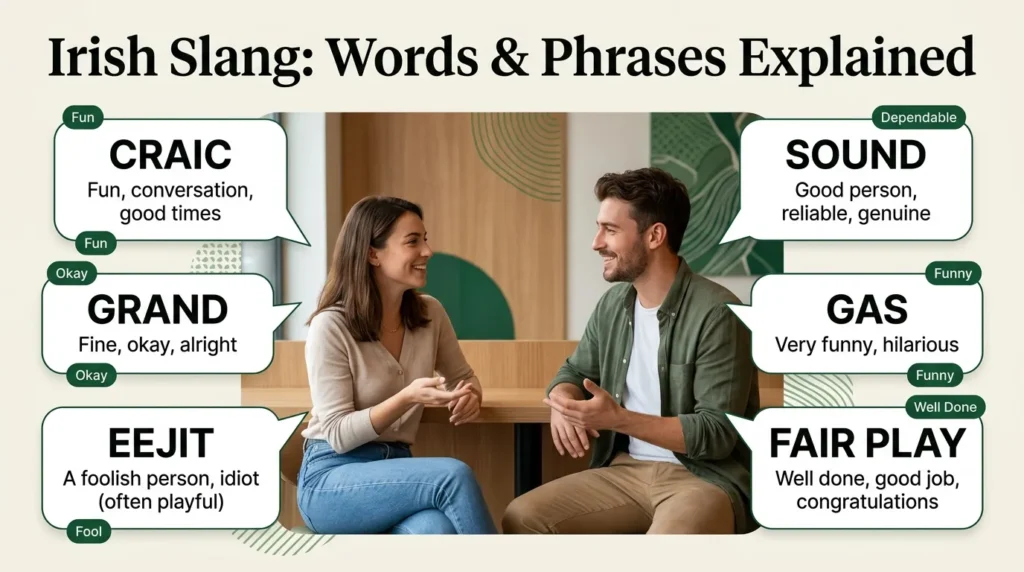

Irish slang is the informal vocabulary and expressions used in everyday Irish English, often called Hiberno-English. Words such as craic, grand, sound, gas, eejit, and yoke can look familiar to English speakers but carry distinctly Irish meanings or uses. The meaning of an expression can also change with tone, region, relationship, and situation.
Irish slang is not one fixed vocabulary used identically throughout Ireland. Some expressions are widely understood, while others are strongly associated with particular regions, generations, or social groups. Irish English also has vocabulary and grammatical patterns influenced by the Irish language, so understanding the culture behind an expression can be just as useful as memorizing its English translation.
Quick Answer: What Is Irish Slang?
| Category | Quick Answer |
|---|---|
| What is Irish slang? | Informal words, phrases, and expressions used in Irish English |
| Most recognizable examples | Craic, grand, sound, gas, eejit, deadly, savage, fair play |
| Typical tone | Casual, friendly, humorous, understated, teasing, or occasionally rude |
| Is it the same everywhere? | No. Usage can vary by region, age, and social setting |
| Is Irish slang the Irish language? | No. Much of it is Irish English, although Irish-language influence is significant |
| Can visitors use it? | Yes, but understanding an expression before using it is safer than copying slang blindly |
| Are all terms friendly? | No. Some are mild, some insulting, and some vulgar or context-sensitive |
| Biggest clue to meaning | Context and tone |
What Is Irish Slang?
Irish slang refers broadly to informal vocabulary and expressions used in everyday speech in Ireland. It is better understood as part of the wider Irish English landscape rather than as a separate language.
That distinction matters. Someone might hear an Irish person say grand, craic, or giving out and assume the words have their standard English meanings. They do not always. Irish English has developed its own vocabulary, expressions, meanings, and sentence patterns over time, with significant influence from the Irish language.
Irish slang also tends to rely heavily on context. Grand can simply mean fine or okay. Gas can mean funny rather than something related to fuel. Bold can describe a mischievous child rather than someone courageous. Giving out usually means complaining or scolding rather than handing something to somebody.
For that reason, learning Irish slang is less about memorizing a dictionary and more about understanding how ordinary words are used in Irish conversations.
Common Irish Slang Words and Their Meanings
Here are some of the most useful expressions to recognize.
| Irish Slang | Meaning | Typical Tone |
|---|---|---|
| Craic | Fun, entertainment, news, or what is happening | Casual |
| Grand | Fine, okay, satisfactory | Casual, often understated |
| Sound | Good, decent, trustworthy, kind | Friendly |
| Gas | Funny or entertaining | Casual |
| Eejit | Fool or silly person | Usually teasing |
| Fair play | Well done; good for you | Supportive |
| Deadly | Excellent or very good | Positive |
| Savage | Excellent, impressive, very good | Casual |
| Class | Excellent or great | Casual |
| Mighty | Very good or excellent | Positive |
| Yoke | A thing or object whose name is unknown or unimportant | Informal |
| Bold | Naughty or misbehaving | Usually playful |
| Giving out | Scolding or complaining | Casual |
| Banjaxed | Broken, exhausted, or worn out | Informal |
| Knackered | Extremely tired | Casual |
| Gobshite | Foolish or annoying person; someone talking nonsense | Insulting |
| Chancer | Someone taking a risky opportunity or pushing their luck | Teasing/negative |
| Cute hoor | A clever or sly person, often someone who gets what they want | Context-dependent |
| Jacks | Toilet | Informal |
| Press | Cupboard | Everyday Irish English |
| Messages | Grocery shopping or errands | Everyday Irish English |
These terms are not all interchangeable. Some are widespread across Ireland, while others can sound more regional, old-fashioned, humorous, or strongly informal depending on the speaker and setting.
Craic
Craic, pronounced roughly like crack, is one of the best-known Irish expressions.
In everyday use, it can refer to fun, entertainment, social activity, news, or what is happening. It is especially useful because it can work in several different expressions.
Examples:
- What’s the craic? — What’s happening? / What’s new?
- Any craic? — Anything happening?
- The craic was mighty. — We had a great time.
- Good craic — Fun or enjoyable company.
The important point is that craic is not simply another word for fun. In conversation, it can function as a social check-in or a question about what is going on.
Also Read: Torta Slang: Meaning, Context, and Usage Explained
Is craic pronounced crack?
Yes. In Irish English, craic is pronounced like the English word crack. The spelling can surprise people who encounter it for the first time.
Grand
In standard English, grand can suggest something impressive or magnificent. In Irish English, grand very often means fine, okay, satisfactory, or no problem.
For example:
“How are you?”
“I’m grand.”
That does not necessarily mean the person is having an amazing day. It may simply mean they are doing fine.
Tone matters too. A cheerful I’m grand! and a flat I’m grand can communicate slightly different feelings.
You may also hear:
- That’s grand.
- It’ll be grand.
- You’re grand.
- Ah, grand so.
The phrase it’ll be grand often carries a reassuring sense of things being okay or manageable.
Sound
Sound is another useful Irish expression. Depending on context, it can mean good, decent, reliable, kind, or okay.
Examples:
- “He’s a sound lad.” — He’s a good/reliable guy.
- “That was sound of you.” — That was kind of you.
- “Are we sound?” — Are we okay?
Calling someone sound is generally positive. It can be especially useful when describing someone who is trustworthy, friendly, or easy to deal with.
Gas
If an Irish person says something is gas, they usually mean it is funny, amusing, or entertaining.
For example:
“Your brother is gas.”
This means the brother is funny or entertaining, not that he is literally made of gas.
You can also hear:
“That was gas.”
That means something was funny or enjoyable.
The expression is generally casual and positive.
Eejit
Eejit is a playful form of idiot or fool.
It can be an actual insult, but among friends and family it is frequently softened by affection or humor.
For example:
“You forgot your keys again, you eejit.”
That sounds more teasing than vicious when said between people who know each other well.
Still, relationship and tone matter. Calling a stranger an eejit is not necessarily friendly.
Fair Play
Fair play is commonly used to express approval, congratulations, or recognition.
For example:
“You got the promotion? Fair play to you.”
The expression can mean something like:
- Well done.
- Good for you.
- You deserve credit.
- Nice one.
It can also be used when someone handles a difficult situation well.
Deadly
In many varieties of English, deadly sounds negative because it literally relates to death. In Irish slang, however, deadly can mean excellent, brilliant, or very good.
Example:
“That concert was deadly.”
The speaker is praising the concert.
Context makes the difference. A visitor who interprets every occurrence literally can easily misunderstand the sentence.
Savage
Savage can be used positively in casual Irish speech to mean excellent, impressive, or really good.
For example:
“That was a savage match.”
Depending on context, it can also retain its ordinary English meaning of harsh or brutal. It is therefore a good example of why Irish slang should not be interpreted word-for-word.
Class
Class can mean excellent, impressive, or very good.
Example:
“That restaurant was class.”
It is informal and generally positive.
Mighty
Mighty can mean very good, excellent, or great.
Example:
“We had a mighty night.”
The expression is casual and enthusiastic, although its exact force depends on the speaker.
Everyday Irish Slang and Expressions
Irish English contains many expressions that may confuse visitors even when every individual word looks familiar.
Yoke
A yoke is an informal word for a thing or object when the speaker does not know, remember, or care about its exact name.
For example:
“Pass me that yoke over there.”
The speaker is referring to an object without naming it precisely.
This makes yoke extremely context-dependent. The object could be almost anything.
Bold
In Irish English, calling a child bold often means the child is naughty, mischievous, or misbehaving.
For example:
“Stop being bold.”
An American English speaker might interpret that as encouragement to be brave. In this Irish context, it is much closer to stop misbehaving.
Giving Out
Giving out is an especially useful expression to recognize.
In Irish English, it can mean scolding, complaining, or expressing annoyance.
Example:
“Mam was giving out to me for being late.”
That means Mam was scolding the speaker.
It does not mean she was distributing something.
Banjaxed
Banjaxed means something is broken, ruined, exhausted, or worn out, depending on context.
You might hear:
“The washing machine is banjaxed.”
That means the washing machine is broken.
You could also hear someone describe themselves as banjaxed when they are completely exhausted.
Knackered
Knackered means extremely tired.
Example:
“I’m absolutely knackered after work.”
It is informal but widely understandable in several varieties of British and Irish English.
Gobshite
A gobshite is someone who talks nonsense or behaves foolishly. It is an insult and contains a vulgar element, so it is not suitable for every situation.
Among friends, it may be used jokingly:
“You absolute gobshite.”
Between strangers or in a professional setting, however, it can be genuinely offensive.
Also Read: ICL Meaning Slang: The Real Meaning and How to Use It
Chancer
A chancer is someone who takes chances, pushes their luck, or tries to get away with something.
Example:
“He’s some chancer, asking for another discount.”
The word often carries a mildly negative or teasing tone.
Cute Hoor
A cute hoor describes someone who is clever, sly, or skilled at getting what they want, sometimes through questionable tactics.
The expression is highly context-dependent. It can be criticism, admiration, or a mixture of both.
For example:
“He managed to get the last ticket without even queuing. He’s a cute hoor.”
The speaker may be impressed by the person’s cleverness while also acknowledging that the tactic was cheeky.
Irish Slang by Context
| Situation | Expressions You May Hear | Typical Meaning |
|---|---|---|
| Greeting | What’s the craic? / What’s the story? | What’s happening? / How are things? |
| Approval | Fair play / Sound / Class | Well done / good / excellent |
| Reassurance | Grand / It’ll be grand | Fine / it will be okay |
| Humor | Gas / Craic | Funny / fun |
| Praise | Deadly / Savage / Mighty | Excellent |
| Describing a fool | Eejit / Gobshite | Fool / idiot |
| Misbehavior | Bold / Acting the maggot | Naughty / fooling around |
| Complaining | Giving out | Scolding or complaining |
| Tiredness | Knackered / Banjaxed | Extremely tired |
| Objects | Yoke | Unspecified object |
| Bathroom | Jacks | Toilet |
| Shopping | Messages | Grocery shopping or errands |
The expressions above are useful starting points, but they should not be treated as a universal Irish vocabulary list. Regional speech varies, and some expressions are much more natural in certain communities than others.
Irish Slang Greetings
Irish conversations often use expressions that function as greetings even though they are not literal equivalents of hello.
What’s the Craic?
What’s the craic? can mean:
- What’s happening?
- What’s new?
- How are things?
- What have you been up to?
Example:
“Ah, Sarah! What’s the craic?”
A natural response might be:
“Not much. You?”
What’s the Story?
What’s the story? can also function as a casual greeting or a way of asking what is happening.
It does not necessarily require a detailed story.
For example:
“What’s the story?”
could simply mean:
“How are you?”
“What’s going on?”
Well?
A simple Well? can function as a casual greeting in Irish English.
The meaning comes heavily from delivery and context. It can be warm, surprised, curious, or simply conversational.
Irish Slang for Having Fun
Several Irish expressions are useful when talking about enjoyable experiences.
Craic
Fun, entertainment, social activity, or good times.
“There was great craic at the party.”
Gas
Funny or amusing.
“That film was gas.”
Mighty
Very good or enjoyable.
“We had a mighty weekend.”
Deadly
Excellent.
“The gig was deadly.”
Savage
Excellent or impressive in casual speech.
“That was savage.”
Class
Excellent or very good.
“The food was class.”
These words are not exact synonyms. Gas focuses more on humor, while craic is broader and often concerns social enjoyment.
Irish Slang for Friends and People
Irish English has a particularly rich collection of informal ways to describe people.
Eejit
A fool or silly person, often used playfully.
Gobshite
Someone who talks nonsense or behaves foolishly. More insulting than eejit.
Chancer
Someone who pushes their luck or tries to get away with something.
Cute Hoor
A clever or sly person who knows how to work a situation.
Yer Man
Yer man can refer informally to that man, that guy, or the person being discussed.
Example:
“Yer man in the shop said it would be ready tomorrow.”
The phrase does not necessarily mean the speaker knows the man’s name.
Yer Wan
Yer wan is the corresponding informal expression for that woman or that girl.
These expressions can sound strange when translated literally, but they are natural examples of how Irish English uses familiar English words in distinctive ways.
Also Read: HB Meaning Slang: Happy Birthday, Homeboy, or Something Else?
Irish Slang for Places and Things
Some of the most confusing Irish expressions are ordinary words used with local meanings.
The Jacks
The jacks means the toilet.
Example:
“Where are the jacks?”
A visitor may understand the sentence only from context.
Press
A press can mean a cupboard.
A hot press traditionally refers to a warm airing cupboard, commonly associated with storing clothes, towels, or linens.
The Messages
The messages can mean the groceries or shopping.
Example:
“I’m heading out to get the messages.”
Someone unfamiliar with Irish English might assume the speaker is going to check their phone.
Irish Slang for Being Tired, Drunk, or Exhausted
Some informal expressions describe physical or mental condition.
Knackered
Extremely tired.
“I’m knackered after that shift.”
Banjaxed
Broken, worn out, or exhausted.
“My phone is banjaxed.”
or:
“I’m absolutely banjaxed.”
Ossified
In some contexts, ossified is used informally to mean extremely drunk.
Half Cut
Half cut can describe someone who is noticeably drunk but not necessarily completely intoxicated.
These expressions are informal and should be understood according to context rather than treated as interchangeable medical descriptions of intoxication.
Irish Slang and Humor
One of the most important things to understand about Irish slang is that the literal meaning and social meaning are not always identical.
Irish conversation can use understatement, exaggeration, teasing, irony, and playful insults. An expression that looks harsh on paper can be affectionate between close friends.
For example:
“You absolute eejit.”
Depending on tone, this could be a genuine insult or a playful reaction to a friend’s silly mistake.
Likewise:
“That’s grand.”
might mean genuinely fine, merely acceptable, or reassuringly okay.
This is why copying Irish slang from a list and inserting it into every conversation can sound unnatural. Understanding when people use an expression is more valuable than simply knowing its translation.
How Context Changes Irish Slang Meaning
Context is especially important with Irish slang.
1. Listen to the surrounding words
If someone says:
“The match was deadly.”
Deadly is clearly positive.
2. Consider the relationship
A close friend can call another friend an eejit affectionately. The same word directed at a stranger may be insulting.
3. Listen to the tone
Irish understatement can make a simple word carry more meaning than its dictionary definition suggests.
4. Consider the setting
A phrase that sounds normal in a pub or among friends may not belong in a formal business meeting.
5. Consider regional usage
Some expressions are much more strongly associated with particular places. Ireland is linguistically diverse, and speech can vary between cities, counties, generations, and communities.
Irish Slang in Text Messages and Social Media
Irish slang is not limited to face-to-face conversation. Many of the same expressions appear in texts, group chats, comments, and social media.
Someone might text:
“What’s the craic?”
or:
“That was gas 😂”
or:
“Grand, see you later.”
The spelling is generally straightforward because most Irish slang uses ordinary English letters.
Online communication can make some expressions easier for outsiders to encounter because regional language now travels between communities more quickly. At the same time, social media can exaggerate the impression that one phrase is universally used across Ireland.
A phrase appearing frequently online does not necessarily mean every Irish person uses it in everyday speech.
Irish Slang in Different Parts of Ireland
Irish slang is not completely uniform.
Expressions can differ between:
- Dublin
- Cork
- Galway
- Limerick
- Kerry
- Other counties and regions
- Urban and rural communities
- Different generations
Northern Ireland also has its own patterns of English usage, and it should not automatically be treated as linguistically identical to the Republic of Ireland. Irish English itself contains substantial regional variation.
This does not mean you need to memorize a separate dictionary for every county. Most learners are better served by first understanding widely recognizable expressions and then noticing regional differences naturally through conversation.
Irish Slang vs. the Irish Language
Irish slang and the Irish language are not the same thing.
The Irish language, often called Gaeilge, is a Celtic language with its own vocabulary, grammar, pronunciation, and writing system.
Irish slang generally refers to informal expressions used within Irish English.
However, the two are not completely unrelated. Irish English has been shaped by the Irish language, and some Irish expressions, structures, and words have influenced everyday English in Ireland.
So when someone uses an unusual Irish English expression, it does not necessarily mean they have switched languages. They may simply be speaking English in a distinctly Irish way.
Irish Slang Examples in Real Conversations
1. Greeting a Friend
A: “What’s the craic?”
B: “Not much. How are you keeping?”
Meaning: What’s happening? / How are you doing?
2. Talking About a Funny Person
A: “Did you meet John?”
B: “Yeah, he’s gas.”
Meaning: John is funny or entertaining.
3. Reassuring Someone
A: “Sorry I’m late.”
B: “You’re grand.”
Meaning: It’s okay; don’t worry about it.
4. Complimenting Someone
A: “I finally finished the project.”
B: “Fair play to you.”
Meaning: Well done.
5. Talking About a Silly Mistake
A: “I left my phone at home again.”
B: “You eejit.”
Meaning: You silly fool.
6. Talking About a Broken Object
A: “Why isn’t the printer working?”
B: “It’s banjaxed.”
Meaning: The printer is broken.
7. Talking About a Fun Night
A: “How was the party?”
B: “The craic was mighty.”
Meaning: The party was great fun.
Also Read: DL Meaning Slang: What Does DL Mean in Text?
Irish Slang Tone: Friendly, Funny, or Rude?
Irish slang does not have one universal tone.
| Expression | Possible Tone | Potential Risk |
|---|---|---|
| Grand | Neutral, reassuring | Low |
| Sound | Friendly, approving | Low |
| Craic | Casual, social | Low |
| Gas | Playful | Low |
| Fair play | Supportive | Low |
| Eejit | Teasing or insulting | Medium |
| Chancer | Teasing or critical | Medium |
| Cute hoor | Admiring, teasing, or critical | Medium |
| Gobshite | Insulting | High |
| Shite | Vulgar | High |
| Feck | Mildly profane depending on use | Medium |
The safest approach is to understand an expression before actively using it.
A visitor who says grand, fair play, or what’s the craic? in an appropriate setting is unlikely to cause much trouble. Stronger insults and swear words require considerably more awareness of relationship and context.
Is Irish Slang Offensive?
Some Irish slang is completely harmless. Some is mildly insulting. Some expressions contain profanity or can become offensive depending on how they are delivered.
The key distinction is between the word itself and the way it is used.
For example, eejit can be affectionate teasing between friends but insulting when aimed at a stranger. Gobshite is much more clearly vulgar and should be treated accordingly.
If you are learning Irish slang as a visitor, the safest strategy is:
- Learn the meaning first.
- Listen to how locals use it.
- Pay attention to tone.
- Avoid using insults with strangers.
- Avoid profanity in professional situations.
- Do not assume a phrase is friendly simply because you heard it used jokingly.
Is Irish Slang Appropriate at Work?
Some Irish expressions are perfectly normal in relaxed workplace conversation, especially among colleagues who know each other well.
Words such as grand, sound, or fair play can be relatively low-risk.
More strongly informal or vulgar terms are different. Expressions such as gobshite, swear words, and aggressive insults are not appropriate simply because they are common in casual speech.
A useful rule is to match your language to the setting. Understanding informal Irish English can help you communicate with coworkers, but you do not need to use every slang term you recognize.
Is Irish Slang Appropriate for Visitors?
Yes, but understanding is more important than imitation.
Visitors sometimes try to reproduce an accent or use a large number of slang expressions at once. That can sound forced and may unintentionally turn a natural local expression into a stereotype.
A better approach is simple:
Listen → understand → notice context → use naturally.
If you hear someone say what’s the craic?, you can understand that it is a casual social greeting. You do not need to immediately fill your vocabulary with dozens of expressions.
Commonly Confused Irish Slang Terms
| Term | Meaning | Main Difference | Typical Context |
|---|---|---|---|
| Craic | Fun, news, social activity | Broader than simply “fun” | Social conversation |
| Gas | Funny or entertaining | Focuses on humor | Casual conversation |
| Grand | Fine or okay | Usually less enthusiastic than “amazing” | Everyday conversation |
| Deadly | Excellent | Positive despite negative literal meaning | Casual praise |
| Savage | Excellent or impressive | Can also retain ordinary negative meaning | Casual praise |
| Sound | Good, kind, trustworthy | Often describes people or approval | Social conversation |
| Eejit | Fool | Often milder and more playful than harsher insults | Teasing |
| Gobshite | Fool or person talking nonsense | More vulgar and insulting | Informal/argumentative |
Who Uses Irish Slang?
Irish slang can be used across many age groups and social settings, but individual expressions vary considerably.
Some words are deeply familiar across generations. Others can feel more strongly associated with younger speakers, particular regions, or specific communities.
It is therefore better to say that an expression is commonly heard, regionally associated, or informal rather than claiming that every Irish person uses it.
Irish English also changes over time. Expressions can become less common, gain new meanings, or spread beyond their original communities through travel, migration, entertainment, and online communication.
Where Did Irish Slang Come From?
There is no single origin for Irish slang.
Modern Irish English developed through a long history of contact between English and Irish. As a result, Irish English has distinctive vocabulary, grammar, expressions, and ways of structuring conversation.
Some slang expressions are old. Others are relatively recent. Some are regional. Others have spread widely enough that they are now immediately recognizable outside their original communities.
This also explains why viral claims about the exact origin of a particular Irish expression should be treated cautiously. A colorful story may be memorable without being historically reliable.
How Irish Slang Has Evolved Online
The internet has made regional language easier to encounter outside its original setting.
Irish expressions can now appear in:
- Text messages
- Group chats
- Short-form videos
- Memes
- Gaming conversations
- Online communities
- International conversations
That does not mean every expression has become universal. A phrase can be highly visible online while remaining relatively uncommon in ordinary speech.
Modern Irish slang should therefore be viewed as a living part of Irish English rather than a fixed list of words that never changes.
How to Use Irish Slang Naturally
If you want to use Irish slang without sounding forced, focus on a few expressions rather than memorizing a huge list.
Start with words whose meanings are relatively straightforward:
- Grand — fine or okay
- Craic — fun, news, or what’s happening
- Sound — good or kind
- Fair play — well done
- Gas — funny
- Class — excellent
Then pay attention to how people actually use them.
Do not force an expression into every sentence. Slang is natural precisely because speakers use it without consciously performing it.
And remember that an Irish accent and Irish slang are separate things. You can understand Irish English perfectly well without trying to imitate someone’s pronunciation.
A Simple Irish Slang Cheat Sheet
If you only want the essentials, remember these:
Craic = fun, news, or what’s happening
Grand = fine or okay
Sound = good, kind, or reliable
Gas = funny
Fair play = well done
Deadly = excellent
Savage = excellent
Class = very good
Mighty = great
Eejit = fool
Yoke = unspecified thing or object
Bold = naughty or mischievous
Giving out = scolding or complaining
Banjaxed = broken or exhausted
Knackered = extremely tired
Gobshite = person talking nonsense; vulgar insult
Chancer = someone pushing their luck
Jacks = toilet
Press = cupboard
Messages = groceries or shopping
How to Reply to Common Irish Slang
If someone asks What’s the craic?, natural replies include:
“Not much, you?”
“All good. What about yourself?”
If someone says Fair play to you, you can simply say:
“Thanks!”
If someone says You’re grand, they are usually reassuring you that everything is okay.
If someone calls you an eejit jokingly, the best response depends on the relationship. A playful:
“Ah, leave off!”
can fit a friendly exchange, while a neutral response may be better if you are unsure of the tone.
Irish Slang vs. Irish Accent
These are two different things.
An accent concerns pronunciation: how words sound when spoken.
Slang concerns informal vocabulary and expressions.
Someone can speak with a strong Irish accent while using very little slang. Another person can use Irish English expressions while having an accent that is easy for an international listener to understand.
This distinction is especially useful for English learners. You do not need to imitate an accent to understand Irish expressions.
Also Read: Jamaican Slang: 50+ Jamaican Patois Words and Phrases With Meanings
Frequently Asked Questions
What is the most common Irish slang?
There is no single expression that everyone would agree is the most common, but grand and craic are among the most recognizable and widely discussed examples. Grand commonly means fine or okay, while craic can refer to fun, entertainment, news, or what is happening.
What does craic mean in Irish slang?
Craic generally refers to fun, entertainment, social activity, news, or what is happening. In What’s the craic?, it functions as a casual way of asking what is going on or what is new. It is pronounced like crack.
What does grand mean in Irish slang?
In Irish English, grand commonly means fine, okay, satisfactory, or no problem. It does not necessarily mean magnificent or excellent. Tone can affect the emotional meaning, so I’m grand may simply mean that everything is okay.
What does eejit mean in Ireland?
Eejit is an informal word meaning fool or idiot. It is often used playfully between friends and family, especially when someone makes a silly mistake. However, it can still be insulting when used toward someone who does not know the speaker well.
Is Irish slang the same as the Irish language?
No. Irish slang generally refers to informal expressions in Irish English, while the Irish language, or Gaeilge, is a separate Celtic language. Irish English has nevertheless been strongly influenced by the Irish language, which helps explain some of its distinctive vocabulary and structures.
Is Irish slang offensive?
Some Irish slang is completely harmless, while other expressions are teasing, insulting, vulgar, or potentially offensive. Words such as eejit can be playful in one relationship and insulting in another. Stronger expressions should be avoided in formal or unfamiliar settings.
Can Americans and other English speakers use Irish slang?
Yes, but it is better to understand an expression before using it. Widely understood words such as grand, craic, and fair play are relatively easy to learn. Strong insults, profanity, and highly regional expressions require more caution.
Why does Irish slang sound different from standard English?
Irish English has developed its own vocabulary, expressions, pronunciation patterns, and grammatical features. Historical influence from the Irish language is one important part of that development. Regional and generational differences also contribute to the variety of Irish speech.
Conclusion
Irish slang is much more than a collection of funny words. Expressions such as craic, grand, sound, gas, fair play, and eejit show how Irish English gives familiar English vocabulary its own meanings, rhythm, and personality. The most important lesson is to pay attention to context: the same expression can sound friendly, teasing, understated, or insulting depending on who says it and how. If you are learning Irish slang, start with a few common expressions, listen to how they are used naturally, and remember that Ireland has plenty of regional and generational variation. Understanding the language is more important than trying to sound like a local overnight.

Pingback: SYFM Meaning Explained: Tone, Uses, and Examples
Pingback: Belfast Slang Meaning: Words, Phrases & What Locals Say
Pingback: British Slang for Idiot: 14 Words Brits Use Explained