
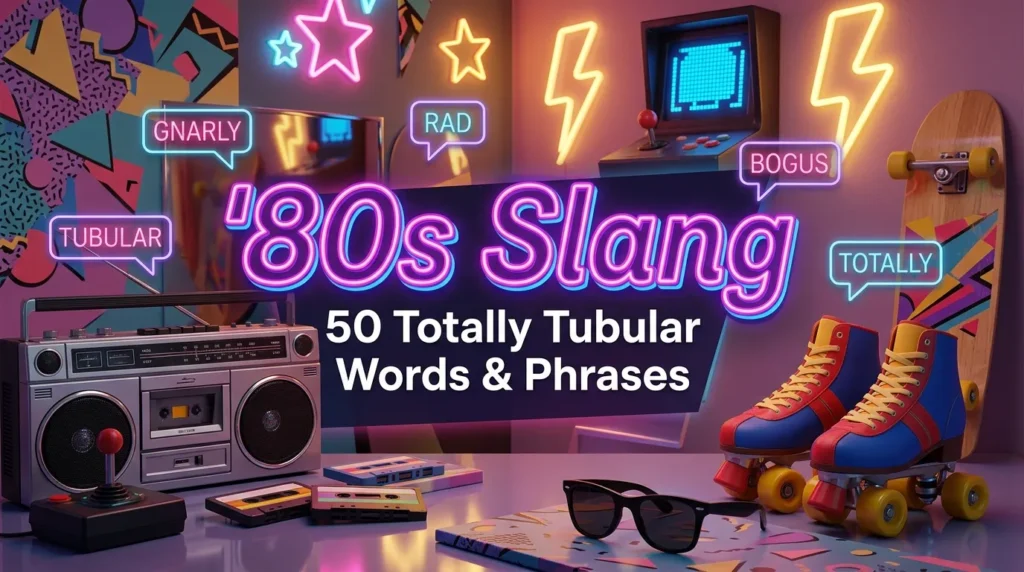

80s slang was colorful, exaggerated, playful, and heavily shaped by youth culture, music, movies, television, surfing, skating, and regional speech. Words such as rad, gnarly, tubular, bogus, totally, choice, and grody could quickly communicate whether something was impressive, unpleasant, exciting, or ridiculous. Some expressions were genuinely common in everyday speech, while others became famous because of movies, commercials, or pop culture.
The important thing is that there was never one universal “80s language.” Valley Girl speech, West Coast surf and skate vocabulary, hip-hop-influenced expressions, schoolyard slang, and broader American youth language overlapped during the decade. Some terms have disappeared, while others survived and are now often used nostalgically or humorously rather than as ordinary everyday slang.
Quick-Answer Box
| Question | Quick Answer |
|---|---|
| What does 80s slang mean? | Informal words and expressions associated with American speech and youth culture during the 1980s. |
| What are the most recognizable examples? | Rad, tubular, gnarly, bogus, totally, choice, grody, awesome, dude, and psych. |
| Was all 80s slang created in the 1980s? | No. Some expressions were older but became especially popular or recognizable during the decade. |
| Was 80s slang used everywhere? | No. Usage varied by region, age group, social group, and cultural scene. |
| Is 80s slang still used? | Some terms remain recognizable and occasionally appear today, often with a nostalgic or playful tone. |
| Is 80s slang appropriate today? | Most harmless expressions are fine in casual conversation, although some can sound deliberately retro or dated. |
What Does 80s Slang Mean?
80s slang refers to informal words, phrases, and expressions associated with American speech during the 1980s. The category includes genuine everyday slang, regional expressions, youth vocabulary, catchphrases, and words that became strongly associated with the decade through entertainment and popular culture.
The phrase itself does not describe one specific dialect. Instead, it is a convenient label for a collection of expressions that people now associate with the 1980s.
For example:
“That new arcade game is totally rad.”
Here, rad means extremely cool or impressive.
Another example:
“That movie was bogus.”
In this context, bogus means fake, unfair, disappointing, or otherwise not what it should have been.
This variety is part of what makes 80s slang interesting. A single decade could contain expressions from very different communities and cultural influences. Some words came from surf and skate culture, some were associated with Southern California speech, and others spread through movies, music, television, advertising, and everyday teenage conversation.
50 Popular 80s Slang Words and Phrases
The following list focuses on recognizable expressions that genuinely fit the cultural vocabulary associated with the decade. It does not mean every American used every expression, or that every term originated during the 1980s.
Rad
Rad is short for radical and means extremely cool, exciting, impressive, or excellent.
It became strongly associated with West Coast youth culture, especially surf and skate communities, before becoming much more widely recognizable.
Example: “That new skateboard is rad.”
Today, “rad” is often understood immediately but may sound deliberately retro when used in ordinary conversation. It is one of the clearest examples of a word that can instantly evoke the 1980s.
Radical
In 80s slang, radical could mean exceptionally cool, exciting, bold, or impressive rather than simply extreme or political.
The shortened form rad eventually became even more recognizable.
Example: “Those new sneakers are radical.”
The word had an energetic quality that fit the decade’s tendency toward exaggerated approval.
Tubular
Tubular meant excellent, fantastic, or extremely cool. Its imagery came from surfing, where a “tube” refers to the hollow part of a breaking wave.
Example: “That wave was tubular!”
The expression became one of the most recognizable pieces of stereotypical 80s slang, especially when associated with exaggerated California-style speech.
Gnarly
Gnarly is particularly interesting because it can describe something impressive, difficult, intense, dangerous, unpleasant, or extreme depending on context.
Example: “That was a gnarly skateboard trick.”
It could express admiration for something difficult or describe an experience that was rough or unpleasant. That flexibility is why simply translating “gnarly” as “good” misses part of its meaning.
Totally
Totally was used as an emphatic intensifier, especially in speech associated with the Valley Girl stereotype.
Example: “That is totally awesome.”
The word itself was not invented in the 1980s, but its exaggerated conversational use became strongly associated with the decade’s youth culture.
Awesome
Awesome means extremely good, impressive, exciting, or admirable.
Although the word predates the 1980s, it became a major part of casual American vocabulary during the era and continued growing in popularity afterward.
Example: “That concert was awesome.”
Unlike some highly dated expressions, “awesome” survived and remains completely natural in modern American English.
Bogus
Bogus generally meant fake, false, unfair, disappointing, or unacceptable.
Example: “They canceled the concert? That’s bogus.”
It was especially useful because it could describe both something literally false and a situation that simply felt unfair or disappointing.
Choice
Choice could be used as an adjective meaning excellent, desirable, or high quality.
Example: “That’s a choice car.”
It conveyed approval without needing a long explanation. The expression is now much less common in ordinary American conversation but remains recognizable as period slang.
Also Read: Bop Meaning in Slang: What Does “Bop” Mean?
Righteous
Righteous could describe something exceptionally good, admirable, impressive, or worthy of approval.
Example: “That was a righteous trick.”
The word illustrates how slang can take an existing standard English word and give it a more casual, culturally specific meaning.
Bitchin’
Bitchin’ was an emphatic way of saying something was excellent, cool, or impressive.
Example: “That’s a bitchin’ stereo.”
The expression can still be understood today, but it contains a mild profanity component and can sound deliberately retro. It is therefore more appropriate in casual or nostalgic contexts than in formal communication.
Bodacious
Bodacious means bold, impressive, excellent, or remarkable. Although the word predates the 1980s, it became strongly associated with the decade’s exaggerated slang style.
Example: “That was a bodacious wave.”
It is a good reminder that “80s slang” does not necessarily mean “words invented in 1980.”
Dude
Dude became a highly versatile casual term during the 1980s. Depending on tone, it could function as a form of address, greeting, reaction, or expression of surprise.
Example: “Dude, you have to see this.”
The word had roots before the 1980s, but its association with West Coast youth culture helped make it a familiar part of broader American casual speech.
Grody
Grody meant disgusting, dirty, unpleasant, or revolting.
Example: “That locker room is totally grody.”
The phrase grody to the max intensified the idea, essentially meaning extremely disgusting.
Grody to the Max
This exaggerated phrase meant extremely gross or disgusting.
Example: “That leftover food is grody to the max.”
The expression captures an important characteristic of 80s slang: ordinary descriptions were often intensified for comic effect.
Gag Me With a Spoon
Gag me with a spoon was an exaggerated way of expressing disgust, disbelief, or strong dislike.
Example: “You actually like that movie? Gag me with a spoon!”
The phrase became closely associated with Valley Girl speech and was popularized beyond its original social setting through popular culture.
Take a Chill Pill
Take a chill pill means calm down, relax, or stop getting so worked up.
Example: “Take a chill pill. We still have plenty of time.”
The phrase can be friendly, teasing, or dismissive depending on tone. Telling an upset person to “take a chill pill” may actually make them more annoyed, so context matters.
Psych!
Psych! was used after deliberately misleading someone or playing a trick to reveal that the previous statement was not serious.
Example:
“I ate the last slice of pizza. Psych! It’s in the fridge.”
It resembles a verbal “gotcha” and was particularly recognizable in late-20th-century American youth culture.
No Duh
No duh means something like obviously or of course.
Example:
“The test was hard.”
“No duh.”
It is usually sarcastic or mildly dismissive rather than genuinely informative.
Not Even
Not even could function as a quick denial, particularly in an exaggerated argument.
Example:
“You totally like him.”
“Not even!”
Its effect depends heavily on delivery. Said playfully, it can be teasing; said sharply, it can sound dismissive.
Whatever
Whatever became strongly associated with an attitude of indifference, dismissal, or refusal to argue.
Example: “Whatever. I’m not arguing about this.”
The word itself is ordinary English, but its sarcastic, drawn-out delivery became an important part of the cultural image of teenage speech during the period.
Wastoid
Wastoid referred to a person regarded as useless, aimless, intoxicated, or generally wasting their time.
It became particularly recognizable through 1980s teen movie culture.
Example: “He’s acting like a total wastoid.”
The term is now largely historical or humorous.
Burner
In period slang, burner could refer to someone viewed as a burnout or drug user.
Example: “They called him a burner.”
Because the term can have different meanings in other contexts, it should not automatically be interpreted this way outside a clearly 1980s-style conversation.
Ralph
To ralph meant to vomit.
Example: “That roller coaster made me ralph.”
It belongs to a broader group of informal words for vomiting, including barf and upchuck.
Barf
Barf means to vomit.
Although the word existed before the 1980s, it fits naturally into the era’s playful vocabulary for unpleasant experiences.
Example: “I ate too much and almost barfed.”
Veg Out
Veg out means to relax passively, usually by doing very little and simply watching television, resting, or hanging around.
Example: “I’m staying home tonight to veg out.”
The expression remains understandable today, although it has a distinctly casual feel.
Book It
Book it means leave quickly, hurry away, or move fast.
Example: “We’re going to miss the bus. Book it!”
It was especially useful as an informal alternative to “hurry” or “run.”
Bounce
Bounce could mean leave.
Example: “It’s getting late. I’m going to bounce.”
The expression survived beyond the 1980s and remains recognizable in some forms of casual speech.
Jet
Jet could also mean leave quickly.
Example: “I’ve got to jet.”
The expression is short, energetic, and easy to understand from context.
Big Time
Big time was an emphatic way of saying very much, definitely, or to a great degree.
Example: “Are you going to the party?”
“Big time.”
It could also describe someone or something operating at a high level.
For Sure
For sure means definitely, certainly, or absolutely.
Example: “Are you coming tomorrow?”
“For sure.”
Unlike many expressions on this list, it never disappeared. It remains natural casual English.
Also Read: Jamaican Slang: 50+ Jamaican Patois Words and Phrases With Meanings
Word
Word could be used as an informal affirmation meaning something like absolutely, I agree, or that’s true.
Example: “That was the best track on the album.”
“Word.”
Its use has important connections to Black American speech and hip-hop culture, so it should not be treated as a uniquely invented 80s expression.
Fresh
Fresh could describe something fashionable, impressive, new, or stylish.
Example: “Those shoes are fresh.”
The meaning could shift depending on context, and the word later continued evolving through hip-hop and youth culture.
Fly
Fly meant stylish, attractive, fashionable, or cool.
Example: “That jacket is fly.”
It has roots well before the 1980s and was especially significant in Black American speech and hip-hop culture. Treating it as a uniquely “80s” invention would erase that broader linguistic history.
Bad
One of the more confusing examples is bad, which could sometimes mean extremely good or impressive.
Example: “That car is bad!”
The meaning depended entirely on context and tone. It is an example of slang reversing or creatively extending the ordinary meaning of a word.
Bad to the Bone
Bad to the bone described someone or something as tough, rebellious, impressive, or exceptionally cool.
Example: “That motorcycle is bad to the bone.”
The expression was especially compatible with the decade’s fascination with rebellious imagery.
Big Whoop
Big whoop was a sarcastic way of saying that something was not particularly impressive or important.
Example: “I finished the assignment early.”
“Big whoop.”
It usually communicated mild dismissal rather than serious anger.
Duh
Duh was used to indicate that something should have been obvious.
Example: “Of course I knew that, duh.”
The expression could be playful or insulting depending on delivery.
Wannabe
A wannabe was someone trying to imitate a particular person, style, group, or identity without being accepted as genuinely belonging to it.
Example: “He’s a rock-star wannabe.”
The term remains widely understood today.
Poser
A poser was someone perceived as pretending to be part of a particular scene or culture without genuinely participating in it.
Example: “He’s just a poser.”
The term became especially useful in youth subcultures where authenticity mattered.
Lame
Lame could mean boring, uncool, weak, disappointing, or ineffective.
Example: “That party was lame.”
The word is still used today, although its frequency and nuances have shifted over time.
Rip-Off
A rip-off was something unfairly expensive, deceptive, or poor value.
Example: “Ten dollars for that? What a rip-off.”
The expression remains standard informal English.
Scarf
To scarf meant to eat something quickly or hungrily.
Example: “I scarfed down my lunch before class.”
The verb predates the 1980s but fits the era’s informal vocabulary.
Butter
In some period slang lists, butter appeared as a positive description meaning something especially smooth, attractive, or impressive.
Because this use was not universal, it is best treated as context-dependent rather than a standard nationwide definition of 80s slang.
Freakazoid
Freakazoid was a playful term for an eccentric, strange, or unusually intense person.
Example: “That guy is a total freakazoid.”
It is strongly retro and is generally more likely to appear today as a humorous throwback.
Motor
Motor could be used informally as a command to move or get going.
Example: “Come on, motor!”
It is less familiar today and should be treated as period-specific slang.
Yes Way
Yes way was a playful emphatic response to someone saying “no way.”
Example:
“No way!”
“Yes way!”
It worked primarily as a humorous verbal reversal.
Cheeuh!
Cheeuh! was an exaggerated expression of enthusiastic agreement associated with 1980s slang lists.
It is far less recognizable today than expressions such as “rad” or “totally,” so it should be considered niche rather than universal 80s vocabulary.
I Kid You Not
I kid you not means I’m telling you the truth; I’m not joking.
Example: “I kid you not, he finished the entire pizza.”
The phrase is older than the 1980s, but it appeared in casual speech during the era and remains understandable today.
Also Read: ISO Meaning Slang: What ISO Means in Text & Online
Where’s the Beef?
Where’s the beef? became a famous 1980s catchphrase meaning, in broader use, where is the substance, important part, or evidence?
It originated in a 1984 fast-food advertising campaign and quickly moved beyond the original commercial context into political and everyday conversation.
Example: “The presentation looked impressive, but where’s the beef?”
Today, using the phrase is usually humorous or deliberately nostalgic.
Eat My Shorts
Eat my shorts was a crude but relatively mild insult or comeback meaning something like go away, get lost, or I don’t care what you think.
Example: “You can’t tell me what to do. Eat my shorts!”
The phrase became particularly recognizable through 1980s entertainment and later television culture.
Take a Hike
Take a hike means go away or leave me alone.
Example: “If you’re going to complain all day, take a hike.”
It predates the 1980s but fits naturally into the era’s collection of informal dismissive expressions.
Chill
Chill could mean relax, calm down, or remain relaxed.
Example: “Chill, dude. It’s not a big deal.”
The word has continued evolving and remains highly productive in modern English.
Totally Awesome
Totally awesome combines an intensifier with a strong compliment.
Example: “That new arcade is totally awesome.”
It is less a unique lexical item than a classic example of the emphatic style associated with stereotypical 80s speech.
Most Definitely
Most definitely was an emphatic way to express agreement or certainty.
Example: “Are you coming?”
“Most definitely.”
The phrase is still grammatically ordinary English, although its exaggerated delivery can sound period-specific.
Quick Meaning by Context
| Context | Likely 80s Slang | Meaning | Usage Level |
|---|---|---|---|
| Approval | Rad, radical, tubular | Very cool or excellent | Commonly associated |
| Excitement | Bodacious, awesome, righteous | Impressive or exciting | Commonly associated |
| Disgust | Grody, gag me with a spoon | Gross or revolting | Strongly period-associated |
| Agreement | For sure, word, most definitely | Yes or definitely | Common |
| Sarcasm | No duh, big whoop, whatever | Obviously / not impressive / dismissal | Common |
| Leaving | Bounce, book it, jet | Leave or hurry away | Casual |
| Insult | Lame, poser, wannabe | Uncool or inauthentic | Common |
| Relaxation | Chill, veg out | Relax or do very little | Casual |
| Deception | Psych! | Gotcha / just kidding | Strongly period-associated |
| Extreme experiences | Gnarly | Intense, difficult, impressive, or unpleasant | Context-dependent |
How 80s Slang Changed by Context
The same word could have very different emotional effects depending on how it was delivered.
Consider gnarly. Saying “That wave was gnarly” might express admiration for an impressive surf experience. Saying “That accident was gnarly” could mean the event was frightening, severe, or disturbing.
Likewise, dude could be friendly:
“Dude, that’s awesome!”
It could express disbelief:
“Dude! What happened?”
Or it could simply get someone’s attention:
“Dude, look over here.”
Tone, facial expression, relationship, and surrounding words all mattered.
This is especially important when reading dialogue from 1980s movies or television. Characters were often written to exaggerate recognizable youth speech, so entertainment dialogue should not automatically be treated as a perfect representation of how every young American actually talked.
Valley Girl Slang and 80s Speech
One of the most recognizable forms of 1980s youth language was Valley Girl speech, associated with young women from California’s San Fernando Valley and later amplified by popular culture.
Expressions such as totally, like, gag me with a spoon, and exaggerated agreement became part of the cultural stereotype. A 1982 musical treatment of Valley Girl speech helped bring this style to a much larger audience.
However, it is important not to confuse a media stereotype with the speech of every young woman in California. Real speech varies by person, community, region, social background, and generation.
The influence of this speech style nevertheless extended beyond individual catchphrases. Conversational uses of like, expressive intonation, and certain discourse habits became much more widespread over time.
Surf and Skate Slang
Surf and skate culture contributed heavily to the vocabulary commonly associated with the 1980s.
Words such as rad, radical, tubular, gnarly, dude, and bodacious carried an energetic, physical quality that fit sports built around waves, speed, tricks, and risk.
These expressions also demonstrate how slang travels. A word can originate or become established within a particular subculture, then spread into youth culture more broadly through music, movies, television, magazines, and social interaction.
Not everyone who said “rad” was a surfer. By the time expressions become mainstream youth slang, their original community associations can become much less obvious.
80s Slang in Movies, Music, and Television
Entertainment played a major role in preserving the decade’s slang.
Movies and television did not simply reflect youth vocabulary; they could also make specific expressions recognizable to people who might not otherwise encounter them.
Catchphrases such as eat my shorts, where’s the beef?, and other memorable lines became part of a broader cultural vocabulary.
Music had a similar effect. The decade’s rapidly expanding music-video culture helped spread regional styles and expressions to audiences far beyond their original communities.
This is one reason modern people can recognize many 80s slang expressions even if they never lived through the decade.
Also Read: 90s Slang Meanings: A Guide to Classic 1990s Terms
80s Slang in Texting and Social Media Today
There was, of course, no modern social-media environment in the 1980s. People encountered slang primarily through face-to-face conversation, telephone calls, school, music, television, movies, magazines, and local communities.
Today, the situation is different.
Someone might write:
“That outfit is totally tubular 😂”
The phrase is understandable, but the emoji and exaggerated wording make the intention clear: the speaker is probably being playful or nostalgic.
Similarly:
“That was gnarly!”
can still work naturally because gnarly has survived in some varieties of casual English.
Other expressions, such as gag me with a spoon or grody to the max, are more likely to be used as deliberate throwbacks.
The key distinction is that recognizable does not always mean currently fashionable. A term can remain understandable for decades after its everyday popularity has declined.
Are 80s Slang Words Still Used Today?
Yes, but not all at the same level.
Some expressions survived and became ordinary informal English. Awesome, dude, chill, lame, whatever, for sure, and rip-off are still widely understandable.
Others remain recognizable but strongly signal a retro style. Tubular, grody, gag me with a spoon, psych, and grody to the max generally sound more intentionally nostalgic today.
Some are mostly historical or humorous.
That difference matters when deciding whether to use 80s slang in modern conversation. If you say “awesome,” nobody is likely to think you’re pretending to be in an 80s movie. If you say “grody to the max,” people may immediately recognize the joke.
Who Used 80s Slang?
There was no single group responsible for all 80s slang.
Different expressions were associated with different communities, including:
- Teenagers and young adults
- Surfers and skateboarders
- Southern California youth
- Hip-hop communities
- Music fans
- Movie and television audiences
- School and college social groups
The decade’s slang was therefore culturally mixed.
It is also important to recognize that some expressions now marketed as generic “80s slang” have deeper histories in particular communities. Black American English, regional American varieties, and subcultural speech all influenced the broader vocabulary that became popular during the period.
Reducing everything to a single “Gen X dictionary” can make the history less accurate.
Was All 80s Slang Actually Invented in the 1980s?
No.
This is one of the biggest misconceptions about 80s slang.
Words such as bodacious, bitchin’, barf, awesome, and dude have histories that extend beyond the decade. Some became especially fashionable during the 1980s, while others were simply associated with the period because of how often they appeared in popular culture.
A better way to understand “80s slang” is to think of it as language strongly associated with the cultural atmosphere of the 1980s, not as a list of words invented between January 1, 1980 and December 31, 1989.
That distinction makes the category much more historically accurate.
Is 80s Slang the Same as Gen X Slang?
Not exactly.
There is significant overlap because many members of Generation X were children, teenagers, or young adults during the 1980s. However, 80s slang is a decade-based category, while Gen X slang is a broader generational label.
The two should not be treated as interchangeable.
Some Gen X-associated expressions belong to the 1990s as well, while some 80s slang was used by people outside the generation.
Is 80s Slang Offensive or Rude?
Most classic 80s slang is not inherently offensive.
Words such as rad, tubular, awesome, bogus, chill, and gnarly are generally harmless.
However, a few expressions contain profanity or can become rude depending on how they are used. Bitchin’, for example, contains a profanity-derived element even though the slang meaning is positive.
Insults such as poser, wannabe, lame, wastoid, and freakazoid can also be dismissive or insulting when directed at someone.
The safest approach is to distinguish the word itself from the situation in which it is used. A playful phrase between friends can have a very different effect when directed at a stranger, coworker, teacher, or customer.
80s Slang vs. Modern Slang
| 80s Expression | Approximate Modern Equivalent |
|---|---|
| Rad | Awesome / cool |
| Tubular | Amazing / awesome |
| Bogus | Unfair / fake / messed up |
| Grody | Gross |
| Take a chill pill | Calm down |
| Book it | Hurry / run |
| Bounce | Leave |
| Psych! | Just kidding / gotcha |
| No duh | Obviously |
| Big whoop | So what? |
| Wannabe | Pretender / someone trying too hard |
| Poser | Fake / pretender |
| Veg out | Chill / relax |
| For sure | Definitely |
| Dude | Man / bro / dude |
These are not perfect one-to-one translations. Slang carries personality, cultural associations, and tone that a simple synonym cannot always reproduce.
Commonly Confused 80s Slang Terms
| Term | Meaning | Main Difference | Typical Use |
|---|---|---|---|
| Rad | Extremely cool | Strong approval | People, things, experiences |
| Gnarly | Intense, difficult, impressive, or unpleasant | Can be positive or negative | Experiences and events |
| Tubular | Excellent | More strongly tied to surf-style slang | Things and experiences |
| Bogus | Fake, unfair, disappointing | Usually negative | Situations or claims |
| Grody | Disgusting | Specifically about unpleasantness | Food, places, things |
| Bitchin’ | Excellent or cool | Contains profanity-derived wording | Casual praise |
| Lame | Boring, weak, uncool | More dismissive than strongly insulting | People, plans, situations |
| Choice | Excellent or desirable | Period-specific approval | Things and choices |
Gnarly vs. Rad
Rad is overwhelmingly positive.
Gnarly is more flexible. It can describe something awesome, difficult, dangerous, rough, or unpleasant.
So:
“That trick was rad.”
means the trick was impressive.
But:
“That accident was gnarly.”
could mean the accident was severe or disturbing.
Bogus vs. Lame
Bogus often suggests that something is unfair, fake, false, or disappointing.
Lame usually means boring, weak, disappointing, or uncool.
For example:
“That excuse is bogus.”
suggests the excuse is not legitimate.
“That excuse is lame.”
suggests the excuse is weak or unimpressive.
Real 80s-Style Conversation Examples
Friends Talking About a Party
Alex: “How was the party?”
Jamie: “Totally rad. The band was awesome.”
Here, totally rad expresses enthusiastic approval.
Someone Complaining About Food
Alex: “You ate that?”
Jamie: “I know. It looked grody.”
Here, grody means disgusting or unpleasant.
A Playful Argument
Alex: “You said you weren’t coming.”
Jamie: “Psych! I changed my mind.”
Psych! turns the previous statement into a playful trick.
Someone Getting Impatient
Alex: “Why are you freaking out?”
Jamie: “Take a chill pill. I’m not freaking out.”
The phrase is intended to tell someone to calm down, although it can sound dismissive.
Talking About a Skateboard Trick
Alex: “Did you see that?”
Jamie: “Dude, that was gnarly!”
Here, gnarly expresses excitement and admiration.
Calling Something Unfair
Alex: “They raised the ticket price again.”
Jamie: “That’s bogus.”
Bogus communicates frustration with something perceived as unfair or unreasonable.
Ending the Night
Alex: “It’s almost midnight.”
Jamie: “Yeah, I’m gonna bounce.”
Here, bounce simply means leave.
How to Use 80s Slang Without Sounding Forced
If you want to use 80s slang today, moderation helps.
Using one recognizable expression in an otherwise normal sentence usually feels more natural than filling every sentence with period slang.
For example:
“That movie was totally rad.”
sounds playful and understandable.
But:
“Dude, that tubular bodacious movie was righteous to the max!”
sounds intentionally exaggerated.
That second style can still be funny, especially for an 80s-themed party, costume, social post, trivia night, or nostalgic event. It simply communicates that you’re performing a retro style rather than speaking ordinary modern English.
Why Does 80s Slang Sound So Distinctive?
A major reason is exaggeration.
The decade’s recognizable slang often pushed ordinary adjectives toward extremes:
- Cool became rad
- Excellent became totally awesome
- Disgusting became grody to the max
- Difficult became gnarly
- Fake or unfair became bogus
- Calm down became take a chill pill
The expressions also had strong cultural associations with movies, music, fashion, surfing, skating, television, and youth culture.
That combination made 80s slang highly memorable. Even people who never lived through the decade can often recognize its vocabulary immediately.
What 80s Slang Is Still Useful Today?
If you want expressions that sound natural rather than purely nostalgic, the safest choices include:
- Awesome
- Dude
- Chill
- For sure
- Whatever
- Lame
- Rip-off
- Book it
- Bounce
- Gnarly
- Rad
If you want a phrase that deliberately sounds like a retro 1980s reference, try:
- Totally tubular
- Gag me with a spoon
- Grody to the max
- Take a chill pill
- Psych!
- Eat my shorts
- Where’s the beef?
- Big whoop
The second group works especially well for themed parties, costumes, jokes, captions, and nostalgic content.
Also Read: DSL Meaning Slang: What Does DSL Mean?
Frequently Asked Questions
What is the most famous 80s slang?
Some of the most recognizable examples include rad, totally, tubular, gnarly, bogus, dude, awesome, grody, psych, and gag me with a spoon. Their familiarity varies, and some are now used mainly to create a deliberately nostalgic 1980s tone.
What did “rad” mean in the 80s?
“Rad” was short for “radical” and meant extremely cool, exciting, impressive, or excellent. It became strongly associated with West Coast surf and skate culture before spreading into broader youth vocabulary. Today, it remains recognizable but often sounds intentionally retro.
What did “gnarly” mean in the 80s?
“Gnarly” could describe something intense, difficult, dangerous, impressive, rough, or unpleasant. Context determines the intended meaning. “That trick was gnarly” might be praise, while “that accident was gnarly” could describe something disturbing or severe.
What did “bogus” mean in the 80s?
“Bogus” generally meant fake, false, unfair, disappointing, or unacceptable. Someone might say “That’s bogus” after encountering a situation they considered unfair. The word remains understandable today, although it has a somewhat retro or casual flavor.
What did “gag me with a spoon” mean?
“Gag me with a spoon” was an exaggerated expression of disgust or strong dislike. It became closely associated with Valley Girl speech and 1980s popular culture. Today, it is usually used humorously or nostalgically rather than as ordinary everyday speech.
Is “dude” an 80s slang word?
“Dude” is strongly associated with 1980s West Coast youth culture, but the word is considerably older. During the 1980s it became a highly flexible casual form of address and reaction. It survived the decade and remains common in many varieties of informal English.
Is 80s slang still used today?
Some 80s expressions remain part of everyday English, while others survive mainly as nostalgic references. Words such as “awesome,” “dude,” “chill,” and “whatever” remain familiar, whereas “grody to the max” and “gag me with a spoon” usually sound intentionally retro.
What is a good 80s slang word for cool?
Rad is probably one of the clearest choices. Radical, tubular, righteous, choice, awesome, and bitchin’ can also express strong approval, although each carries slightly different historical and tonal associations.
Conclusion
80s slang was much more than a collection of funny words from an old decade. It reflected several overlapping American youth cultures, including surf and skate scenes, Southern California speech, music communities, television and movie culture, and everyday teenage language. Expressions such as rad, gnarly, tubular, bogus, totally, grody, and dude became memorable because they communicated attitude as much as meaning.
Some of these terms have disappeared from ordinary conversation, while others evolved into modern English. The biggest lesson is that 80s slang was never completely uniform. Meaning depended on community, region, age, situation, and tone. If you want to bring a little 1980s energy into modern conversation, one well-placed “totally rad” will probably do more than an entire paragraph of slang.


Pingback: 90s Slang: Popular Words and Phrases From the 1990s
Pingback: DL Meaning Slang: What Does DL Mean in Text?
Pingback: HB Meaning Slang: Happy Birthday, Homeboy, or Something Else?
Pingback: 1970s Slang Meaning: Popular 1970s Slang Words and Phrases Explained
Pingback: 1990s Slang Meaning: Popular 1990s Slang Words and Phrases Explained
Pingback: 60s Slang Meaning: 25 Groovy Words From the 1960s Explained