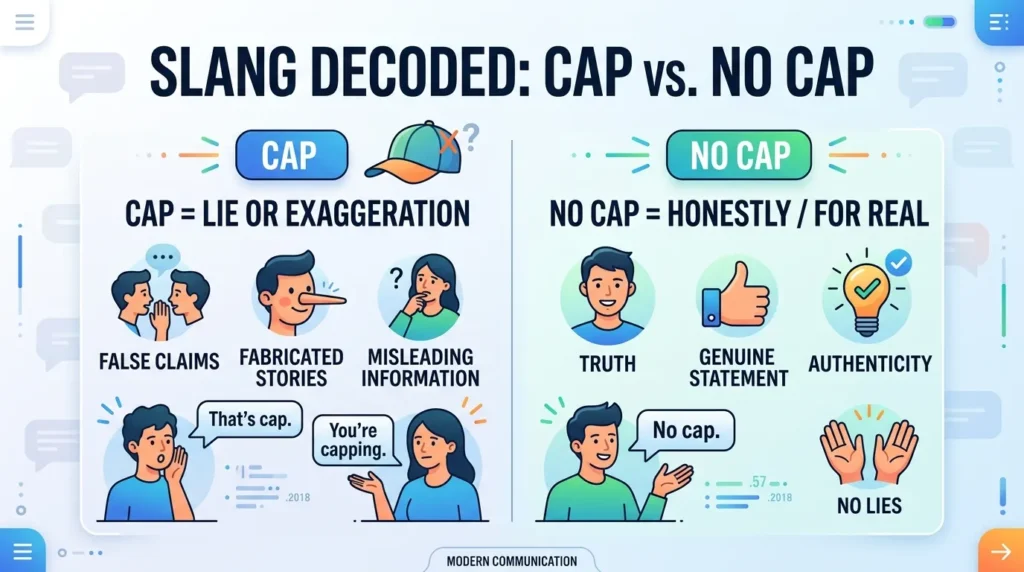

In modern slang, cap usually means a lie, exaggeration, or false claim. If someone says, “That’s cap,” they are saying they do not believe what was said. The verb form works similarly: “You’re capping” means “You’re lying” or “You’re exaggerating.”
The opposite expression is no cap, meaning “no lie,” “seriously,” or “I’m telling the truth.” These expressions appear in casual speech, texts, social media comments, gaming chats, memes, and music-related conversation. Although they are strongly associated with younger online speakers today, their linguistic history is older than modern social media.
Quick Answer
| Detail | Meaning |
|---|---|
| Cap | A lie, exaggeration, or false claim |
| That’s cap | That’s not true / I don’t believe that |
| Capping | Lying or exaggerating |
| No cap | Honestly / seriously / no lie |
| Typical context | Texting, social media, casual speech, gaming |
| Tone | Casual, playful, skeptical, or confrontational |
| Formality | Very informal |
| Offensive? | Not inherently offensive |
| Pronunciation | “cap,” like the word for a hat |
What Does Cap Mean in Slang?
The simplest cap slang meaning is a lie or exaggeration.
Someone can use cap as a noun:
“He said he owns five cars, but that sounds like cap.”
Here, cap means the story sounds false or exaggerated.
It can also work more like a verb:
“Stop capping. You never met her.”
In this sentence, capping means lying or stretching the truth. This verb use is well established in contemporary informal English.
The expression does not always accuse someone of telling a carefully planned, serious lie. Friends often use it casually when they think another person is exaggerating.
For example:
“You finished that entire game in one night? Cap.”
The speaker may simply mean, “I find that hard to believe.”
That distinction matters because cap can range from playful disbelief to a direct accusation of dishonesty, depending on tone and relationship.
Quick Meaning by Context
| Expression | Likely Meaning | Example | Usage Level |
|---|---|---|---|
| Cap | Lie or exaggeration | “That story is cap.” | Very common |
| That’s cap | That isn’t true | “You won 20 games straight? That’s cap.” | Very common |
| Capping | Lying or exaggerating | “Bro, you’re capping.” | Very common |
| No cap | Honestly / for real | “That was the best burger I’ve had, no cap.” | Very common |
| Cap? | Are you serious? / Is that true? | “You got the job? Cap?” | Context-dependent |
| Stop the cap | Stop lying or exaggerating | “Stop the cap. You weren’t even there.” | Common |
What Does “No Cap” Mean?
No cap means “no lie,” “for real,” “seriously,” or “I genuinely mean this.” It tells the listener that the speaker considers the statement sincere rather than exaggerated.
For example:
“That restaurant is actually amazing, no cap.”
The speaker is emphasizing that the praise is genuine.
Another example:
“No cap, I was nervous before the interview.”
Here it works almost like saying:
- “Honestly…”
- “Seriously…”
- “I’m not even joking…”
“No cap” can appear at either the beginning or end of a statement.
Beginning:
“No cap, that test was difficult.”
End:
“That test was difficult, no cap.”
The basic meaning remains the same.
What Does “That’s Cap” Mean?
That’s cap means:
“That’s a lie,” “That isn’t true,” or “I don’t believe you.”
Imagine someone says:
“I could beat everyone here in basketball.”
A friend might answer:
“That’s cap.”
The reply challenges the claim.
However, the emotional force depends on context. Between close friends, it may be playful teasing. During an argument, the same phrase can sound much more serious.
That is why translating “that’s cap” as simply “you are lying” does not always capture the social tone.
Sometimes it really means:
“Come on, I don’t believe that.”
What Does “Capping” Mean?
Capping is the common verb form and means lying, exaggerating, boasting falsely, or making a claim that the speaker does not believe is true.
Examples:
“He’s capping about how much money he makes.”
“Why are you capping? We both know what happened.”
“I thought she was capping, but she actually did meet him.”
The informal spelling cappin’ may also appear, especially when written to reflect casual pronunciation.
Cap vs. Capping vs. No Cap
The easiest way to remember the difference is:
Cap = false
Capping = lying or exaggerating
No cap = true / honestly
For example:
“I scored 50 points.”
“Cap.”
versus:
“I scored 50 points, no cap.”
The first speaker is challenged. The second speaker is emphasizing that the claim is genuine.
Also Read: Goyim Slang Meaning: What Does Goyim Mean?
Also Read: Toronto Slang: Popular Words, Meanings, and Examples
What Does Cap Mean in Text Messages?
In texts, cap normally has the same meaning it has in spoken slang: a lie or exaggeration.
Example:
Alex: I studied for eight hours yesterday.
Jordan: Cap 😂
The laughing emoji makes the response sound playful.
Compare that with:
Alex: I never said that.
Jordan: That’s cap. I have the messages.
Here, the phrase sounds more serious because the surrounding context involves proof and disagreement.
Texting removes voice and facial expression, so punctuation and emojis can greatly affect how the message feels.
What Does Cap Mean on TikTok, Instagram, Snapchat, and Other Social Platforms?
There is no strong reason to give cap a separate definition for every major social platform. Across TikTok, Instagram, Snapchat, X, Discord, and similar spaces, the dominant slang meaning remains lying, exaggerating, or making a questionable claim. Current usage guides continue to recognize that meaning in 2026.
You might see comments such as:
“This is cap.”
“Bro is capping.”
“No cap, this worked.”
“Biggest cap I’ve heard all week.”
The surrounding content usually determines whether the commenter is genuinely accusing someone of dishonesty or simply joking.
The 🧢 Emoji
A cap emoji 🧢 can sometimes represent the slang meaning of cap.
For example:
“He said he never checks her profile 🧢”
The emoji implies that the writer thinks the statement is false.
Similarly, combinations involving a crossed-out or rejected cap can visually represent “no cap.” This is an informal wordplay based on the slang expression rather than the literal hat.
How Context Changes the Meaning of Cap
Understanding cap usually requires more than replacing it with the word “lie.” Look at who is speaking, what happened before the message, and whether the conversation is serious.
1. Playful disbelief
“You ate six burgers?”
“Yeah.”
“Cap 😂”
This sounds more like friendly disbelief than a serious accusation.
2. Calling out exaggeration
“He keeps saying every company wants to hire him.”
“He’s capping.”
The speaker believes the person is exaggerating.
3. Serious dishonesty
“She said she never received the money.”
“That’s cap. The payment went through yesterday.”
Here, cap is closer to a direct accusation of lying.
4. Emphasizing sincerity
“No cap, I really appreciate what you did.”
Here, the phrase adds emotional sincerity.
5. Expressing a strong opinion
“That album is his best one, no cap.”
Nothing needs to be objectively provable. The speaker is emphasizing that the opinion is genuine.
Tone and Emotional Meaning
Cap does not carry one fixed emotional tone.
It can sound playful when friends tease each other:
“You woke up at 5 a.m.? Cap.”
It can sound skeptical when someone doubts a claim:
“That explanation sounds like cap.”
It can sound confrontational when dishonesty matters:
“Stop capping. Tell me what actually happened.”
And no cap can sound sincere or emphatic:
“You handled that situation really well, no cap.”
This is one reason direct translation can sometimes miss the point. The literal idea concerns truth and falsehood, but the social function may be teasing, challenging, agreeing, or emphasizing sincerity.
Real Conversation Examples
Friends
Maya: I could definitely run a marathon tomorrow.
Chris: That’s cap. You hate running.
Chris thinks Maya is exaggerating.
School
Ryan: I didn’t study at all and still got 100%.
Leo: No way. You’re capping.
Leo doubts the claim.
Gaming
Sam: That boss was easy. I beat it first try.
Eli: Cap 😂
The response is probably playful disbelief.
Social media
Comment: This phone battery lasts three days.
Reply: Biggest cap ever.
The reply strongly rejects the claim.
Compliment
Nina: Your presentation was actually really good, no cap.
“No cap” emphasizes that Nina genuinely means the compliment.
Serious conversation
Taylor: I never told anyone what happened.
Morgan: That’s cap. Two people already told me you did.
Here, the phrase functions as a direct accusation.
Opinion
Ava: No cap, that was the best episode of the season.
Ava is emphasizing a sincere opinion rather than proving an objective fact.
Grammar and Language Role
Cap is unusually flexible in casual English.
As a noun
“That’s cap.”
Meaning: “That’s a lie.”
As a verb
“Don’t cap.”
Meaning: “Don’t lie.”
As a present participle
“You’re capping.”
Meaning: “You’re lying.”
In a fixed expression
“No cap.”
Meaning: “Honestly,” “seriously,” or “no lie.”
Capitalization
There is normally no special requirement to capitalize the slang word.
All of these may appear online:
- cap
- CAP
- Cap
- no cap
- NO CAP
Uppercase usually adds visual emphasis rather than changing the definition.
Also Read: 90s Slang Meanings: A Guide to Classic 1990s Terms
How to Reply When Someone Says “Cap”
Your reply should depend on whether the conversation is playful or serious.
If they are joking
Them: “Cap 😂”
You: “I swear I’m serious.”
Or:
You: “No cap this time.”
If you have proof
Them: “That’s cap.”
You: “I’ve got the screenshot.”
If you exaggerated
Them: “Bro, you’re capping.”
You: “Okay, maybe I exaggerated a little.”
If you want to avoid an argument
Them: “That’s cap.”
You: “I’m serious, but you don’t have to believe me.”
If someone says “no cap”
Usually you do not need a special slang response.
You can simply say:
“I agree.”
“For real.”
“Exactly.”
“I believe you.”
Similar and Commonly Confused Terms
| Term | Meaning | Main Difference | Typical Context |
|---|---|---|---|
| Cap | Lie or exaggeration | Challenges truthfulness | Casual speech, texts |
| No cap | Honestly / no lie | Emphasizes sincerity | Casual speech, texts |
| For real / fr | Seriously / genuinely | Broader agreement or emphasis | Texting and conversation |
| Facts | Strong agreement | Usually agrees with another person’s point | Comments, conversations |
| Fake | Not genuine | Can describe people or things, not just statements | General informal speech |
| Sus | Suspicious or questionable | Expresses suspicion rather than directly saying something is false | Online and casual speech |
Cap vs. “For Real”
No cap and for real often overlap.
“That food was amazing, no cap.”
and
“That food was amazing, for real.”
Both emphasize sincerity.
However, for real? can also function as a question:
“For real?”
meaning:
“Seriously?”
Cap vs. Fake
Cap normally targets a statement, claim, story, or behavior involving dishonesty or exaggeration.
Fake is broader.
You can call a product fake, a friendship fake, or a person fake without using cap naturally in exactly the same way.
Cap vs. Sus
Sus means suspicious.
If someone says:
“That story is sus.”
they think something seems questionable.
If they say:
“That story is cap.”
they are making a stronger judgment that the story is false or exaggerated.
Who Uses the Term?
Cap and no cap are strongly associated with African American English and hip-hop culture, and later spread widely through music, youth conversation, memes, texting, gaming, and social media. They are now understood well beyond the communities in which their modern usage developed.
They are also frequently associated with Gen Z and younger speakers, but describing them simply as “Gen Z slang” hides their longer history. Current 2026 discussions still include cap/no cap among recognizable youth and internet expressions rather than treating them as completely obsolete slang.
Usage still varies by social group. Some people use the terms naturally in everyday speech, while others mostly encounter them in memes, comments, music, or conversations with younger speakers.
Also Read: DSL Meaning Slang: What Does DSL Mean?
Origin and Evolution of Cap Slang
The modern slang meaning of cap did not suddenly originate on TikTok or another recent social platform.
Forms of cap and capping have a longer history in African American speech, with earlier senses involving boasting, exaggeration, verbal competition, and eventually lying or stretching the truth. The exact path between every historical use is difficult to reduce to one simple origin story.
The word also appeared in hip-hop well before no cap became a widely recognized internet expression. During the 2000s and especially the 2010s, no cap gained much broader visibility through hip-hop and online communication.
That history explains an important distinction:
The slang is older than the social-media trend surrounding it.
Modern platforms helped spread the expression to larger audiences, but they did not create the underlying slang meaning.
Does Cap Have Other Slang Meanings?
Yes, but context matters.
“Bust a cap”
The older phrase “bust a cap” refers to firing a gun. Historical slang records also document cap in firearm-related senses. This is a different slang branch from modern cap = lie and should not normally be assumed when someone simply comments “cap” on a social-media post.
For example:
“That’s cap.”
almost certainly concerns truthfulness in a modern casual conversation.
But an older expression such as:
“bust a cap”
has an entirely different meaning.
Older insult or verbal-competition meanings
Earlier forms of capping have also been associated with boasting, insulting, outdoing someone verbally, and exaggerated verbal performance. These historical uses help explain why modern definitions sometimes include both lying and exaggerating, rather than only deliberate deception.
For most people searching cap slang meaning today, however, lie or exaggeration is the relevant definition.
Is Cap Offensive, Rude, or Inappropriate?
Cap itself is not profanity or a slur.
However, saying someone is capping can be rude because you are questioning their honesty.
Compare:
“Cap 😂”
between close friends after an unbelievable story.
with:
“Everything you said is cap.”
during a serious disagreement.
The vocabulary is the same, but the emotional effect is different.
Is cap appropriate at school?
It may be common in casual student conversation, but it is still slang. Formal assignments should generally use words such as false, inaccurate, exaggerated, dishonest, or untrue instead.
Is cap appropriate at work?
Usually not in formal professional communication.
Instead of:
“That explanation is cap.”
write:
“I don’t believe that explanation is accurate.”
Among coworkers who already use informal language with one another, the slang may appear casually, but familiarity and workplace culture matter.
Real-World Interpretation
The most useful way to understand cap is not simply as another word for lie.
It often acts as a challenge to credibility.
When someone responds with:
“Cap.”
they are not only defining the previous statement as false. They are signaling:
“I’m not buying that.”
That makes the word useful for jokes, reactions, arguments, and disbelief. The meaning is about truth, but the conversational function is often about whether the listener accepts the speaker’s claim.
Also Read: What Does PSA Mean in Text, Chat, and Social Media?
Frequently Asked Questions
What does cap mean in slang?
Cap usually means a lie, false claim, or exaggeration. Saying “that’s cap” means you believe something is untrue, while saying someone is “capping” means you think they are lying or exaggerating.
What does no cap mean?
No cap means “no lie,” “honestly,” “seriously,” or “I genuinely mean it.” People often add it to a statement to emphasize sincerity, as in, “That was the best concert I’ve been to, no cap.”
What does cap mean in a text?
In texting, cap usually means that something is false or exaggerated. A reply such as “cap 😂” can show playful disbelief, while “that’s cap, I have proof” sounds more like a serious accusation.
What does 🧢 mean in slang?
The cap emoji can represent cap, meaning a lie or exaggeration. If someone replies to a questionable claim with 🧢, they may be implying, “That’s cap” or “I don’t believe you.”
What does “stop capping” mean?
Stop capping means “stop lying,” “stop exaggerating,” or “be serious.” It may be playful between friends or confrontational during a disagreement, depending on tone.
Is cap a bad word?
No. Cap is not inherently vulgar or offensive. However, accusing someone of capping can feel rude because it questions their honesty. The relationship between the speakers and the seriousness of the situation determine how harsh it sounds.
Does cap mean the same thing on TikTok and Snapchat?
Usually, yes. The dominant modern slang meaning across major social and messaging platforms is a lie, false claim, or exaggeration. There is no widely established separate TikTok-only or Snapchat-only definition that needs to be learned.
Is cap still used?
Yes. The expression remains recognizable in current youth, social-media, and informal-language discussions in 2026, although slang preferences naturally vary between communities and individuals.
Conclusion
In modern slang, cap most commonly means a lie, exaggeration, or claim someone does not believe. “That’s cap” challenges a statement, while “you’re capping” accuses someone of lying or exaggerating. No cap reverses the idea and means “honestly,” “seriously,” or “no lie.”
The definition remains fairly consistent across texting, social media, gaming, and casual conversation. What changes most is the tone. “Cap” can be friendly teasing between friends or a serious challenge to someone’s honesty, so the surrounding conversation matters as much as the word itself.


Pingback: Drip Meaning Slang: What It Means and How to Use It
Pingback: ISO Meaning Slang: What ISO Means in Text & Online
Pingback: 50+ Jamaican Slang Words and Phrases Explained
Pingback: ICL Meaning Slang: The Real Meaning and How to Use It
Pingback: Blue Waffles Slang: Meaning, Origin, and Online Use
Pingback: AI Meaning Slang: What Does 'AI' Mean in Text & Online?
Pingback: Boof Meaning Slang: What "Boof" Means (All 5 Uses)