


HN means “hell nah” in texts and DMs, a short, strong, casual way to say “absolutely not.”
If you got a message that just said “hn” and you stared at it for a second too long, you are not alone. It is only two letters, yet it carries a whole attitude. It can shut down a plan, laugh off a wild idea, or answer a question before you even finish asking it. And because the same two letters mean something completely different on a tech forum, in an anime, or on a map, the context around them matters more than the letters themselves. This guide walks through every meaning, where each one shows up, how people actually use it, and how to answer it without sounding stiff or out of place.

Table of Contents
- What Does HN Mean in Text?
- Where Did “Hell Nah” Come From?
- HN on Snapchat, Instagram, and TikTok
- The Other Meanings of HN
- How to Tell Which HN You Are Looking At
- HN vs Nah and Similar Short Replies
- How to Use HN Naturally
- How to Reply When Someone Says HN
- When NOT to Use HN
- Myths About HN
- Quick Answers
- Sources and Further Reading
What Does HN Mean in Text?
HN stands for “hell nah” in texts and direct messages, a strong casual way to say “absolutely not.” It can also mean “hell no,” and the two versions are interchangeable. When someone sends it, they are not just saying no. They are saying no with feeling, the kind of no that comes with a laugh, a shake of the head, or a look that says you cannot be serious.
TextExplain notes that HN is almost always written lowercase, as “hn,” and that it usually stands alone as a whole reply or sits at the start of a short sentence. That lowercase style is part of the point. Capital letters would make it feel loud or formal, and HN is neither. It is quick, relaxed, and confident, the texting version of leaning back in your chair and saying “nope, not happening.”
FluentSlang describes “Hn” as standing for “Hell No,” a strong or forceful way of saying no that expresses strong disagreement or refusal. Their example is simple and true to life: “Hn, I’m not really in the mood.” That one line shows the whole shape of the term. It opens a sentence, sets the tone, and leaves no doubt about where the speaker stands.
Think of HN as a reaction word. Someone suggests something wild, asks a question with an obvious answer, or floats a plan you want no part of, and HN is the whole response. It does the job of a full sentence in two letters. You will see it after a dare, after a bad idea, after a question like “are you really going to wear that?” and after a piece of gossip so unbelievable that a plain “no” would feel too weak.
The tone is usually playful rather than angry. TextExplain points out that the tone is casual and confident, usually playful rather than angry, and that matches how most people use it day to day. HN is the sound of a friend laughing at your suggestion, not the sound of someone slamming a door. It can carry real refusal, and it often does, but the refusal usually comes wrapped in humor or disbelief instead of hostility.
It helps to hear it in your head before you type it. Say “hell nah” out loud, slowly, and you will hear the shape of it. The first word adds the punch, the second word delivers the refusal. Now shrink that to two letters and you have the texting version. It keeps the punch and drops everything else. That is why it works so well in fast chats, where nobody wants to type a paragraph to turn down a plan.
Here is how it looks in real conversations:
“Wanna go to that party tonight?”
“hn, I am staying in.”
“Did you actually eat the last slice?”
“hn, that was not me.”
“You think I would pay forty bucks for that?”
“hn.”
In the last example, one word does everything. No explanation, no apology, no extra sentence. The person reading it knows exactly what it means, and the conversation can move on. That is the whole appeal of HN. It is fast, clear, and hard to misunderstand once you know the code.
HN is also a reaction, not a conversation starter. TextExplain makes this point clearly, and it is worth keeping in mind. Nobody opens a chat with “hn” out of nowhere, because there is nothing to react to yet. It only makes sense after someone else says something first. It is a reply word through and through, and that is why it almost always appears at the start of a message or as the entire message.
One more thing to notice is the spelling. You will see “hn,” “Hn,” and “HN” in the wild, but lowercase “hn” is by far the most common in casual texting. The capital version shows up more when people are quoting the term, writing a headline, or using one of the other meanings, like the tech forum sense covered later in this guide. In a normal chat with a friend, lowercase is the natural choice, and it reads as relaxed instead of shouty.
Where Did “Hell Nah” Come From?
“Hell nah” is not a new invention. It has been common spoken slang for decades in music, movies, and everyday conversation, and texting simply shortened it to two letters. The phrase was already doing its job long before smartphones existed. Phones just gave it a faster form.
The spoken phrase grew out of a very old pattern in English: take a plain word like “no” or “nah” and add “hell” in front of it to make it stronger. “Hell no” works the same way, and so does “hell yeah” on the positive side. The added word is a mild swear, but in this phrase it functions more like an amplifier than an insult. It turns a quiet refusal into a firm one. People have been using that trick in speech for generations, in every region and every age group, because it is simple and it works.
You can hear the phrase across decades of pop culture. It shows up in rap lyrics, in comedy routines, in movie dialogue, and in ordinary conversation on the street. It is the kind of phrase that sounds natural coming from almost anyone, because it belongs to spoken English rather than to one scene or one generation. That long history is part of why it feels so natural in text now. Nobody had to learn it from a dictionary. Most people picked it up by hearing it, the same way they picked up “nah” itself.
Texting changed the shape, not the meaning. When people started typing fast on small keyboards, long phrases got squeezed. “Hell nah” became “hn” for the same reason “laughing out loud” became “lol” and “oh my god” became “omg.” The two letters carry the full phrase in miniature. Everyone who knows the phrase reads the short form and hears the long one in their head, and that shared understanding is what makes slang work.
The shortening also changed the rhythm of the word. Spoken aloud, “hell nah” has two beats and a bit of swagger. Typed as “hn,” it is instant. You can fire it off in half a second, and the person on the other end reads it just as fast. In group chats, where messages fly past and a slow reply can get buried, that speed matters. A two-letter reply lands before the moment passes.
It is worth saying plainly that HN did not start on TikTok or Snapchat. Those apps spread it further and gave it new places to live, but the phrase itself predates them by a long stretch. What social media did was put it in front of more people, more often, in more kinds of conversations. A phrase that used to live mostly in spoken conversation now lives in comments, captions, and DMs too, and that wider exposure is why so many people have started seeing it and asking what it means.
The 2017 crowd-sourced slang dictionary entry quoted in the Lilach Bullock guide gives a useful snapshot of how people were already defining it years ago: “hells nah, hell no, heck no.” That entry shows the term was already settled and widely understood nearly a decade ago, with the same cluster of meanings it has today. Slang terms come and go fast, but HN has stuck around because the need it fills never goes away. People will always need a quick, firm, funny way to say no.
HN on Snapchat, Instagram, and TikTok
On Snapchat, Instagram, and TikTok, HN works the same way it does in a text, with small differences in flavor on each app. It is a quick reaction word, and each platform gives it a slightly different stage to perform on.
On Snapchat and Instagram, HN shows up most often in DMs as a quick reaction. TextExplain notes exactly this pattern: on Snapchat and Instagram it appears in DMs as a fast response to something a friend just sent. Someone sends a photo, a story reply, or a wild suggestion, and “hn” comes straight back. It fits the pace of those apps, where chats are short, visual, and constant. You are not writing essays in a Snapchat DM. You are reacting, and HN is a reaction.
Instagram adds one more setting: story replies. When someone posts a poll, a question sticker, or a story that begs for a reaction, “hn” is a natural answer. It can reply to a story that shows something overpriced, something embarrassing, or something that deserves a firm no. Because story replies land in the DM inbox, the same quick, private tone applies. It is a one-to-one moment, not a public statement.
TikTok is where HN gets its most public outings. TextExplain notes that on TikTok it appears in comments the same way, giving the example “hn, I would never.” That is the classic TikTok use: a video shows something wild, risky, or ridiculous, and the comments fill up with people refusing it on behalf of themselves. “hn, I would never” is a whole stance in four words. It says the video is funny, the idea is wild, and the commenter wants no part of it.
TikTok comments reward short replies, and HN is built for that. Long comments get skipped, but a two-letter reply with a clear attitude can collect likes fast because everyone reading it gets the joke instantly. You will see HN under videos about bad ideas, awkward dates, expensive products, and challenges nobody in their right mind would try. It is the comment-section version of shaking your head and laughing at the same time.
The platform differences are small but real. In a DM, HN is personal: you are refusing a specific person about a specific thing. In a TikTok comment, HN is public: you are performing a refusal for an audience, and the audience is part of the fun. In a Snapchat reply, it is often tied to something visual, a snap that just landed on your screen. The meaning stays the same across all three, but the audience changes, and the audience changes how it feels to send it.
One thing that does not change across platforms is the tone. It stays casual and confident, playful more often than angry. That is true in a text, in a DM, and in a comment. If someone wanted to sound truly furious, they would write more than two letters. HN is the sound of someone who is sure of their answer and comfortable saying it fast.
If you are new to the term and you see it on one of these apps, the safest way to read it is as a friendly, firm no. Assume playfulness first. Only read anger into it if the rest of the conversation supports that reading, like a fight or a serious disagreement. In most cases, the person who sent it is laughing, or at least smiling, when they type it.
The Other Meanings of HN
HN has one main meaning in texting, but the same two letters do other jobs in other places. These other meanings are less common in a normal chat, yet they are common enough that you will run into them sooner or later, especially online. Knowing them saves you from confusion when the texting meaning clearly does not fit.
The most important of these is the tech meaning. On Reddit, on tech forums, and across the wider internet, HN almost always means Hacker News. The capital letters are a clue, and so is the setting. If you see HN in a conversation about startups, code, or tech news, it is almost certainly not “hell nah.” It is a website, and a famous one.
Hacker News on Tech Forums
Hacker News is a social news site for computer science and entrepreneurship, run by a startup incubator and created by Paul Graham in February 2007, first under the name Startup News. That history comes from the Lilach Bullock guide, which lays out the details clearly. The site is a place where people share links about technology, startups, and programming, and vote and comment on them. If you spend any time in tech circles, you will see it mentioned constantly.
The site has its own shorthand, and two pieces of it are worth knowing. Ask HN means a question or text submission, the kind of post where someone asks the community for advice or an opinion. Show HN means someone sharing their own personal work, like a tool they built or a project they launched. Both labels appear in post titles all over the site, and once you know them, the pattern is easy to spot.
Here is the practical rule: if the conversation is about code, startups, or tech news, and HN appears in capitals, read it as Hacker News. If the conversation is a casual chat with a friend and HN appears in lowercase, read it as “hell nah.” The setting and the capitalisation together will steer you right almost every time.
Honduras and Other Formal Uses
HN is also a formal code, not just slang. Wiktionary lists HN as the country code for Honduras, which is why websites from Honduras end in .hn. If you see a web address ending in .hn, that is what it means. It has nothing to do with texting, and the context makes that obvious.
In the US military, HN stands for hospitalman, a rank for a hospital corpsman. Again, the setting gives it away. Nobody in a casual DM is using a military rank abbreviation, and nobody on a naval base is using texting slang to address a corpsman. The same letters, a completely different world, and the context does the work of telling them apart.
In Japanese internet use, HN is short for “handle name,” which means a screen name or username. That one is closer to everyday online life, and it shows up in Japanese forums and communities where people talk about their online identities. If you see HN in a Japanese internet context next to talk about usernames, this is the meaning in play.
The Anime Grunt: Lowercase “hn”
Then there is the strangest and most fun of the other meanings: lowercase “hn” as a grunt. In anime, it is the sound of a cold, moody character answering a question without really answering it. The classic example, from a 2003 crowd-sourced entry quoted in the Lilach Bullock guide, is Hiei from Yu Yu Hakusho. Hiei answers with a short, dismissive “hn,” and fans have been quoting it ever since.
This grunt is not a word with a dictionary definition. It is a sound, a piece of character acting in text form. It says “I heard you, I do not care, and I am not going to explain myself.” Fans use it in jokes, memes, and roleplay to imitate that exact attitude. It is a niche use, but a beloved one, and it is one of the reasons the lowercase spelling matters. The Lilach Bullock guide notes that capital HN leans toward the abbreviations, while lowercase hn leans toward the grunt. That is a neat rule of thumb, and it holds up well in practice.
Wiktionary adds one more literary use: “hn” as an interjection tagging a rhetorical question. The example quoted is from Ian Fleming’s 1956 novel Diamonds Are Forever: “Not bad for the House, hn?” There, “hn” works like a nudge at the end of a sentence, a way of asking “right?” without really asking. It is old, it is literary, and you will almost never see it in a modern text, but it shows how flexible these two letters have been across the decades.
Finally, there are the rare texting readings that float around in slang dictionaries. Some people have used HN to mean “how now?” as a greeting, or “how nice,” and it can also appear as a simple typo for “in” or “on.” These are real entries in the sense that someone, somewhere, has used them, but they are rare enough that you should treat them as curiosities, not as meanings you need to memorise. If someone texts you “hn” and none of the rare readings fit the conversation, they almost certainly mean “hell nah.”
How to Tell Which HN You Are Looking At
The fastest way to tell which HN you are looking at is to check three things: where you are, how it is capitalised, and what came right before it. Those three clues will solve the puzzle in nearly every case, and they take about two seconds to check.
First, check where you are. A casual DM, a Snapchat reply, or a TikTok comment is the home turf of “hell nah.” A tech forum, a Reddit thread about startups, or a post with “Ask” or “Show” in front of it is Hacker News territory. An anime meme page is grunt territory. A web address ending in .hn is Honduras. The platform and the topic together narrow the options fast.
Second, check the capitalisation. Lowercase “hn” in a chat almost always means “hell nah” or, in an anime context, the grunt. Capital “HN” leans toward the abbreviations: Hacker News, Honduras, hospitalman, handle name. Capitalisation is not a perfect rule, since people type carelessly, but it is a strong hint, and it matches how the term is actually used in the wild.
Third, check what came before it. HN is a reaction word, so the message before it usually explains it. If the previous message was a question, a suggestion, or a dare, HN is a refusal. If the previous message was a link about a startup, HN is probably a reference to Hacker News. If the previous message was a joke about an anime character, HN is probably the grunt. The conversation gives you the answer if you read one message back.
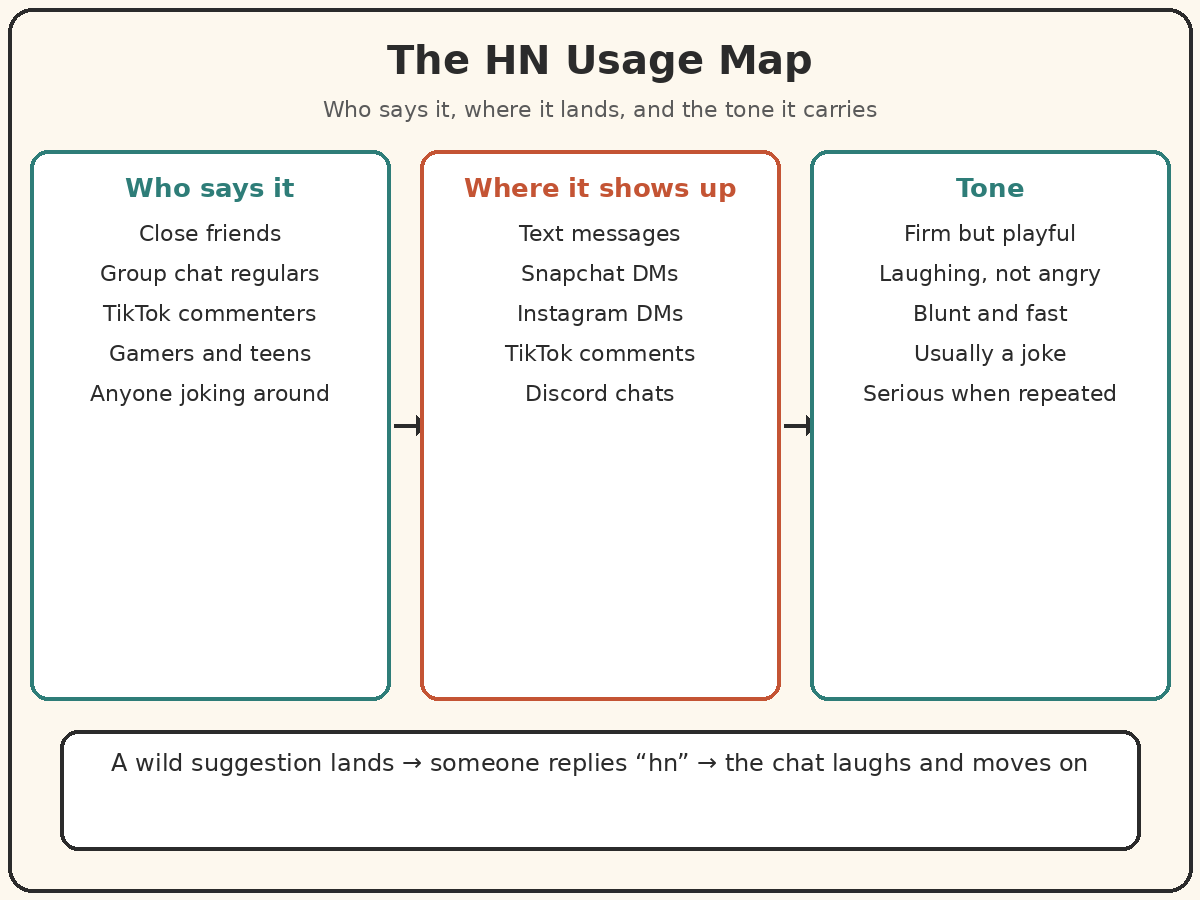
Here is the usage map in plain form. Who says it: mostly teens and young adults in casual chats, plus tech people on forums using the Hacker News sense, plus anime fans using the grunt. Where it shows up: texts, DMs, Snapchat, Instagram, TikTok comments, Reddit, and tech forums. To whom: friends, followers, and fellow commenters, almost never to a boss or a stranger in a formal setting. Tone: casual, confident, playful, firm. That map covers nearly every sighting you will ever have of these two letters.
When you are still unsure, the safest move is to read it as “hell nah” in any casual chat, and as Hacker News in any tech discussion. Those two cover the vast majority of cases. The other meanings are real, but they live in specific corners, and you will know you are in one of those corners when you get there.
HN vs Nah and Similar Short Replies
HN sits in a family of short replies that all say no in different strengths, and knowing the differences helps you pick the right one. The closest relative is “nah,” and the comparison between the two is the one that matters most.
HN vs nah is a question of strength. TextExplain puts it plainly: nah is a casual no, while HN is a stronger one. “Nah” is soft. It says “no thanks” or “not really” with a shrug. HN says “absolutely not” with a laugh and a firm shake of the head. If someone asks “want the last slice?” and you say “nah,” you are passing politely. If you say “hn,” you are saying the idea is funny and the answer is a hard no. Same question, different energy.
That strength difference shows up in the situations each word fits. “Nah” works for small, low-stakes refusals: turning down a snack, declining a song request, passing on a plan you are mildly uninterested in. HN fits the bigger, funnier, more dramatic refusals: a dare, a wild plan, an overpriced item, a question with an obvious answer. Use “nah” when the no is gentle. Use HN when the no deserves emphasis.
Other short replies fill nearby slots. “Nope” is cheerful and firm, a friendly no that often comes with a smile. “No way” is close to HN in strength, but it leans more toward disbelief than refusal, and it works well as a reaction to surprising news. “DW” means “do not worry,” which is a different job entirely: it reassures instead of refusing, and it pairs naturally with HN in the same conversation, since one person can refuse a plan and the other can say DW about it. If you want to learn that one properly, the DW meaning guide on Slangiify covers it in full.
| Term | Meaning | Strength | Tone | Where used | Example |
|---|---|---|---|---|---|
| HN | Hell nah / hell no | Strong | Confident, playful, firm | Texts, DMs, TikTok comments | “hn, I would never.” |
| Nah | A casual no | Soft | Relaxed, easy, mild | Texts, speech, casual chats | “Nah, I am good.” |
| Nope | No, with a smile | Medium | Cheerful, light, friendly | Texts, speech, social media | “Nope, not today.” |
| DW | Do not worry | Not a refusal | Reassuring, calm, kind | Texts, DMs, group chats | “DW, I have got it.” |
The table makes the pattern clear. HN is the strongest refusal of the group, and its tone is what sets it apart. It is not angry, and it is not rude by itself. It is confident. That confidence is why people reach for it when a plain “no” would feel too flat. They want the other person to feel the refusal, not just read it.
There is also a rhythm difference worth noticing. “Nah” is a word you can say softly. HN is a word you say with a beat behind it. Even typed out, it reads as if the person saying it is grinning. That is why it pairs so well with jokes and wild suggestions. It turns a refusal into a punchline, and the conversation keeps moving with a laugh instead of stalling on a flat no.
If you are choosing between HN and nah in your own messages, ask yourself one question: how strong is this no? If it is a gentle pass, nah is the right call. If it is a firm, funny, obvious no, HN fits better. Getting that choice right is most of what natural slang use comes down to. The rest is just practice.
How to Use HN Naturally
Using HN naturally comes down to timing, tone, and audience. Get those three right and it will sound like you have been saying it for years. Get them wrong and it can sound forced, cold, or out of place, so it is worth learning the shape of a natural use before you start dropping it into chats.

The timing rule is simple: HN is a reaction, so use it as a reply. Someone has to say something first. A friend suggests a plan, asks a question, sends a meme, or dares you to do something, and HN is your answer. Used that way, it feels instant and obvious. Used out of nowhere, with nothing to react to, it feels random and confusing. Wait for the setup, then deliver the punchline.
The tone rule is just as simple: keep it light. HN works best when the refusal comes with a smile behind it. That does not mean you have to add a laughing emoji every time, though one does not hurt. It means the rest of your message should match the playful energy of the word. “hn, I am staying in tonight” reads as relaxed. “hn, I would never do that” reads as funny. A bare “hn” on its own reads as confident and a little cheeky, which is fine between friends who know your tone.
Here are natural patterns you can copy and adapt:
“hn, I am not doing that.”
“hn, you cannot be serious.”
“hn, I would never.”
“hn, that is not happening.”
Each one follows the same shape: HN first, then a short sentence that explains the refusal. That shape is the most common and the most natural in real chats. The HN sets the tone, and the sentence that follows gives the detail. You can also use HN on its own as a whole reply, and that works best when the previous message makes the meaning obvious, like a dare or a wild suggestion where no explanation is needed.
The audience rule matters most. HN belongs in casual chats with friends, siblings, and people your own age who share your slang. It fits group chats, DMs, and comment sections. It does not fit a message to a teacher, a boss, a client, or anyone you need to impress formally. The word itself contains a mild swear, and even though most people read it as playful, it still signals a casual register. Save it for people who already talk to you casually.
I have seen people try to force slang like this into every message once they learn it, and it never works. The trick is to use it only when a plain “no” genuinely feels too weak for the moment. If the moment calls for emphasis, HN earns its place. If the moment calls for a gentle pass, “nah” or “no thanks” does the job better. Slang sounds natural when it is chosen, not when it is sprayed everywhere.
One more habit helps: match the spelling of the people around you. If your friends type “hn” in lowercase, type it in lowercase too. If a group chat uses “Hn” at the start of sentences, that works as well. The lowercase form is the default in casual texting, and it reads as relaxed. Capital “HN” in a casual DM can look like you are shouting the refusal, which is rarely the effect you want.
HN also pairs well with other short slang when the conversation moves fast. Someone suggests a plan, you answer “hn,” they joke about it, and you reply with something like FS when you agree with their joke. Or a friend worries about a plan falling through and you answer with DW to reassure them. These short replies form a small toolkit, and each one has its own job. HN refuses, FS agrees, DW reassures, and together they cover most of what a fast chat needs. If you want to round out that toolkit, the ATP guide and the FMU guide on Slangiify cover two more short replies you will see in the same chats.
How to Reply When Someone Says HN
Replying to HN is easy once you know what the sender meant by it, and the reply depends on the situation. TextExplain gives a clear set of moves for the common cases, and they work because they match the tone of the word itself: light, friendly, and fast.
If they refused your suggestion, accept it lightly. A simple “Fair enough” does the job. It shows you heard the no, you are not going to push it, and the conversation can move on without awkwardness. You can also offer an alternative in the same breath: “Fair enough, what about tomorrow instead?” That keeps the plan alive without arguing with the refusal.
If they were joking, joke back. HN is often a punchline, and the best reply to a punchline is another joke. If a friend answers your wild idea with “hn, I would never,” you can laugh along and raise the stakes: “Fine, I will do it alone then.” The exchange stays fun, and nobody feels shut down. The refusal was part of the joke, so treating it as one keeps the energy right.
If they were disagreeing with you, keep it friendly. A disagreement is not a fight, and HN does not have to start one. You can answer with a light “Alright, agree to disagree” or restate your point once, calmly, and let it go. Pushing hard after a firm HN rarely changes the answer, and it usually just makes the chat tense. A friendly reply keeps the door open for the next topic.
If they were reacting to something unbelievable, agree with them. When someone sends “hn” after a piece of gossip or a wild story, they are saying “no way, that cannot be true.” The natural reply is agreement: “I know, right?” That mirrors their reaction and keeps the conversation rolling. You are on the same side of the disbelief, and saying so is the whole point.
If they sound actually upset, check in. This is the one case where the tone matters more than the words. Most HN messages are playful, but if the rest of the conversation feels tense, or if the refusal came after something serious, the sender may be genuinely annoyed or hurt. In that case, a soft check-in like “You good?” shows you noticed the shift and you care. It costs nothing, and it can turn a tense moment into a real conversation.
What you should not do is argue with a bare HN. If someone answers your suggestion with a single “hn” and nothing else, they have given you a clear signal. Asking “why not?” three times in a row will not soften the answer. It will just annoy them. Accept the no, change the subject, or offer something else. The conversation will be better for it.
Here is a quick set of replies you can keep in your pocket:
Refused suggestion: “Fair enough.”
Joke: laugh along and joke back.
Disagreement: “Alright, agree to disagree.”
Unbelievable news: “I know, right?”
Upset tone: “You good?”
Each of these is short, warm, and matched to the situation. That is all a good reply needs to be.
When NOT to Use HN
HN is a great tool in casual chats, but it has clear limits, and knowing them keeps you out of trouble. The boundaries are simple, and they all come back to one idea: HN is informal, and informal language has places where it does not belong.
Do not use it at work. TextExplain states this directly: because HN contains the mild swear “hell,” keep it out of work messages and formal emails. That advice holds even in a relaxed workplace. A message to a manager, a client, or a colleague you do not know well should use plain language: “No, that does not work for me” or “I am afraid I cannot make it.” Those sentences say the same thing without the slang and without the swear, and they protect your professional image.
Do not use it in formal writing. School assignments, job applications, cover letters, official forms, and anything that will be read by someone judging you on paper are all off limits. HN would look careless there, and it would distract from whatever you are actually trying to say. Save it for chats, where the audience expects casual language.
Do not use it with people who do not know the slang. If you send “hn” to a grandparent, a new acquaintance, or someone who does not spend time on social media, they may have no idea what you mean. They might read it as a typo, a grunt, or a cold brush-off. When you are unsure whether the other person knows the term, use plain words instead. A clear “no, not for me” is always understood, and it never needs a glossary.
Do not use it when the conversation is serious. If someone is telling you about a loss, a health problem, or a real conflict, a two-letter refusal can read as dismissive. Serious moments need full sentences and real attention. HN is built for speed and humor, and neither of those fits a moment that needs care. Read the room first. If the room is heavy, leave HN out of it.
Do not use it as a weapon. A firm no is fine. A repeated, mocking HN aimed at shutting someone down is not. If you find yourself sending it over and over to the same person to make them feel small, the problem is not the word. It is the intent behind it. Use HN to refuse a plan or laugh at a wild idea, not to dismiss a person.
Do not use it when you actually mean maybe. HN is a strong no, and people will read it that way. If you are unsure, say so plainly: “Not sure yet” or “Let me think about it.” Sending HN when you mean “maybe” creates confusion, and you will spend more time undoing the message than you saved by typing two letters.
These limits are not complicated, and they are not a reason to avoid the term. They are just the edges of where it works. Inside those edges, with friends, in casual chats, in jokes and reactions, HN is a natural and useful word. Outside them, plain language does the job better.
Myths About HN
Short slang terms collect myths fast, and HN has picked up a few. Each one below is a claim people repeat about the term, followed by the facts as they actually stand.
Myth: HN Is Always Rude
This is the most common myth, and it is wrong. HN contains a mild swear, so people assume it must be rude, but the tone in real use is usually playful rather than angry. TextExplain makes this point clearly, and everyday chats back it up. Friends send it to each other as a joke, as a laugh, and as a firm but friendly refusal. Rudeness depends on intent and context, not on the letters themselves. A “hn” between friends laughing at a wild plan is not rude. A “hn” sent to shut someone down in a serious conversation could be, but the rudeness there comes from the situation, not from the word alone.
Myth: HN Only Means “Hell No” on TikTok
TikTok helped spread HN, but the term did not start there and it does not live only there. The phrase “hell nah” was common spoken slang for decades before TikTok existed, and HN appears in texts, Snapchat DMs, Instagram DMs, group chats, and comments across many apps. TikTok is one stage among several. If you only ever saw it there, it is easy to think it belongs to that app, but the term is far older and far wider than any single platform.
Myth: HN and “Nah” Mean Exactly the Same Thing
They are related, but they are not identical. Nah is a casual no. HN is a stronger one. That difference in strength changes which situations each word fits, and native users feel the difference even if they never stop to explain it. Treating them as perfect synonyms flattens a real distinction. Use nah for a gentle pass and HN for a firm, funny refusal, and your messages will sound more natural.
Myth: HN Is a Typo
Because HN looks like a mistyped “in” or “on,” some people assume it must be a keyboard slip. It can be a typo in rare cases, and that reading exists in slang dictionaries, but in the vast majority of messages it is deliberate. The sender meant to type two letters, and the receiver is expected to know what they mean. If a message that says “hn” makes sense as a refusal, it is not a typo. It is slang doing its job.
Myth: Capital HN and Lowercase “hn” Are Interchangeable
They overlap, but the capitalisation often signals a different meaning. Capital HN leans toward the abbreviations: Hacker News, Honduras, hospitalman, handle name. Lowercase hn leans toward “hell nah” in a chat and toward the anime grunt in fan contexts. The distinction is not a hard rule, and people type carelessly, but it is a useful signal, and ignoring it is how people end up confused in tech threads and anime memes alike.
Myth: You Need to Be Young to Use HN
Age has nothing to do with it. HN is used most by teens and young adults, but the phrase “hell nah” has been spoken by people of every age for decades. What matters is not your age but your audience and your setting. If you are chatting casually with friends who use the term, your age does not matter. If you are writing to a boss, your age does not save you either. Context decides, not birth year.
Quick Answers
These are the questions people ask most often about HN, answered directly and briefly first, with a little more detail after each one.
What does HN mean in texting?
HN means “hell nah” in texting, a strong casual way to say “absolutely not.” It can also mean “hell no,” and the two are interchangeable. It is usually written lowercase as “hn,” and it works as a whole reply or at the start of a short sentence. The tone is casual, confident, and usually playful rather than angry. It is a reaction word, so it answers something someone else just said, like a suggestion, a dare, or a wild idea.
Is HN rude?
HN is not rude by itself. It contains the mild swear “hell,” so it is informal, and it does not belong in work messages or formal emails, but between friends it reads as playful and confident, not hostile. Whether it feels rude depends on the situation and the intent behind it. A joking HN between friends is fine. A dismissive HN in a serious conversation can sting, but that is true of any short refusal. Read the room, and save HN for casual chats.
What does HN mean on Snapchat?
On Snapchat, HN means “hell nah” and shows up in DMs as a quick reaction. Someone sends a snap, a story reply, or a suggestion, and “hn” comes back as a fast, firm no. It fits the pace of Snapchat, where chats are short and visual. The meaning is the same as in a text, and the tone is the same too: casual, confident, and usually playful. If you see it as a story reply, it is almost always a reaction to something in that story.
What is the difference between HN and nah?
Nah is a casual no, and HN is a stronger one. That is the whole difference, and it matters. “Nah” says “no thanks” with a shrug, while HN says “absolutely not” with a laugh. Use nah for small, gentle refusals and HN for firm, funny ones. Both are casual, both are common, and native speakers switch between them based on how strong the no needs to be. If you are still learning the difference, the CTFU guide on Slangiify shows another slang term where tone and strength work the same way.
What does HN mean in anime?
In anime, lowercase “hn” is a grunt, the sound of a cold, moody character answering without really answering. The classic example is Hiei from Yu Yu Hakusho, who answers with a short, dismissive “hn” that fans have quoted since a 2003 crowd-sourced entry first recorded it. It is not a word with a definition. It is a sound that says “I heard you, I do not care, and I am not explaining myself.” Fans use it in jokes and memes to imitate that exact attitude.
What does HN mean on Reddit and tech sites?
On Reddit and tech sites, HN almost always means Hacker News, a social news site for computer science and entrepreneurship created by Paul Graham in February 2007, first under the name Startup News. Ask HN means a question or text submission, and Show HN means someone sharing their own work. If the conversation is about startups or code and HN appears in capitals, read it as Hacker News. If it is a casual chat in lowercase, read it as “hell nah.” The setting and the capitalisation together will tell you which one it is.
Sources and Further Reading
The definitions and details in this guide come from sources that were opened and checked before writing. Each one is listed here so you can read further or verify any claim for yourself.
- FluentSlang HN guide
- TextExplain HN guide
- Lilach Bullock HN guide
- Pexels photo by Anna Shvets
- Pexels photo by Dario Fernandez Ruz
If you want to keep building your slang toolkit, the DW guide, the FS guide, and the ATP guide cover three more short replies you will see in the same chats as HN. Learn them together, and fast group chats get a lot easier to read.