


In slang, “FMU” stands for “f*** me up,” a crude abbreviation people use when something hits them hard, whether that is a joke that makes them laugh until they cry, a song that wrecks them emotionally, or a week that wears them down completely.
Three letters, three very different moods. A friend drops “that video fmu” under a clip of a dog stealing a sandwich, and it means the video destroyed them with laughter. Someone else texts “tryna get fmu tonight” before a party, and now it means getting very drunk. And in an argument, “fmu then” is not a joke at all. It is a dare to fight. Same letters, same spelling, completely different energy, and the only way to tell them apart is the sentence around them.
That is why FMU confuses people. It looks like a simple acronym, but it carries a swear word inside it, and the tone of the conversation decides whether it lands as playful, reckless, or aggressive. I have watched it show up in TikTok comments, group chats, and Snapchat stories for years now, and the pattern is steady. Most of the time it is harmless, a loud way of saying something got to you. Sometimes it is not. This guide walks through every meaning, where the phrase came from, how to use it without landing in trouble, and what to say back when someone sends it to you.
Table of Contents
- What Does FMU Mean in Text?
- FMU on TikTok and Snapchat
- Where Did FMU Come From?
- FMU vs Similar Slang
- Who Says FMU, and Where?
- How to Use FMU in Real Conversations
- What to Say Back When Someone Types FMU
- Myths About FMU
- When NOT to Use FMU
- FAQs About FMU Slang
- Sources and Further Reading
What Does FMU Mean in Text?
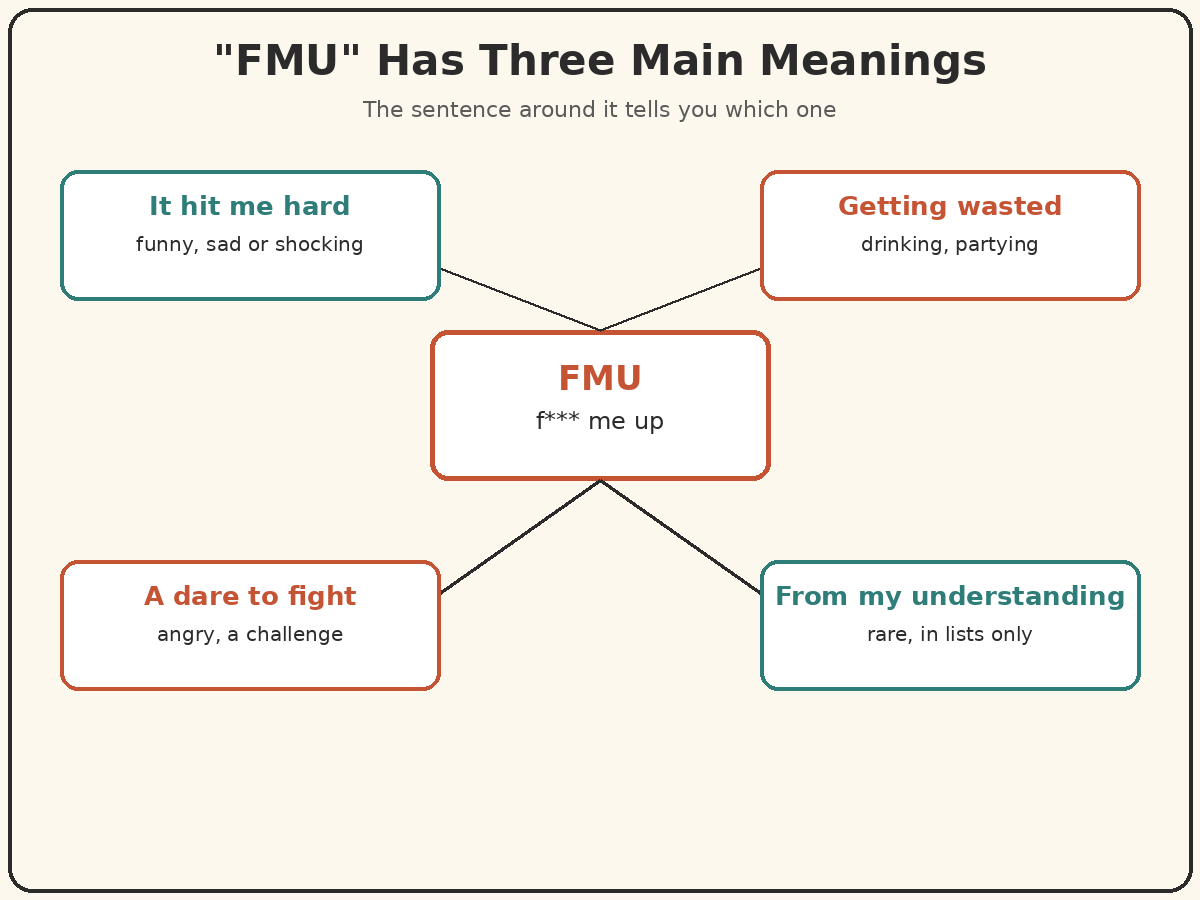
FMU stands for “f*** me up” in texting and online slang. People use it when something affects them strongly, and the feeling behind it can be laughter, sadness, shock, or exhaustion. The phrase is crude because of the swear word inside it, but in most chats it is not about real harm. It is a dramatic way of saying “that got to me.” The exact meaning depends on the conversation, and three uses cover almost everything you will see.
The three main meanings, ranked by how often they show up
The friendly reaction meaning comes first by a wide margin. This is the one you see in comment sections and group chats every day. Someone watches a video that makes them laugh hard, hears a song that hits an old memory, or finishes a brutal week, and FMU is the shorthand for all of it. Wordhurst puts it plainly in its guide to the term: FMU stands for f*** me up, and in most chats it means something got a big reaction out of the person, not that anyone is actually hurt.
The second meaning is about drinking and partying. “Tryna get fmu tonight” means the person plans to get very drunk. You will see this one before nights out, in group chats planning a party, and in captions about weekends. It is less common than the reaction meaning, but it is common enough that you should know it before you misread a plan as a joke.
The third meaning is a dare to fight. In an argument, “fmu then” or “come fmu” means “go ahead and try to hit me.” This is the least common use, and it is the one that matters most to spot, because answering it like a joke can make a tense situation worse. Tone is the giveaway. If the messages around it are angry, short, and confrontational, FMU is not playful.
| Message | What it means | The mood |
|---|---|---|
| that dog video fmu | The video made me laugh a lot | Playful |
| this song always fmu | This song gets to me emotionally | Emotional |
| finals week gonna fmu | Finals week is going to wear me out | Exhausted |
| we going out tonight, tryna get fmu | I want to get very drunk tonight | Party mode |
| say that again, fmu then | Go ahead and fight me | Aggressive |
A rare fourth meaning shows up in some acronym lists: “from my understanding.” You will almost never see it in a real chat. If someone is clearly summing up facts or explaining something, that reading is possible, but in casual conversation you should assume FMU means f*** me up unless the context proves otherwise.
How to say it
People say FMU letter by letter: F-M-U, pronounced “eff-em-you.” Nobody says it as a single word. In writing it shows up in lowercase (fmu) just as often as uppercase (FMU), and the lowercase version is slightly more common in fast chats and comments, where nobody bothers with the shift key.
FMU on TikTok and Snapchat
On TikTok, FMU lives in the comments. A video lands a perfect punchline, a plot twist nobody saw coming, or a sound that unlocks a core memory, and the comments fill up with some version of “this fmu” or “the ending fmu.” The meaning there is almost always the reaction one. The clip got a strong response, usually laughter or a wave of feeling, and the commenter is saying so in the shortest way possible. Wordhurst notes the same pattern: in TikTok comments, FMU usually means the clip got a strong reaction, and a comment like “the cat at the end fmu” means the ending made the person laugh a lot.
Snapchat works the same way, only more private. FMU shows up in replies to stories and in one-to-one chats, where the audience is a friend rather than a public comment section. The tone is looser there, and the party meaning shows up more often, since people use Snapchat to plan nights out in real time.
On Instagram, FMU appears in Reels comments and in DMs, following the same split. Public comments lean toward the reaction meaning. Private messages carry more of the party meaning and the emotional one, because people say things to close friends that they would not post for everyone to see.
Where Did FMU Come From?
The long phrase came first. People have said for years that a movie, a drink, or a rough day would mess them up, and the ruder version of that sentence was already everyday spoken slang long before anyone shortened it. As texting and social apps grew, the phrase got cut down to three letters, the same way many long phrases did. There is no known first post or person behind FMU, and no single viral moment launched it. SlangSphere traces the same path in its guide: FMU emerged from online communities, especially forums and gaming chats, where players wanted to convey emotions quickly, and its rise parallels other abbreviations built for speed, like LOL and FOMO.
It spread mostly through comment sections, where people react fast and keep things short. A three-letter reaction fits a comment box better than a full sentence, and once a few big comment threads used it, the rest followed. That is the usual life cycle for this kind of slang. Nobody votes on it. It just becomes the fastest way to say a thing, and then it sticks.
The phrase also fits a wider pattern in internet slang, where a dramatic physical metaphor stands in for an emotional reaction. People say a joke “killed” them, a song “destroyed” them, or a plot twist “broke” them. FMU is the same idea, only cruder, and that crudeness is part of why it caught on with younger users. It sounds like something you would only say to friends, and that is exactly the point.
FMU vs Similar Slang
FMU sits in a crowded family of reaction slang, and the terms overlap enough to confuse people. The table below sorts them out by meaning, tone, and where you will see each one.
| Term | Meaning | Tone | Where you see it | Example |
|---|---|---|---|---|
| FMU | Something hit me hard | Crude, dramatic | Comments, group chats | “that ending fmu” |
| FAFO | Bad choices lead to bad results | Warning, blunt | Comments, captions | “FAFO, now look at you” |
| CTFU | Cracking the f*** up, laughing hard | Crude, funny | Texts, comments | “I am CTFU right now” |
| DPMO | Do not piss me off | Annoyed, warning | Texts, captions | “DPMO today” |
| OD | Overdoing it, too much | Playful or critical | Texts, comments | “you OD with that” |
The closest cousin is CTFU, and the two get mixed up often. Both are crude, both show up when something is funny, and both live in the same comment sections. The difference is the feeling behind them. CTFU is only about laughing. FMU is wider. It covers laughing, crying, feeling shocked, and feeling worn out. If the reaction is pure laughter, CTFU fits better. If the reaction is a mix of feelings, or the thing that caused it is sad or exhausting rather than funny, FMU is the right word.
FAFO is the one people confuse with FMU in arguments, and the mix-up matters. FAFO is a warning about consequences: mess around and find out. FMU in an argument is a dare: go ahead and try it. Wordhurst flags this exact confusion in its guide, warning readers not to mix the two, because FAFO warns that bad choices lead to bad results while FMU in a fight is a challenge. Reading one as the other can turn a tense exchange into a real problem.
Who Says FMU, and Where?
FMU belongs to casual, peer-to-peer spaces. Teenagers and people in their twenties use it most, and it shows up wherever fast reactions matter: TikTok comments, Snapchat replies, Instagram DMs, Discord servers, and group chats. The audience is almost always friends or people the writer already knows. It is not a word people use with strangers in a formal setting, and it is not a word that shows up in work chats.

The usage map below sums up the split. The reaction meaning dominates in public comment sections, the party meaning clusters around nights out and group chats, and the fight dare appears almost only in one-to-one arguments.
Who does not say it? Teachers, managers, parents texting their kids, and anyone writing to a customer. The swear word inside it makes it a poor fit for any audience that expects polite language. That is not a judgment about the word. It is a practical fact about how audiences read it. Friends hear the joke. A boss hears the swear word.
How to Use FMU in Real Conversations
Use FMU the way everyone else does: as a reaction, not as a sentence starter. It works best attached to the thing that caused the feeling. “That video fmu” works. “The plot twist in episode six fmu” works. “This week fmu” works. The pattern is simple. Name the thing, then let FMU carry the reaction.
Here are natural examples, sorted by meaning, so you can see the grammar in action.
When something is funny or emotional
“bro that dog video fmu, I watched it five times.” “This song always fmu, I cannot listen to it at work.” “The season finale fmu, what a twist.” SlangSphere gives a similar example from texting: “Just watched the season finale, and wow… FMU! What a twist!” The structure is always the same. The thing comes first, FMU comes second, and the feeling is obvious from the thing itself.
When you mean getting drunk
“We going out tonight, tryna get fmu.” “That drink just FMU,” as SlangSphere puts it in its social-situations example, meaning a particular drink hit the person hard. This use needs a party context around it. Without one, people will read it as the reaction meaning and get confused.
When you are angry
“Say that again, fmu then.” This one I would not recommend using at all, and I will explain why in the section on when not to use it. But you need to recognize it when someone says it to you, because the correct response is to step back, not to match the energy.
A quick grammar note
FMU works as a verb phrase in these sentences, even though it is an abbreviation. “That video fmu” means “that video f***ed me up.” You can also use it as a standalone reaction: someone sends you a meme, and you reply “FMU.” That works too, and it is probably the most common single use. The standalone reply means “that got me,” and the meme supplies the rest.
What to Say Back When Someone Types FMU
Your reply depends on which meaning the person used, so read the message around it first. If they are laughing or upset about something, match their energy and share the moment. If it sounds like a dare, stay calm and step back. Wordhurst gives the same advice in its reply guide: if the person is laughing or upset, share the moment, and if it sounds like a dare, do not answer in the same tone.
| They said | You could say | Why it works |
|---|---|---|
| this clip fmu | right, I watched it five times | Matches the laughter |
| that ending fmu | same, I was not ready | Shares the shock |
| this week fmu | that sounds rough, you good? | Shows care, not just reaction |
| tryna get fmu tonight | have fun, drink some water too | Playful, with a nudge to be safe |
| fmu then | not worth it, I am done here | De-escalates instead of feeding it |
The “this week fmu” case deserves a little more attention. When someone uses FMU about their life rather than a video, they are usually venting, not joking. SlangSphere notes this use too: people share personal struggles with FMU to highlight the intensity of their feelings about a life event, like an argument with a boss that totally FMU. A reply that just laughs it off can feel dismissive. A short check-in, “you good?” or “that sounds rough,” costs nothing and lands better.
Myths About FMU
Myth: FMU means someone is in danger
Most of the time, no. When a friend says a meme fmu, it means the meme was funny. The phrase sounds violent because of the words inside it, but the meaning is emotional, not physical. The exception is the fight dare, and that one comes with an angry context that is hard to miss.
Myth: FMU is always a bad word you should never use
It contains a swear word, so it is crude, and that is a fact. But crude is not the same as offensive in every setting. Among friends, in a group chat, or in a comment section, it is normal and often playful. The problem is the audience, not the word itself. A teacher, a parent, or a coworker will only see the swear word, while a friend will hear the joke.
Myth: FMU means the same thing from everyone
It does not. Wordhurst answers this exact question in its FAQ section: FMU means the same thing from anyone in the sense that the definition does not change by gender, but the tone of the chat decides the meaning. Read the rest of the message. If she says a show or a meme fmu, she means it got to her. The person matters less than the context.
Myth: FMU is a TikTok invention
TikTok made it visible, but it did not invent it. The phrase grew out of forums and gaming chats, where short emotional reactions were already the norm, and it spread through comment sections across platforms. TikTok accelerated it. It did not create it.
When NOT to Use FMU
Some places are simply wrong for FMU, even as a joke. Skip it at work, in school groups, in public posts tied to your real name, and with family members who may not know the slang. In those spaces, plain words carry the same feeling without the risk. Saying “that got me” or “this week is wearing me out” works fine, and nobody has to explain a swear word to their grandmother.
Do not use the fight-dare version at all. “Fmu then” in an argument is a challenge, and challenges have a way of getting answered. Even if you mean it as a bluff, the other person may not read it that way, and a text argument can turn into a real one fast. Walk away from that version of the word entirely.
Do not use FMU with people you do not know well. A stranger will not know your tone, and the swear word will do most of the talking. And do not use it with anyone younger, in mixed groups, or in any message that could be screenshotted and shown to someone who was never meant to see it. That last one is worth remembering for every piece of slang with a swear word in it, not just FMU.
FAQs About FMU Slang
What does FMU mean in text?
It stands for f*** me up. People use it when something hits them hard, such as a video that makes them laugh, a song that makes them sad, or a day that leaves them drained. The meaning is emotional, not literal, in almost every case.
What does FMU mean on TikTok?
In TikTok comments it usually means the clip got a strong reaction. A comment like “the cat at the end fmu” means the ending made the person laugh a lot. It is the reaction meaning, and it is the most common use on the platform.
What does FMU mean from a girl?
It means the same thing from anyone. Read the rest of the message. If she says a show or a meme fmu, she means it got to her. In rare cases it can be flirty, so the tone of the chat decides, but the definition does not change by who sends it.
Is FMU a bad word?
It contains a swear word, so yes, it is crude. Among friends it is normal and often playful, but it is not polite enough for teachers, bosses, or older relatives. The audience decides whether it lands as a joke or as rudeness.
Can FMU mean “from my understanding”?
Some lists show that meaning, but it is rare. In casual chats, assume it means f*** me up unless the person is clearly summing up facts. If the sentence is an explanation rather than a reaction, the rare meaning is possible, but you will hardly ever need it.
What does “fmu then” mean?
Said during an argument, it can be a dare, like “go ahead and fight me.” This use is aggressive, so it is best not to answer in the same tone. Step back, stay calm, and do not feed the argument.
Is FMU the same as FAFO?
No. FAFO means “f*** around and find out,” a warning that bad choices lead to bad results. FMU means something hit you hard, and in an argument it works as a dare. They sound similar because both are crude abbreviations, but they do different jobs. Our guide to what FAFO means in slang breaks that one down in full.
Sources and Further Reading
Wordhurst walks through the three meanings of FMU, its TikTok use, and its reply guide in its FMU meaning guide, and SlangSphere covers the term’s origins in forums and gaming chats plus its pop-culture spread in its guide to understanding FMU. The featured photo of friends laughing at a phone is by Andrea Piacquadio on Pexels, and the in-body photo of two friends laughing at a smartphone is by Kaboompics on Pexels.



Pingback: FW Meaning Slang: What Does FW Mean in Text?