

A flow state is a mental state of total immersion in an activity, and on TikTok the phrase is also a joke format for mundane moments that just feel right.
If you have spent any time on TikTok lately, you have probably seen the line. Someone is eating wings and fries at the same time, or matching socks, or reorganising a Notes app at 11pm, and the caption says they genuinely reached a flow state. It sounds like psychology. It reads like a joke. It is a bit of both, and that is exactly why the phrase took off.
The real idea behind it is serious. Psychologists have studied flow for decades, and it describes one of the best feelings a person can have while doing something: full focus, no clock-watching, and a task that feels rewarding on its own. The TikTok version borrows that feeling and pastes it onto everyday chaos. This article explains both sides, so you know what flow state means, where the phrase came from, and how to tell the difference between real flow and a funny caption.
Table of Contents
- What Does Flow State Mean?
- What Is Flow State in Psychology?
- Flow State Meaning on TikTok
- Real Flow vs TikTok Flow
- Flow State vs Hyperfocus vs Being in the Zone vs Locked In
- How to Tell If You Are Actually in Flow
- How to Get Into Flow State More Often
- Who Says Flow State, and Where
- What to Say When Someone Says They Are in Flow State
- Myths About Flow State
- When Not to Use Flow State
- Frequently Asked Questions
- Sources
What Does Flow State Mean?
A flow state means being so absorbed in what you are doing that everything else fades into the background. Your attention locks onto the task, time feels strange, and the work itself keeps you going. Online, it also means a TikTok joke about feeling weirdly focused during something small, like eating snacks or cleaning a room.
That double meaning is the whole story. In psychology, flow is a real, studied experience. On social media, it is shorthand for “this felt weirdly good and I was locked in for a second.” Both uses share the same core idea: total focus. They just apply it to very different things.
When someone asks “what does flow state mean” in a text or a comment, they usually want one of two answers. Either they want the psychology definition, or they want to know why everyone on TikTok keeps saying it about snacks and chores. This article gives you both, because you need both to use the phrase correctly.
What Is Flow State in Psychology?
In psychology, a flow state is a state of complete absorption in an activity that matches your skills, gives clear feedback, and feels rewarding in itself. Time distorts, self-consciousness drops away, and attention stays fixed on the task. It is a real experience studied since the 1970s, not just a slang word.
The term was coined by Hungarian-American psychologist Mihaly Csikszentmihalyi in the 1970s, after he studied artists and musicians who became so immersed in their work that they forgot to eat, drink, or sleep. Varsity reports that he watched creative people lose themselves in painting and composing, and he wanted a name for that total absorption. The word he chose was flow, because people described the feeling as being carried along by a current.

The key condition is balance. Csikszentmihalyi argued that flow happens when your abilities line up with the challenge in front of you. Fast Company explains the same idea in plain terms: if a task is too easy, you get bored; if it is too hard, you get stressed. Flow sits in the middle, where the task stretches you just enough to hold your full attention without overwhelming you. Brain research adds another layer. Varsity notes that fMRI studies suggest decreased activity in the prefrontal cortex during flow, a pattern sometimes called transient hypofrontality. In simple terms, the part of the brain tied to self-monitoring and second-guessing quiets down, which may explain why people in flow stop worrying about how they look and just do the work.
Csikszentmihalyi himself described the feeling in vivid terms. In his 2004 TED Talk, quoted by Fast Company, he spoke about intense focus leading to a sense of ecstasy and clarity, with immediate feedback and a sense of time disappearing. He later called flow “the secret to happiness,” and Fast Company reports that research links flow to better performance in sports and music, plus improved creativity and wellbeing. Varsity adds that people in flow perform at their best, athletes actively chase the state, and more time in flow is linked to better wellbeing, stronger motivation, and lower cognitive decline. Around 85% of people can recall at least one flow experience, a figure Varsity attributes to Johann Hari, author of Stolen Focus. Think back to a time when you lost track of hours while doing something you loved. Maybe you were cooking a new recipe, writing, drawing, or playing a sport. You were not checking the time. You were just there, in the task. That is flow.
Flow State Meaning on TikTok
On TikTok, “flow state” is a joke format where a user claims they genuinely reached a flow state while doing something unserious, chaotic, or mundane. The humour comes from the gap between the grand psychology term and the small, silly moment, like eating snacks, matching socks, or cleaning at midnight.
The trend took off in late 2025. Mental Floss, writing in December 2025, describes users claiming they “genuinely reached a flow state” while doing things like assembling IKEA furniture, matching socks, eating crunchy grapes, reorganising a Notes app, or rage-cleaning at 11pm. None of these are the deep creative absorption Csikszentmihalyi studied. That is the point. The joke works because the activity is so ordinary, and the claim is so grand.
The audio behind many of these videos comes from an old Shane Dawson video featuring Jeffree Star reorganising makeup. Mental Floss traces the sound to that clip, where the reorganising feels oddly satisfying to watch. TikTok users borrowed the audio and paired it with their own small moments of focus, and the format spread from there. Fast Company, writing in November 2025, gives more examples of the joke in action. One reads: “When the iced latte, Zyn and Adderall hit at the same time and I genuinely reach flow state.” Another describes “a drink for hydration, a drink for caffeine, and a drink for fun.” A third says: “eating wings and fries at the same time while also getting water.” Each one follows the same pattern: a small, everyday moment, plus the claim of flow state, plus the word “genuinely” doing a lot of comic work. That word pretends the claim is serious, which makes it funnier.
There is also a softer side to the trend. NSSG Club, in a piece updated in May 2026, describes flow state on TikTok as a trend about immersion, comfort, and momentary focus, with micro-moments of presence like cooking without a phone, working with music on loop, or crocheting in front of a TV series. In those videos, the phrase often just signals that something felt right. The person felt calm, present, and pleasantly focused, even if only for a few minutes. That softer use is closer to the real psychology than the snack jokes, but it is still casual, and the word has become a flexible label for “I felt good and focused.”
Real Flow vs TikTok Flow
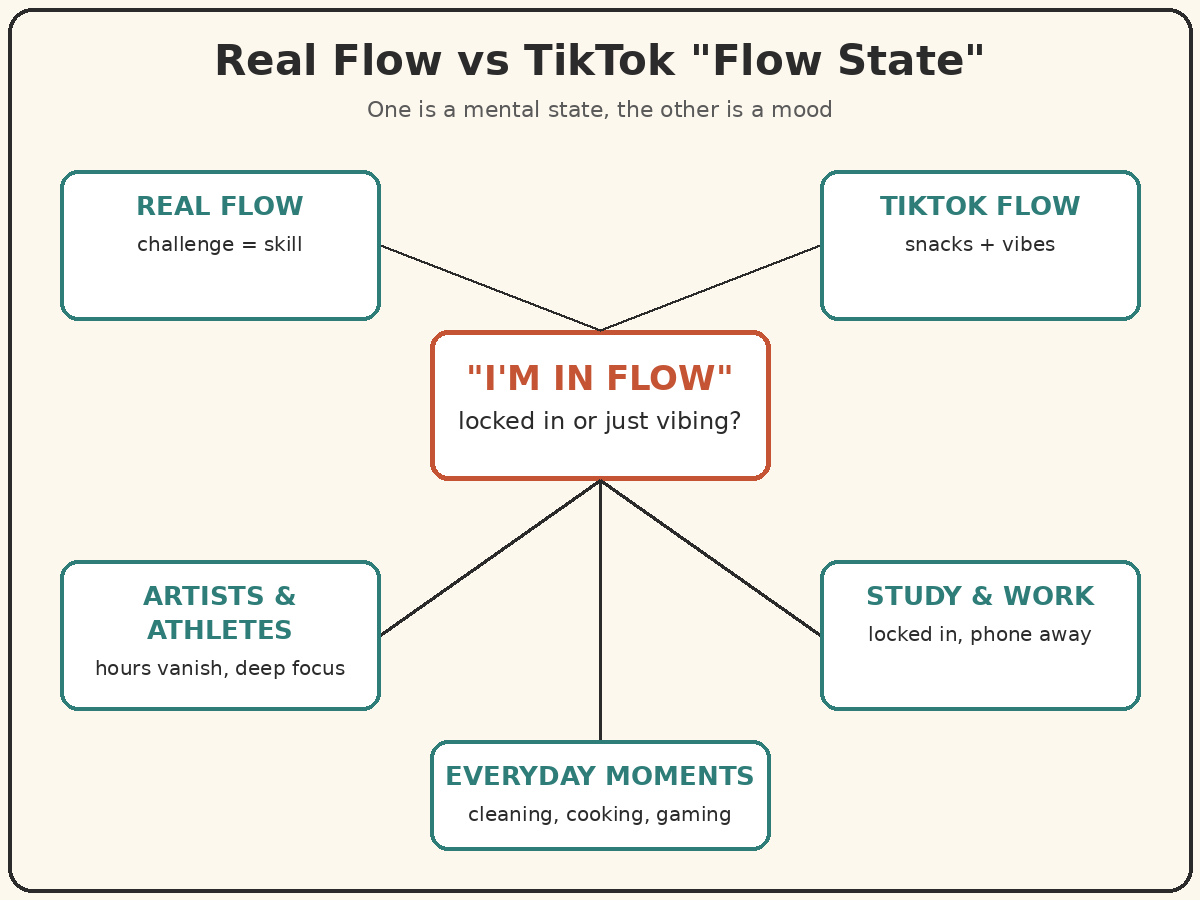
Real flow is deep, sustained absorption in a challenging task that matches your skills, while TikTok flow is a funny label for a brief moment that felt satisfying. The first can last for hours and improve your work; the second usually lasts for seconds and makes a good caption.
The clearest difference is time. Real flow stretches out. An artist can paint for three hours and feel like thirty minutes passed. TikTok flow is short: the minute you spent matching socks, or the few seconds when the snacks, the drink, and the show all lined up. The second difference is the challenge. Real flow needs a task that stretches your skills. TikTok flow needs almost nothing. Eating crunchy grapes is not a challenge, and the satisfaction comes from order, rhythm, or comfort, not from meeting a hard task with the right abilities. The third difference is what happens after. Real flow often leaves you with something: a finished painting, a better performance, a solved problem. TikTok flow leaves you with a clean room or an empty plate. That is fine. Not every good moment has to produce something.
None of this means the TikTok use is wrong. Language moves, and slang borrows serious words for fun all the time. The TikTok version keeps the core feeling, focus plus pleasure, and drops the strict conditions. The aura, the vibe a moment gives off, matters more in a TikTok caption than the psychology textbook does. The problem only comes when people confuse the two. If someone thinks eating snacks with three drinks is the same as the flow state that helps athletes perform, they miss what makes real flow valuable. Keep both meanings in your head, and use the right one for the moment you are in. A good test is to ask what the person is claiming. If they are joking about socks, they are using TikTok flow. If they are talking about losing track of time while doing hard, skilled work they love, they are talking about real flow.
Flow State vs Hyperfocus vs Being in the Zone vs Locked In
Flow state is balanced, chosen absorption in a task that fits your skills; hyperfocus is intense, often unchosen fixation that can ignore everything else; being in the zone is the casual sports phrase for peak focus; and locked in is the slang way of saying you are fully concentrated right now.
| Term | Meaning | Tone | Where used | Example |
|---|---|---|---|---|
| Flow state | Deep absorption in a task that matches your skills, with time distortion and intrinsic reward | Positive, a little scientific | Psychology, self-improvement, TikTok jokes | “I lost three hours painting and it felt like thirty minutes.” |
| Hyperfocus | Intense, narrow fixation on one thing, often hard to break away from, sometimes at the cost of food, sleep, or other tasks | Neutral to clinical, sometimes worried | ADHD and neurodivergence talk, psychology, everyday chat | “I hyperfocused on the game and forgot to eat lunch.” |
| Being in the zone | Peak focus during a performance, usually in sports or music, where everything clicks | Casual, admiring | Sports commentary, music, everyday talk about good work | “She was in the zone in the second half and could not miss.” |
| Locked in | Fully concentrated right now, not distracted, ready to work or compete | Casual slang, energetic | Gaming, sports, study, work chats, TikTok | “Headphones on, phone away, I am locked in for this essay.” |
Flow and hyperfocus are the pair people confuse most. Both involve deep focus and lost time. The difference is balance and control. Flow feels good, fits your skills, and leaves you energised. Hyperfocus can feel compulsive. You may struggle to stop, even when you need to eat, sleep, or switch tasks. Being in the zone is closest to flow, and many people use the two as synonyms, but “in the zone” is casual and tied to performance, while “flow state” sounds more like psychology. Locked in is the most flexible of the four. Gamers know the locked-in feeling from FF forfeit votes and ranked matches, where a whole team needs to focus at once. It does not claim a deep psychological state. It just says: I am focused now, do not distract me. When you are writing or talking, pick the phrase that fits what you actually mean. If you lost track of time doing skilled work you love, flow state fits. If you could not pull yourself away from a screen for six hours, hyperfocus may be the honest word. If you just sat down to study and want everyone to know you mean business, say you are locked in.
How to Tell If You Are Actually in Flow
You are probably in real flow if you lose track of time, forget about yourself for a while, feel energised rather than drained, and keep going because the task itself feels good. If you are just enjoying a snack or a tidy room, that is a nice moment, not the full state.
Start with time. In flow, the clock behaves strangely. Hours pass like minutes, and you only notice it after the fact. Next, notice your sense of self. In flow, self-consciousness fades. You stop thinking about how you look or whether you are doing it right. Then check your energy. Flow is tiring in a good way, like a long run that leaves you satisfied. If you finish a task feeling wired, anxious, or hollow, that was probably not flow. Ask yourself whether the task gave you feedback. A musician hears a wrong note at once. A writer sees a sentence land or fall flat. That loop of action and feedback keeps you in the moment. Finally, ask whether you would do it again for its own sake. The painter paints because painting feels good, not only because the painting will sell. None of these signs alone proves flow. Together, they give you a decent test, and when only one shows up, like enjoying a snack, you had a good moment. That is worth enjoying too, just under a different name.
How to Get Into Flow State More Often
You cannot force flow on demand, but you can set it up: pick a clear goal, choose a task that stretches your skills without overwhelming them, remove distractions, work on one thing at a time, and build in quick feedback so you know how you are doing.
Start with a clear goal. “Write for an hour” is vague. “Finish the first draft of this section” is clear. A clear goal tells your attention where to go. Then match the difficulty to your skill. If a task is too easy, you will get bored and reach for your phone. If it is too hard, you will get anxious and freeze. Pick the version that stretches you a little. A student might move from easy practice questions to harder ones. A cook might try a recipe with one new technique, not five. Remove the phone, since flow needs sustained attention and a phone is built to break it. Put it in another room, or at least face down and on silent. Work on one thing, because multitasking is the opposite of flow. Close the extra tabs, pause the show, and tell the people around you that you are busy for a while. Build in feedback so you know how you are doing while you work: a writer rereads a paragraph, a musician records a take, a coder runs the code. Protect a block of time, too, since flow rarely shows up in ten minutes and often needs twenty or thirty minutes before attention settles. Finally, pick something you care about, at least a little, because flow is much easier when the task matters to you. That does not mean every flow activity has to be a passion. It means the task should have some pull: curiosity, pride, pleasure, or a goal you want. When the conditions line up, flow shows up. When they do not, a focused work session is still useful, even without the full state, and a session that ends well can feel awesome for a great experience.
Who Says Flow State, and Where
Psychologists, athletes, artists, and self-improvement writers use “flow state” seriously, while TikTok users, gamers, students, and group-chat friends use it as a joke or a casual label for feeling focused. In psychology and sports, the phrase is technical. Coaches talk about helping athletes find flow, researchers study it, and writers on creativity use it to describe peak work. On TikTok, the audience is younger and the tone is comic. The phrase shows up in captions, comments, and voiceovers, usually with the word “genuinely” in front of it, from Gen Z and younger millennial users who know the psychology term well enough to joke about it.
Gamers use a nearby version of the idea, talking about being locked in during a ranked match or hitting a groove where every play works. Students use it too, usually before an exam or a long study session, as a way of saying they mean business. In group chats, someone sends a photo of a clean desk or a finished puzzle, and a friend replies that they are in flow state. The phrase works because everyone in the chat knows the joke. If you are writing for a general audience, assume most readers have met the TikTok version first, and give them the psychology version as the useful surprise.
What to Say When Someone Says They Are in Flow State
Match their tone: if they are joking, laugh along and play with the format; if they are serious about deep work, respect the focus and keep it short. The wrong reply is a lecture about psychology when they just wanted a laugh.
When a friend posts a TikTok-style joke, the best reply is a joke back. “The socks never stood a chance.” “That is the most serious flow state I have ever seen.” “Genuinely? The grapes?” A short, playful reply keeps the bit going. The person is not asking for an explanation. When someone is talking seriously about flow, the best reply is brief and warm. “Nice, what were you working on?” “That sounds like a great session.” If someone says they are in flow state right now, do not interrupt unless you have to. Send a short acknowledgement and wait. The kindest thing you can do for a person in flow is leave them alone for a while. What not to say: do not correct a joke with a definition. Nobody posting about crunchy grapes wants a paragraph about Csikszentmihalyi in the comments. And do not use the phrase to brag about overwork. Saying you were in flow state for twelve hours without food is not impressive. It is a sign you skipped a meal, and that is not what flow is for. A friend who nails a tricky task with total focus deserves a cool as a compliment for effortless focus, not a lecture, and a performance that genuinely impresses is dope for something impressive.
Myths About Flow State
Flow gets misunderstood a lot, partly because the TikTok joke strips away the details. These are the myths that show up most often, and what is actually true instead.
Myth: Flow Is Just Feeling Relaxed
Relaxation is pleasant, and flow can feel calm, but the two are not the same. Flow needs active engagement with a task that stretches you. Relaxation needs almost nothing from you. Lying on a sofa with a show on is relaxing. Painting for three hours, fully focused, is flow. Both feel good. Only one involves deep, sustained attention on a challenge that fits your skills.
Myth: Snacks and Caffeine Create Flow
The TikTok joke about an iced latte, a drink for fun, and snacks creating flow is funny because it treats treats as a recipe for a psychological state. Snacks and caffeine can make you feel alert or comfortable, and comfort can help you settle into work. But they do not create flow on their own. Flow comes from the match between challenge and skill, plus clear goals and feedback. A snack can sit beside flow. It cannot replace the task. And to be clear, the Fast Company example that mentions Zyn and Adderall is a TikTok joke being quoted, not advice. Substances are not a route to flow, and no snack or drink can do the work of a well-matched task.
Myth: You Can Decide to Enter Flow on Demand
You can set up the conditions for flow, but you cannot switch it on like a light. Flow shows up when the goal is clear, the challenge fits, distractions are gone, and feedback is flowing. Some days those conditions line up. Some days they do not, and the same task feels flat. That is normal. The honest approach is to build good conditions often, and let flow arrive when it will, rather than forcing it and getting frustrated.
Myth: Flow and Hyperfocus Are the Same Thing
They share deep focus and lost time, but they differ in balance and control. Flow feels good, fits your skills, and leaves you energised. Hyperfocus can feel compulsive and hard to break, sometimes at the cost of food, sleep, or other tasks. A person in flow can usually pause when they need to. A person in hyperfocus may struggle to stop even when they want to. Use flow for the balanced, rewarding state, and hyperfocus for the intense fixation that can run away with you.
When Not to Use Flow State
Do not use “flow state” to describe real mental health struggles, to romanticise overwork, or to make skipping meals and sleep sound impressive. Flow is a positive state tied to a well-matched task, not a cover story for harm.
Mental health is the clearest boundary. If someone is struggling to focus because of anxiety, depression, ADHD, or burnout, calling that a flow state problem misses the point and can feel dismissive. Flow is not a treatment, and its absence is not a personal failure. Overwork is the second boundary. The artists Csikszentmihalyi studied forgot to eat, drink, or sleep while they worked. That is a description of absorption, not a recommendation. Skipping meals to stay in flow is not a badge of honour. It is a sign you need a break. Do not use the phrase to make exhaustion sound productive. The best flow sessions end with you tired in a good way, fed, hydrated, and ready to come back. If a session ends with you wrecked, something went wrong, and the word flow should not be used to hide it.
Frequently Asked Questions
What does flow state mean in slang?
In slang, flow state means feeling totally focused and in a groove, often used as a joke on TikTok. A person might say they reached flow state while eating snacks, matching socks, or cleaning at midnight. The slang use keeps the feeling of focus and drops the strict psychology conditions, so it works as a funny caption for a small, satisfying moment.
What is flow state in psychology?
In psychology, flow is a state of complete absorption in an activity that matches your skills, gives clear feedback, and feels rewarding in itself. Time distorts, self-consciousness fades, and attention stays fixed on the task. The term was coined by Mihaly Csikszentmihalyi in the 1970s after studying artists and musicians who forgot to eat or sleep while they worked.
What does “genuinely reach flow state” mean on TikTok?
On TikTok, “genuinely reach flow state” is the punchline of a joke format where a user claims they hit flow state during something mundane. The word “genuinely” pretends the claim is serious, which makes it funnier. Examples include assembling IKEA furniture, eating crunchy grapes, reorganising a Notes app, and rage-cleaning at 11pm. The audio often comes from an old Shane Dawson video featuring Jeffree Star reorganising makeup.
Is flow state real?
Yes, flow state is real as a psychological experience, and it has been studied since the 1970s. Around 85% of people can recall at least one flow experience, a figure Varsity attributes to Johann Hari, author of Stolen Focus. Not every use of the phrase online describes real flow, though. The TikTok version is usually a joke about a small moment, not a claim of deep absorption.
What is the difference between flow state and hyperfocus?
Flow is balanced absorption in a task that fits your skills, and it feels good and leaves you energised. Hyperfocus is intense, narrow fixation that can be hard to break, sometimes at the cost of food, sleep, or other tasks. A simple test is control. If you can pause when you need to and feel good after, that looks like flow. If you struggle to stop even when you want to, that looks more like hyperfocus.
How do you get into a flow state?
Pick a clear goal, choose a task that stretches your skills without overwhelming them, remove distractions like your phone, work on one thing at a time, and build in quick feedback. Give yourself a protected block of time, since flow often needs twenty or thirty minutes to arrive. You cannot force flow on demand, but you can make it more likely by setting up these conditions often.