

In slang, “edge” means a deliberately provocative, boundary-pushing attitude or style, and in a separate meme sense it refers to “edging,” stopping just before climax. The two meanings live in different rooms, so context tells you which one someone means.
You have probably seen the word in two very different places. In one comment section, someone writes “that outfit has edge” and means the look is bold, dark, and a little dangerous. In another, someone writes “I edge to you” under a random TikTok, and that is a joke about something else entirely. Both uses are real, both are common, and mixing them up is awkward. This guide untangles them: the attitude meaning first, the meme meaning second, and the older senses that still float around, with examples, origin, and the lines you should not cross.
One warning up front: the meme sense is NSFW-adjacent. This article explains it plainly because that is what people are searching for, but it keeps the detail clinical and brief. If you are writing for a younger audience or a classroom, the attitude meaning is the only one you need.
Table of Contents
- What Does “Edge” Mean in Slang?
- Where Did “Edge” Come From?
- Edge vs Similar Words
- How People Actually Use “Edge”
- What Does “I Edge to You” Mean?
- What to Say Back When Someone Calls You Edgy
- Myths About “Edge” Slang
- When NOT to Use “Edge”
- FAQs About “Edge” Slang
- Sources and Further Reading
What Does “Edge” Mean in Slang?
In slang, “edge” most often describes something or someone that is deliberately provocative, dark, or controversial, pushing against what is normal or polite. A second, separate sense comes from “edging,” a sexual term that became a meme. The attitude sense is the one you will meet in fashion, music, and comment sections. The meme sense is the one you will meet in spam comments and jokes. Knowing which room you are in is the whole skill.
The Attitude Sense: Provocative on Purpose
The main slang meaning is about performance. Street Slang puts it plainly: edge means trying to look provocative, rebellious, or intentionally controversial. It can describe a sharp, bold style or attitude, but the social read is usually that someone is acting edgy on purpose to get attention or seem tougher than they are. The word is a judgment as much as a description. When people say something “has edge,” they often mean the person behind it is reaching for shock value, posturing as dangerous, or leaning hard into a dark or rebellious vibe just to stand out.
That judgment cuts both ways. A look with genuine edge reads as confident and sharp: black leather, heavy eyeliner, a joke that lands because it is brave. A look with forced edge reads as try-hard, and people will call it out. Street Slang gives the contrast in two short lines: “His jokes have edge, but he is not forcing it” sounds right, while “I wore all black and wrote a scary caption because I wanted edge” sounds forced. The difference is whether the boldness feels natural or performed. SlangSphere makes the same point from the other side: someone who is “edgy” flirts with taboo topics or controversial humor, acting like they are right on the borderline of “too much” but totally owning it. Owning it is the key part. If you have to announce the edge, you probably do not have it.
You will hear the word as a noun, an adjective, and a verb. As a noun: “That whole caption feels like edge for no reason.” As an adjective: “That is an edgy take.” As a verb, people say someone is “edging” a joke toward the line, though that verb form is rarer and easy to confuse with the meme sense, so most people avoid it. The adjective “edgy” is the safest and most common form, and it is the one you should learn first. If you want a deeper guide to the praise word that sits next to this one, see our guide to cool slang, which covers how “cool” and “edgy” overlap without meaning the same thing.
The Meme Sense: “Edging”
The second meaning is sexual, and it is the one that dominates the top of the search results. Know Your Meme defines edging and edge as slang terms for the act of preventing oneself from orgasming just before reaching climax, to prolong sexual activity, with an “edger” being someone who does it. The Farlex Dictionary of Idioms lists the same definition as vulgar slang: to provide just enough sexual stimulation to approach but not reach orgasm. That is the literal meaning, and it is also the raw material for the joke.
The joke works by using the word nonsensically. Know Your Meme notes that memes about edging often use the term in absurd, out-of-place ways, highlighting how strange the concept sounds when you say it out loud. A TikToker “edges” his microwave. A cartoon character has “been edging for 2,000 years.” A shopping cart full of clothes you never check out becomes “edging for girls.” The humor comes from the mismatch: a clinical sexual term dropped into a totally innocent scene. That is why the word shows up in spam comments like “I edge to you” and “I edge to your videos,” which we cover in their own section below. The joke is meant to make the creator uncomfortable, in the same family as the “I Know It’s Pink” trend and the Grip Reaper comments that Know Your Meme lists alongside it.
One more connection matters here. Know Your Meme says edging is used in memes similarly to the term “gooning,” and the two trends fed each other on TikTok in 2023. If you want the full story on that side of meme culture, our guide to gooner slang covers it in detail. For this article, the point is simple: when you see “edge” in a meme comment, it is almost always this sense, and the correct response is usually no response at all.
The Older Senses: A Buzz and “Take the Edge Off”
Edge has older slang lives that predate both the attitude and the meme meanings, and they still show up in conversation. The Farlex Dictionary of Idioms lists edge as noun slang for mild intoxication: “I only had a couple of beers, enough to get a bit of an edge, but nothing debilitating.” McGraw-Hill’s Dictionary of American Slang gives the same sense: drunkenness, the early stage of intoxication from alcohol or drugs, and the adjective “edged” for someone who is intoxicated. You will still hear this in bars and at parties, usually from older speakers.
The other old sense is about intensity, not intoxication. “Take the edge off” means to reduce the sharpness of something: a snack takes the edge off hunger, medicine takes the edge off pain, a drink takes the edge off grief. Farlex lists it as slang for intensity or severity, and it is the most standard-English of all the senses in this article. None of these older uses are what a teenager means when they type “edge” in a comment, but they explain why the word feels so flexible. It has always been about sharpness, about being close to a limit. The slang just moved the limit from alcohol and pain to attitude and jokes.
Where Did “Edge” Come From?
The word “edge” comes from the literal idea of a sharp border or limit, and each slang sense grew out of a different edge. The attitude sense grew from “edgy,” a word for pushing social boundaries. The meme sense grew from “edging,” a word for stopping at a physical limit. They share a root and almost nothing else, which is why the word feels confusing until you split it in two.
From “Edgy” to “Edge”
SlangSphere traces the attitude sense to the literal meaning of a border or margin, which naturally morphed into describing people or content that flirt with boundaries: social norms, good taste, or polite conversation. The specific slang use of “edgy” to mean dark, goth, or rebellious gained traction in the early 2000s, especially in alternative subcultures like emo kids, punk bands, and internet forums such as 4chan and Reddit. That timing matters. The early 2000s were when being “edgy” became an identity you could wear: black clothes, dark humor, an avatar that looked like it wanted to fight you. Forums rewarded the boldest take, so “edgy” became both a compliment and an insult, depending on who was saying it and whether the boldness landed.
Over time the adjective shortened. “Edgy edits” on TikTok and Instagram, high-contrast, fast-cut videos of models and fictional characters set to intense soundtracks, carried a sharp, dramatic aesthetic, and fans started calling the vibe itself “edge.” The word moved from describing a person to describing a quality you could have, lose, or fake. That is also where “edgelord” comes from: the internet’s name for someone who tries too hard to be dark and mysterious, usually a guy, usually in a comment section, usually failing. SlangSphere lists “edgelord” as the affectionate and sometimes roasting term for that person, and it is still one of the most useful words in this family. If you can spot an edgelord, you understand edge.
How “Edging” Became a Meme
The meme sense has a longer paper trail. Know Your Meme records that the earliest addition of “edging” to Urban Dictionary was on December 16, 2003, submitted by a user named Edge, and the definition has since been deleted, though it is still accessible through the Internet Archive. The term surfaced in forums through the 2000s and 2010s, and NSFW subreddits centered on it appeared in the early 2010s. In the early 2020s, sexual health blogs started writing about it more openly, and Medical News Today published an article about the pros and cons of edging on July 20, 2020. None of that made it a meme. What made it a meme was TikTok.
The memetic use started surfacing in the late 2010s and went wide in the early 2020s. Know Your Meme cites an early viral example from TikToker @lust4honeymoon on May 24, 2021, a Twilight scene that gained over 3.9 million plays, and a late-2023 video from @bofem “edging” his microwave that passed 8 million plays in two months. The gooning trend of early 2023 pushed it further, and by late 2023 the word was everywhere in image memes on Instagram and iFunny. Even the Dungeons and Dragons movie got pulled in: when the trailer dropped on July 21, 2022, people joked about Chris Pine’s character being named Edgin. The pattern is the same in every case. A normal scene plus the word “edge” equals a joke about the gap between the innocent picture and the loaded word. That gap is the whole meme.
Edge vs Similar Words
Edge sits in a crowded family of attitude words, and the differences are small but real. The table below compares it with the closest alternatives.
| Word | Meaning | Tone | Where you hear it | Example |
|---|---|---|---|---|
| Edge / edgy | Deliberately provocative, boundary-pushing | Sharp, dark, judgmental | Fashion, comments, music, memes | “That caption is pure edge.” |
| Edgelord | Someone who tries too hard to be dark | Mocking, roasting | Forums, Reddit, comment sections | “Okay, edgelord, calm down.” |
| Cringe | Embarrassing, awkward, secondhand shame | Dismissive, amused | Comments, group chats, reactions | “That forced edge is cringe.” |
| Based | Unapologetically yourself, unbothered | Approving, confident | Twitter/X, forums, replies | “Saying it anyway, based.” |
| Dark humor | Jokes about taboo or grim topics | Playful, risky | Comedy, group chats, memes | “That is dark humor, not edge.” |
The key distinction is intent versus effect. Edge is about trying to seem provocative, and the word often carries a side-eye: the person is performing boldness. Based is the opposite energy, someone being themselves without caring what the room thinks, and it is almost always a compliment. Cringe is what happens when the performance fails, when the edge is so forced that it becomes embarrassing. Our guide to cringe slang covers that reaction in full, and it pairs naturally with this one, because forced edge is one of the fastest routes to cringe. Dark humor is a tool, not a vibe: a dark joke can have edge, but a person can be edgy without telling a single joke. If you are trying to describe someone who is bold without trying, “based” fits better. If you are describing someone who is trying and failing, “edgelord” or “cringe” fits better. Edge fits the middle: bold on purpose, and the room is still deciding whether it worked.
How People Actually Use “Edge”
The word shows up in five places, and the meaning shifts slightly in each one. The diagram below maps where you will meet it.
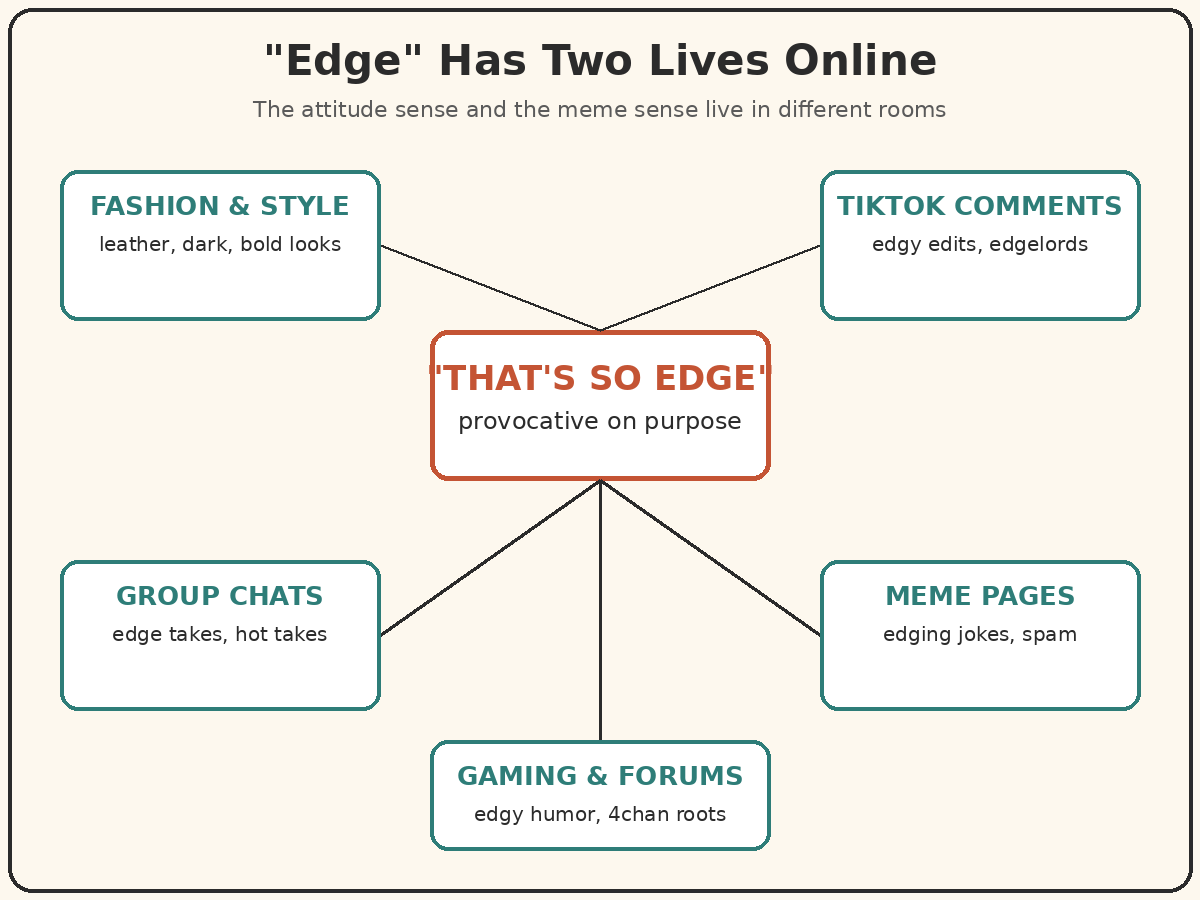
In fashion and style, edge is a compliment about a look. “That outfit has edge” means it is bold, dark, and confident, the kind of look that stops a scroll. The photo below is exactly that kind of look: leather jacket, sunglasses, pink braid, a pose that says the person knows what they are doing. In comments and group chats, edge is usually a critique. “He keeps posting edge takes just to get replies” means the takes are not brave, they are bait. “That whole caption feels like edge for no reason” means the boldness has no point behind it. On TikTok, the word lives in edits and aesthetics: high-contrast cuts, intense soundtracks, a vibe that feels sharp. On meme pages, the word means the other thing, and the joke is the mismatch. In gaming and forums, the word still carries its old 4chan roots, where being edgy was a competitive sport and “edgelord” was the penalty for losing.

A few real examples show how the word bends. In a fashion comment: “The outfit is cool, but the fake menace thing is pure edge.” In a group chat: “Bro, that take had edge and zero facts.” In a reaction post: “She is not edgy, she is just mean, there is a difference.” That last one is worth remembering, because it is the most common correction people make. Edge is not cruelty. A sharp joke that punches up has edge. A cruel comment that punches down is just mean, and calling it edgy does not make it clever. The word works best when the boldness has a point.
What Does “I Edge to You” Mean?
“I edge to you” is a spam comment that trended on TikTok, Twitter/X, and Instagram starting in the early 2020s. It uses the meme sense of “edge” as a joke designed to make the creator uncomfortable, in the same way as the “I Know It’s Pink” trend. The commenter is pretending, or jokingly claiming, to do something intimate while thinking about the creator or their videos. The humor, such as it is, comes from the awkwardness it creates. Know Your Meme notes that the trend reached a peak of absurdity in 2024, when the same comments flooded the TikTok videos of Republican presidential candidate Vivek Ramaswamy, turning a political account into a punchline.
If you see this comment on your own video, you do not owe it a reply. Most creators delete it or ignore it, and the algorithm does not reward engaging with spam. If you see it on someone else’s video, understand that it is not a compliment, not a fan message, and not a real confession. It is a copy-paste joke, and the person posting it is usually chasing a reaction from the replies, not from the creator. The best response is the one that gives them nothing: delete, block, or scroll past. If you are a parent or a teacher and a kid asks what it means, the honest short answer is that it is a crude sexual joke disguised as a comment, and the right move is to ignore it.
What to Say Back When Someone Calls You Edgy
Being called edgy can be a compliment or an insult, and the reply depends on which one it is. If someone says your outfit or your joke has edge and they mean it warmly, a simple “thank you” or “I know, right?” works. If they mean it as a critique, that you are trying too hard, the best reply is usually to laugh it off or ignore it. Arguing about whether you are edgy is the fastest way to prove their point.
A few replies that work in the wild: “Thanks, I try” keeps it light when the comment was friendly. “And?” is a good shrug when the comment was meant as an insult, because it refuses the argument. “Okay, edgelord” is the standard comeback when someone else is the one forcing it, and it works because it turns their own word back on them. What does not work is explaining your edge. The moment you have to explain why your joke was bold or your outfit was daring, the edge is gone. Confidence is quiet. If the word fits, people will say it without you asking.
Myths About “Edge” Slang
Myth: “Edge” and “edging” are the same thing
They share a root, but they are not the same word in practice. “Edge” in most everyday slang means a provocative attitude or style. “Edging” is the sexual term and the meme. People who say “that has edge” are almost never talking about the meme sense, and people who write “I edge to you” are never talking about fashion. Context splits them cleanly, and the confusion mostly comes from seeing the two uses side by side in search results.
Myth: Being edgy means being cool
Not always. Edgy can be cool when the boldness is real and the timing is right, but forced edge is one of the fastest ways to look uncool. The room decides, not the person performing. If people call something edgy as a compliment, it landed. If they call it edgy with an eye-roll, it did not. The word itself does not tell you which one happened, so listen to the tone.
Myth: “Edgelord” is a compliment
It is almost never a compliment. An edgelord is someone who tries too hard to be dark and mysterious, and the word is used to roast them, not praise them. It is the internet’s way of saying “we see what you are doing, and it is not working.” If someone calls you an edgelord, they are not saying you are bold. They are saying you are performing boldness.
Myth: The meme sense is new
The meme is new, but the word is not. Know Your Meme traces “edging” on Urban Dictionary back to December 16, 2003, and the term circulated in forums for years before TikTok turned it into a joke. The 2023 meme wave made it visible to everyone, but the word had been around for two decades. TikTok was the amplifier, not the inventor.
When NOT to Use “Edge”
There are clear lines. Do not use the meme sense of edge in any public or mixed setting: a work chat, a classroom, a comment on a stranger’s video, or a conversation with someone you do not know well. It is a sexual joke, and it will read as harassment or creepiness, not humor. The “I edge to you” comment is spam for a reason, and posting it can get your account flagged or blocked. Keep that sense out of your vocabulary in public, full stop.
Do not use the attitude sense to describe cruelty. Calling a mean comment “edgy” does not make it clever, and it does not protect you from the reaction. Do not use it in formal settings either: a job interview, a work email, or a serious conversation is not the place for a word that means “provocative on purpose.” And do not call yourself edgy. The word is a judgment other people make about you, and claiming it for yourself is the most reliable way to sound like you are forcing it. Let the room decide.
FAQs About “Edge” Slang
What does “edge” mean in slang?
In slang, “edge” most often means a deliberately provocative, boundary-pushing attitude or style, as in “that outfit has edge.” In a separate meme sense, it refers to “edging,” a sexual term that became a joke on TikTok. Context tells you which meaning applies: fashion and comment sections usually mean the attitude, meme comments usually mean the joke.
What does “edgy” mean?
“Edgy” means provocative, dark, or deliberately pushing boundaries, often with sarcasm or irony. Someone who is edgy flirts with taboo topics or controversial humor and acts like they are right on the borderline of “too much.” It can be a compliment when the boldness feels real, and a criticism when it feels forced.
What is an “edgelord”?
An edgelord is someone who tries too hard to be dark, mysterious, or controversial online, usually in comment sections or forums. The term is mocking, not a compliment. It describes a person who performs boldness for attention rather than actually being bold.
What does “I edge to you” mean?
“I edge to you” is a spam comment that trended on TikTok starting in the early 2020s. It uses the meme sense of “edging” as a crude joke meant to make the video’s creator uncomfortable. It is not a compliment or a fan message. Most creators delete it or ignore it.
Is “edge” slang offensive?
The attitude sense is not offensive on its own, though it can be used to describe offensive behavior. The meme sense is NSFW-adjacent and can be offensive or harassing when aimed at a real person, especially a stranger. Keep the meme sense out of public comments and conversations.
What does “take the edge off” mean?
“Take the edge off” means to reduce the sharpness or intensity of something, like hunger, pain, or stress. It is an older idiom, not internet slang, and it comes from the same root idea of sharpness. A snack takes the edge off hunger, and medicine takes the edge off pain.
Where did “edge” slang come from?
The attitude sense comes from “edgy,” which gained traction in early-2000s alternative subcultures like emo, punk, and forums such as 4chan and Reddit, then spread through TikTok edits. The meme sense comes from “edging,” which Know Your Meme traces to a December 16, 2003 Urban Dictionary entry, and which became a TikTok meme in the early 2020s. For the related meme term, see our gooner slang guide and our chat slang guide.
Sources and Further Reading
- Know Your Meme on Edging / Edge, with the definition, the December 16, 2003 Urban Dictionary origin, the TikTok meme wave, and the “I edge to you” spam comments
- Street Slang on Edge, with the attitude definition, real examples, and the difference between natural and forced edge
- SlangSphere on what edge means in slang, with the early-2000s “edgy” origin, the edgelord term, and the TikTok spread
- The Free Dictionary on edge, with the mild-intoxication sense, “take the edge off,” and the vulgar “edging” definition
- brandon retratos’s photo of an edgy fashion portrait on Pexels, used as the featured image
- Connor Scott McManus’s moody punk fashion portrait on Pexels, used in the article body