
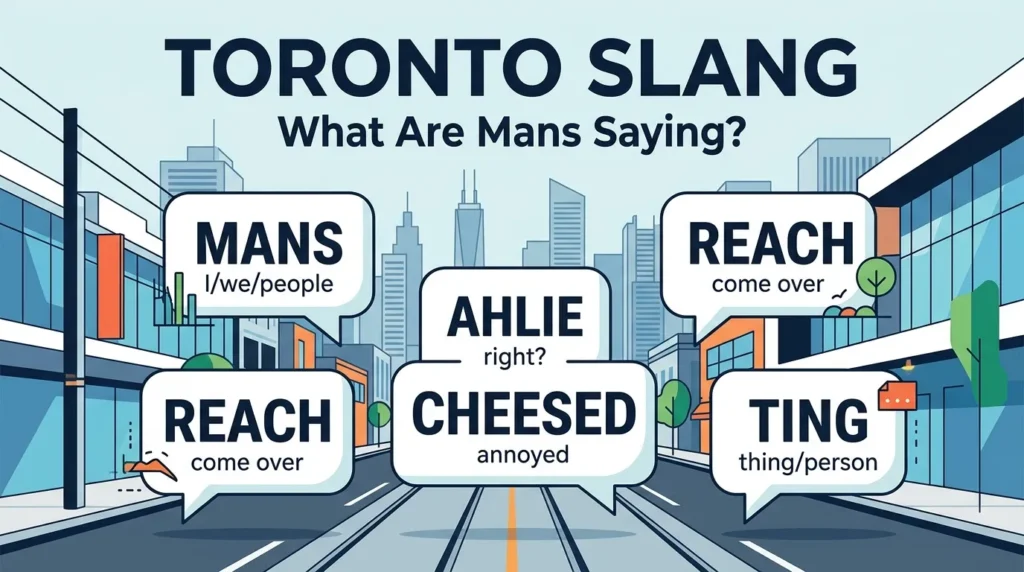

Toronto slang is the informal vocabulary associated with the city’s multicultural speech, especially among younger speakers across Toronto and the Greater Toronto Area. Words such as mans, ting, ahlie, reach, cheesed, bare, wallahi, and waste yute can appear in everyday conversations, music, texts, memes, and social media.
It is important not to treat Toronto slang as the way every Torontonian speaks. Much of it overlaps with what linguists call Multicultural Toronto English, a broader speech variety shaped by contact among Jamaican, Caribbean, Somali, Arabic, African, South Asian, Canadian, and other communities. Some expressions are strongly associated with Toronto, while others existed elsewhere before becoming part of local speech.
| Quick Answer | Details |
|---|---|
| What is Toronto slang? | Informal vocabulary associated with multicultural speech in Toronto and the GTA |
| Who uses it? | Especially younger speakers and people familiar with Toronto youth culture, although usage varies widely |
| Common examples | mans, ting, ahlie, bare, reach, cheesed, wallahi, waste yute |
| Main influences | Jamaican Patois and Caribbean speech, Somali, Arabic, Canadian English, and other urban varieties |
| Tone | Usually casual, social, humorous, expressive, or confrontational depending on the term |
| Formal? | Generally no |
| Important warning | Some words are insults, profanity, religious expressions, or culturally specific terms and should be used carefully |
What Is Toronto Slang?
Toronto slang is not simply a collection of random trendy words. It is the informal vocabulary connected to a broader urban way of speaking that has developed through generations of cultural and linguistic contact in the Greater Toronto Area.
The phrase Toronto slang usually refers to vocabulary. Multicultural Toronto English, however, can include vocabulary, pronunciation, grammar, rhythm, and patterns of conversation. That distinction matters because someone can know several Toronto slang words without actually speaking the broader dialect.
The vocabulary is also not uniform across the city. A teenager in Scarborough, someone raised in Rexdale, and a university student downtown may recognize different sets of expressions. Age, neighborhood, family background, friend groups, and online culture all affect which words a person naturally uses.
Another important point is that Toronto slang does not mean “slang invented in Toronto.” Words such as wagwan and ting have strong Jamaican roots. Wallahi comes from Arabic and also entered Toronto speech through Somali-speaking communities. Chalo comes from South Asian languages. Other expressions overlap with British or broader North American urban slang. Toronto’s distinctiveness comes partly from how these influences meet and function together.
Quick List of Popular Toronto Slang Terms
| Slang Term | Simple Meaning | Tone | Usage Warning |
|---|---|---|---|
| Mans | I, me, you, we, or people depending on context | Casual | Meaning depends heavily on the sentence |
| Mandem / man dem | The guys, boys, or friend group | Friendly | Informal |
| Ting | Thing, person, or romantic interest | Casual | Can sound objectifying when used for a person |
| Ahlie | Right? Really? Isn’t that true? | Conversational | Meaning changes with intonation |
| Bare | A lot of, many | Casual | Not unique to Toronto |
| Cheesed | Angry or annoyed | Negative | Usually harmless among friends |
| Gassed | Excited, pleased, or hyped | Positive | Meaning differs in other regions |
| Chopped | Unattractive | Insulting | Avoid saying it directly to someone |
| Reach | Come, arrive, or show up | Casual | Very common as an invitation |
| Cut | Leave | Casual | Can sound abrupt |
| Marved | Extremely hungry | Casual | Informal only |
| Styll / still | Though, actually, emphasis | Casual | Often appears at the end of a sentence |
| Deep it | Think carefully about it | Serious/casual | Context determines intensity |
| Say word? | Really? Seriously? | Surprised | Shared beyond Toronto |
| Fam | Friend, close person | Friendly | Very informal |
| Yute | Young person or kid | Neutral/casual | Can become insulting with modifiers |
| Wagwan | What’s going on? | Friendly | Jamaican-origin expression |
| Wallahi | By God; I swear to God | Serious/emphatic | Has religious significance |
| Miskeen | Poor, unfortunate, innocent, or pathetic person | Mixed | Can be sympathetic or insulting |
| Khalas | Enough; stop; finished | Casual/firm | Arabic expression, tone matters |
| Yallah | Let’s go; hurry; come on | Casual | Arabic expression with broader use |
| Chalo | Let’s go; okay, come on | Casual | South Asian expression |
| Two-twos | Quickly, soon, or within a short time | Casual | Exact nuance varies |
| Mazza | Madness; something wild or intense | Excited | Shared with UK urban slang |
| Leng | Very attractive or good-looking | Complimentary | Strongly informal |
| Nize it | Be quiet; shut up | Rude/playful | Can easily sound aggressive |
| Waste yute | Useless or foolish young person | Insulting | Avoid in polite conversation |
| Wasteman | Useless or foolish person | Insulting | Clearly negative |
| Bucktee | Derogatory label for a troubled, suspicious, or marginalized person | Offensive | Better understood than casually used |
| Dun know | You know; of course; affirmation | Friendly/confident | Meaning shifts with context |
These meanings reflect documented Toronto usage, but several expressions also belong to languages or speech communities outside Toronto. Slang changes quickly, and familiarity with individual terms is never universal across the GTA.
Also Read: 90s Slang Meanings: A Guide to Classic 1990s Terms
Popular Toronto Slang Words and Meanings
Mans
Mans is one of the most recognizable features associated with Toronto slang. What makes it unusual is that it can behave like a pronoun.
Depending on context, mans may refer to I, me, you, we, us, them, or people generally.
Example:
“Mans is tired after work.”
Depending on who is speaking, this may effectively mean, “I’m tired after work.”
The pronoun-like use of mans has attracted particular attention because Toronto speakers developed uses that go beyond simply meaning “a group of men.”
Mandem or Man Dem
Mandem refers to a group of male friends, guys, or people in someone’s social circle.
Example:
“The mandem are reaching later.”
Translation:
“The guys are coming later.”
The expression has Caribbean roots and also appears in British urban English, so it should not be presented as exclusively Torontonian.
Ting
Ting can simply mean thing, but in informal conversation it may also refer to a person, romantic interest, or attractive person.
Example:
“That’s my old ting.”
Here, ting probably refers to someone the speaker previously dated or talked to.
Tone matters. Calling someone a ting can sound playful within some friend groups but objectifying or disrespectful in others.
Ahlie
Ahlie, sometimes written ah lie, usually works like “right?”, “isn’t that true?”, or a surprised “really?”
Example:
“That place closes early, ahlie?”
It can also stand alone:
“Ahlie?”
In that case, the speaker may be expressing disbelief rather than asking for agreement.
Bare
Bare means a lot of or many.
Example:
“There were bare people outside.”
That simply means there were a lot of people outside.
The term is not exclusive to Toronto and appears in other Caribbean-influenced and urban English varieties.
Cheesed
If someone in Toronto says they are cheesed, they are usually annoyed, angry, or frustrated.
Example:
“I missed the train by ten seconds. I’m cheesed.”
This meaning can surprise people from places where cheesed is interpreted differently. Toronto usage is strongly negative.
Gassed
Gassed often means excited, pleased, flattered, or hyped up.
Example:
“She got front-row tickets, so she’s gassed.”
Context matters because gassed has different slang meanings outside Toronto. In this local usage, it is generally positive.
Chopped
Calling someone chopped means saying they are unattractive.
Example:
“He called her chopped, and everyone told him he was being rude.”
This is clearly insulting when directed at a person, so it is safer to recognize the meaning than imitate it casually.
Reach
Reach means come, arrive, or show up somewhere.
Example:
“You reaching tonight?”
Translation:
“Are you coming tonight?”
A one-word text such as “Reach” can work as an invitation: “Come through” or “Come here.”
Cut
Cut means leave.
Example:
“It’s getting late. I’m gonna cut.”
The phrase is casual and can sound abrupt in a formal setting, but among friends it simply means the speaker is leaving.
Marved
Marved means very hungry or starving.
Example:
“I skipped lunch. I’m actually marved.”
It appears to be built from starved and functions as an informal adjective.
Styll or Still
Toronto speakers sometimes place styll, also written still, near the end of a sentence for emphasis. Depending on context, it can feel similar to “though,” “actually,” or simply an emphatic sentence ending.
Example:
“That restaurant is expensive. It’s good styll.”
The speaker is roughly saying, “It’s expensive, but it is good though.”
Deep It
Deep it means think carefully about something, especially when the speaker wants someone to notice an important detail or implication.
Example:
“Deep it. He only calls when he needs something.”
It can introduce a serious observation even in an otherwise casual conversation.
Say Word?
Say word? expresses surprise or asks for confirmation.
It usually means:
- “Really?”
- “Seriously?”
- “Is that true?”
Example:
“They cancelled class tomorrow.”
“Say word?”
The phrase also exists outside Toronto, so its presence alone does not identify someone as a Toronto speaker.
Fam
Fam comes from family but commonly addresses a close friend or someone treated with familiarity.
Example:
“You good, fam?”
It is friendly and casual rather than literally referring to a relative.
Yute
Yute is a pronunciation and spelling of youth, commonly used for a young person or kid.
Example:
“Those yutes are always playing basketball outside.”
The term has Jamaican roots and appears throughout Caribbean-influenced speech, not only in Toronto.
Wagwan
Wagwan means “What’s going on?”, “What’s up?”, or “How are things?”
Example:
“Wagwan, fam?”
It comes from Jamaican Patois and remains strongly associated with Jamaican and Caribbean speech even though it is also heard in Toronto.
Wallahi
Wallahi literally carries the sense of “by God” or “I swear to God.” It comes from Arabic and is also widely used among Somali speakers.
Example:
“Wallahi, I didn’t touch your food.”
In casual Toronto speech, it can work as an emphatic “I swear,” but it still has genuine religious significance. People unfamiliar with that meaning should avoid treating it as a meaningless catchphrase.
Miskeen
Miskeen can describe someone as poor, unfortunate, innocent, naive, pathetic, or deserving sympathy, depending on tone.
Example:
“He waited outside for an hour? Miskeen.”
That could express sympathy: “Poor guy.”
Used differently, however, it can sound condescending or insulting.
Also Read: DSL Meaning Slang: What Does DSL Mean?
Khalas
Khalas is an Arabic expression that can mean enough, finished, stop, done, or that’s it.
Example:
“Khalas, stop arguing.”
It is not originally Toronto slang, but multilingual speakers have helped make it recognizable in some Toronto social circles.
Yallah
Yallah can mean let’s go, hurry up, come on, or sometimes simply signal that it is time to move.
Example:
“Yallah, we’re already late.”
Its tone ranges from friendly encouragement to impatience depending on delivery.
Chalo
Chalo is used in Hindi, Urdu, Punjabi, and related South Asian contexts with meanings such as “let’s go” or “come on.”
Example:
“Chalo, the train’s here.”
Like yallah, it illustrates how words from languages spoken in Toronto can enter mixed English conversations.
Two-Twos
Two-twos can refer to something happening quickly, shortly, or within a small amount of time.
Example:
“I’ll be there two-twos.”
The exact nuance varies among speakers, so learners should pay attention to context rather than treating it as a rigid substitute for one English word.
Mazza
Mazza is associated with madness, something wild, or something intensely exciting.
Example:
“That party was mazza.”
The expression is also strongly associated with British urban slang, making it a good example of a term that may be heard in Toronto without being Toronto-created.
Leng
Leng means very attractive, beautiful, or good-looking.
Example:
“Her outfit is leng.”
It is a strong informal compliment and is also familiar in British multicultural English.
Nize It
Nize it or nize your beak means be quiet or shut up.
Example:
“Bro, nize it. The movie started.”
Friends may use it jokingly, but the literal social effect is dismissive. Said angrily to a stranger, it can easily sound confrontational.
Waste Yute
A waste yute is a foolish, useless, irresponsible, or annoying young person.
Example:
“He keeps starting problems for no reason. What a waste yute.”
It is an insult rather than a neutral description.
Wasteman
Wasteman similarly describes someone viewed as useless, irresponsible, foolish, or not worth taking seriously.
Example:
“Don’t listen to him. He’s acting like a wasteman.”
Even when friends use it jokingly, the underlying meaning is negative.
Bucktee
Bucktee is a derogatory term with Somali influence in Toronto speech. Meanings have included descriptions of someone associated with substance abuse, homelessness, suspicious behavior, or someone considered a loser.
Because it can stigmatize vulnerable people and its meaning varies, this is one of those expressions outsiders are better off understanding rather than actively using.
Dun Know
Dun know, with spelling variations such as dunno or dun knoe, can function as an affirmation similar to “you already know,” “of course,” or an emphatic acknowledgment.
Example:
“You coming tonight?”
“Dun know.”
In context, that can mean something like, “Of course I am.” Its exact function changes with tone and placement.
Toronto Slang on Social Media and Messaging Apps
Toronto slang moves easily between spoken conversation and online communication. You may see spellings such as mans, styll, ahlie, yute, ting, mandem, cheesed, and wasteyute in texts, comments, memes, short videos, music discussions, and group chats.
The meaning usually does not change simply because the word appears on TikTok, Instagram, Snapchat, WhatsApp, Discord, or another platform. Ahlie still asks for confirmation. Reach still means come or arrive. Cheesed still communicates annoyance.
Online communication does affect spelling. Slang has no single mandatory spelling system, so forms such as man dem/mandem, styll/still, and ah lie/ahlie may appear side by side.
Social media also spreads Toronto-associated vocabulary beyond the GTA. Someone using mans or ting online may have encountered the expression through music, memes, friends, or internet culture rather than through everyday Toronto speech. Modern Toronto slang is therefore both local and highly mobile.
Real Toronto Slang Conversations
1. Making Plans
A: “You reaching tonight?”
B: “Yeah, two-twos.”
Meaning:
“Are you coming tonight?”
“Yes, I’ll be there soon.”
2. Being Annoyed
A: “The bus left right when I got there.”
B: “I’d be cheesed.”
Meaning:
The second speaker says they would be annoyed.
3. Asking for Agreement
A: “That food spot is actually good, ahlie?”
B: “Yeah, for sure.”
Meaning:
The first speaker is asking, “That restaurant is good, right?”
4. Talking About Friends
A: “Where’s the mandem?”
B: “They’re reaching.”
Meaning:
“Where are the guys?”
“They’re coming.”
5. Expressing Surprise
A: “We don’t have class tomorrow.”
B: “Say word?”
Meaning:
“Really?”
6. Giving Someone Perspective
A: “I’m thinking of lending him money again.”
B: “Deep it. He still owes you from last time.”
Meaning:
“Think carefully about what you’re doing.”
7. Ending an Evening
A: “I’m marved.”
B: “Same. Let’s grab food, then cut.”
Meaning:
“I’m really hungry.”
“Me too. Let’s eat and then leave.”
Also Read: What Does PSA Mean in Text, Chat, and Social Media?
Formal Versus Informal Usage
Most Toronto slang belongs in casual conversation, not formal English.
Words such as reach, fam, cheesed, marved, bare, and ahlie are usually harmless when used naturally among friends. They may still sound out of place in a job interview, academic essay, formal presentation, or professional email.
Other terms need more caution.
Nize it is essentially telling someone to shut up. Chopped, waste yute, wasteman, and bucktee are insults. Their seriousness depends on tone and familiarity, but none should be treated as neutral vocabulary.
Expressions such as wallahi deserve a different type of care. The issue is not simply politeness. It is a religious oath with significance beyond Toronto slang. Using it constantly because it sounds fashionable can feel unnatural or disrespectful.
The safest rule for learners is simple: understand more Toronto slang than you actively use. Natural slang comes from social context. Forcing several expressions into one sentence usually makes a speaker sound less authentic, not more.
Similar Terms and Regional Differences
| Terms | Main Difference |
|---|---|
| Mans vs. mandem | Mans can function like a pronoun or refer to people; mandem usually refers to a group of guys or friends |
| Reach vs. cut | Reach means arrive or come; cut means leave |
| Cheesed vs. gassed | Cheesed is negative; gassed is usually positive |
| Yute vs. waste yute | Yute means a young person; waste yute is an insult |
| Leng vs. chopped | Leng compliments appearance; chopped insults it |
| Ahlie vs. say word? | Ahlie often seeks agreement; say word? usually expresses surprise or disbelief |
| Yallah vs. chalo | Both can mean “let’s go,” but they come from different linguistic traditions |
| Wagwan vs. ahlie | Wagwan is a greeting; ahlie asks for confirmation or shows disbelief |
Toronto also shares vocabulary with other multicultural cities. Words such as mandem, bare, leng, and mazza may sound familiar to people in London. Caribbean-origin vocabulary naturally appears far beyond Toronto, while Arabic and South Asian expressions are used globally within their original language communities.
What makes Toronto speech interesting is therefore not ownership of every individual word. It is the particular combination, local meanings, grammar, pronunciation, and social patterns that developed around them.
Cultural Origin and Evolution
Toronto slang reflects decades of contact among communities rather than a single moment when someone “invented” it.
Jamaican and wider Caribbean influence is especially visible in vocabulary such as wagwan, ting, yute, man dem, ahlie, and dun know. Somali and Arabic influence appears in terms such as wallahi, miskeen, and other expressions that have circulated through multilingual Toronto communities. More recent everyday speech can also include South Asian expressions such as chalo and Arabic words such as khalas and yallah.
Music, schools, neighborhoods, friendship networks, migration, and later social media have helped expressions travel between communities. Some words maintain strong connections to their original languages, while others acquire additional local meanings.
Mans is particularly interesting because Toronto usage developed beyond the ordinary noun man and can function in pronoun-like ways. That grammatical behavior demonstrates why Toronto speech is more than a list of fashionable words.
Current slang continues to change. Words can become mainstream, decline, return through memes, or shift meaning between generations. A list of Toronto slang should therefore be treated as a guide to recognizable usage, not a permanent rulebook.
Respectful Usage and Cultural Sensitivity
Learning Toronto slang is useful even if you never plan to speak it yourself. It can help you follow conversations, music, comedy, online videos, and local cultural references without misinterpreting tone.
When you do use it, context matters.
Do not assume every Torontonian speaks this way. Avoid imitating a fake “Toronto accent” or packing multiple expressions into a sentence simply to perform a stereotype.
Remember that several words existed in Jamaican, Somali, Arabic, South Asian, African, Caribbean, and other communities before becoming associated with Toronto youth culture. Understanding those connections prevents the slang from being treated as meaningless internet vocabulary.
Be particularly cautious with insults, religious expressions, and terms describing marginalized people. Wallahi carries religious meaning. Bucktee can be stigmatizing. Waste yute, wasteman, chopped, and nize it can offend someone when used without familiarity.
The most natural approach is to listen first. Slang works because speakers share social context, not because someone memorized a glossary.
Also Read: Mexican Slang: Common Words, Meanings, and How to Use Them
Frequently Asked Questions
What does Toronto slang mean?
Toronto slang refers to informal vocabulary associated with Toronto and the Greater Toronto Area, particularly multicultural youth speech. Common examples include mans, ting, ahlie, bare, reach, and cheesed. It draws heavily from several linguistic traditions, so not every expression associated with Toronto actually originated there.
What does mans mean in Toronto slang?
Mans can refer to I, me, you, we, us, them, or people generally, depending on the sentence. Its pronoun-like use is one of the more distinctive grammatical features associated with Toronto speech. Context is essential because the same word can point to different people in different conversations.
What does ahlie mean in Toronto slang?
Ahlie usually means “right?”, “isn’t that true?”, or sometimes “really?” when expressing disbelief. At the end of a statement, it commonly invites agreement: “That movie was good, ahlie?” Used alone with surprised intonation, it can mean something closer to “Seriously?”
What does reach mean in Toronto slang?
Reach means come, arrive, or show up. “You reaching?” means “Are you coming?” Someone may also simply text “Reach,” meaning “Come here” or “Come through.” It is one of the easiest Toronto expressions for outsiders to understand from context.
Is Toronto slang Jamaican?
Toronto slang is not simply Jamaican Patois, although Jamaican and broader Caribbean speech have had major influence. Toronto’s multicultural vocabulary also includes Somali, Arabic, South Asian, Canadian, African American, British urban, and other influences. The local combination and development of these features is what matters.
Is Toronto slang the same as a Toronto accent?
Not exactly. Slang refers mainly to vocabulary. A Toronto accent or Multicultural Toronto English can also involve pronunciation, grammar, rhythm, and other linguistic patterns. Someone could know dozens of Toronto slang words while speaking them with a completely different accent.
Is Toronto slang rude?
Toronto slang as a whole is not rude. Words such as reach, fam, and marved can be harmless. Others, including wasteman, waste yute, chopped, and nize it, are insulting or confrontational. Tone, relationship, and setting determine how strong many expressions sound.
Can someone outside Toronto use Toronto slang?
Yes, but natural usage depends on context. Many supposed “Toronto” words already belong to broader Caribbean, Arabic, Somali, South Asian, British, or internet communities. Using a familiar expression naturally is different from forcing an exaggerated Toronto persona. Understanding the word’s original cultural meaning is especially important for religious or insulting expressions.
Conclusion
Toronto slang is best understood as part of the GTA’s multicultural linguistic environment rather than as a fixed list of words everyone in the city uses. Expressions such as mans, ting, ahlie, reach, cheesed, wallahi, and waste yute reveal influences from several communities while also developing distinct local meanings and patterns.
The practical skill is not memorizing the most slang possible. It is recognizing who is speaking, what the situation is, and what tone the word carries. Once those clues make sense, Toronto slang becomes much easier to understand without turning a complex local speech culture into a stereotype.
Related Slang Terms
Explore more slang meanings from our dictionary:

Pingback: 90s Slang: Popular Words and Phrases From the 1990s
Pingback: Goyim Slang Meaning: Definition, Usage, Tone, and Context
Pingback: Cap Slang Meaning: What “Cap” and “No Cap” Really Mean
Pingback: FOMO Meaning Slang: What It Means in Text and Online
Pingback: Eiffel Tower Slang Meaning: What Does It Really Mean?
Pingback: Bomboclat Meaning: What This Jamaican Slang Word Means