
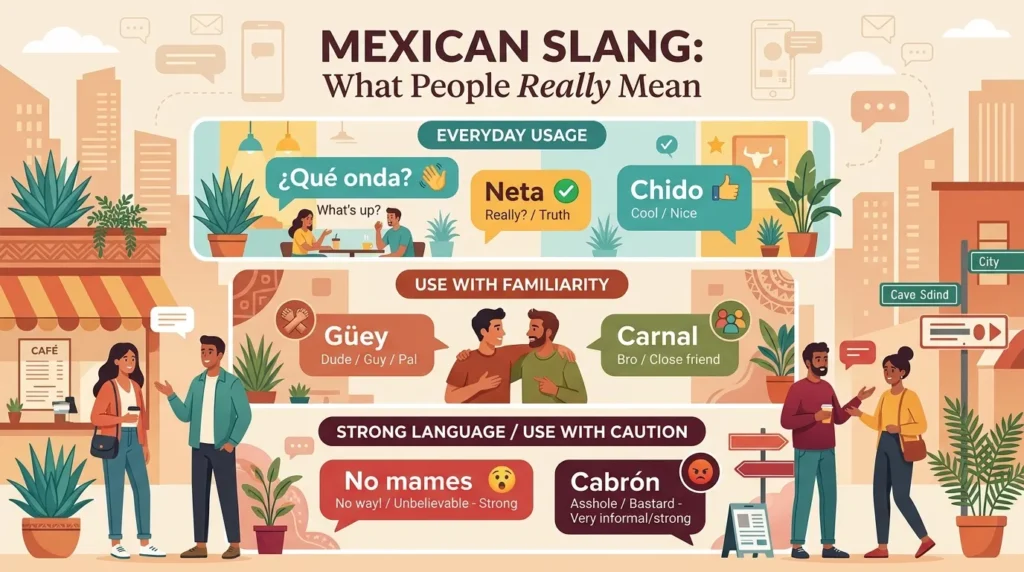

Mexican slang includes informal words and expressions such as güey, qué onda, órale, neta, no manches, chido, and chamba. They appear in casual Mexican Spanish among friends, family, coworkers, online communities, and everyday conversations, but their tone can range from friendly to strongly vulgar.
There is no single slang vocabulary used identically throughout Mexico. Age, region, social group, relationship, and tone all matter. A word that sounds affectionate between close friends may be insulting when directed at a stranger. Some expressions are widely recognized, while others are especially associated with particular parts of the country.
Quick-Answer Box
| Question | Quick Answer |
|---|---|
| What is Mexican slang? | Informal vocabulary and expressions associated with everyday Mexican Spanish |
| Common examples | Güey, qué onda, órale, neta, chido, no manches |
| Typical context | Friends, family, casual conversation, messaging, entertainment and social media |
| Formality | Mostly informal |
| Can it be rude? | Yes. Some words are harmless, while others are vulgar or insulting |
| Does meaning change by tone? | Very often |
| Is all Mexican slang used everywhere in Mexico? | No. Regional and generational differences are important |
| Best advice for learners | Learn to recognize expressions before copying how native speakers use them |
What Is Mexican Slang?
Mexican slang is the informal side of Spanish as spoken in Mexico. It includes individual words, shortened forms, greetings, reactions, insults, humorous expressions, and ordinary words that develop special meanings in Mexican usage.
It is important to separate Mexican slang from Mexican Spanish as a whole. Mexican Spanish includes standard vocabulary, pronunciation patterns, regional varieties, grammar, and ordinary everyday language. Slang is only one part of that much larger linguistic system.
The line between slang and ordinary colloquial language is not always sharp. A word can begin as slang and become so familiar that speakers barely notice it as unusual. Other expressions remain strongly tied to casual speech.
Regional variation matters too. Mexico is linguistically diverse, so speech in Mexico City, Guadalajara, Monterrey, Tijuana, Oaxaca, Veracruz, Yucatán, Sonora, and other areas should not be treated as identical.
Quick List of Popular Mexican Slang Terms
| Slang Term | Simple Meaning | Tone | Usage Warning |
|---|---|---|---|
| ¿Qué onda? | What’s up? | Friendly | Informal |
| Güey / wey | Dude, guy, idiot | Friendly to insulting | Use mainly with familiar people |
| Órale | Okay, wow, come on, let’s go | Expressive | Meaning depends on tone |
| Neta | Truth, really, seriously | Casual | Generally mild |
| No manches | No way, come on | Surprised | Mild and informal |
| Chido | Cool, nice, good | Positive | Informal |
| Padre | Cool, great | Positive | Informal but fairly mild |
| Aguas | Watch out | Warning | Informal |
| Simón | Yes, sure | Playful/casual | Slangy |
| Chale | Geez, darn, what a shame | Disappointed | Casual |
| Cuate | Friend, buddy | Friendly | Informal |
| Carnal | Brother, close friend | Familiar | Best with people you know |
| Chavo / chava | Young person | Casual | Can also mean a partner in some contexts |
| Morro / morra | Kid, young person | Casual | Especially associated with northern/northwestern usage |
| Chamba | Job, work | Casual | Widely understood |
| Lana | Money | Casual | Informal |
| Chela | Beer | Casual | Alcohol-related |
| Bronca | Fight, trouble, problem | Negative | Informal |
| Chafa | Cheap, poor quality, disappointing | Negative | Can criticize a thing or situation |
| Fresa | Privileged, conservative or “preppy” type | Judgmental | Can carry social-class assumptions |
| No mames | No way, you’ve got to be kidding | Vulgar | Avoid formal situations |
| Pedo | Problem, conflict, drunkenness and other meanings | Vulgar | Highly context-dependent |
| Pinche | Damn, lousy, miserable | Vulgar/insulting | Often intensifies criticism |
| Cabrón | Jerk, bastard, skilled person, guy | Vulgar | Tone changes it dramatically |
| Chingón | Excellent, highly skilled, badass | Positive but vulgar | Not suitable for formal settings |
| Pendejo | Idiot, fool | Insulting | Strong insult |
The difference between popular/informal expressions and clearly vulgar ones is important. Terms such as pedo, pendejo, pinche, and some uses of cabrón belong to a much stronger register than everyday expressions such as neta or chido.
Popular Mexican Slang Words and Meanings
Greetings and Everyday Expressions
¿Qué onda?
¿Qué onda? is a casual way to say “What’s up?”, “How’s it going?”, or “What’s going on?”
It works best with people you already speak to informally.
Example:
¿Qué onda, Luis? ¿Todo bien?
“What’s up, Luis? Everything good?”
The word onda literally has meanings such as “wave,” but learners should understand ¿qué onda? as a complete conversational expression rather than translating it word by word.
Güey or Wey
Güey, frequently written wey in messages and informal online writing, is one of the most recognizable Mexican slang words.
Between friends, it can function much like “dude,” “man,” or “bro.” It can also simply refer to a person. But with a different tone, it can mean something closer to “idiot” or become openly disrespectful. It may also function almost like a conversational filler among familiar speakers.
Example:
Güey, se me olvidaron las llaves.
“Dude, I forgot my keys.”
Compare that with:
¡Qué güey fui!
“I was such an idiot!”
The relationship between the speakers matters more than a simple English translation.
Pronunciation: roughly “way” or “whey.”
Órale
Órale is unusually flexible. Depending on intonation and situation, it can communicate:
- Okay
- Let’s do it
- Come on
- Hurry up
- Wow
- Go ahead
It can encourage someone, accept a suggestion, show surprise, or push somebody to act.
Example:
—¿Vamos por tacos?
—¡Órale!
“Want to go get tacos?”
“Sure!”
In another situation:
¡Órale, ya vámonos!
“Come on, let’s go!”
For learners, órale is a good example of why Mexican slang cannot always be translated with one fixed English word.
Neta
Neta commonly relates to truth, seriousness, or sincerity. It can mean “the truth,” “really,” or “seriously.” The expression ser la neta can also praise someone or something as excellent.
Examples:
La neta, no quiero ir.
“Honestly, I don’t want to go.”
¿Neta?
“Seriously?” / “Really?”
Esos tacos son la neta.
“Those tacos are amazing.”
It is casual but much less risky than many vulgar expressions.
No manches
No manches is used to express surprise, disbelief, frustration, or amazement. Depending on the situation, natural English equivalents include “No way,” “Come on,” “You’re kidding,” or “Seriously?”
Example:
—Me gané dos boletos.
—¡No manches!
“I won two tickets.”
“No way!”
It is usually considered much milder than no mames.
Chido
Chido means something like cool, good, nice, attractive, or enjoyable. It can describe an object, plan, experience, or situation.
Está chido tu carro.
“Your car is cool.”
Qué chido que viniste.
“It’s great that you came.”
It is strongly informal but useful for recognizing casual Mexican speech.
Padre and Padrísimo
When padre is used colloquially to describe something rather than referring to a father, it can mean cool, nice, great, or enjoyable.
Está padre el lugar.
“This place is cool.”
Padrísimo intensifies the idea:
La fiesta estuvo padrísima.
“The party was awesome.”
Compared with stronger slang, qué padre is relatively easygoing.
¡Aguas!
¡Aguas! means “Watch out!” or “Be careful!” when shouted as a warning.
¡Aguas! Viene una bici.
“Watch out! A bike is coming.”
This meaning has nothing to do with asking for drinking water. Context immediately separates the warning from the ordinary noun agua.
Simón
Simón is a playful informal way to say yes, sure, or of course.
—¿Vienes mañana?
—Simón.
“You coming tomorrow?”
“Yeah.”
It is distinctly casual. In a professional conversation, normal sí is safer.
Chale
¡Chale! can express disappointment, annoyance, disbelief, or resignation. Depending on context, it may resemble “geez,” “come on,” “darn,” or “what a shame.”
Chale, otra vez está lloviendo.
“Darn, it’s raining again.”
Tone does much of the work.
Also Read: New York Slang: 30 NYC Words and Phrases Explained
Slang for Friends and People
Cuate
Cuate commonly means friend, buddy, or pal. It can also simply refer informally to a person.
Voy a salir con unos cuates.
“I’m going out with some friends.”
It is friendly and less potentially confrontational than güey.
Carnal
Carnal literally has other meanings connected with flesh or blood relationships, but in popular speech it can mean brother or close friend.
Ese güey es mi carnal.
“That guy is my close friend / my bro.”
Calling someone carnal usually suggests familiarity or solidarity.
Chavo and Chava
Chavo and chava commonly refer to a young person, guy, girl, young man, or young woman. They can also refer to someone’s boyfriend or girlfriend in certain contexts.
Había muchos chavos en el concierto.
“There were lots of young people at the concert.”
The exact age implied is flexible rather than fixed.
Morro and Morra
Morro and morra can mean kid, boy, girl, or young person, but they have stronger regional associations than some of the expressions above. The usage is especially documented in northwestern Mexican speech.
Cuando estaba morro, jugaba fútbol todos los días.
“When I was a kid, I played soccer every day.”
A learner should therefore avoid assuming that morro is equally natural for every Mexican speaker.
Work, Money, and Everyday Life
Chamba
Chamba means work, a job, or employment.
Conseguí chamba.
“I got a job.”
Tengo mucha chamba hoy.
“I have a lot of work today.”
The related verb chambear means to work.
Lana
Lana literally means wool, but in popular usage it also means money.
No tengo lana.
“I don’t have any money.”
Le costó una buena lana.
“It cost him/her a lot of money.”
The surrounding sentence makes the slang meaning obvious.
Chela
Chela is an informal word for beer.
Vamos por unas chelas.
“Let’s go get some beers.”
Because it refers to alcohol, it naturally appears more often in social situations than formal conversation.
Cruda
In Mexican usage, cruda can mean a hangover.
Traigo una cruda horrible.
“I have a terrible hangover.”
Do not confuse this with the ordinary adjective crudo/cruda, which can also mean raw or describe something harsh or intense.
Bronca
Bronca can mean a fight, conflict, difficulty, or problem.
No quiero broncas.
“I don’t want any trouble.”
Tenemos una bronca con el carro.
“We have a problem with the car.”
It does not necessarily imply a physical fight.
Chafa
Chafa describes something that is bad, cheap, disappointing, defective, or poor quality.
Compré unos audífonos bien chafas.
“I bought some really lousy headphones.”
It can also criticize an experience:
Qué chafa que cancelaron.
“That sucks / What a shame that they canceled.”
Also Read: Spanish Slang: Common Words, Meanings, and Regional Differences
Social Labels That Need More Care
Fresa
Fresa literally means strawberry, but as a social label it can describe someone perceived as privileged, conservative in taste, sheltered, polished, or associated with an affluent social environment.
The exact stereotype changes by speaker and context.
Calling another person fresa is therefore more judgmental than saying something neutral like chavo. A learner should recognize the term without assuming that every person fitting a particular fashion, accent, or background should be labeled this way.
Naco and Ñero
Some Mexican social labels can carry strong judgments about education, class, behavior, neighborhood, or perceived social status. Terms in this category may be used jokingly within particular groups but can also reproduce class prejudice or sound demeaning.
For a non-native speaker, these are generally better understood than casually adopted. The risk is not simply grammatical error; it is misunderstanding the social meaning attached to the label.
Strong and Vulgar Mexican Slang
The following expressions appear frequently enough that learners may hear them, but recognition is safer than immediate imitation.
No Mames
No mames can express disbelief, shock, annoyance, or strong surprise. In some conversations it works emotionally like “No freaking way,” “You’ve got to be kidding,” or a stronger English reaction.
It is more vulgar than no manches. The underlying expression belongs to a sexual/vulgar register, even though speakers sometimes use the whole phrase casually among friends.
Compare:
¡No manches! — milder
¡No mames! — stronger and vulgar
The emotional message may be similar, but the register is not.
Pedo
Pedo is one of the most context-dependent vulgar words in Mexican slang. Its literal meaning refers to intestinal gas, but slang expressions built around it can refer to problems, fights, conflict, drunkenness, challenges, or situations.
For example:
¿Cuál es el pedo?
“What’s the problem?” / “What’s going on?”
Se armó un pedo.
“A big problem/fight started.”
Andaba pedo.
“He was drunk.”
Because the meaning changes dramatically inside different phrases, memorizing pedo = one English word will usually cause confusion.
Pinche
Pinche often works as a negative intensifier before a noun, roughly resembling damn, lousy, crappy, miserable, or stronger English profanity depending on tone. It can also describe something as cheap or poor quality.
Este pinche tráfico.
“This damn traffic.”
It is vulgar and unsuitable for polite or professional speech.
Cabrón
Cabrón demonstrates especially clearly why context matters.
It can function as:
- A serious insult
- A rough term between close friends
- A general reference to a person
- Praise for someone extremely skilled
- An adjective meaning something is difficult, intense, or severe
These meanings are all documented in Mexican usage.
Ese examen estuvo cabrón.
“That exam was really tough.”
Between close friends, a completely different tone may make the same word sound playful. Directed angrily at a stranger, it can become confrontational.
Learners should be very cautious with it.
Chingón
Chingón is often positive despite belonging to a vulgar word family. It can describe someone who is extremely skilled, impressive, excellent, or among the best, or something of very high quality.
Es un músico chingón.
“He’s an amazing musician.”
Está chingón.
“It’s awesome.”
The positive meaning does not make it formal. It is still inappropriate in many professional, academic, or polite settings.
Pendejo
Pendejo is a direct insult usually meaning something like idiot, fool, moron, or stupid person in Mexican usage.
No seas pendejo.
“Don’t be an idiot.”
Friends may sometimes use insults jokingly with each other, but that does not make the word universally friendly. With strangers or during an argument, it can be strongly offensive.
Mexican Slang on Social Media and Messaging Apps
Text messages, TikTok, Instagram, WhatsApp, gaming chats, and other informal online spaces often reproduce the same slang heard in speech rather than creating completely separate definitions.
One visible difference is spelling. Güey is frequently typed wey, especially in fast casual messages. Accent marks may also disappear in informal typing, so qué onda may appear as que onda and órale as orale.
Online communication can also make tone harder to interpret. A message such as:
No mames wey 😂
may indicate amused disbelief between friends, while:
No mames, güey.
in an argument can sound irritated or aggressive.
Emojis, punctuation, relationship, and the previous message therefore matter as much as the dictionary meaning.
Also Read: Australian Slang: Popular Aussie Words and Phrases Explained
Real Conversations Using Mexican Slang
1. Greeting a Friend
A: ¿Qué onda?
B: Todo bien. ¿Y tú?
Translation:
“What’s up?”
“All good. You?”
2. Expressing Surprise
A: Conseguí boletos para el concierto.
B: ¡No manches! ¿Neta?
Translation:
“I got tickets for the concert.”
“No way! Seriously?”
3. Making Plans
A: ¿Vamos a comer?
B: Órale, vamos.
Translation:
“Want to go eat?”
“Sure, let’s go.”
4. Talking About Work
A: ¿Por qué no puedes salir?
B: Tengo un montón de chamba.
Translation:
“Why can’t you go out?”
“I have a ton of work.”
5. Warning Someone
A: Voy a cruzar.
B: ¡Aguas! Viene un coche.
Translation:
“I’m going to cross.”
“Watch out! A car is coming.”
6. Complimenting Something
A: ¿Qué te pareció el lugar?
B: Está bien chido.
Translation:
“What did you think of the place?”
“It’s really cool.”
7. A Stronger Conversation Between Friends
A: Güey, olvidé las llaves otra vez.
B: No mames.
Translation:
“Dude, I forgot the keys again.”
“You’ve got to be kidding.”
The last exchange depends heavily on familiarity. The same wording with an angry tone can sound much harsher.
Formal Versus Informal Usage
Some expressions are relatively easy for learners to understand and occasionally use with friends:
Lower-risk casual terms: qué onda, chido, qué padre, neta, aguas, chamba, and cuate.
Others require stronger familiarity:
More relationship-dependent: güey, carnal, simón, morro/morra, and chale.
And some should generally be avoided in professional environments:
Vulgar or potentially insulting: no mames, pedo, pinche, cabrón, chingón, and pendejo.
The workplace is especially context-sensitive. Mexican coworkers who have known each other for years may use informal language privately that would sound inappropriate from a new employee, customer, manager, or visitor.
Knowing that a word exists is not the same as having the social permission to use it.
Similar Terms and Regional Differences
| Terms | Shared Idea | Main Difference | Typical Context |
|---|---|---|---|
| Güey / cuate / carnal | Person or friend | Güey is flexible and riskier; cuate means friend; carnal suggests closeness | Casual relationships |
| Chido / padre / chingón | Something positive | Chido and padre are milder; chingón is stronger and vulgar | Praise |
| No manches / no mames | Surprise or disbelief | No mames is considerably more vulgar | Reactions |
| Chavo / morro | Young person | Morro has stronger regional associations | Informal descriptions |
| Bronca / pedo | Problem or conflict | Pedo is much more vulgar and has many additional meanings | Problems and arguments |
| Neta / ¿neta? | Truth or seriousness | Statement versus questioning reaction | Casual conversation |
One useful lesson is that apparent synonyms are rarely identical. Choosing a stronger expression changes not only meaning but also the social tone.
Cultural Origin and Evolution
Mexican colloquial vocabulary comes from many layers of linguistic history. Some expressions belong to long-established Mexican usage, some developed new figurative meanings from ordinary Spanish words, and others reflect particular regions or social groups.
Mexican Spanish itself has substantial internal variation, so slang naturally changes across geography and generations. Urban speech can spread widely through entertainment, migration, music, memes, messaging, and other forms of communication, but wider recognition does not automatically mean identical usage everywhere.
Exact origin stories for slang should also be treated cautiously. Colorful explanations often circulate online, but not every popular story about where an expression supposedly came from can be established confidently.
For learners, present-day meaning and social context are usually more useful than a questionable origin story.
Respectful Usage and Cultural Sensitivity
The best way to learn Mexican slang is to listen before imitating.
Pay attention to who says the word, who receives it, and what relationship exists between them. Two longtime friends can exchange language that would sound rude from a stranger.
Do not assume that knowing an English translation gives you the same social instincts as a native speaker. English labels such as “dude,” “badass,” or “idiot” only approximate the meaning. Tone and familiarity can change the force of the Spanish expression.
It is also worth avoiding slang labels that judge people by perceived social class, neighborhood, ethnicity, appearance, or identity unless you fully understand the context.
And remember that sounding natural does not require using the strongest vocabulary. A learner who uses qué onda, neta, or qué padre naturally will usually sound more comfortable than someone who forces profanity into every sentence.
Also Read: Eiffel Tower Slang Meaning: What Does “Eiffel Tower” Mean?
Frequently Asked Questions
What are the most common Mexican slang words to learn first?
Useful expressions to recognize first include qué onda, güey or wey, órale, neta, no manches, chido, qué padre, aguas, chamba, and cuate. They cover greetings, reactions, friendship, praise, warnings, and everyday life without requiring you to begin with the strongest profanity.
What does güey mean in Mexican slang?
Güey, also commonly typed wey, can mean “dude,” “guy,” or “friend” among familiar speakers. It can also refer to someone as stupid or function as an insult. Tone and relationship are essential, which is why learners should avoid using it casually with strangers.
What does no manches mean?
No manches expresses surprise, disbelief, or frustration and often corresponds to “no way,” “come on,” or “you’re kidding.” It is informal but generally milder than the vulgar expression no mames.
Is Mexican slang different from Spanish slang?
Yes. Spanish varies widely between countries and regions. Expressions that sound completely ordinary in Mexico may be uncommon, confusing, humorous, or have a different meaning elsewhere. Even within Mexico, slang can vary substantially by region and community.
Is Mexican slang the same on TikTok, Instagram, and WhatsApp?
Usually, common words keep their core meanings across platforms. The biggest differences involve context, spelling, memes, abbreviations, and tone. For example, güey is often written wey. Creating separate definitions for every social platform would therefore be misleading when the underlying meaning has not changed.
Is Mexican slang appropriate at work?
Some mild colloquial expressions may occur naturally between coworkers, but slang is generally safer in casual relationships than formal business communication. Vulgar expressions such as no mames, pinche, pendejo, and pedo should not be treated as normal professional vocabulary simply because coworkers sometimes use them privately.
Is chingón a compliment or an insult?
It is often a compliment meaning someone is exceptionally skilled or something is excellent. However, it belongs to a vulgar word family and can carry other meanings in different constructions. Calling someone chingón may be enthusiastic praise among friends but remains unsuitable for many formal settings.
Can non-native Spanish speakers use Mexican slang?
Yes, but observation matters. Start with milder expressions and notice how people around you use them. Avoid assuming that profanity makes your Spanish more authentic. Using a simple expression naturally is usually better than repeating a strong word without understanding the relationship, tone, or regional context.
Conclusion
Mexican slang is best understood as a flexible part of everyday Mexican Spanish rather than a fixed list of funny translations. Expressions such as qué onda, güey, órale, neta, no manches, chido, and chamba can make conversations much easier to follow, while stronger words such as pedo, cabrón, pinche, pendejo, and no mames require much more caution.
The most important skill is not memorizing the largest number of slang words. It is recognizing who is speaking, how they say it, where they are from, and how well the speakers know each other. Once those clues become familiar, the vocabulary begins to make much more sense.



Pingback: FOMO Meaning Slang: What It Means in Text and Online
Pingback: DSL Meaning Slang: What It Means in Text and Online
Pingback: Spanish Slang: Common Words, Meanings, and Regional Differences
Pingback: 90s Slang: Popular Words and Phrases From the 1990s