
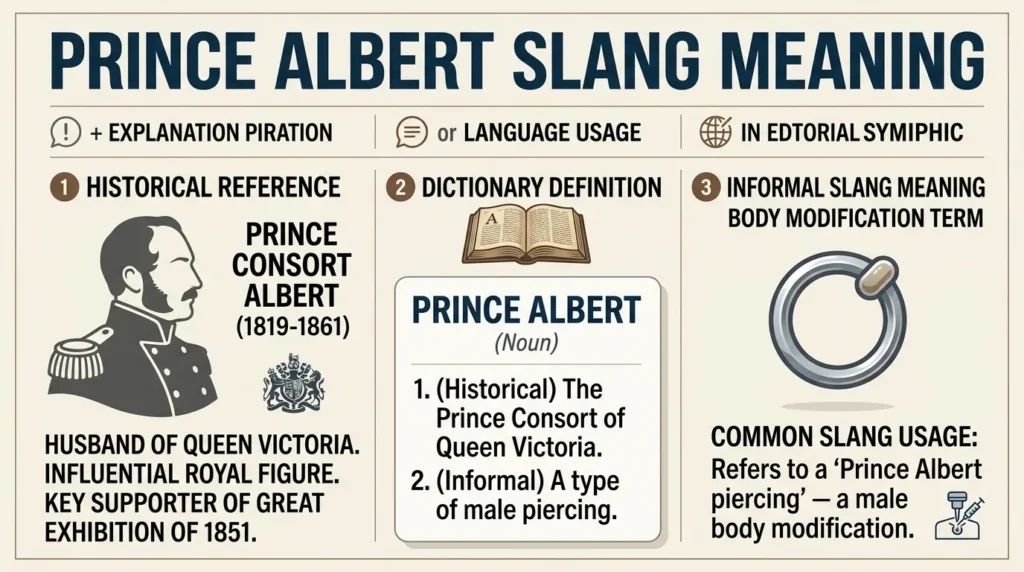

“Prince Albert” slang usually refers to a male genital piercing, specifically a type of piercing that passes through the urethral opening and exits through the underside of the penis. The term is mainly used in discussions about body modification, sexual health, or adult slang. The meaning is highly context-dependent because “Prince Albert” can also refer to the historical figure, a clothing style, or other non-slang uses.
In casual conversations, online discussions, or adult-related contexts, “Prince Albert” almost always refers to the piercing rather than the person or historical references. Because the term has both a common name-based meaning and a slang meaning, surrounding words and the situation usually determine the intended interpretation.
| Category | Meaning |
|---|---|
| Most common slang meaning | A Prince Albert genital piercing |
| Typical context | Body modification, adult conversations, sexual health discussions |
| Tone | Neutral, clinical, casual, or explicit depending on context |
| Formality | Informal; medical discussions may use more specific terminology |
| Pronunciation | “Prince AL-bert” |
| Safe to use? | Context-sensitive; avoid using casually in professional settings |
What Does “Prince Albert” Mean in Slang?
The slang term Prince Albert refers to a specific type of male genital piercing. The piercing is named after the historical figure associated with the name, although the popular stories surrounding the origin of the term are uncertain.
In modern usage, someone saying they have a “Prince Albert” usually means they have this type of body piercing. The phrase is often shortened in conversations among people familiar with piercing terminology.
Examples:
- “He got a Prince Albert years ago.”
- “They were discussing different types of piercings, including a Prince Albert.”
- “I didn’t know what a Prince Albert was until I saw the term online.”
The expression is not usually used as a general insult, joke, or everyday slang word. Its meaning is specific and connected to body modification.
Why Context Matters With “Prince Albert”
The phrase can be confusing because “Prince Albert” is also a normal name and historical reference.
For example:
- “Prince Albert visited the museum.”
→ Refers to a person or historical figure. - “He has a Prince Albert.”
→ Usually refers to the piercing. - “They sell Prince Albert jewelry.”
→ Likely refers to piercing jewelry.
The surrounding topic usually makes the meaning clear. Conversations about history, royalty, clothing, or museums point toward the traditional meaning. Conversations about piercings, tattoos, or body modification point toward the slang meaning.
Quick Meaning by Context
| Context | Likely Meaning | Example | Usage Level |
|---|---|---|---|
| Body modification | Genital piercing | “She asked about his Prince Albert piercing.” | Very common |
| Sexual health discussion | Specific anatomy-related piercing | “The doctor asked about his Prince Albert.” | Common |
| Historical discussion | Prince Albert as a person | “Prince Albert was Queen Victoria’s husband.” | Common |
| Clothing or accessories | Possible reference to a style or name | “A Prince Albert coat style.” | Less common |
What Is a Prince Albert Piercing?
A Prince Albert piercing is a type of genital piercing involving jewelry placed through part of the penis. It is generally recognized as one of the more well-known male genital piercings.
The term usually refers to the specific placement rather than genital piercings in general. Other types of genital piercings have different names and locations.
People may discuss Prince Albert piercings for different reasons, including:
- Personal body modification choices
- Aesthetic preferences
- Curiosity about piercing styles
- Sexual discussions
- Health or aftercare questions
Because it involves an intimate part of the body, conversations about it are often considered private. Whether the term feels casual, medical, humorous, or inappropriate depends heavily on who is speaking and the situation.
Also Read: OAT Slang Meaning: Complete Definition, Usage & Examples
Is “Prince Albert” Considered Slang?
Yes, in many conversations the term functions as slang because it is an informal name for a specific body modification. However, it is also a widely recognized term within piercing communities and discussions about anatomy.
It is different from many slang words because it is not primarily a shortened expression, insult, or internet phrase. Instead, it is a commonly used name for a particular type of piercing.
The word “slang” in this case mainly refers to its informal cultural use rather than a hidden meaning.
Where Is the Term Used?
The phrase appears most often in conversations involving:
- Body piercing
- Tattoo and modification communities
- Sexual health discussions
- Adult topics
- Online forums
- Informal conversations
It is less likely to appear in everyday conversation unless the topic naturally involves piercings or personal preferences.
Someone unfamiliar with piercing terminology may not recognize the slang meaning immediately.
How Tone Changes the Meaning
The words themselves usually carry the same meaning, but the tone around them can change how the phrase feels.
Neutral Tone
A person may use the term simply to describe a piercing.
Example:
“He has experience with different piercings, including a Prince Albert.”
This is informational.
Medical or Educational Tone
The term may appear during health-related conversations.
Example:
“The patient mentioned having a Prince Albert piercing.”
The focus is anatomy or care rather than humor.
Humorous or Shock Value Tone
Some people mention the term as a joke because it involves an intimate body area.
Example:
“That conversation took an unexpected turn when someone brought up a Prince Albert.”
Here, the reaction comes from the subject matter rather than the word itself.
Private or Sexual Context
The phrase may appear in adult conversations where the meaning is more personal or intimate.
Real Conversation Examples
Example 1: Casual discussion
Person A: “He has several piercings.”
Person B: “Including a Prince Albert?”
Meaning: Asking about a specific genital piercing.
Example 2: Learning about body modification
Person A: “I’m researching different types of piercings.”
Person B: “You’ll probably see Prince Albert mentioned.”
Meaning: A type of piercing being discussed.
Example 3: Medical conversation
Person A: “The doctor asked about previous piercings.”
Person B: “That would include a Prince Albert if someone had one.”
Meaning: A health-related reference.
Example 4: Online discussion
Person A: “What does Prince Albert mean?”
Person B: “It’s a type of genital piercing.”
Meaning: Asking for a definition.
Example 5: Misunderstanding the phrase
Person A: “I saw Prince Albert mentioned online.”
Person B: “Were they talking about history or piercings?”
Meaning: Context determines the interpretation.
Example 6: Professional setting
Person A: “Someone used the phrase during a meeting.”
Person B: “That sounds unusual unless the topic was relevant.”
Meaning: The phrase may be inappropriate if unrelated to the conversation.
Example 7: Body modification discussion
Person A: “Which piercings are considered advanced?”
Person B: “A Prince Albert is one example people often discuss.”
Meaning: Referring to piercing categories.
Grammar and Language Role
“Prince Albert” works as a proper noun phrase when referring to the piercing name.
Examples:
- “He has a Prince Albert.”
- “She learned about Prince Albert piercings.”
- “They sell jewelry for Prince Albert piercings.”
The term is usually capitalized because it comes from a name.
Common variations include:
- Prince Albert piercing
- PA piercing
- Prince Albert
The shortened form “PA” may appear among people familiar with piercing terminology, but outside that context it can have many unrelated meanings.
Also Read: Mid Meaning Slang: What “Mid” Means in Text and Online
Other Genuine Meanings of “Prince Albert”
Although the slang meaning is now common in certain conversations, Prince Albert is not originally a slang phrase. It has several other meanings that can appear depending on the topic.
Prince Albert as a Historical Name
The most traditional meaning refers to Prince Albert of Saxe-Coburg and Gotha, who was the husband of Queen Victoria.
In historical contexts, “Prince Albert” usually refers to:
- Royal history
- The Victorian era
- British monarchy
- Art, science, and cultural developments associated with the 19th century
Example:
“Prince Albert supported many educational and cultural projects during the Victorian period.”
This meaning has no connection to the slang usage.
Prince Albert as a Clothing Reference
“Prince Albert” can also appear in clothing-related contexts. Some fashion terms use the name because of historical associations with Victorian style.
Examples include:
- Prince Albert coats
- Formal Victorian-inspired clothing
- Traditional men’s fashion references
In these cases, the phrase refers to style rather than body modification.
Prince Albert as a Place Name
“Prince Albert” is also used as a geographic name in different locations.
For example, it may refer to:
- Cities or towns
- Buildings
- Streets
- Historical landmarks
When the phrase appears in a travel, geography, or local-news context, it usually has nothing to do with slang.
Meaning of “Prince Albert” on Social Media and Messaging Apps
Unlike many internet slang terms, Prince Albert does not have a special Snapchat, TikTok, Instagram, or texting meaning that differs from its standard slang meaning.
If someone mentions it online, the intended meaning usually depends on the surrounding conversation.
In Educational or Informational Posts
The phrase may appear in:
- Health discussions
- Body modification explanations
- Anatomy-related conversations
- Piercing communities
Example:
“This article explains different types of piercings, including a Prince Albert.”
Meaning: educational reference.
In Humor or Meme Contexts
The term may appear because some people find the subject unusual, surprising, or sensitive.
In these situations, the humor usually comes from the unexpected topic rather than from a separate slang definition.
In Private Messages
The meaning may depend strongly on the relationship between the people communicating.
A message between close friends may use the term casually, while the same phrase from a stranger may feel inappropriate or intrusive.
How to Understand “Prince Albert” From Context
Because the phrase has multiple meanings, readers should look at the surrounding clues.
Look at the Topic
The subject usually gives the biggest clue.
| Conversation Topic | Most Likely Meaning |
|---|---|
| Royal history | Historical person |
| Victorian fashion | Clothing style |
| Piercings or tattoos | Genital piercing |
| Health discussion | Piercing or anatomy |
| Travel or geography | Place name |
Look at Nearby Words
Certain words strongly suggest the slang meaning.
Examples:
- piercing
- jewelry
- aftercare
- body modification
- anatomy
- intimate
- genital
These words usually indicate that “Prince Albert” refers to the piercing.
Consider the Relationship Between Speakers
The same phrase can feel different depending on who says it.
- Between friends discussing piercings → likely casual
- In a medical conversation → informational
- In a workplace conversation without context → potentially inappropriate
- From a stranger → may be viewed as overly personal
Is “Prince Albert” Offensive, Rude, or Inappropriate?
The term itself is generally not an insult or offensive word. It is a descriptive term for a type of piercing.
However, appropriateness depends on the situation.
Casual Conversations
Among people discussing body modification, the term can be completely normal.
Example:
“I’m learning about different piercing styles.”
A discussion of Prince Albert piercings may fit naturally.
Professional Settings
Using the term at work may be inappropriate unless the topic is relevant.
For example:
- A healthcare discussion → possibly appropriate
- A workplace meeting about unrelated topics → usually unnecessary
With Strangers
Bringing up intimate body topics with someone who has not invited that conversation may feel uncomfortable.
The issue is usually not the word itself but the personal nature of the subject.
Online Communities
In spaces focused on:
- Piercing
- Body art
- Sexual health
- Personal experiences
the term may be used openly.
Outside those spaces, readers should consider the audience before using it.
Commonly Confused Terms
| Term | Meaning | Main Difference | Typical Context |
|---|---|---|---|
| Prince Albert | A specific male genital piercing | Refers to one particular piercing style | Body modification |
| PA | Short form sometimes used for Prince Albert | Can have many other meanings outside piercing contexts | Piercing communities |
| Frenum piercing | A different genital piercing style | Located in another area | Piercing discussions |
| Apadravya | Another type of genital piercing | Different placement | Body modification discussions |
| Ampallang | Another genital piercing type | Different location and style | Piercing terminology |
The important distinction is that Prince Albert is a specific name, not a general term for all genital piercings.
Who Uses the Term?
Usage varies depending on the community and conversation.
The term is more commonly encountered among:
- People interested in body modification
- Piercing professionals
- Individuals researching piercings
- Adults discussing sexual health
- Online communities focused on alternative lifestyles
It is not generally part of everyday slang used by most people.
Someone unfamiliar with piercing terminology may only recognize “Prince Albert” as a historical name.
Origin and Evolution of the Term
The exact history behind the name is not completely certain.
The phrase became associated with the piercing over time and is now widely recognized in body modification discussions. Stories connecting the name directly to historical figures are often repeated, but the details surrounding the origin are difficult to verify.
The modern meaning developed through piercing culture rather than through everyday language.
Over time, the term moved from specialized body modification discussions into broader internet conversations, where many people encounter it for the first time.
Today, it remains a stable term rather than a rapidly changing internet expression.
Real-World Interpretation: Why This Term Gets Misunderstood
“Prince Albert” is a good example of how language can change through communities.
A phrase that originally functions as a name can gain a completely different meaning in a specialized group. Once that meaning becomes widely recognized, people may encounter two interpretations at the same time.
The safest approach is not to assume immediately. The surrounding topic usually reveals whether someone is discussing history, fashion, geography, or body modification.
Also Read: Chicago Slang: Words, Phrases, Meanings, and How Locals Use Them
How to Reply When Someone Mentions “Prince Albert”
The best response depends on the situation.
Neutral Reply
Useful when you want clarification:
“Do you mean the piercing or the historical figure?”
Informational Reply
If someone is asking for the meaning:
“A Prince Albert is a type of genital piercing.”
Professional Reply
If the topic appears unexpectedly:
“Can you clarify the context you mean?”
Friendly Reply
With someone discussing piercings:
“I’ve heard of that type of piercing, but I don’t know much about it.”
Avoid making assumptions about someone’s personal choices based only on the term.
Frequently Asked Questions
What does Prince Albert mean in slang?
In slang, “Prince Albert” usually means a specific type of male genital piercing. The term is commonly used in body modification discussions, sexual health conversations, and informal online discussions.
Is Prince Albert a sexual slang term?
It can appear in sexual or adult conversations, but the term itself is mainly a name for a type of piercing. The context determines whether the discussion is educational, personal, humorous, or sexual.
Why is it called a Prince Albert?
The exact origin of the name is uncertain. The phrase became associated with the piercing through body modification culture, and many stories about its historical connection are difficult to confirm.
Is “Prince Albert” the same as a regular piercing?
No. A Prince Albert refers to a specific genital piercing placement. Other genital piercings have different names and designs.
What does PA mean in piercing conversations?
“PA” can be shorthand for Prince Albert among people familiar with piercing terminology. However, the abbreviation can mean many unrelated things in other contexts.
Can I use “Prince Albert” in professional writing?
It depends on the subject. In medical, educational, or body modification contexts, the term may be appropriate. In unrelated professional communication, it is usually unnecessary.
Does “Prince Albert” mean something different on TikTok or Snapchat?
Generally, no. Social platforms may change how people encounter the phrase, but the slang meaning remains the same: a type of genital piercing.
Conclusion
“Prince Albert” slang usually refers to a specific male genital piercing, especially in conversations about body modification, anatomy, or adult topics. However, the phrase can also refer to historical, fashion, or place-related meanings, so context is essential.
The term itself is not automatically offensive, but because it involves an intimate subject, it should be used with awareness of the audience and situation. Understanding the context around the phrase is the easiest way to know which meaning someone intends.



Pingback: What Does DL Mean Slang? Text Meaning, Uses, and Examples