


In slang, a Dutch oven is a prank where someone farts under the bed covers and then pulls the covers over another person to trap the smell around them. It is crude, it is usually meant as a joke, and it is the kind of joke that lands very differently depending on who is in the bed and whether they were expecting it. Say the words “Dutch oven” in a kitchen and everyone pictures a heavy pot. Say them in a group chat and everyone pictures a blanket, a trapped partner, and a very bad smell.
That split is exactly why this term confuses people. It has a perfectly respectable cooking meaning and a very unserious slang meaning, and context decides which one you hear. This guide covers both, so you can tell them apart, use the slang meaning correctly in a joke or a story, and know when the joke stops being funny. You will also find the origin story, real examples, a comparison with the cooking pot, related pranks, and a straight answer to the question most people actually search: is Dutch oven slang offensive?
Contents
- What Does Dutch Oven Mean in Slang?
- Dutch Oven vs the Cooking Pot
- Where Did Dutch Oven Slang Come From?
- How People Use Dutch Oven in Conversation
- Who Says It, Where, and to Whom
- Related Terms and Variations
- Is Dutch Oven Slang Offensive?
- What to Say If Someone Dutch Ovens You
- Myths vs Facts About the Dutch Oven
- Frequently Asked Questions About Dutch Oven Slang
- Sources and Further Reading
What Does Dutch Oven Mean in Slang?
In slang, a Dutch oven is the act of farting in bed and holding the blanket over someone so the smell stays trapped under the covers with them. The blanket works like a lid. It seals in the air, the smell gets stronger in that small space, and the other person cannot simply wave it away. The prank is usually over in seconds, but the story gets told for years, which is part of why the term has stuck around.
People use it as a noun and as a verb. As a noun, it names the prank itself: “He pulled a Dutch oven on me last night.” As a verb, it names the action: “Do not Dutch oven me again.” You will also hear “Dutch ovened” for the person on the receiving end: “I got Dutch ovened and had to sleep on the couch side of the bed with the window open.” The core image never changes. It is always a bed, a blanket, a fart, and someone trapped in the middle of it.
One detail matters for understanding the joke. The humor, such as it is, comes from surprise and discomfort, not from clever wordplay. The person doing it usually laughs because the other person reacts, coughs, yells, or dives out from under the covers. The person receiving it may laugh too, if they share that kind of humor, or they may be genuinely annoyed. That split reaction is why the same prank can be a funny couple story in one home and a real argument in another.
The slang meaning in one line
If you need a short definition for a text or a comment, use this: a Dutch oven is when someone farts under the covers and traps their bed partner under the blanket with the smell. Keep it that simple and people will know exactly what you mean, because the image does most of the work.
What it is not
A Dutch oven is not just farting in bed. Plenty of people fart in bed without it becoming a Dutch oven. The prank part is the trapping. If the covers stay down and the other person is held inside that pocket of air, even briefly, that is the Dutch oven. If someone farts and everyone laughs and the air clears on its own, that is just a fart joke, not a Dutch oven. The blanket as a lid is what makes the term fit.
Dutch Oven vs the Cooking Pot
The slang meaning only makes sense because the cooking meaning came first. A Dutch oven in a kitchen is a heavy pot, usually cast iron, with a tight lid that traps heat and moisture so food cooks slowly and evenly. Stews, braises, soups, and bread all benefit from that sealed environment. The slang prank borrows the same idea, except the pot is a blanket, the lid is the covers pulled tight, and what gets trapped is not steam from a stew.
That is why the joke works as a metaphor. Anyone who has cooked with a real Dutch oven knows the moment you lift the lid and a cloud of hot air escapes. The prank copies that moment in miniature. Lift the blanket and the trapped air escapes, usually right into the face of the person who was underneath it. The comparison is gross, and that grossness is the point.
| Feature | Cooking Dutch oven | Slang Dutch oven |
|---|---|---|
| What it is | A heavy, lidded pot | A bed prank with a blanket |
| What gets trapped | Heat, steam, and cooking aromas | Warm air and the smell of flatulence |
| Where you hear it | Recipes, kitchens, camping gear lists | Jokes, group chats, couple stories, memes |
| Tone | Neutral and practical | Crude, playful, or rude, depending on context |
Context almost always clears up which meaning is meant. “Put the stew in the Dutch oven for three hours” is cooking. “He gave me a Dutch oven and I nearly threw up” is slang. Problems only start when someone drops the term with no context, like a text that just says “Dutch oven lol,” and the reader has to guess whether a pot or a prank is involved. If you are writing about the slang, say “Dutch oven prank” the first time so no one has to guess.
Where Did Dutch Oven Slang Come From?
The honest answer is that no one can point to a single inventor, and slang origin is murkier than the pot origin. The cooking pot has a long, documented history tied to Dutch metal casting methods. The prank, by contrast, grew out of bedroom and dorm humor, the kind of joke that gets passed around by word of mouth long before anyone writes it down. That gap is why different sources give different dates, and why you should treat any single date as reported rather than proven.
DUDE Wipes traces the slang use back to a 1974 National Lampoon reference describing the act of trapping a fart under a bedsheet, and notes that the earliest digital definition appears to be a 2001 Urban Dictionary entry that collected more than 1,200 upvotes. Resto NYC dates the vulgar meaning to at least the 1990s, possibly earlier, and points out that the exact reason the prank took the pot’s name remains unclear. Both accounts agree on the broad shape: the prank existed as a joke before it became a widely known term, and the internet gave it a name people could search.
The name itself is almost certainly a joke about the lid. A real Dutch oven seals in heat. A blanket seals in air. Once someone made that comparison out loud, it was too vivid to forget. Other theories float around, including camping trips where close quarters and fart jokes mix, and the general habit of attaching the word “Dutch” to blunt, bodily humor, but none of them is settled. The lid comparison is the explanation that fits best, and it is the one most writers repeat.
A short timeline, with soft edges
Think of the history in loose phases rather than exact years. First, the pot: a heavy lidded cooking vessel used for slow cooking, long before slang entered the picture. Then, the prank as an unnamed bedroom joke, the kind of thing siblings, roommates, and couples did and laughed about without a label. Then, the 1990s and early 2000s, when the name spread through magazines, books about relationship humor, and early internet dictionaries. Then, the social media era, where the term became a searchable joke, a meme caption, and a story people tell in comments. The dates are fuzzy, but the direction is clear: private joke first, public term later.
How People Use Dutch Oven in Conversation
Most uses fall into three buckets: telling a story, warning someone, or joking in a chat. Story uses sound like this: “My brother Dutch ovened me on a camping trip and I have never forgiven him.” Warning uses sound like this: “Do not fall asleep first, he will Dutch oven you.” Chat uses are shorter and looser: “Dutch oven revenge is coming,” or simply, “Dutch oven lol,” under a meme about couples.
Here are examples that show the range:
- “I woke up to a Dutch oven and spent the whole morning airing out the bedroom.”
- “She tried to Dutch oven me, but I escaped before she could pull the covers down.”
- “That is the third Dutch oven this week. We need new house rules.”
- “He calls it a Dutch oven. I call it grounds for sleeping on the couch.”
Notice how often the examples are past tense stories rather than instructions. People rarely announce a Dutch oven in advance, because surprise is the mechanism. The term is more useful for retelling than for planning, which is another reason it works so well in memes and comment sections. The story is short, visual, and instantly understood by anyone who has shared a bed.
Grammar notes that help you sound natural
Use “a Dutch oven” for the prank, “to Dutch oven someone” for the action, and “Dutch ovened” for the result. Do not capitalize it unless it starts a sentence. The cooking pot follows the same pattern, which is another reason context matters. If you write “Dutch Oven” with capitals in the middle of a joke, readers may still understand you, but lowercase reads more natural in casual writing.
Who Says It, Where, and to Whom
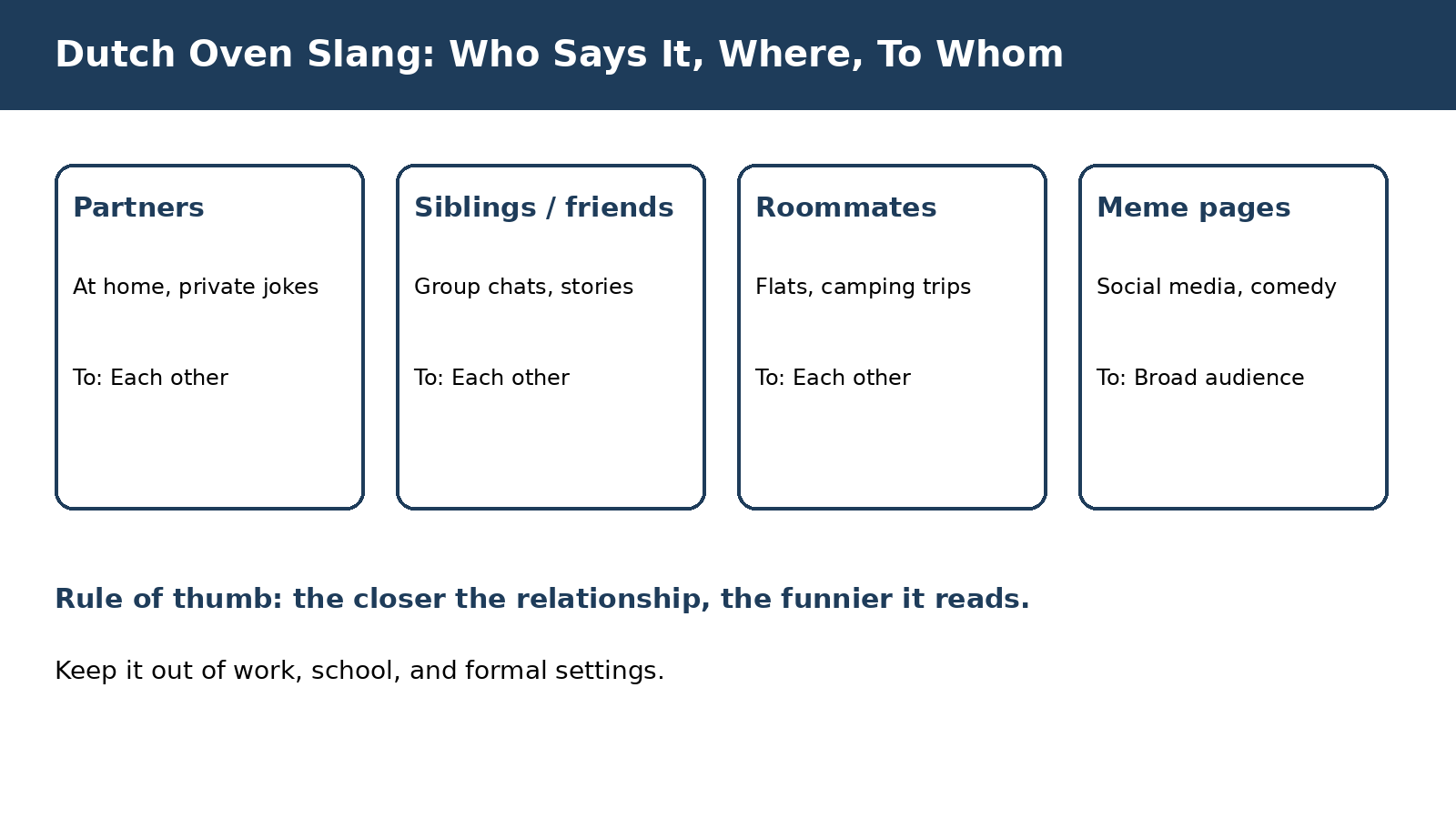
The Dutch oven joke lives in close relationships and casual spaces. It is a couples joke, a siblings joke, a roommates joke, and a dorm joke. It shows up in group chats, meme captions, comedy routines, and stories told at parties. It does not show up, or should not show up, in work emails, classrooms, or formal writing, because the bodily function at its center makes it vulgar by definition.
| Who says it | Where you hear it | To whom | How it usually lands |
|---|---|---|---|
| Partners and spouses | At home, in private jokes | Each other | Funny or annoying, depending on the couple’s humor |
| Siblings and close friends | Childhood stories, group chats | Each other | Usually funny in retelling, less funny in the moment |
| Roommates and dorm mates | Shared rooms, parties, prank stories | Each other | Funny if everyone is in on the joke, tense if not |
| Meme pages and comedians | Social media, stand-up, captions | A broad audience | Funny as a shared reference, not as a personal attack |
Related Terms and Variations
Dutch oven slang does not live alone. It sits in a small family of bed, bathroom, and prank terms, and people often confuse them because they all involve bodily humor and close friends.
- Crop dusting — Farting while walking, so the smell follows you or hits someone behind you.
- Silent but deadly — A fart that makes almost no sound but smells very strong.
- Potty humor — A broad label for jokes about bodily functions, including Dutch oven jokes.
- Prank war — A back-and-forth series of pranks between friends or partners, where a Dutch oven might be one move.
Related does not mean identical. Crop dusting is about movement, silent but deadly is about sound and smell, potty humor is a category, and a prank war is a format. A Dutch oven is specific: a bed, a blanket, and a trapped smell. If those three are not present, you are probably talking about a different joke.
If you like this kind of slang, you will also run into terms for reactions, like learning what cringe means in slang and what chat means in slang, and for laughter itself, like what CTFU means in text. Those terms often appear in the same memes and comments as Dutch oven jokes, because the same audiences share them.
Is Dutch Oven Slang Offensive?
Yes and no, which is the honest answer. The term itself is vulgar because it names a bodily function and a prank built around it. Most people will not use it in a formal email, a classroom, or a job interview, and they should not. In a casual conversation between consenting adults who share that humor, it is usually treated as a crude joke, not as a serious insult.
The prank is a different question from the word. A word can be vulgar without being harmful. A prank becomes a problem when it ignores consent, repeats after a clear no, or targets someone who cannot easily escape, such as a child, a guest who is asleep, or someone with a medical condition. In those cases, the issue is not the slang, it is the behavior.
If you are unsure whether to use it, ask yourself three questions: Would the person laugh if they heard this story told back? Did they agree, even loosely, to this kind of humor? Can they say no without it becoming a fight? If the answer to any of those is no, skip the prank and keep the word for a story, if you use it at all.
| When it is usually fine | When it is NOT fine |
|---|---|
| Both people find it funny | One person has said they hate it |
| It is told as a story later | It is used to embarrass someone in front of others |
| It is brief and the person can escape | It is repeated after being asked to stop |
| It is between consenting adults | It involves a child, a stranger, or someone asleep who did not agree |
What to Say If Someone Dutch Ovens You
If it was genuinely funny to you, the classic replies write themselves: “You are sleeping on the couch tonight” and “That is war” are both common. If it was not funny, say so plainly and early, before it becomes a pattern. “Please do not do that again” is enough. You do not need a lecture, and you do not need to pretend you found it funny to keep the peace.
If it keeps happening after you asked them to stop, treat that as information about respect, not about humor. A partner or friend who keeps doing a prank you hate is not misunderstanding the joke, they are ignoring a boundary. In that case, a calm, direct conversation matters more than a clever comeback. You can say you love the person and still hate the prank, and those two things can both be true.
Myths vs Facts About the Dutch Oven
| Myth | Fact |
|---|---|
| You can get pink eye from a Dutch oven. | DUDE Wipes notes that you cannot get pink eye from a fart, so that particular fear is not supported. |
| It is always harmless because it is just a smell. | A brief smell is usually harmless, but trapping someone, repeating it against their will, or targeting someone with breathing trouble can cause real distress. |
| Dutch people invented the prank. | There is no solid evidence for that. The name most likely comes from the pot’s tight lid, not from Dutch habits. |
| Everyone finds it funny. | Many people do, many people do not, and the same person can find it funny in a story and hate it in real life. |
| It is the same as farting in bed. | No. The trapping under the covers is what makes it a Dutch oven. A fart alone is just a fart. |
Frequently Asked Questions About Dutch Oven Slang
What does Dutch oven mean in slang?
It means farting under the bed covers and pulling the covers over another person to trap the smell around them. The blanket acts like the lid of a cooking pot, sealing the air in for a short time.
Is Dutch oven slang offensive?
It can be. The term is vulgar, and the prank is rude when done without consent, especially on someone who is asleep or who has said they dislike it. Between consenting adults who share that humor, it is usually treated as a crude joke rather than an insult.
Where did Dutch oven slang come from?
The name borrows from the cooking pot, whose tight lid traps heat and steam. Reports trace the slang use to a 1974 magazine reference and a 2001 online dictionary entry, with wider spread in the 1990s and 2000s, but no single inventor is proven.
Is a Dutch oven the same as a cooking pot?
No, even though they share a name. A cooking Dutch oven is a heavy, lidded pot for slow cooking. The slang Dutch oven is a blanket prank. Context tells you which one is meant.
Can you Dutch oven yourself?
In a loose sense, yes, you can trap yourself under your own covers, but the joke usually needs another person. Without a victim, or at least a partner in the joke, it is just farting under a blanket.
What should I say if someone Dutch ovens me?
If you found it funny, a light comeback like “That is war” keeps it playful. If you did not, say so directly: “Please do not do that again.” A clear boundary early saves a bigger argument later.
Is it safe to Dutch oven someone?
A brief exposure to trapped air is not usually dangerous for a healthy adult, but it can be unpleasant, and it is unwise for anyone with breathing trouble, smell sensitivity, or anxiety about enclosed spaces. The bigger risk is social: damaging trust by ignoring someone’s boundaries.
Sources and Further Reading
- DUDE Wipes: Dutch Oven, the Deadliest Form a Fart Can Take
- Resto NYC: What Is Doing a Dutch Oven on Someone?
- Slangify: CTFU Meaning Slang
If you came here wondering whether to tell a Dutch oven story or to pull one, remember the simplest rule in this whole guide: funny stories need consent too, in the sense that the person in the story should be someone who would laugh hearing it retold. A prank that only one person enjoys is not a shared joke, it is just someone being unpleasant under a blanket. Keep the humor, lose the trapping, and you will stay on the right side of the line.