


Ditto means “the same as what was just said,” and in slang it works as a quick way to say “me too” or “I agree, and the same goes for me.”
If a friend texts “I am so tired after that shift” and you reply “Ditto,” you are not just agreeing with a fact. You are borrowing their whole sentence and applying it to yourself, without typing it out again. That shortcut is the whole point of the word, and it is also why it can feel warm in one chat and lazy in another. This guide covers the ditto definition, the real story behind the word, how people use it in texts, gaming chats, and everyday talk, and the moments when a fuller reply works better.
What Ditto Means in Slang
Ditto in slang means the same thing that was just said, applied to the speaker or to a second person or thing. When someone says “I love this song” and you answer “Ditto,” you mean “I love this song too,” with no extra words needed. It is agreement by pointing back, not by repeating.
That pointing-back quality is what makes ditto different from a plain “yes.” A yes can agree with a question. Ditto copies a statement. If your friend says “This pizza place never misses,” a reply of “Ditto” says your opinion matches theirs, bite for bite. If they say “I need a nap,” ditto says you need one too. The word does the copying for you.
In everyday use, ditto usually shows up as a standalone reply, or at the start or end of a short sentence. People write “Ditto!” with an exclamation mark when they feel strongly, and a flat “ditto” when they are just nodding along. Tone lives in the punctuation and in the chat around it, because the word itself is short and plain.
Here are the most common ways the word lands in real messages:
- Agreement with a feeling: “I am done with Mondays.” “Ditto.”
- Same preference: “I could eat tacos every day.” “Ditto, honestly.”
- Same experience: “That meeting could have been an email.” “Ditto.”
- Applying a statement to someone else: “Sam hates cilantro, ditto his brother.”
- Playful copying: “You are the best.” “Ditto, right back at you.”
Notice how the last example softens the shortcut. Adding “right back at you” turns a borrowed reply into a real return of the compliment. That small addition matters, and it comes up again in the section on what to say back. If you want a quick rule, use ditto when the other person will instantly know what you are copying, and add a few of your own words when the message deserves more than a copy.
People also ask what does ditto mean in text when it appears alone, with no context in the screenshot. The honest answer is that context does most of the work. A lone “ditto” under a photo caption usually means “same here” about the caption. A lone “ditto” after a long, emotional message can feel thin, because the reader cannot tell which part you meant. If you are replying to a long message, quote the part you agree with, or add one line of your own, so your ditto points at something clear.
Where Ditto Comes From
Ditto comes from Italian, where ditto is a dialect form of detto, meaning “said,” and it entered English in the 1600s as a written shortcut for “the aforesaid” before it ever became spoken slang. Early English writers used it in lists and accounts to avoid writing the same word twice, and that practical job shaped the meaning it still carries today.
Mental Floss traces ditto to Italian ditto, a dialect variation on detto, meaning “said,” the past participle of the verb for “to say.” In Italian, a phrase like il ditto libro meant “the aforesaid book.” English speakers took the shortcut and ran with it. Instead of writing “January 29” and then “Newcastle upon Tyne” again and again in a list, a clerk could write ditto and move on.
Merriam-Webster lists the noun use from around 1678, in the sense of “the aforesaid, the same,” and the adverb use from 1706, in the sense of “as before” or “in the same manner.” That timeline is useful because it kills a common mix-up. Many people assume ditto comes from the copy machine, but the word was doing its copying job centuries before any machine existed.
The long road from ledgers to conversation
For a long time, ditto lived mostly on paper. A 1759 cookbook used it in a list of ingredients, writing “parsley roots, and leaves of ditto” instead of repeating “parsley roots.” Inventories, invoices, and scientific notes used it the same way. It was boring, useful, and everywhere in written records, even if nobody said it at the dinner table.
By the 1700s and 1800s, the word started to drift into speech. Merriam-Webster notes that adjectival use followed the noun use, and by the second decade of the 1700s ditto was also working as an adverb and a verb in English. A speaker could say “ditto” to mean “the same applies,” and a writer could say someone “dittoed” a comment. The verb form is rare now, but you still see it in older books and in playful writing.
In the 1800s, novelists picked the word up and gave it a more human voice. Charles Dickens and Louisa May Alcott used it in colloquial passages, which helped ordinary readers meet the word outside a ledger. Once a word shows up in stories, it starts to feel like something people actually say, not just something clerks write.
Ghost, dittoheads, and the 1990s comeback
Most people alive now met ditto through pop culture, not through accounting. The 1990 film Ghost gave the word its most famous scene. Patrick Swayze plays Sam, a man who struggles to say “I love you” back to Demi Moore as Molly. Instead of returning the words, he says “Ditto.” Mental Floss points out why that scene works, and why “agreed” would not have worked in its place. Molly does not just want agreement with the fact that Sam loves her. She wants Sam to say the same thing back. Ditto, in that moment, means “I hereby say the same,” not just “I agree.”
Around the same era, radio host Rush Limbaugh called his fans “dittoheads,” a nickname built on the same idea. A dittohead was someone who agreed so fully that they could just say ditto instead of restating the argument. The nickname stuck, and it helped keep the word in everyday talk through the 1990s, even as other old slang faded.
Today, ditto feels a little retro, and that is part of its charm. Younger texters often reach for “same,” “literally,” or “real” first, but ditto still shows up in group chats, gaming lobbies, and comments, usually from someone who wants a quick, slightly witty agreement. It also shows up in memes and captions, where one word can carry a whole reaction.
Ditto in Texts, Chats, and Gaming
In texts and gaming chats, ditto is shorthand for fast agreement, and it works best when speed matters and the thing being agreed with is still on screen. Gamers, group chat regulars, and busy texters use it to keep the conversation moving without typing a full sentence.
Texting is the natural home for ditto now. A friend sends a long rant about traffic, a bad date, or a show finale, and “ditto” lands as a nod. It says “I read that, I feel that, same here,” in five letters. In a fast group chat, that speed is a feature. Nobody wants to scroll past five versions of “I completely agree with everything you just said” when one word does the job.
Gaming chats use ditto the same way, with one extra twist. In a match, players need to confirm a plan, a callout, or a feeling, and they need to do it while playing. A teammate types “we need to rotate” and another replies “ditto” to mean “same plan, I am with you.” It is less common than “same” or “copy” in voice chat, but in text chat it fits the rhythm of quick callouts.
Social media comments give ditto a second life as a reaction. Under a relatable post, a comment that just says “Ditto” tells the poster and everyone else reading that the feeling is shared. It works like a like with words attached, and it often picks up likes of its own from people who feel the same way but did not want to write a comment.
Work chats are a different story, and the tone shifts fast. In a casual team channel, “ditto” after a teammate says “Friday cannot come fast enough” is fine. In a thread about a serious decision, a bare “ditto” can read as if you did not read the thread, or as if you are hiding behind someone else’s opinion. If your boss or a client is in the thread, write the sentence out. “Same here, I support the new timeline” takes five seconds longer and avoids a whole misunderstanding.
Ditto as a noun, verb, and adjective
Most of the time, ditto is an adverb or a standalone reply, but the dictionary still records other jobs for it. As a noun, a ditto can mean an exact copy or duplicate, as in “this phone is just a ditto of last year’s model.” As a verb, to ditto something means to repeat it or copy it, as in “she dittoed his complaint in her own email.” As an adjective, ditto can describe identical things, as in “they bought ditto jackets in three colors.”
You will not hear those forms every day, and you do not need them to use the slang meaning well. They are worth knowing because they explain why the word feels so flexible. It started as a noun for “the same thing,” then learned to act like an adverb, a verb, and an adjective. The slang reply is just the most social version of that old copying job.
Ditto Marks, Ditto Machines, and the Other Ditto
Ditto marks, ditto machines, and the slang reply share one idea, which is copying, but they are not the same thing, and mixing them up is the most common confusion around the word. The marks and the machine came from the word, not the other way around.
Ditto marks are the little marks, usually two apostrophe-like strokes or quotation marks, placed under a word in a list to mean “repeat the word above.” If a handwritten list reads “apples” on one line and ditto marks on the next, the second line means apples again. Merriam-Webster dates ditto marks to the late 1800s. They are rare in typed text now, because copy and paste did their job better, but you still see them in handwritten notes, old records, and some forms.
The ditto machine was a spirit duplicator, a mid-1900s classroom and office machine that made copies from a master sheet using alcohol-based ink. The Ditto Corporation of Chicago made the machines, and the brand name stuck to the whole category, the way some brand names become generic words. Students of a certain age remember the smell of fresh ditto copies and the purple ink. That machine took its name from the older word, not the reverse. The “what you said” use of ditto is centuries older than the machine, which is why the machine story, while fun, gets the history backwards.
There is also a Pokemon named Ditto, a pink, blob-like creature that copies other Pokemon, and that is no accident. The name fits the copying theme perfectly, and younger fans often meet the word through the game before they meet it in a sentence. If someone says “ditto” in a Pokemon chat, they might mean the creature, not agreement, so context still rules. A quick check of the chat topic usually clears it up.
Ditto vs Similar Words
Ditto is close to several agreement words, but each one copies a different amount, and picking the wrong one can change how warm or how lazy your reply feels. The table below lines up the main options so you can see the difference at a glance.
| Word | Meaning | Tone | Where it fits best | Example |
|---|---|---|---|---|
| Ditto | The same as what was just said | Casual, a little witty, slightly retro | Texts, group chats, comments | “I am exhausted.” “Ditto.” |
| Same here | I feel or think the same | Warm, friendly, clear | Texts, talk, comments | “I am exhausted.” “Same here.” |
| Likewise | The same to you, or in the same way | Polite, a touch formal | Greetings, emails, polite replies | “Nice to meet you.” “Likewise.” |
| Me too | I also feel or do that | Simple, direct, universal | Any casual conversation | “I love that song.” “Me too.” |
| Copy that | Message received and understood | Crisp, practical, team-like | Gaming, work chat, radio-style talk | “Rotate left.” “Copy that.” |
The key difference is scope. “Me too” and “same here” point at feelings and experiences. “Likewise” often returns a greeting or a wish. “Copy that” confirms instructions. Ditto copies a whole statement, word for word in spirit, and applies it to a new person or thing. That is why “Ditto, New York” works after “Boston is getting a lot of rain.” You are not just agreeing that Boston is rainy. You are saying the same sentence is true of New York.
If you are learning English, ditto is a handy word to recognize even if you do not use it often. Native speakers use it in jokes, in old movies, and in quick replies, and knowing it saves you from wondering why someone answered a heartfelt message with a word that sounds like a copy machine. It is a copy, in a sense, but a deliberate one.
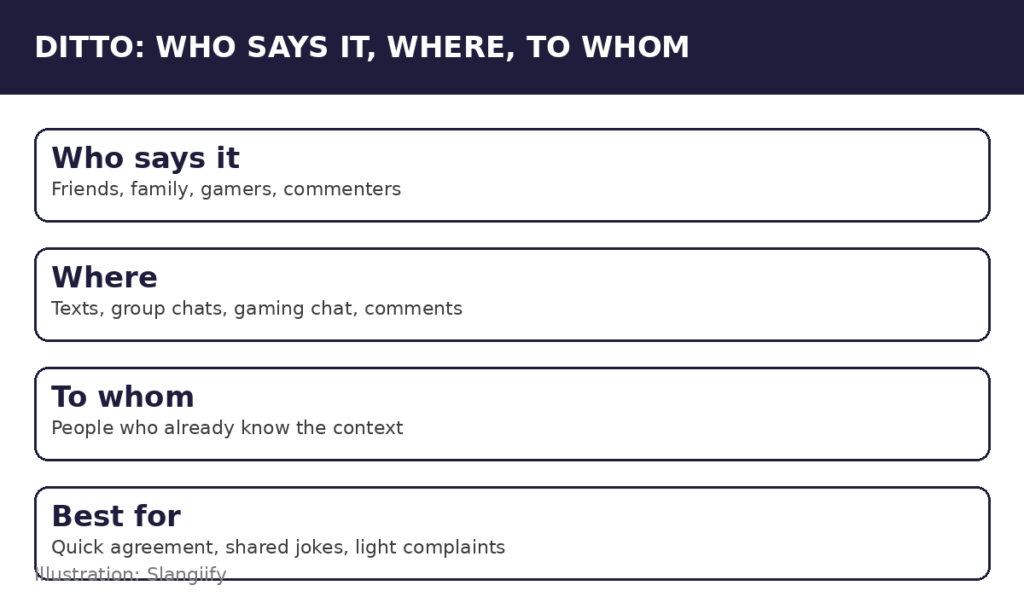
Who Says Ditto, Where, and to Whom
Ditto shows up most often between friends, family members, and online peers who already share context, and it shows up least often in formal writing, serious apologies, and first-time professional messages. The audience matters as much as the word itself.
Friends use ditto as a fast bond. When two friends discover they had the same bad day, the same craving, or the same opinion about a show, ditto seals the match. It is the verbal version of a high five. Family members use it the same way, often with humor. A sibling who texts “Mom’s cooking fixes everything” and gets “ditto” back knows the feeling is shared, not just acknowledged.
Online, ditto travels across ages. Older users who grew up with the Ghost scene and ditto machines use it without thinking. Younger users pick it up from memes, older relatives, and gaming chats, and they often use it with a wink, as a slightly old-school reply. That mix keeps the word alive without making it feel tied to one generation.
In work settings, ditto is best kept to casual channels and close colleagues. A teammate who knows your humor will read “ditto” as friendly. A new manager, a client, or a large group thread may read it as low effort. When in doubt, add the sentence you actually mean. “Ditto, I am in favor of the later date” is still short, and it removes the guesswork.
Here is a simple usage map to keep in mind:
- Who says it: friends, siblings, partners, gaming teammates, commenters, and anyone replying fast in a casual chat.
- Where it appears: text messages, group chats, gaming chat, social media comments, and casual spoken talk.
- To whom: people who already know the context, and who will read the reply as warm rather than dismissive.
- When it shines: quick agreement, shared jokes, relatable posts, and light complaints about everyday life.
- When it struggles: apologies, condolences, serious feedback, and any message where the other person needs to feel truly heard.
How to Use Ditto Naturally
Use ditto when the statement you are copying is short, recent, and obvious, and add your own words when the moment calls for care, detail, or a personal touch. That one rule covers most cases, and the examples below show it in action.
Start with the clean cases. If someone says “I cannot wait for the weekend” and you feel the same, “Ditto!” is perfect. If a group chat is sharing favorite snacks and someone names yours, “Ditto, that one every time” adds a little personality without slowing the chat down. If a friend compliments you and you want to return it, “Ditto, right back at you” turns a copy into a compliment.
Watch out for the copy trap. Ditto copies everything in the last statement, including parts you might not mean. If a friend says “I hate my job and I am quitting tomorrow,” a reply of “ditto” could be read as if you are quitting too. If you only agree with the first half, say so. “Same feeling about the job, though I am staying for now” is clearer and kinder.
Pronunciation is simple: DIT-oh, with the stress on the first syllable. In writing, people sometimes write “ditto” in lowercase in casual chats, and “Ditto” with a capital at the start of a reply. Both are fine in informal messages. In formal writing, the word is usually lowercase unless it starts a sentence, and it rarely belongs in a formal document at all.
Here is a short checklist before you hit send:
- Can the other person tell exactly what you are copying? If not, add a few words.
- Does the message deserve more than a copy? If it is emotional, write a real reply.
- Would “same here” or “me too” sound warmer? If yes, use one of those instead.
- Are you in a work or formal thread? If yes, write the full sentence.
- Does your ditto add humor or speed? If it adds neither, a fuller reply is better.
For more texting shorthand in the same spirit, see our guide to what chat means in slang, our breakdown of cool meaning in slang, and our look at awesome meaning in slang. If you like fast agreement words, our guide to CTFU meaning in slang covers another short reply that travels in group chats.
What to Say Back When Someone Says Ditto
When someone replies “ditto” to you, the best response depends on what you wanted from the message, and most of the time the right move is to accept it as agreement and keep the conversation going. A ditto is not a rejection, even if it feels short.
If you shared something light, a ditto is a win. You can reply with a laugh, an emoji, or a follow-up question. “Right? I knew you would get it” keeps the energy up. “Same taste, as always” turns the copy into a shared joke. You do not need to ask what they meant, because the meaning was clear.
If you shared something personal and got a bare “ditto” back, it is fair to want more. You can gently open the door without making it a confrontation. Try “Ha, which part hit you hardest?” or “Same here, or same all of it?” Those questions invite a fuller reply without accusing the other person of not caring. Often, the person was just busy, or they thought ditto was enough.
If someone uses ditto to return a compliment, take the compliment. “You are amazing.” “Ditto.” That exchange is complete. Adding “No, really, you are” can turn into a loop, so a simple “Thank you, that means a lot” closes it warmly.
If a ditto feels dismissive in a serious conversation, say so plainly and calmly. “I wanted to talk this through a bit more, can we?” is better than reading the worst into a five-letter word. Most people who reply ditto in a serious moment are not trying to shut the conversation down. They are just reaching for the fastest reply, and a nudge helps them switch gears.
Myths vs Facts About Ditto
Ditto has been around long enough to collect a few myths, and most of them come from mixing up the word, the machine, and the movie scene. Sorting them out makes the word easier to use with confidence.
Myth: Ditto comes from the copy machine
Fact: The “same as above” use of ditto predates the ditto machine by centuries. The machine took its name from the word, because it made copies, not the other way around. Mental Floss makes this point clearly, and the dictionary timeline backs it up, with noun use in the 1600s and the machine arriving in the 1900s.
Myth: Ditto is rude
Fact: Ditto is not rude on its own, but it can feel rude when it replaces a reply that needed care. A ditto after a joke is friendly. A ditto after a heartfelt message can feel thin, because it borrows words instead of offering new ones. The rudeness, when people feel it, comes from the mismatch, not from the word itself.
Myth: Ditto only means “me too”
Fact: “Me too” is the most common slang sense, but ditto can also apply a statement to a second person or thing, as in “Ditto New York” after a comment about Boston. It can also work as a noun for a copy, and, rarely, as a verb for repeating something. The “me too” sense is the headline, not the whole story.
Myth: Ditto is outdated and nobody says it anymore
Fact: Ditto is less common than “same” in some young group chats, but it still appears in texts, gaming chats, comments, and spoken jokes. Its slightly retro feel is part of why people reach for it. It signals agreement with a wink, and that tone keeps it useful even when newer words are more frequent.
Myth: Ditto and ditto marks are the same thing
Fact: Ditto marks are written symbols that mean “repeat the word above,” while ditto as a spoken reply means “the same applies to me.” They share the copying idea and the name, but one is a punctuation shortcut and the other is a word you say or type in conversation.
When NOT to Use Ditto
Skip ditto when the other person needs to feel heard, when the stakes are high, or when copying the last statement could be misunderstood. A fuller reply costs a few seconds, and in these moments it is worth every one of them.
Do not use a bare ditto for condolences, apologies, or serious news. If someone shares a loss, a health worry, or a hard decision, they need your words, not a copy of theirs. “I am so sorry, I am here for you” is a real reply. “Ditto” is not, even if you feel the same sadness.
Do not use ditto when you disagree with part of the last message. Copying the whole statement can lock you into a position you do not hold. If a friend says “This restaurant is perfect and cheap,” and you agree about the food but not the price, say “Food, yes, price, not so much.” Precision beats speed here.
Do not use ditto as your only reply in a work decision thread, a client email, or a formal message. Readers in those settings may take a short reply as a lack of engagement, or they may wonder whether you read the thread at all. Write the sentence you mean, even if it is short.
Do not use ditto to dodge a question. If someone asks “Do you want to come on Saturday?” and you reply “Ditto,” they still do not know your answer, because there is no statement to copy. Answer the question directly, then add ditto if you want to echo someone else’s enthusiasm. “Yes, ditto to what Sam said, Saturday works” is clear and friendly.
Finally, do not overuse ditto in the same chat. One ditto is a witty shortcut. Five dittos in a row start to feel like you are not really in the conversation. Mix in “same here,” “exactly,” or a sentence of your own, so your agreement still sounds like you.
Ditto FAQs
What does ditto mean in slang?
Ditto means “the same” or “me too” in slang. It copies the last statement and applies it to the speaker, so “I am tired.” “Ditto.” means “I am tired too.” It is a fast way to agree without repeating the whole sentence.
Is ditto rude?
Ditto is not rude on its own. It can feel rude or dismissive when it replaces a thoughtful reply to a serious or emotional message, because it borrows words instead of offering new ones. In light, casual chats, it usually reads as friendly and quick.
Where does ditto come from?
Ditto comes from Italian ditto, a dialect form of detto, meaning “said.” It entered English in the 1600s as a written shortcut for “the aforesaid” in lists and accounts, then moved into speech as a way to say “the same applies.” The copy machine came much later and took its name from the word.
What is the difference between ditto and same?
Ditto copies a whole statement, while “same” usually points at a feeling or a shared experience. “Ditto” after “I love this place” means “I love this place too, in the same words.” “Same” is shorter, newer in feel, and often warmer, because it sounds less like a copy and more like a reaction.
Can ditto be used in formal writing?
Ditto is best avoided in formal writing. It belongs in casual texts, chats, comments, and spoken jokes. In a work email or a formal report, write the full sentence you mean, so the reader does not have to guess what you are copying.
What does ditto mean in Ghost?
In Ghost, Sam says “Ditto” instead of “I love you” back to Molly, because he struggles to say the words out loud. The scene works because ditto means “I hereby say the same,” not just “I agree.” Molly wants Sam to say it back, and ditto lets him do that in one word.
Is ditto a noun, verb, or adverb?
Ditto can be all three, though the adverb and standalone reply are by far the most common now. As a noun, it can mean a copy. As a verb, to ditto means to repeat or copy something. As an adverb, it means “as before” or “in the same manner,” which is the sense behind the slang reply.
Sources
Sources used for this article, all opened and checked before writing: