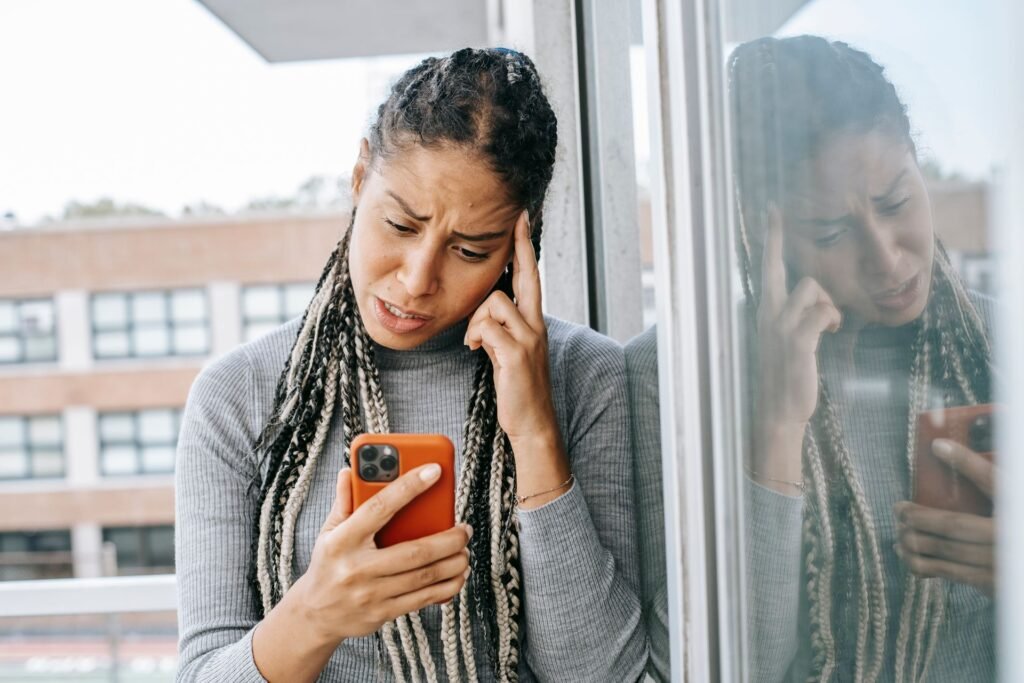

In texting slang, DPMO means “Don’t Piss Me Off”: a blunt, four-letter warning that someone’s patience is running out. It shows up in group chats, TikTok comments, and DMs, usually half joking and sometimes not joking at all, and the difference between those two readings is the whole skill of using it well. If you have ever stared at those four letters and wondered whether your friend was mad or just messing around, this guide will clear it up.
DPMO is a small term with a surprisingly tangled life. It grew out of the older acronym PMO, it picked up a second life on Instagram where it can mean something about photos instead of anger, and it shares its letters with a serious business metric that has nothing to do with texting. Most short explainers pick one of those meanings and stop. This article covers all of them, shows you how to tell them apart in seconds, and gives you reply lines for each situation.
Contents
- What Does DPMO Mean in Text?
- DPMO and PMO: Why the Extra Letter Matters
- The Other Meanings of DPMO You Should Know
- Who Says DPMO, Where, and to Whom
- DPMO by Platform: TikTok, Instagram, Snapchat, and More
- DPMO vs. Similar Terms
- How to Use DPMO Naturally
- How to Reply When Someone Sends You DPMO
- When NOT to Use DPMO
- Myth vs. Fact About DPMO
- FAQs About DPMO
- Sources
What Does DPMO Mean in Text?
In texts and online chats, DPMO almost always stands for “Don’t Piss Me Off,” a short warning that the sender is annoyed, close to annoyed, or joking that they might get there. It works as a boundary line in advance: instead of saying “that annoyed me” after the fact, the sender says “do not push this further” before it happens.
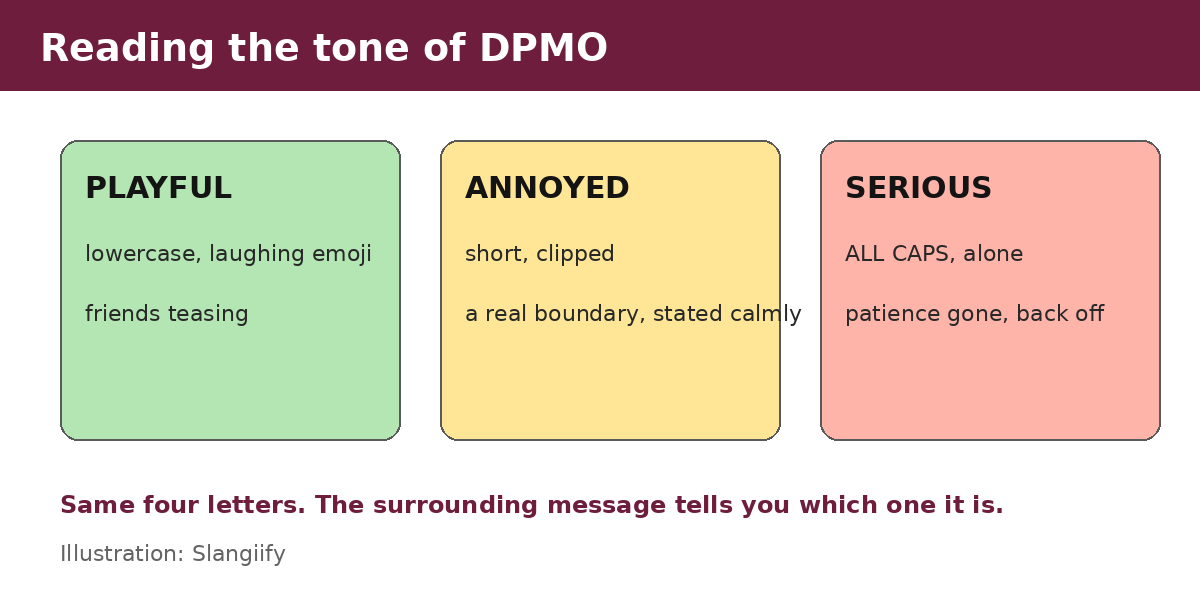
The tone range is wide, and that is why the term confuses people. Between close friends, lowercase “dpmo” with a laughing emoji is teasing, closer to “stop it, you are killing me” than to a real threat. In a tense exchange, all-caps “DPMO” standing alone reads as a genuine warning, and it should be treated that way. The letters do not change. Everything around them does: capital letters, punctuation, emojis, and your history with the person.
A useful way to read it is to look at what comes next in the message. DPMO usually sits right beside the actual complaint, like “dpmo about the dishes again” or “I already told you twice, dpmo.” It rarely stands completely alone the way a simple “lol” might, because it is doing a specific job: flagging that a line is close, or that it was already crossed once and should not be crossed again.
It also helps to know what DPMO is not. It is not a compliment, it is not flirting on its own, and it is not a neutral filler word. Even in its playful form, it borrows the shape of a warning, and that borrowed edge is the joke. If you strip the edge away entirely, the term stops making sense, which is why it never quite becomes a soft, friendly word.
DPMO and PMO: Why the Extra Letter Matters
DPMO is built directly on top of PMO, and understanding that relationship explains why the longer form exists at all. PMO, on its own, is ambiguous: it can mean “Piss Me Off” or, in a totally different sentence, “Put Me On,” as in asking for a recommendation. A guide to the slang meaning of DPMO on HolyMeaning puts it plainly: adding “Don’t” to the front locks the sentence into the frustration lane, because nobody asks for a recommendation by saying “don’t put me on.”
Think of the pair as past and future. PMO describes a feeling that already happened: “that pmo” means “that pissed me off.” DPMO is preemptive: it warns before the next annoyance lands. That timing difference is the whole point of the extra letter, and it is why people reach for DPMO when PMO feels too vague for the moment.
PMO picked up serious momentum on TikTok in the early 2020s, and DPMO rode along with it into comments, captions, and group chats. If you already know PMO, you already know most of DPMO. Our guide to what PMO means in slang covers the shorter form in full, including the “Put Me On” reading that DPMO deliberately avoids.
The family does not stop there. DPMO sits in a cluster of blunt, attitude-heavy acronyms that took off in the same era, and the comparison table later in this article shows how it differs from its closest cousins. For now, remember the core idea: DPMO is PMO with the ambiguity removed and the warning turned up.
The Other Meanings of DPMO You Should Know
Most of the time, context hands you the right meaning without effort. Still, three other readings show up often enough that a complete guide has to name them, so you never get caught out by the wrong one.
Don’t Post Me Online
On Instagram, DPMO can mean “Don’t Post Me Online”: a request not to share someone’s photo or video. GB Times explains this reading as a digital “please don’t,” used when someone does not want their picture posted, whether for privacy, work, or simple personal preference. This is a consent statement, not an anger statement, and it deserves a different response: honor it, no debate, no teasing. If someone says DPMO before you post a group photo, the photo does not go up with them in it. That rule is simple, and breaking it damages trust fast.
How do you tell this reading from the anger reading? Look for a camera, a photo, or a post in the conversation. If the chat is about pictures, DPMO is almost certainly about posting. If the chat is about an argument or an annoyance, it is almost certainly about anger. The topic of the conversation does the disambiguation for you.
Don’t Play Me Out, or Don’t Play Me Over
A smaller group of slang guides gives DPMO as “Don’t Play Me Out” or “Don’t Play Me Over,” meaning do not disrespect me, mislead me, or take me for granted. This reading overlaps heavily with the main one: both are boundary statements from someone who feels disrespected. In practice, you can treat them as the same warning with slightly different wording. The response is identical either way: stop, acknowledge it, and do not push further.
Defects Per Million Opportunities
Outside of texting entirely, DPMO is a real Six Sigma quality metric: Defects Per Million Opportunities, a measure of how often a process goes wrong out of a million chances. The HolyMeaning guide notes that this business meaning predates the slang by decades, since Six Sigma methodology has used it since the late 1980s. You will meet it in factory reports, quality dashboards, and process improvement meetings, never in a casual DM. The giveaway is numbers: if DPMO sits next to a figure, a percentage, or the word “sigma,” it is the metric. Slang DPMO is never followed by a specific number.
Who Says DPMO, Where, and to Whom
DPMO lives in informal, peer-to-peer spaces: group chats, DMs between friends, TikTok comments, Discord servers, and gaming lobbies. The typical sender is a young person talking to people their own age, in a conversation where blunt humor is normal and nobody is keeping score for politeness. It is not office language, it is not customer service language, and it is not how you talk to a teacher, a boss, or a stranger you want to impress.
The audience matters as much as the sender. Between close friends, DPMO reads as teasing because both sides know the relationship can absorb it. Between acquaintances or strangers, the same letters read colder, because the reader has no history to soften them. A good rule is to match the relationship: use DPMO freely with people who already joke this way with you, and skip it with people you barely know.
Age and platform also shape it. Teenagers and young adults use it most, and it travels with TikTok and stan culture in particular. Older readers may not know it at all, which is a real risk: send DPMO to someone who has never seen it, and they may read pure hostility where you meant a joke. If your audience might not know the term, spell out the feeling instead.
| Setting | Typical DPMO use | How it usually lands |
|---|---|---|
| Close friends group chat | Playful complaint about a joke or habit | Teasing, everyone laughs |
| DM with a partner or sibling | Half-serious boundary about a repeated annoyance | Understood, usually resolved fast |
| TikTok or X comments | Reaction to a relatable annoyance video | Performs frustration for an audience |
| Gaming or Discord server | Blunt callout during a tense match | Heated, can escalate |
| Work chat or formal message | Almost never appropriate | Reads as unprofessional or hostile |
DPMO by Platform: TikTok, Instagram, Snapchat, and More
The core meaning stays stable across apps. What shifts is frequency, tone, and the exact spot where the term appears. Here is the honest breakdown, without inventing differences that do not exist.
DPMO on TikTok
On TikTok, DPMO lives mostly in comments under videos about petty annoyances, relatable frustrations, and “things that instantly pmo” style content. Comments are short and rapid, so the term often appears alone or attached to a brief phrase. It also travels with the PMO family of acronyms that blew up on the app in the early 2020s.
DPMO on Instagram
Instagram is where the two slang readings collide, which makes it the trickiest platform for this term. In DMs, it usually means “Don’t Piss Me Off,” playful or serious depending on tone. Around photos and stories, it can mean “Don’t Post Me Online.” Check the topic of the chat before you decide, and when a photo is involved, default to the consent reading, because that is the one where a wrong guess has real consequences.
DPMO on Snapchat
Snapchat conversations mimic regular texting, so DPMO behaves much like it does in a text thread. Because Snapchat chats usually happen between people who know each other well, the playful reading is more common here than the serious one. Still, a serious DPMO on Snapchat is serious, and the closeness of the relationship makes it sting more, not less.
DPMO on K-pop Twitter and stan culture
DPMO found a second home on K-pop Twitter, where fans use it alongside IJBOL and IDGAF to describe attitudes and reactions. SpielTimes, explaining the trio, notes that DPMO relates to someone rational and serious, in contrast to easygoing IJBOL energy and unfazed IDGAF energy. Fans even sort idols and themselves into these three vibes, and a post like “went from ijbol to idgaf to dpmo” tells a whole emotional story in a few letters. If you see DPMO in a fan post, it is often this vibe reading: serious, done joking, not here for nonsense.
DPMO on Discord and in gaming
Discord servers and gaming lobbies skew blunt and fast, and DPMO fits that pace. During a competitive match, it shows up when a teammate’s mistakes wear patience thin. Because gaming chat moves quickly and tone is hard to read, DPMO here escalates more easily than in a private DM. If you are on the receiving end mid-game, a short acknowledgment beats a sarcastic mirror every time.
DPMO vs. Similar Terms
DPMO has several close cousins, and mixing them up changes the message. This table keeps them straight.
| Term | Meaning | Tone | Example |
|---|---|---|---|
| DPMO | Don’t Piss Me Off | Warning, playful to serious | “I told you twice, dpmo about it again” |
| PMO | Piss Me Off, or Put Me On | Complaint, or a request | “Slow wifi pmo” / “pmo to a good show” |
| IDGAF | I Don’t Give A F**k | Indifference, unfazed | “Idgaf what they think anymore” |
| IJBOL | I Just Burst Out Laughing | Easygoing, amused | “That edit had me ijbol” |
| ATP | At This Point | Exasperated setup, not a warning | “Atp I am just going to bed” |
The key contrast is DPMO versus IDGAF. IDGAF says “I do not care,” which ends a conversation. DPMO says “I care, and you are pushing it,” which is a demand that the other person change course. One walks away, the other draws a line. Confusing them sends the opposite message from the one you mean.
For more of this family, our guides to what CTFU means in slang and the slang meaning of FAFO cover two more blunt acronyms from the same era, and the ATP meaning in slang guide explains the exasperated setup that often appears right before a DPMO.
How to Use DPMO Naturally
Natural DPMO use follows a simple pattern: put it next to the thing that is bothering you, keep the sentence short, and let the rest of the message set the tone. It works best as a spice, not as the whole meal. A message that is only “DPMO” with no context leaves the reader guessing, and guessing usually lands on the worst reading.
Examples that sound like real texts:
- “Running late but dpmo, traffic is not my fault.”
- “I already told you twice, dpmo about it again.”
- “Dpmo but can you not eat my leftovers?”
- “If you bring that up one more time dpmo fr.”
- “Love you but dpmo with the spoilers, I have not watched it yet.”
Notice the pattern in each one. The complaint is specific, the sentence is short, and the relationship is close enough that the joke survives. That is the formula. Vague DPMO with no complaint attached reads as a mood, not a message, and moods are easy to misread.
A few style notes help too. Lowercase “dpmo” reads softer than all-caps “DPMO.” A laughing emoji softens it further. “Fr” (for real) at the end sharpens it slightly, signaling that the annoyance is genuine even if the delivery is casual. Small choices like these carry the tone, so make them on purpose instead of by accident.
How to Reply When Someone Sends You DPMO
Getting a DPMO text can sting, especially when you are not sure how serious it is. The right reply depends on the reading, and the reading depends on the tone clues around it.
If it is clearly a joke
When the message is lowercase, casual, and paired with something silly, match that energy. A simple “lol my bad” or a laughing reaction closes the loop. Over-apologizing for a playful DPMO makes things awkward for no reason, because it treats a joke like a conflict.
If they seem genuinely irritated
When the tone reads serious, the best move is a short, direct acknowledgment rather than a joke back. Something like “got it, sorry” or “noted, won’t bring it up again” shows you actually heard them. This is not the moment for a long explanation of your side, because that usually escalates instead of resolving.
If it came out of nowhere
Sometimes DPMO lands with zero context, and you honestly do not know what triggered it. A simple, non-defensive check-in works best: “Did I do something?” Asking directly beats guessing, and it beats the anxious spiral of trying to reverse-engineer what you might have said three conversations ago.
If it means Don’t Post Me Online
Honor it immediately and say so: “Got it, I won’t post it.” If you already posted the photo, take it down and apologize for not asking first. Do not argue, do not ask them to explain, and do not repost a cropped version hoping they will not notice. Consent is not a negotiation.
What NOT to say back
A few replies make things worse in almost every situation: mirroring it back sarcastically (“well dpmo too”) when the original was serious, ignoring it entirely, which reads as dismissive, or demanding an immediate explanation in a combative tone. If you are unsure which reply fits, the short acknowledgment is the safe default.
When NOT to Use DPMO
DPMO is strong language, even in lowercase, and strong language has boundaries. Do not use it with a boss, a teacher, a client, or anyone in a professional setting, because it reads as hostility no matter how you meant it. Do not use it with strangers in public comments when a disagreement is already heated, because it pours fuel on a fire that a calmer sentence could cool.
Do not use it as your first message to someone you barely know. Without shared history, the reader has no reason to assume the playful reading, and the safe assumption for them is the serious one. Do not use it repeatedly in the same conversation either: a warning that gets repeated stops being a boundary and starts being a pattern, and patterns change how people see you.
Do not use it to shut down a real conversation that deserves words. If someone hurt you, or if a problem needs solving, a full sentence will do more than four letters. DPMO is a flag, not a solution. Use it to mark the moment, then use real words for the part that matters.
Finally, do not use the “Don’t Post Me Online” reading as a joke. If you say DPMO about a photo while laughing, and the other person takes it seriously, you have created a consent problem out of a punchline. Keep the photo reading serious, every time.
Myth vs. Fact About DPMO
Myth: DPMO always means someone is mad at you
Fact: the playful version is far more common in day-to-day chats than the genuine-warning version. Tone and context decide, and most DPMO messages between friends are teasing.
Myth: DPMO is brand new slang
Fact: the business meaning has existed since the late 1980s, and the slang grew out of the older PMO, which itself built on a much older phrase. The letters are old. The texting use is the new part.
Myth: DPMO means the same thing on every app
Fact: mostly true, with one real exception. Instagram adds the “Don’t Post Me Online” reading around photos, so the topic of the conversation matters more there than anywhere else.
Myth: DPMO and PMO are interchangeable
Fact: PMO can also mean “Put Me On,” a recommendation request, while DPMO cannot. Adding “Don’t” removes that reading entirely, which is exactly why the longer form exists.
Myth: Replying to DPMO with DPMO is a good comeback
Fact: mirroring it back sarcastically escalates a serious warning and confuses a playful one. A short acknowledgment works better in both cases.
FAQs About DPMO
What does DPMO mean in text?
DPMO means “Don’t Piss Me Off” in text messages and online chats. It is a blunt warning that the sender is annoyed or close to it, used playfully between friends and seriously when patience has actually run out.
What does DPMO mean on Instagram?
On Instagram, DPMO usually still means “Don’t Piss Me Off” in DMs, but around photos and stories it can mean “Don’t Post Me Online.” If the conversation involves a picture, treat it as the consent request and do not post the photo.
Is DPMO rude?
It can be, depending on context. Between close friends it is often playful teasing, but with strangers, in professional settings, or in all caps during an argument, it reads as rude or aggressive. The relationship and the tone decide.
What is the difference between DPMO and PMO?
PMO means “Piss Me Off” or “Put Me On,” so it is ambiguous. DPMO adds “Don’t” to the front, which removes the “Put Me On” reading and turns a complaint into a warning: do not push this further.
What does DPMO mean in Six Sigma?
In Six Sigma and quality management, DPMO means Defects Per Million Opportunities, a metric for how often a process goes wrong out of a million chances. You can spot this reading by the numbers and work terms around it, which slang DPMO never has.
How do you reply to DPMO?
For a playful DPMO, a light “lol my bad” works. For a serious one, a short “got it, sorry” works better than a joke or a long defense. For the photo meaning, say you will not post it, and take the photo down if you already did.
Is DPMO offensive to use?
It contains a mild swear word, so it is not polite language, but it is common in casual texting among peers. Avoid it in professional, formal, or mixed-age settings, and avoid it entirely with people who may not know the term.