
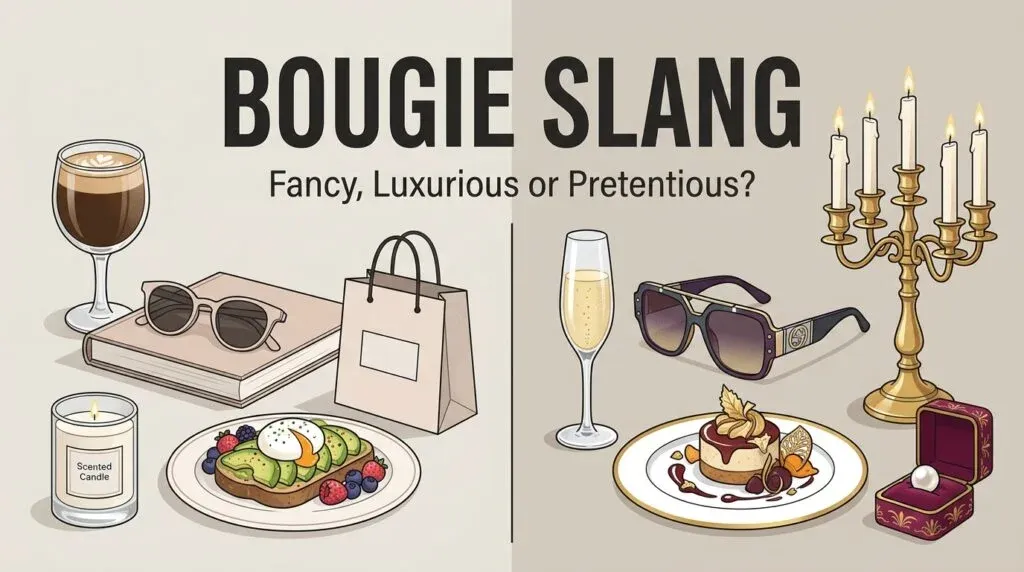

Bougie is slang for someone or something that seems fancy, upscale, expensive, status-conscious, or a little pretentious. You might call a luxury brunch spot, an elaborate coffee order, expensive taste, or someone who enjoys high-end experiences “bougie.” Depending on the tone, it can be playful praise or mild criticism.
The slang comes from bourgeois and has roots in African American English, where it historically carried sharper criticism of materialism, respectability, and social climbing. Modern usage has broadened considerably, so people now also use bougie affectionately or self-deprecatingly to mean simply “fancy” or “a little luxurious.” Boujee is a common alternate spelling.
| Quick Answer | Meaning |
|---|---|
| Most common meaning | Fancy, upscale, luxurious, or status-conscious |
| Possible negative meaning | Pretentious, materialistic, or trying too hard to appear wealthy |
| Tone | Playful, teasing, complimentary, or critical |
| Formality | Very informal |
| Pronunciation | Usually BOO-zhee |
| Related spelling | Boujee |
| Typical contexts | Conversation, texting, memes, lifestyle talk, social media |
| Offensive? | Usually no, but it can sound judgmental when aimed at a person |
What Does Bougie Mean in Slang?
In everyday American slang, bougie describes tastes, behavior, places, products, or experiences associated with luxury, refinement, money, or social status.
Someone might say:
“This rooftop restaurant is so bougie.”
Here, bougie probably means the restaurant feels stylish, expensive, sophisticated, or more luxurious than an ordinary place.
But the word can carry more attitude than simply calling something “fancy.”
Consider:
“He got a promotion and suddenly started acting bougie.”
Now the speaker may be criticizing the person for becoming status-conscious, snobbish, or overly concerned with appearing successful.
That flexibility is central to the bougie slang meaning: the same word can express admiration, friendly teasing, or social criticism depending on context.
Quick Meaning by Context
| Context | Likely Meaning | Example | Tone |
|---|---|---|---|
| Food | Fancy or unnecessarily elaborate | “That brunch looks bougie.” | Playful |
| Fashion | Stylish, expensive-looking | “That coat is bougie.” | Often positive |
| Lifestyle | Luxurious or indulgent | “She loves bougie vacations.” | Neutral/playful |
| Personality | Status-conscious or snobbish | “He’s acting bougie lately.” | Critical |
| Shopping | More expensive than necessary | “I bought the bougie version.” | Self-deprecating |
| Social media | Aesthetic, polished, luxurious | “This setup is so bougie.” | Often complimentary |
| Friends | Someone with expensive tastes | “You’re too bougie for instant coffee.” | Teasing |
The object being described matters. Calling a hotel bougie usually sounds more positive than calling a person bougie.
Is Bougie a Compliment or an Insult?
It can be either.
Bougie as a Compliment
In positive usage, bougie can suggest:
- Stylish
- Classy
- Sophisticated
- Luxurious
- Well put together
- Indulgent
- Expensive-looking
- More elevated than usual
For example:
“Your apartment looks bougie!”
With an enthusiastic tone, this probably means the apartment looks impressive, polished, or expensive.
Similarly:
“We’re doing a bougie girls’ night tonight.”
Nothing necessarily negative is being communicated. The group may simply be planning cocktails, good food, nice clothes, or an upscale venue.
Modern slang often uses bougie this way to describe an enjoyable upgrade from ordinary life.
Bougie as an Insult
The older critical edge of the word has not disappeared.
When used negatively, bougie can imply that someone:
- Cares too much about status
- Wants others to notice their expensive taste
- Acts superior
- Rejects ordinary or inexpensive things
- Is overly materialistic
- Tries too hard to appear sophisticated
- Is behaving like a social climber
For example:
“She won’t eat anywhere without a dress code now. She’s getting bougie.”
That sentence does more than describe expensive taste. It suggests that the speaker believes her behavior has become pretentious.
The difference is often luxury versus attitude. Enjoying expensive things can be called bougie playfully. Acting superior because of them makes the word much more critical.
Also Read: What Does Opp Mean? Slang Meaning, Uses, and Examples
What Does Bougie Mean in Text and Social Media?
In texts, captions, comments, memes, TikTok videos, Instagram posts, and other casual online conversations, bougie usually keeps the same basic meaning: fancy, luxurious, expensive, indulgent, or pretentiously upscale.
There is no major platform-specific definition that requires separate meanings for every social network.
Examples include:
“Why is your breakfast so bougie 😂”
The laughing emoji suggests friendly teasing.
“Need a bougie hotel for my birthday.”
Here, bougie simply means luxurious or stylish.
“He’s way too bougie now.”
This sounds more judgmental because the word describes the person’s behavior rather than a particular object or experience.
Online usage has also encouraged a playful, self-aware version of the word. Someone might call themselves bougie because they prefer premium coffee, expensive skincare, upscale restaurants, or nicer versions of everyday products without seriously claiming to be wealthy.
How Context Changes the Meaning of Bougie
Three clues usually reveal what someone means.
1. Look at What Is Being Called Bougie
When the word describes an object or experience, it is often relatively harmless.
“Bougie candles”
Probably expensive, aesthetic, or unusually fancy candles.
“Bougie vacation”
Probably a luxurious trip.
When it describes a person, criticism becomes more likely.
“She’s bougie.”
This could imply expensive taste, snobbery, status-consciousness, or all three.
2. Pay Attention to the Relationship
Friends commonly use bougie as affectionate teasing.
A friend saying:
“Of course you ordered the bougie coffee.”
may simply be joking about your preference for a complicated or premium drink.
The same sentence from someone who already thinks you are wasteful or pretentious could feel more insulting.
3. Watch for Tone and Emojis
Compare:
“Okayyy, bougie! 😍”
This sounds approving.
“Wow. That’s bougie 🙄”
The eye-roll changes the message. Now bougie suggests unnecessary extravagance or pretension.
Slang meaning often depends as much on social signals as dictionary-style definitions.
Real Conversation Examples of Bougie
Expensive Taste
A: “Why did you buy imported sparkling water?”
B: “I felt bougie today.”
Here, bougie means indulgent or unnecessarily fancy.
Friendly Teasing
A: “I only stay at hotels with a spa.”
B: “You are so bougie.”
The tone is probably playful unless there is existing tension.
Restaurant
A: “Where are you going for dinner?”
B: “Some bougie place downtown.”
The restaurant is likely upscale, stylish, or expensive.
Fashion
A: “That jacket looks expensive.”
B: “I know. It makes the whole outfit look bougie.”
Here, the word is complimentary.
Mild Criticism
A: “He says regular coffee isn’t good enough anymore.”
B: “He’s getting bougie.”
The implication is that his tastes or attitude have become pretentious.
Self-Deprecating Humor
A: “You bought a towel warmer?”
B: “Listen, I’m bougie on a budget.”
The speaker jokingly admits enjoying luxury while recognizing the expense.
Social Media Caption
“Bougie brunch because we survived the week.”
Here, bougie means a fun, upgraded, indulgent experience rather than an insult.
Bougie vs. Boujee: Is There a Difference?
Bougie and boujee largely overlap in contemporary slang. Both can describe something fancy, luxurious, status-conscious, or pretentious. Boujee became especially visible in mainstream popular culture during the 2010s, but it functions as an alternate slang spelling rather than a consistently separate word with a fixed different definition.
You may encounter claims that:
- Bougie means fake wealth while boujee means real wealth.
- One means “old money” while the other means “new money.”
- One is always negative while the other is positive.
Those distinctions are not reliable rules of everyday English. Individual speakers may create their own nuance, but context matters more than the spelling.
Bougie
Usually pronounced roughly BOO-zhee.
Example:
“This grocery store is bougie.”
Boujee
Often pronounced roughly BOO-jee and strongly associated with informal pop-culture spelling.
Example:
“We’re feeling boujee tonight.”
Both forms can be playful, complimentary, ironic, or critical.
Bougie vs. Bourgeois and Bourgeoisie
These words are related, but they are not interchangeable in every situation.
| Term | Basic Meaning | Typical Context |
|---|---|---|
| Bougie | Fancy, status-conscious, luxurious, pretentious | Slang |
| Boujee | Alternate slang spelling of bougie | Casual speech, pop culture |
| Bourgeois | Relating to the middle class or its perceived values | Social, political, historical discussion |
| Bourgeoisie | A social or economic class | Historical, political, economic discussion |
Bougie developed from bourgeois, but modern speakers frequently use it much more loosely.
Calling a $14 smoothie bougie does not mean the speaker is making a serious statement about economic class. They may simply mean:
“That is unusually expensive and fancy for a smoothie.”
This everyday exaggeration explains why translating bougie literally as “bourgeois” can miss the tone.
Also Read: Ohio Slang Meaning: What Does “Ohio” Mean Online?
How Do You Pronounce Bougie?
The slang spelling bougie is commonly pronounced:
BOO-zhee
The second consonant resembles the sound in words such as vision or measure.
The alternate spelling boujee may be pronounced with a harder “j” sound:
BOO-jee
Pronunciation can vary somewhat in natural speech, especially because the spellings and slang senses overlap.
Is Bougie an Adjective or a Noun?
In contemporary slang, bougie most commonly works as an adjective.
Examples:
- “a bougie restaurant”
- “a bougie apartment”
- “bougie taste”
- “a bougie vacation”
It can also describe someone’s general behavior:
“You’re getting bougie.”
There is also an established informal noun use referring to a bourgeois or middle-class person, though everyday modern slang is much more likely to use bougie descriptively.
Because it is informal slang, it usually belongs in conversation, social posts, entertainment writing, or intentionally casual copy rather than formal academic or professional writing.
Where Did Bougie Slang Come From?
The modern slang use of bougie is connected to bourgeois, a word associated with the middle class and, in some critical contexts, excessive concern with wealth, possessions, status, and respectability.
The slang sense developed in African American English during the twentieth century and could criticize upwardly mobile people perceived as excessively concerned with middle-class respectability or material status.
Its meaning later broadened.
Instead of always communicating serious class criticism, speakers increasingly used bougie for anything perceived as:
- Fancy
- Expensive
- Upscale
- Lavish
- Aspirational
- Excessively refined
- More luxurious than necessary
The alternate spelling boujee gained major mainstream visibility through hip-hop and internet culture during the 2010s, helping push the lighter “fancy” sense further into general casual speech.
That history explains why two people can hear slightly different messages in the same word. One may hear harmless “fancy,” while another hears a sharper comment about class or pretension.
Does Bougie Mean Rich?
Not exactly.
A genuinely wealthy person can certainly be described as bougie, but being bougie does not require actually being rich.
The word is often about:
- Taste
- Presentation
- Preferences
- Consumption
- Social signals
- Perceived status
Someone living on an ordinary budget might jokingly call an expensive weekend brunch their “bougie moment.”
Likewise, a very wealthy person may not seem bougie at all if they avoid obvious status displays.
So:
Rich describes financial resources.
Bougie often describes the style, behavior, taste, or image associated with luxury and status.
Does Bougie Mean Fancy?
Yes, “fancy” is one of the simplest modern translations, especially when bougie describes a thing, place, meal, outfit, or experience.
However, the two words are not perfectly interchangeable.
Consider:
“That’s a fancy restaurant.”
This is mostly descriptive.
“That’s a bougie restaurant.”
This can add humor, exaggeration, commentary about price, or the idea that the restaurant feels designed to signal status.
Bougie therefore often says something about how luxury is being perceived, not merely that luxury exists.
Is Bougie the Same as Posh?
They overlap, but not completely.
Posh generally means elegant, fashionable, or associated with wealth and high social status.
Bougie can mean upscale too, but it more easily carries ideas of:
- Pretension
- Social climbing
- Consumerism
- Showing off
- Treating yourself
- Trying to appear sophisticated
For example:
“a posh hotel”
sounds mainly descriptive.
“a bougie hotel”
sounds more casual and may suggest expensive décor, trendy amenities, aesthetic presentation, or an indulgent atmosphere.
Similar Terms to Bougie
| Term | Meaning | Main Difference |
|---|---|---|
| Fancy | Elaborate, stylish, or expensive | More neutral |
| Upscale | High quality and aimed at wealthier customers | More formal |
| Posh | Elegant or associated with high social status | Less focused on pretension |
| Luxurious | Providing expensive comfort or pleasure | Usually positive |
| Pretentious | Trying to appear more important or sophisticated | Clearly negative |
| Snobby | Acting superior to others | Focuses on attitude |
| Extra | Excessive or over-the-top | Not specifically about wealth |
| Boujee | Alternate spelling of bougie | Essentially overlapping slang usage |
The closest substitute depends on tone.
If bougie is positive, fancy, upscale, or luxurious may work.
If it is negative, pretentious, materialistic, or snobby may better capture the meaning.
Is Bougie Offensive or Rude?
Bougie is not generally treated as a profanity or slur, but it can become insulting when used to criticize someone’s background, spending habits, personality, or social aspirations.
Compare:
“Those are some bougie cupcakes!”
Usually harmless.
Versus:
“Ever since she started making money, she thinks she’s too good for everyone. She’s bougie now.”
That is clearly more personal and judgmental.
Its cultural history also makes context worth respecting. The slang sense has roots in African American English and historically expressed more specific attitudes toward class, mobility, materialism, and respectability than the modern generic meaning “fancy.”
Using the word naturally does not require turning that history into a major issue every time, but understanding it helps explain why the term can carry more social meaning than luxurious or expensive.
Also Read: Chud Meaning Slang: What Does “Chud” Mean?
Also Read: What Does PMO Mean in Slang, Texts, and Social Media?
Is Bougie Appropriate at Work?
Usually, bougie is better suited to informal workplace conversation than formal communication.
Casual:
“The new coffee machine is pretty bougie.”
That may sound perfectly natural among coworkers.
Formal:
“Our company provides a bougie customer experience.”
That wording may be unclear or overly casual in a report, proposal, contract, or client presentation.
Depending on your intended meaning, use alternatives such as:
- Premium
- Upscale
- Luxury
- High-end
- Sophisticated
- Elevated
If you intend criticism, use more precise language rather than relying on slang.
A Common Bougie Meaning Mistake
One frequent misunderstanding is assuming that bougie always means pretending to be rich.
That meaning certainly exists, but modern usage is broader.
Someone can describe:
- an expensive candle,
- a beautifully designed hotel,
- a gourmet snack,
- premium skincare,
- first-class travel,
- or an elaborate brunch
as bougie without suggesting that anyone is faking wealth.
Likewise, calling yourself bougie may be playful rather than boastful:
“I need my bougie coffee before work.”
The speaker may simply be admitting that their preferred coffee is more elaborate or expensive than necessary.
That distinction matters because slang often softens as it spreads. A term that once carried sharper social criticism can develop lighter, humorous uses without completely losing its older edge.
Real-World Interpretation of Bougie
The most useful way to understand bougie is not simply “rich.”
It often describes the visible performance or enjoyment of luxury.
A plain expensive object is not automatically bougie. What makes something feel bougie may be its presentation, exclusivity, unnecessary refinement, aesthetic appeal, or connection with status.
That is why a person might call a beautifully arranged $12 coffee “bougie” while never using the same word for an expensive but ordinary household repair.
Bougie is therefore partly about perception. It comments on what luxury looks and feels like in everyday social life.
Frequently Asked Questions
What does bougie mean in slang?
Bougie usually means fancy, upscale, luxurious, status-conscious, or somewhat pretentious. It can describe people, restaurants, clothing, vacations, food, décor, and lifestyles. Its tone ranges from complimentary to critical depending on whether the speaker admires the luxury or thinks someone is trying too hard to appear wealthy or sophisticated.
What does it mean when someone calls you bougie?
They may be saying you have expensive, sophisticated, or luxurious tastes. Among friends, it is often playful teasing. In a more critical conversation, however, it can suggest that you are materialistic, snobbish, overly concerned with status, or trying to appear more sophisticated than other people.
Does bougie mean expensive?
It can, but expensive is only part of the meaning. Something bougie often looks or feels upscale, luxurious, refined, or unnecessarily fancy. A product can therefore be expensive without feeling bougie, while an inexpensive item can look bougie because of its design, presentation, or aesthetic.
What does bougie mean on TikTok or Instagram?
It generally has the same modern slang meaning: fancy, luxurious, stylish, indulgent, expensive-looking, or pretentiously upscale. Captions and comments often use it humorously for elaborate food, beauty routines, vacations, décor, fashion, or lifestyle choices. Emojis and the surrounding tone usually reveal whether the speaker is admiring or mocking something.
Are bougie and boujee the same?
They are widely used as overlapping forms of the same slang idea. Boujee is a popular alternate spelling associated strongly with hip-hop and internet culture, while bougie more visibly reflects its connection with bourgeois. Claims that they always represent two completely different types of wealth are not reliable rules of modern usage.
Is bougie a bad word?
No. Bougie is not generally profanity. It can still be insulting if it is used to accuse someone of being snobbish, materialistic, fake, or obsessed with status. When friends use it jokingly about a fancy meal, outfit, hotel, or purchase, it is usually much lighter.
Can bougie be positive?
Yes. Modern speakers frequently use bougie positively or playfully. Someone might describe a spa day, vacation, dinner, outfit, or apartment as bougie because it feels luxurious and special. Tone determines whether the word communicates admiration, self-aware humor, or criticism.
What is the opposite of bougie?
There is no single perfect opposite. Depending on the sentence, suitable contrasts include simple, modest, basic, casual, understated, affordable, down-to-earth, or unpretentious. For example, the opposite of a bougie restaurant might be a casual neighborhood spot, while the opposite of a bougie personality might be down-to-earth.
Conclusion
Bougie slang usually describes someone or something that feels fancy, upscale, luxurious, expensive, or concerned with status. It can be a compliment, a joke, a form of self-deprecating humor, or mild criticism. The key is context: “bougie brunch” probably celebrates indulgence, while “he’s acting bougie” may criticize someone’s attitude.
The word comes from bourgeois and retains some of its historical connection to class, materialism, and social status, even though modern casual usage has broadened considerably. Bougie and boujee now overlap heavily, so rather than searching for a rigid spelling-based distinction, pay attention to tone, speaker intent, and what is being described.
Related Slang Terms
Explore more slang meanings from our dictionary:



Pingback: OP Meaning Slang: What Does OP Mean in Text and Gaming?
Pingback: Unc Meaning Slang: What It Means in Text and Online
Pingback: Snow Bunny Meaning: Dating, Skiing, and Slang Explained
Pingback: Tweaking Meaning Slang: Definition, Uses & Examples