


Diva in slang means a confident, glamorous person who commands attention like a star, and, in its sharper sense, a person who acts demanding, dramatic, or difficult to please.
One word, two very different compliments, and sometimes one insult. When a friend says “She walked in like a total diva,” you have to hear the tone before you know whether that was praise, shade, or a bit of both. This guide untangles the diva definition, traces the word from opera stages to pop charts to group chats, and shows how to use it without accidentally calling someone difficult when you meant to call them iconic.
What Diva Means in Slang
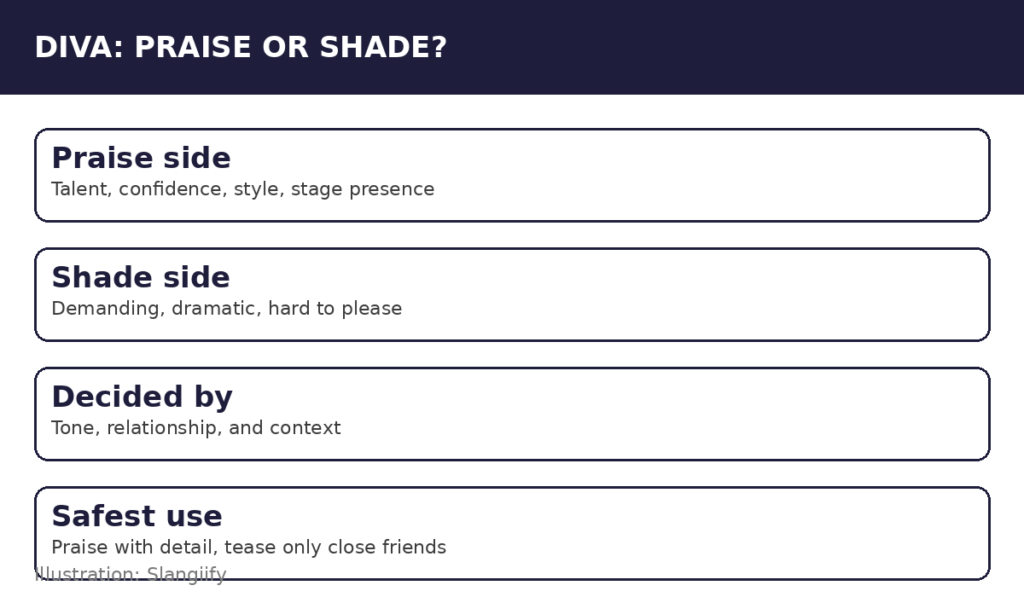
In modern slang, diva means a person, usually a woman, who carries herself with star-level confidence, style, and presence, and it can also mean a person who expects special treatment and makes a scene when they do not get it. The same word covers both readings, so tone, relationship, and context decide which meaning the listener hears.
Start with the praise version, because it is the one people reach for most often among friends. Calling someone a diva in this sense says they own the room. They know what they want, they look the part, and they do not shrink to make other people comfortable. A friend who nails a presentation, walks into a party in a bold outfit, or delivers a perfect comeback might hear “Okay, diva” and take it as a cheer. The word carries glamour, talent, and nerve in one package.
Then there is the shade version, and it is just as common. In this sense, a diva is someone who is high maintenance, dramatic, or hard to please. The classic examples are familiar: the guest who sends food back three times, the coworker who needs the meeting moved to suit only their schedule, the friend who turns a small change of plans into a crisis. Here, “Stop being such a diva” is not a cheer. It is a nudge, or a complaint, that says “You are asking for more than the moment calls for.”
What makes diva tricky, and interesting, is that the two meanings often overlap. A pop star can be praised as a diva for her talent and criticized as a diva for her backstage demands in the same article. A friend can be called a diva lovingly for her confidence and, five minutes later, teased as a diva for refusing to eat anywhere without a reservation. The word holds both the crown and the complaint, and speakers use that tension on purpose.
Here are everyday examples that show the range:
- Praise for presence: “She sang one note and the whole room went quiet. Total diva.”
- Praise for confidence: “She told them her price and did not blink. Diva energy.”
- Playful teasing: “You need your coffee in one exact mug? Okay, diva.”
- Real complaint: “He acted like a diva about the hotel room and ruined the trip.”
- Self-aware joke: “I know, I am being a diva about the playlist, but it matters.”
Notice how the last example works. Calling yourself a diva before someone else does takes the sting out of it. It says “I know this is a lot, and I am owning it.” That self-aware use is common in texts and captions, where people label their own high standards before anyone else can.
People also ask what does diva mean from a girl, and whether the meaning changes with the speaker. It does not change in a fixed way, but the relationship does a lot of work. Between close friends, “diva” is often playful, even when it points at demanding behavior. From a stranger, a boss, or an ex, the same word can land as a judgment about character. If you are not sure how it will land, that uncertainty is itself useful information. Hold the word until you are sure, or soften it with a clear compliment.
Where Diva Comes From
Diva comes from Italian, literally meaning “goddess,” from Latin, and it entered English in the 1800s as a title for a celebrated female opera singer before it broadened into pop music and then into everyday slang for a confident or demanding person.
Merriam-Webster traces diva to Italian, literally goddess, from Latin, and records the first known use in English in 1883, in the opera sense. That origin still explains the praise meaning. A diva was not just a singer. She was a star whose voice and presence felt larger than life, almost divine, and audiences treated her that way.
In opera, the leading female singer was often called the prima donna, Italian for “first lady,” and diva worked as a grander, more worshipful title for the same figure. Think of names like Maria Callas and Beverly Sills, singers whose talent and stage presence made them legends. The word carried respect, awe, and a hint of fear, because a great diva could fill a hall and, reportedly, empty a rehearsal room if things were not right.
That double edge was there from the start. A celebrated singer with real power could set terms, and stories about demanding divas spread as fast as stories about great performances. Over time, the demanding part broke free from opera and became a free-floating insult, or tease, for anyone who acted entitled, regardless of talent or gender.
From opera to pop, and from pop to everyday talk
Pop music gave diva its second life. In the late 1900s, singers like Aretha Franklin, Whitney Houston, Mariah Carey, and later Beyoncé and Lady Gaga were called divas as a mark of honor. A pop diva meant a woman with a huge voice, a distinct style, and a career that shaped the culture around her. Fans used the word proudly, and the singers themselves often embraced it, turning diva into a brand of confidence.
At the same time, tabloid stories about backstage demands, specific bottled water, exact room temperatures, and long lists of requests gave the shade meaning fresh material. Whether every story was true mattered less than the pattern. The public learned to picture a diva as someone who expected the world to adjust to her, and the word started to travel far beyond music.
By the 2000s and 2010s, diva was fully at home in everyday talk. Reality television, social media, and meme culture used it for anyone with big energy, from a talented friend to a dramatic coworker. “Diva” also picked up a life in LGBTQ culture, especially in drag and ballroom communities, where diva can be a term of admiration for charisma, uniqueness, nerve, and talent, delivered with full confidence. That usage leans toward praise, and it reminds us that the word has never belonged to only one tone.
Today, diva sits in that useful, slightly risky middle ground. It is familiar enough that everyone knows it, and flexible enough that it can praise, tease, or criticize. That flexibility is why a guide like this one matters. If you use diva without thinking about tone, you might mean praise and deliver shade, or mean a joke and deliver a judgment.
Diva in Pop Culture
Pop culture made diva a household word, and it also taught most people both meanings at once, because the same stars who were praised as divas for their talent were gossiped about as divas for their demands. That split is the pop culture story in miniature.
Opera gave us the original divas, and pop gave us the modern ones. Aretha Franklin, called the Queen of Soul, is often described as the original diva in the praise sense, a singer whose voice could move a room to tears. Whitney Houston and Mariah Carey carried the title into the pop era, with voices and careers that defined their decades. Beyoncé took the word further, building an image around precision, power, and control, and fans adopted “diva” as a compliment for her work ethic as much as for her voice. Her song “Diva” turned the word into a self-description, a claim of worth and hustle, not just a label from outsiders.
Television and film added the dramatic side. Characters who demand attention, throw tantrums, or steal scenes are routinely called divas by other characters and by viewers. Reality shows, with their confessionals and confrontations, made “diva behavior” a recurring storyline. A contestant who argues with judges, a housemate who needs constant reassurance, or a star who walks off set all get the label, sometimes fairly and sometimes as a quick edit.
Social media finished the job of making diva everyday language. Captions like “diva mode on” or “channeling my inner diva” usually mean confidence, glamour, or a good outfit, not a complaint. Comments like “she is being such a diva today” usually mean the opposite, that someone is acting entitled or difficult. The same platform, the same word, and the tone in the caption or the comment tells you which way it leans.
If you want a quick pop culture test, ask yourself who is being described and why. If the description focuses on talent, presence, or style, diva is praise. If it focuses on demands, drama, or special treatment, diva is shade. If it focuses on both, congratulations, you have found the classic diva story, and the writer probably meant both on purpose.

Diva vs Similar Words
Diva sits close to several personality words, but each one praises or criticizes a different thing, and swapping them can change the message completely. The table below lines up the closest options.
| Word | Meaning | Tone | Where it fits best | Example |
|---|---|---|---|---|
| Diva | Confident star, or demanding and dramatic person | Praise or shade, depending on tone | Music, friendship, pop culture talk | “She owned that stage, total diva.” |
| Prima donna | Demanding person who expects special treatment | Mostly critical, a touch old-fashioned | Work, teams, backstage talk | “He is acting like a prima donna about the schedule.” |
| Drama queen | Person who turns small things into big scenes | Critical, often teasing | Friendship, family talk | “Stop being a drama queen, it was one text.” |
| Queen | Confident, admirable woman who leads | Warm praise, supportive | Friendship, fan talk, compliments | “You handled that like a queen.” |
| Extra | Over the top, dramatic, doing too much | Playful, teasing, modern | Texts, memes, friend talk | “That outfit is extra, and I love it.” |
The closest cousin is prima donna, and the difference is mostly about which side of diva you mean. Prima donna almost always points at the demanding side, and it sounds a little more formal and old-fashioned. Diva can do both jobs, which makes it more flexible and more risky. If you only mean the demanding side, prima donna is clearer, though it is also harsher.
Drama queen points at reactions, not status. A drama queen makes a scene out of a small event. A diva, in the shade sense, expects special treatment because of who they are, or who they think they are. A person can be both, but the words criticize different habits. Queen, by contrast, is almost pure praise in modern slang, a supportive cheer for confidence and grace. Extra is the playful modern cousin, a tease for doing too much that often lands as a compliment, especially among friends.
Choosing well is simple once you name what you actually mean. If you mean talent and presence, diva or queen works. If you mean drama, drama queen or extra is clearer. If you mean entitlement, prima donna says it without the praise baggage. Picking the word that matches your meaning is the kindest and clearest move.
Who Says Diva, Where, and to Whom
Diva is said most often between friends, fans, and peers who share a sense of humor about confidence and drama, and it is riskiest when aimed at someone with less power in the conversation, like an employee, a service worker, or a stranger. The speaker and the setting shape the sting.
Friends use diva as a shared joke and a compliment. A friend group that calls each other divas for bold outfits, strong opinions, or high standards is usually bonding, not bullying. The word works there because everyone knows it can go both ways, and everyone gets a turn. Fans use diva as praise for stars, often in comments and captions, where it signals admiration for talent and style.
In LGBTQ spaces, especially drag and ballroom culture, diva often carries admiration for charisma and nerve. A performer who commands a stage, serves a look, or delivers a sharp read might be celebrated as a diva, and the word feels like an honor, not a warning. That usage is a good reminder that diva is not a fixed insult. Communities shape words, and this community shaped diva toward power and pride.
At work, diva gets trickier. Calling a colleague a diva, even as a joke, can sound like a judgment about their character, especially if the colleague is a woman. Research and everyday experience both show that confident women are more likely than confident men to be labeled difficult, and diva can carry that double standard without the speaker noticing. If you would not call a man in the same situation a diva, pause before you call a woman one. The word may be doing more work than you intended.
Here is a usage map to keep handy:
- Who says it: friends, fans, performers, commenters, and anyone talking about pop culture, style, or strong personalities.
- Where it appears: texts, captions, comments, fan talk, reality television, and casual conversation about celebrities and friends.
- To whom: usually women, but increasingly anyone, with the meaning shifting by gender, relationship, and tone.
- When it shines: praising talent, confidence, style, and stage presence, and playful teasing among close friends.
- When it stings: labeling a woman as difficult for having standards, criticizing a stranger, or using it at work as a character judgment.
How to Use Diva Naturally
Use diva when the praise or the tease will be obvious from your tone and your relationship, and pick a clearer word when the meaning could be read as a judgment about someone’s character. That test keeps the fun of the word without the fallout.
For praise, pair diva with the thing you admire. “Diva vocals” praises a voice. “Diva energy” praises confidence. “She walked in like a diva and owned the room” praises presence. The extra detail tells the listener which diva you mean, so they do not have to guess. A bare “diva” can work among close friends, but a little detail makes it safer and warmer.
For playful teasing, keep it light and keep it mutual. “Okay, diva, your coffee order has five steps” works when the friendship can take a joke and when you would laugh if the roles were reversed. It stops working when the tease is one-sided, repeated, or aimed at something the person cannot change. Teasing about a coffee order is different from teasing about a need, a boundary, or a workplace request.
For real complaints, consider whether diva is the clearest word. If someone is being demanding, say what they did. “She asked for three room changes and yelled at staff” is clearer and fairer than “She was a total diva.” The first version describes behavior. The second version labels a person, and labels stick longer than descriptions. If you do use diva for a complaint, keep it to behavior you saw yourself, not gossip you heard secondhand.
Pronunciation is simple: DEE-vah, with the stress on the first syllable. The plural is divas, and in opera writing you may also see the Italian plural dive, pronounced DEE-veh, but divas is the normal form in English slang. In writing, diva is lowercase unless it starts a sentence or is part of a title.
A quick checklist before you use it:
- Would the listener hear praise, tease, or criticism? If you are not sure, add detail.
- Would you use the same word for a man in the same situation? If not, rethink it.
- Are you describing behavior, or labeling a person? Behavior is fairer and clearer.
- Is this a close friend who will get the joke? If not, choose a warmer word.
- Does the moment need a compliment, a joke, or a boundary? Pick the tool that fits the job.
For more personality and presence words in the same family, see our guide to aura meaning in slang, our breakdown of cool meaning in slang, and our look at awesome meaning in slang. If tone is tripping you up, our guide to cringe meaning in slang covers another word where tone decides the meaning.
What to Say Back When Someone Calls You a Diva
When someone calls you a diva, the best reply starts with figuring out which diva they meant, and the fastest way to figure it out is to look at the smile, the sentence, and the relationship around the word. Most of the time, you will know in a second.
If it was praise, take it and enjoy it. “Thank you, I worked hard on this” accepts a compliment without apologizing for confidence. “Diva mode, activated” plays along and keeps the energy light. You do not need to downplay talent or style to be likable, and accepting praise gracefully is a skill worth practicing.
If it was playful teasing among friends, humor is usually the best return. “Guilty, and I am not changing my coffee order” owns the joke. “Only on days that end in y” keeps it light. A playful reply tells your friends the tease landed safely, and it keeps the friendship easy.
If it felt like a real criticism, you have options, and none of them require a fight. A calm, direct reply works well: “I am not trying to be difficult, I just need this to work.” That sentence separates your request from the label, and it invites the other person to talk about the actual issue. If the label keeps coming up at work, name the pattern privately: “When you call me a diva for asking for clear deadlines, it makes it harder to do my job well.” That is firmer, and it is fair, because it points at the effect, not just the word.
If a stranger or a casual acquaintance calls you a diva and you do not like it, you do not owe them a debate. A short “I would rather you did not call me that” is complete. A smile and a change of subject is also complete. You get to set the boundary, and you get to choose how much energy the label deserves.
Finally, if you called yourself a diva and someone took it seriously, a quick clarification helps. “I meant it as a joke about my playlist standards, not as a real complaint” clears the air fast. Self-aware jokes work best when the audience knows you are joking, and a little context goes a long way.
Myths vs Facts About Diva
Diva has lived in opera, pop, television, and slang for a long time, and that long life has left a few myths behind. Clearing them up makes the word easier to use well.
Myth: Diva is always an insult
Fact: Diva is often praise, especially for singers, performers, and confident friends. The insult sense is real, but it is only half the word. A fan who calls Beyoncé a diva usually means icon, not difficult, and a friend who says “okay, diva” after a bold outfit usually means admiration.
Myth: Diva only applies to women
Fact: Diva started as a title for female singers, and it still leans female in everyday use, but people now apply it to anyone who acts like a star or acts demanding, regardless of gender. A man who needs constant special treatment can be called a diva, and drag culture has long celebrated diva energy across genders.
Myth: Diva means a bad singer with a big ego
Fact: The original diva was a great singer, and the praise sense still points at talent first. A diva in the opera sense earned the title with her voice. The ego sense came later, from stories about demanding stars, and it never replaced the talent sense. Both live side by side.
Myth: Calling someone a diva is harmless because it is just slang
Fact: Slang can still sting, especially at work or from a stranger. Diva labels a person, not just a moment, and it can carry a double standard for confident women. Among friends, it is often harmless fun. In a professional setting, it can read as a judgment, so context matters more than the slang label.
Myth: Diva comes from the word divine in English
Fact: Diva comes from Italian, literally goddess, from Latin, and it entered English through opera in the 1800s. The link to divine is real, through the Latin root, but the word traveled through Italian opera, not straight from English divine into slang.
When NOT to Use Diva
Skip diva when it would label a person instead of describing behavior, when it could carry a double standard, or when the person has not invited playful teasing. A clearer, kinder word is usually close at hand.
Do not use diva for a coworker, an employee, or a service worker you do not know well. In those settings, the word can sound like a verdict on character, and it can follow the person in ways a joke among friends never would. Describe the request or the behavior instead, and keep the label out of it.
Do not use diva to dismiss a reasonable request. If someone asks for an accessible seat, a dietary option, a clear deadline, or a quiet room, calling them a diva turns a need into a personality flaw. That is unfair, and it shuts down a conversation that should stay open. Needs are not diva behavior, even when they are specific.
Do not use diva as a gendered shortcut for confidence. If a woman states her price, sets a boundary, or leads a room, and you would praise a man for the same move, do not reach for diva as a criticism. Call the move what it is: confident, clear, or strong. Save diva for moments when you genuinely mean star presence or playful drama, and when the listener will hear it that way.
Do not use diva in a first message, a cold comment, or a public post about a stranger. Without a relationship, the listener has no reason to read it as praise or as a joke, and the safest reading is often the critical one. A stranger who reads “diva” under their photo will likely hear judgment, not admiration.
Finally, do not use diva repeatedly for the same person. One playful use among friends is a joke. A nickname built on diva can harden into a label, and labels shape how a group treats someone. If you notice yourself reaching for the word every time one friend speaks up, pause and ask what you are actually reacting to. The answer is often confidence, and confidence deserves a better word.
Diva FAQs
What does diva mean in slang?
Diva in slang means a confident, glamorous person who commands attention like a star, and it can also mean a demanding or dramatic person who expects special treatment. Tone and context decide which meaning lands, so listen for praise, teasing, or criticism in the sentence around it.
Is diva a compliment or an insult?
Diva can be both. It is a compliment when it praises talent, confidence, style, or presence, and it is an insult or a tease when it points at demanding, dramatic, or entitled behavior. Among close friends it is often playful, while at work or from a stranger it can read as a judgment.
Where does diva come from?
Diva comes from Italian, literally goddess, from Latin, and it entered English in 1883 as a title for a celebrated female opera singer. It later broadened to pop singers and then to everyday slang for a confident or demanding person, keeping both the praise and the criticism along the way.
What is the difference between diva and prima donna?
Prima donna almost always means a demanding person who expects special treatment, while diva can mean that or it can praise a star. If you only mean the demanding side, prima donna is clearer. If you mean talent and presence, diva is the better word.
Can a man be called a diva?
Yes, a man can be called a diva in modern slang, though the word still leans female because of its opera origin. Used for a man, it usually points at dramatic or demanding behavior, or, in performance contexts, at star-level charisma and confidence.
Is diva a bad word?
Diva is not a vulgar or profane word, and it is not a slur. It can still hurt when it is used as a label for a person, especially at work, because it can sound like a judgment about character. Among friends and fans, it is usually light, playful, or admiring.
What does diva energy mean?
Diva energy means confidence, glamour, and star presence, the feeling of walking into a room like you belong there and knowing your worth. It is almost always praise in captions and friend talk, and it focuses on attitude and style rather than on demands or drama.
Sources
Sources used for this article, all opened and checked before writing: