
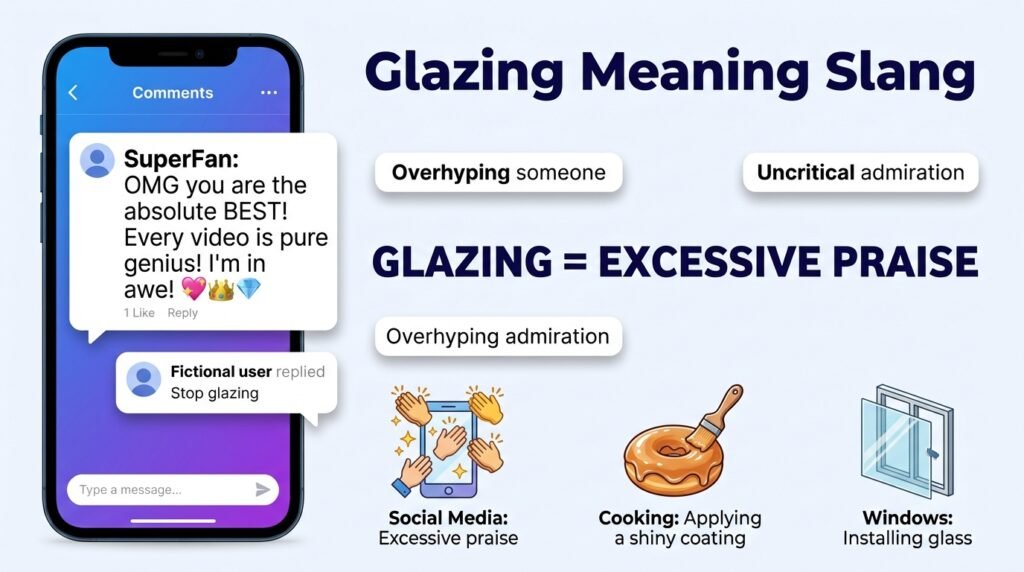

In slang, glazing means praising, complimenting, defending, or hyping someone so excessively that it seems embarrassing, biased, or insincere. People commonly use it in phrases such as “stop glazing” when they think someone is giving another person far more praise than they deserve.
The slang appears frequently in TikTok comments, livestream chats, sports debates, gaming communities, fandom discussions, and school conversations. However, glazing also has several ordinary meanings involving food, windows, paint, and ceramics, so the surrounding topic matters.
| Quick Detail | Meaning |
|---|---|
| Most common slang meaning | Excessively praising or hyping someone |
| Other possible meanings | Applying a coating, installing glass, using a painting technique, or losing focus |
| Typical context | TikTok, Twitch, YouTube, Reddit, X, Discord, gaming, sports, and school |
| Tone | Usually teasing, sarcastic, critical, or dismissive |
| Formality level | Very informal |
| Offensive or safe? | Usually safe, but it can sound insulting or carry a vulgar undertone in some contexts |
What Does Glazing Mean in Slang?
The most common glazing meaning slang users intend is giving someone excessive, uncritical, or over-the-top praise.
The speaker usually believes that the praise is:
- Too intense
- Not fully deserved
- Biased or uncritical
- Intended to gain approval
- Becoming uncomfortable or embarrassing
For example:
“You have called him the greatest player alive five times. Stop glazing.”
Here, the speaker is not simply saying that the other person gave a compliment. They are suggesting that the praise has become excessive.
Someone can also be accused of glazing a celebrity, athlete, musician, movie, game, brand, or fictional character.
“Everyone keeps glazing that new album, but only two songs are good.”
In that example, glazing means overpraising the album.
Does Glazing Always Mean Fake Praise?
Not necessarily.
A person may sincerely admire someone and still be accused of glazing them. The accusation reflects the listener’s opinion that the praise has gone too far.
For example:
“I genuinely think she is the best singer of her generation.”
“You’re glazing.”
The first person may be completely sincere. The second person simply considers the praise exaggerated.
Therefore, glazing does not automatically mean lying. It often means praising without enough balance, criticism, or restraint.
What Does “Stop Glazing” Mean?
Stop glazing means:
Stop praising, defending, or hyping that person so much.
It can be playful between friends, but it can also be dismissive.
Someone might say it when another person:
- Repeatedly compliments a celebrity
- Defends an athlete after a poor performance
- Treats a creator as if they can do nothing wrong
- Gives a teacher or manager excessive praise
- Turns a normal discussion into exaggerated admiration
A similar phrase is:
“Get off his case.”
However, stop glazing specifically focuses on excessive praise rather than general attention.
What Is a Glazer?
A glazer is a person who excessively praises or defends someone or something.
“He is the biggest glazer in the fanbase.”
The word is normally used as an insult or playful criticism. It suggests that the person has lost objectivity.
A glazer may also be called:
- A suck-up
- A fanboy or fangirl
- A brown-noser
- A bootlicker
- A meat rider
- A yes-man
These terms are not exact synonyms, and some are much more vulgar or insulting than others.
Quick Meaning by Context
| Context or Platform | Likely Meaning | Example | Frequency |
|---|---|---|---|
| TikTok comments | Overpraising a creator, celebrity, or trend | “The comments are glazing him again.” | Very common |
| Twitch or YouTube Live | Excessively praising a streamer or player | “Chat needs to stop glazing.” | Very common |
| Sports discussions | Treating a player as flawless or superior | “The commentators glaze him every game.” | Very common |
| Gaming chats | Overhyping a player, character, or game | “You are glazing that update.” | Common |
| Reddit or X | Uncritical praise in a debate or fandom | “This whole thread is glaze.” | Common |
| School conversations | Praising a teacher, student, or friend too much | “Why are you glazing the teacher?” | Common among younger speakers |
| Private texts | Teasing a friend for excessive admiration | “Not you glazing your crush again.” | Common |
| Workplace discussion | Excessive praise intended to impress a manager | “He spent the meeting glazing the boss.” | Possible but very informal |
| Construction | Installing or fitting glass | “The glazing must be replaced.” | Standard professional meaning |
| Cooking | Applying a shiny or sweet coating | “She is glazing the doughnuts.” | Standard literal meaning |
| Ceramics or painting | Applying a transparent or glossy layer | “The artist is glazing the surface.” | Standard technical meaning |
What Does Glazing Mean on Social Media?
Glazing on TikTok, Instagram, and X
On TikTok, Instagram, and X, glazing usually describes comments or posts that praise a person too strongly.
Common targets include:
- Musicians
- Actors
- Athletes
- Influencers
- Fictional characters
- Fashion trends
- Movies, shows, and video games
A commenter might write:
“The glazing in these comments is unbelievable.”
This means the comment section contains too much praise.
Users also say:
“Not to glaze, but…”
This phrase works as a humorous disclaimer before giving a strong compliment.
“Not to glaze, but her performance was incredible.”
The speaker knows the compliment may sound excessive and tries to acknowledge that possibility before saying it.
Glazing on Twitch and YouTube
Livestream communities helped spread the term because viewers react to creators, players, and guests in real time. It is commonly used when chat members repeatedly praise a streamer or when a commentator appears overly favorable toward one person.
Examples include:
“The commentators have been glazing him all match.”
“Chat is glazing the streamer after one good play.”
It can also describe a streamer who keeps praising a guest, game, product, or fellow creator.
Glazing on Reddit and Discord
On Reddit and Discord, the term often appears in discussions about:
- Sports rankings
- Anime characters
- Video game updates
- Celebrity fanbases
- Movies and television
- Music releases
- Online creators
In these communities, glazing often means that fans are refusing to recognize weaknesses.
“You can like the character without glazing every decision he makes.”
The criticism is not always about admiration itself. It is usually about admiration replacing balanced discussion.
Glazing in Text Messages, Snapchat, and WhatsApp
In private messages, glazing is usually playful teasing.
“You have sent me six videos of him today. The glazing is crazy.”
Friends may use it when someone talks constantly about a crush, celebrity, athlete, or favorite artist.
The meaning does not normally change between Snapchat, WhatsApp, and standard text messages. The surrounding conversation is more important than the app.
Glazing at School
Among students, glazing may describe:
- Complimenting a teacher too much
- Agreeing with everything a popular student says
- Excessively praising a friend
- Showing obvious favoritism
- Trying too hard to impress someone
For example:
“You told the teacher that was the best lesson ever. Stop glazing.”
This usage can be humorous, but it can also pressure people to avoid giving sincere compliments. In some situations, students use the accusation so loosely that almost any positive comment gets labeled as glazing.
Glazing at Work
The term is not standard professional language, but coworkers may use it privately to criticize someone who praises a manager or client too much.
“He spent the entire presentation glazing the director.”
At work, more suitable alternatives include:
- Excessive flattery
- Favoritism
- Sycophantic behavior
- Uncritical praise
- Trying to impress management
Using glazing in a formal email, report, or performance review would usually sound unprofessional.
Other Genuine Meanings of Glazing
Applying a Coating
The original everyday meaning of glazing involves placing a smooth, shiny, or protective coating over something.
Examples include:
- Glazing a doughnut with sugar
- Glazing meat with sauce
- Glazing pottery
- Applying glaze to tiles
- Covering a surface with a glossy finish
This physical idea of laying a coating on thick may help explain why the slang became associated with laying praise on thick. The slang began appearing widely online during the early 2020s.
Window Glazing
In construction, glazing means fitting glass into a window, door, wall, or frame. It can also refer to the glass itself.
Examples include:
- Single glazing
- Double glazing
- Triple glazing
- Safety glazing
- Commercial glazing
“The building needs new glazing before winter.”
This is a professional construction term and has no connection to excessive praise.
Glazing in Painting and Ceramics
In art, glazing can mean applying a thin, transparent or semitransparent layer over a dry layer of paint.
Artists use this technique to:
- Adjust color
- Create depth
- Add luminosity
- Change temperature
- Build subtle shadows
In ceramics, glaze creates a decorative, smooth, or protective surface after firing.
“She added a blue glaze to the ceramic bowl.”
These meanings are technical rather than slang.
Eyes Glazing Over
When someone’s eyes glaze over, they appear unfocused, bored, tired, shocked, or mentally absent.
“His eyes glazed over during the long explanation.”
This does not mean he was praising anyone. It means he appeared to lose focus or attention.
A Less Common Vulgar Meaning
In explicitly sexual conversation, glaze can refer to ejaculating onto someone. This vulgar sense is not usually the intended meaning when people say “stop glazing” in sports, gaming, school, or social-media discussions.
However, the sexual association may influence why some people consider the slang crude. The precise origin remains uncertain, and explanations connecting the praise meaning to either a glossy coating, doughnut imagery, or sexual humor should not be treated as definitively proven.
How Context Changes the Meaning
The easiest way to understand glazing is to examine the topic and surrounding words.
1. Celebrity Praise
“You call every song she releases a masterpiece. You’re glazing.”
Meaning: Excessively praising a celebrity.
2. Sports Commentary
“The announcers have been glazing the quarterback all night.”
Meaning: The announcers appear overly positive or biased.
3. Cooking
“I’m glazing the chicken with honey and garlic.”
Meaning: Applying a sauce or coating.
4. Construction
“The contractor finished glazing the new windows.”
Meaning: Installing or securing glass.
5. Loss of Attention
“Her eyes started glazing over during the lecture.”
Meaning: She appeared bored, tired, or mentally disconnected.
Useful clues include:
- Person or celebrity mentioned: Probably the slang meaning
- Praise, compliments, rankings, or fandom: Probably the slang meaning
- Food, pottery, paint, or surfaces: Probably a literal coating
- Windows, buildings, or insulation: Probably a construction term
- Eyes or facial expression: Probably loss of attention
- Explicit sexual conversation: Possibly the vulgar meaning
Tone and Emotional Meaning
Teasing
Friends often use glazing as a joke.
“You bought the shoes, shirt, and poster? The glazing is wild.”
The speaker is playfully pointing out someone’s strong admiration.
Sarcastic
The term can mock exaggerated compliments.
“Sure, tell us for the tenth time how perfect he is. Keep glazing.”
The speaker does not agree with the praise.
Critical
In debates, glazing can accuse someone of being biased or dishonest.
“You are ignoring every bad performance because you keep glazing him.”
Here, the accusation is more serious.
Dismissive
Sometimes people use the word to shut down sincere praise without addressing the actual argument.
“She gave a detailed explanation of why she liked the film.”
“Glazing.”
In this case, the label replaces discussion rather than contributing to it.
Self-Aware or Playful Praise
A person may knowingly admit to glazing.
“I know I’m glazing, but that final scene was perfect.”
This usage means:
I realize I am praising it heavily, and I am comfortable doing so.
An emerging variation, self-glazing, means deliberately praising or encouraging yourself. This is more positive, but it is less established than the critical meaning.
Real Conversation Examples
Between Friends
“That jacket looks great on him.”
“You have complimented everything he wore today. Stop glazing.”
The second friend thinks the compliments have become excessive.
About a Crush
“She is funny, smart, talented, and literally perfect.”
“You are glazing your crush so hard.”
The speaker is teasing a friend for idealizing someone they like.
Sports Discussion
“He scored once and now everyone is calling him world-class.”
“The fanbase always glazes new players.”
Here, glazing means overhyping an athlete after limited success.
Gaming Chat
“This is the greatest update the developers have ever released.”
“Relax. You’re glazing. It still has ten bugs.”
The second player thinks the first is overlooking obvious problems.
At School
“Mr. Harris gives the best assignments and explains everything perfectly.”
“You don’t need to glaze him for extra credit.”
The comment suggests the student is praising the teacher to gain approval.
At Work
“Daniel agreed with every idea the manager suggested.”
“He was glazing the boss throughout the meeting.”
This implies strategic or excessive flattery.
Social Media Comment
“Not to glaze, but this creator has not missed once this year.”
The phrase not to glaze humorously acknowledges that strong praise is about to follow.
Also Read: What Does PMO Mean in Slang, Texts, and Social Media?
Grammar, Pronunciation, and Spelling
Pronunciation
Glazing is pronounced:
GLAY-zing
The first syllable rhymes with days.
Language Role
The slang can function in several ways.
Verb:
“Why are you glazing him?”
Present participle:
“They are glazing that player again.”
Gerund or verbal noun:
“Glazing celebrities has become half of the discussion.”
Informal noun:
“That entire speech was pure glaze.”
Related person noun:
“Ignore him. He is a glazer.”
Common Forms
| Form | Example |
|---|---|
| Glaze | “Don’t glaze that team.” |
| Glazing | “You are glazing again.” |
| Glazed | “The commentators glazed him all night.” |
| Glazer | “His biggest glazer is in the comments.” |
| Self-glazing | “A little self-glazing can build confidence.” |
The slang is normally written in lowercase unless it begins a sentence.
It is not an acronym, so there is no full form of glazing.
How to Reply When Someone Says You Are Glazing
Your reply depends on whether the comment is playful or hostile.
Neutral Replies
- “I’m just giving credit where it’s due.”
- “I like their work, but I can still criticize it.”
- “That is my honest opinion.”
- “Praise is not automatically glazing.”
Friendly Replies
- “Let me be a fan in peace.”
- “Maybe, but they earned it.”
- “I’ll stop when they stop being good.”
- “Call it glazing. I call it appreciation.”
Funny Replies
- “The glaze will continue.”
- “I brought extra glaze today.”
- “Proud glazer, apparently.”
- “I have committed to the bit.”
Serious Replies
- “You can disagree without dismissing my opinion.”
- “Explain what part of my argument you disagree with.”
- “I gave specific reasons. That is not blind praise.”
- “Calling everything glazing makes real discussion impossible.”
When the Accusation Is Fair
Sometimes the best response is to acknowledge it.
- “Fair. I may be overhyping them.”
- “You’re right. I ignored the weaker parts.”
- “Okay, that sounded more dramatic than I intended.”
- “I still like them, but they are not perfect.”
Similar and Commonly Confused Terms
| Term | Meaning | Main Difference | Typical Context |
|---|---|---|---|
| Glazing | Excessive or uncritical praise | Focuses on praise that seems overdone | Social media, fandoms, school, sports |
| Hyping up | Creating excitement or confidence | Can be completely positive and sincere | Friends, events, sports, marketing |
| Simping | Giving excessive attention or devotion, often romantically | Usually involves attraction or a desire for approval | Dating and social media |
| Stanning | Being a highly enthusiastic fan | Does not always imply insincerity | Music, celebrities, fandoms |
| Brown-nosing | Flattering someone powerful for personal gain | Usually involves status or career advantage | Work and school |
| Bootlicking | Showing submissive support for authority | More political and strongly insulting | Politics, work, authority |
| Meat riding | Excessively supporting or praising someone | Much more vulgar and aggressive | Gaming, sports, internet debates |
| Flattery | Praise intended to please someone | Can be polite, strategic, or insincere | General conversation |
| Bias | Favoring one side unfairly | Broader than praise | News, sports, reviews, decisions |
Glazing vs. Hyping Someone Up
Hyping someone up can be supportive and positive.
“You are going to do great in the interview.”
That is encouragement, not necessarily glazing.
It becomes glazing when the praise is seen as unreasonable:
“You are the greatest speaker who has ever lived, and no one is even close.”
Glazing vs. Simping
Simping usually involves excessive attention toward someone a person finds attractive or wants approval from.
Glazing can involve anyone or anything:
- An athlete
- A video game
- A musician
- A teacher
- A movie
- A sports team
Romantic attraction is not required.
Glazing vs. Stanning
A stan is an intense fan. A person can stan an artist while still criticizing their weaker work.
A glazer is accused of praising that artist without reasonable balance.
Therefore:
Strong fandom does not always equal glazing.
Glazing vs. Brown-Nosing
Brown-nosing normally involves praising someone in authority to gain a benefit.
For example:
Praising a manager to receive a promotion.
Glazing is broader. A fan can glaze an athlete or fictional character without expecting any personal reward.
Who Uses the Term Glazing?
The slang is often associated with younger internet users, livestream audiences, students, gaming communities, sports fans, and online fandoms. Its use has also moved from social-media comments into face-to-face school conversations.
However, it would be inaccurate to say that every member of Generation Z or Generation Alpha uses it.
The term is more commonly seen among people who participate in:
- TikTok culture
- Twitch streams
- YouTube livestreams
- Gaming communities
- Sports debates
- Anime and entertainment fandoms
- Meme-focused spaces
- School-based peer groups
Older speakers may understand the word through younger relatives, students, online videos, or sports discussions.
Usage also depends more on online community than geography. An American gamer and a British sports fan may both use the term in nearly the same way because they participate in similar internet spaces.
Also Read: Chopped Meaning Slang: What It Means Online
Origin and Evolution of Glazing Slang
The praise-related use of glaze began appearing online in the early 2020s. It spread through social platforms and streaming communities before becoming common in TikTok videos, YouTube clips, livestream chats, sports discussions, and school conversations.
Its exact origin is not fully settled.
One explanation connects it to the ordinary meaning of coating something with a thick, shiny layer. Under this interpretation, a person who is glazing someone is covering them in praise or “laying it on thick.”
Online jokes also compare it with pouring glaze over a doughnut.
Some speakers connect the term with a vulgar sexual image. That interpretation may have strengthened the term’s mocking tone, but the available evidence does not establish one definitive origin beyond doubt.
The meaning has also broadened.
Initially, it mainly described obvious sucking up or extreme praise. It can now be used for:
- Defending someone too strongly
- Showing favoritism
- Repeating praise
- Treating an opinion as unquestionable
- Giving even an ordinary compliment
That expansion explains why people sometimes criticize the word as overused. A sincere compliment is not automatically glazing.
Is Glazing Offensive, Rude, or Inappropriate?
Does the Word Contain Profanity?
No. The word glazing itself is not profanity.
However, some users recognize a vulgar sexual association behind the slang. Because of that undertone, the term may still be inappropriate in certain settings.
Can It Sound Rude?
Yes.
Calling someone a glazer suggests that they are:
- Biased
- Embarrassingly devoted
- Insincere
- Desperate for approval
- Unable to think independently
Even when used jokingly, it can dismiss a person’s genuine enthusiasm.
Is It Suitable at School?
It depends on the school and context.
Students commonly use the term among friends, but it may become disrespectful when directed at a teacher or used to embarrass another student.
The sexual undertone also makes it unsuitable for some classrooms.
Is It Suitable at Work?
Usually not.
The term is too informal for professional communication. It may also sound immature, insulting, or unclear to coworkers who do not follow internet slang.
Use phrases such as excessive praise, favoritism, or uncritical support instead.
Is It Suitable in Formal Writing?
No.
Avoid it in:
- Academic essays
- Business reports
- Legal documents
- Official emails
- News reports without explanation
- Professional reviews
It may be used in quotation marks when discussing internet language:
The commenters accused the reviewer of “glazing” the new release.
Real-World Interpretation
Glazing does more than describe praise. It also acts as a social warning against appearing too enthusiastic.
Online communities often reward irony, criticism, and emotional distance. As a result, people may use glazing to challenge obvious bias, but they may also use it to make normal appreciation seem embarrassing.
The key difference is balance.
Calling a performance good is praise. Refusing to recognize any weakness while repeatedly declaring it perfect is more likely to be interpreted as glazing.
Frequently Asked Questions
What does glazing mean in text?
In text messages, glazing usually means praising, defending, or hyping someone too much. Friends may use it to tease someone who constantly talks about a crush, celebrity, athlete, or favorite creator. It usually carries a playful or critical tone rather than a literal meaning involving food or glass.
What does glazing mean on TikTok?
On TikTok, glazing means giving a creator, celebrity, trend, song, or opinion excessive praise. Users may write “stop glazing” when a comment section appears overwhelmingly positive or when fans refuse to recognize any flaws. The term can be playful, but it often criticizes perceived bias.
What does “not to glaze” mean?
“Not to glaze” is a humorous disclaimer used before a strong compliment. It means, “I do not want to sound as if I am praising this person too much, but…” The speaker may still give enthusiastic praise immediately afterward. It is often self-aware rather than genuinely defensive.
Is glazing the same as complimenting someone?
No. A normal compliment recognizes something positive without exaggeration. Glazing involves praise that appears excessive, repetitive, unbalanced, or undeserved. However, the difference is subjective. One person’s sincere appreciation may look like glazing to someone who strongly disagrees.
Is glazing always negative?
The usual meaning is negative or teasing because it criticizes excessive praise. However, people sometimes use it playfully about themselves, such as “I know I’m glazing, but this song is perfect.” The newer phrase self-glazing can also describe praising or encouraging yourself in a positive way.
What does “stop glazing” mean in gaming?
In gaming, “stop glazing” means stop overpraising a player, streamer, character, developer, update, or game. It may be used when someone overlooks bugs, poor performance, balance problems, or reasonable criticism because they strongly support the subject.
Is glazing the same as simping?
Not exactly. Simping usually involves giving excessive attention or devotion to someone a person finds attractive or wants approval from. Glazing refers more broadly to excessive praise and can involve an athlete, game, celebrity, movie, teacher, brand, or fictional character.
Can glazing have a sexual meaning?
Yes, glaze can have a vulgar sexual meaning in explicit conversation. However, that is usually not the intended definition when people discuss sports, gaming, celebrities, school, or social media. Context determines whether the word refers to excessive praise, a literal coating, or sexual content.
How should I respond if someone says I am glazing?
A simple reply is, “I’m just giving credit where it’s due.” You can also ask which part of your opinion seems exaggerated. When the comment is playful, a humorous reply works well. When it is dismissive, return the discussion to specific reasons and evidence.
Is glazing still commonly used?
Yes. The term remains widely understood in online fandoms, livestream chats, gaming spaces, sports discussions, and many school communities. Slang changes quickly, but glazing has developed several productive forms, including glaze, glazer, and stop glazing, which may help it remain useful.
What to Remember About Glazing
The most common slang meaning of glazing is praising, defending, or hyping someone so excessively that it appears biased, insincere, or embarrassing. Phrases such as “stop glazing” usually criticize over-the-top admiration, although friends may use them playfully.
Context remains essential because glazing can also refer to coating food, finishing pottery, applying transparent paint, installing window glass, or losing visual focus. Look at the topic, tone, relationship between speakers, and surrounding words. Most importantly, remember that sincere praise is not automatically glazing. The label normally suggests that the praise has become repetitive, unbalanced, or difficult to justify.



Pingback: What Does 6-7 Mean in Slang? The Viral Joke Explained
Pingback: What Does Ohio Mean in Slang? Definition and Examples
Pingback: Chud Meaning Slang: Definition, Origin & Online Use
Pingback: Goyim Slang Meaning: Definition, Usage, Tone, and Context
Pingback: Philly Slang: 25 Words and Phrases Locals Actually Use
Pingback: Cyberpunk 2077 Slang Explained: Choom, Gonk, Nova & More
Pingback: Flex Slang Meaning: What “Flex” Means in Text and Social Media