
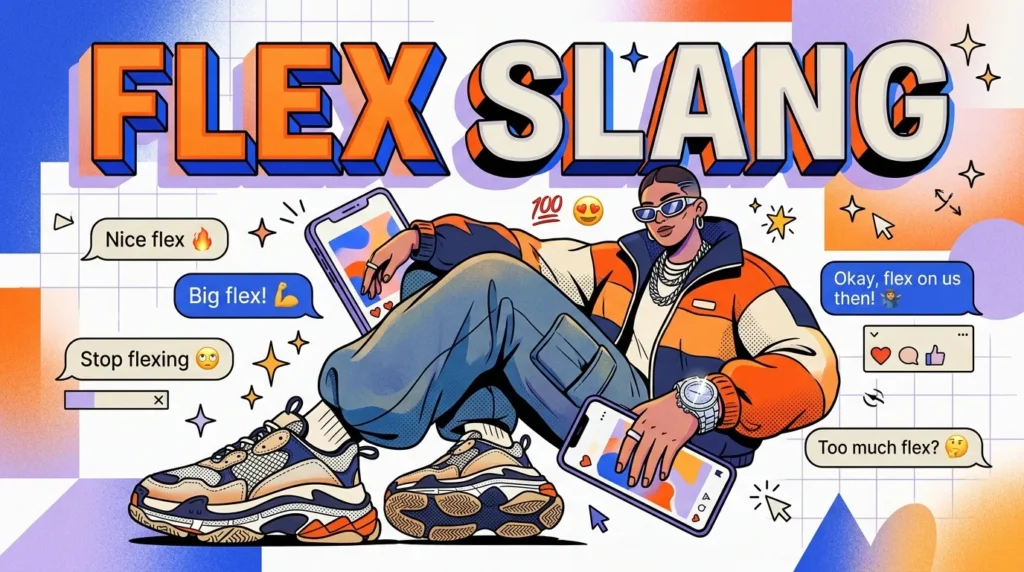

Flex slang usually means to show off, boast about, or deliberately display something you have or can do, especially to impress other people. Someone might flex their new car, expensive clothes, money, achievements, skills, or social status. In casual speech, “flex” can be playful or admiring, but it can also suggest that someone is bragging.
The word is common in texting, social media, music, gaming, and everyday informal conversation. Context matters: “Nice flex” can praise an impressive display, while “Stop flexing” usually means “stop showing off.” The phrase “flex on someone” means to show superiority or an advantage in a way that makes the other person notice it.
Quick Answer
| Aspect | Meaning |
|---|---|
| Most common meaning | To show off or boast |
| Typical context | Texting, social media, casual speech |
| Example | “He’s flexing his new watch.” |
| “Flex on someone” | Show off in front of or against someone |
| Tone | Playful, confident, boastful, or mocking |
| Formality | Very informal |
| Usually offensive? | No, but it can sound arrogant |
| Related words | Show off, brag, stunt, boast |
What Does “Flex” Mean in Slang?
As slang, flex means to show off something in a noticeable way because you want other people to recognize its value, quality, or your ability.
The thing being shown off can be almost anything:
- Money
- Clothing
- Jewelry
- Cars
- Phones
- Houses
- Travel
- Fitness
- Skills
- Achievements
- Connections
- Social status
For example:
“She’s flexing her new designer bag.”
This means she is deliberately showing the bag to other people, often to communicate that it is expensive, fashionable, or desirable.
The word does not always describe serious bragging. Friends may use flex jokingly when someone happens to display something impressive.
“You got front-row seats? Big flex.”
Here, the speaker is probably teasing the person while also acknowledging that the seats are impressive.
Flex Can Be Positive or Negative
The emotional meaning depends heavily on tone.
Positive or playful:
“That’s a pretty good flex.”
This can mean the person has something impressive.
Negative:
“He’s always flexing his money.”
This suggests the person constantly boasts and may be trying too hard to impress others.
So, flex does not automatically mean “brag.” It can describe the act of displaying something impressive without necessarily criticizing the person.
What Does “Flexing” Mean?
Flexing is simply the -ing form of flex.
When someone says:
“He’s flexing.”
They usually mean:
“He’s showing off.”
The object of the flex may be stated explicitly:
“She’s flexing her new car.”
Or it can be understood from the situation:
“Bro is really flexing today.”
In social media conversations, someone may post a photo of an expensive purchase, luxury vacation, impressive physique, achievement, or rare item. A comment such as “Flexing hard” means the poster appears to be showing off.
“Flex” as a Noun
In slang, a flex can also refer to the thing or action being shown off.
“That watch is a serious flex.”
Here, flex is being used as a noun meaning an impressive display.
Another example:
“Getting invited backstage was a flex.”
The invitation itself is being described as something impressive enough to show off.
“Flex” as a Verb
As a verb:
“He likes to flex his wealth.”
Here, flex means to show or display something proudly, especially something associated with status or success.
This noun-versus-verb distinction is useful because flex can appear in several grammatical forms while keeping essentially the same slang idea.
Also Read: Beef Meaning Slang: What “Beef” Means in Text & Conversation
What Does “Flex on Someone” Mean?
Flex on someone means to show off an advantage, possession, achievement, skill, or status in front of that person, often to make the difference between you noticeable.
For example:
“He flexed on me with his new sports car.”
The speaker means that the other person deliberately displayed the car, probably knowing that it would impress or outdo them.
Another example:
“She really flexed on everyone with those concert tickets.”
The idea is not merely that she owns tickets. The phrase suggests that she made the tickets part of a public display.
Does “Flex on” Always Mean Insulting Someone?
No.
Sometimes flex on is playful:
“My little brother flexed on me because he got a higher score.”
Sometimes it is competitive:
“He flexed on the other players with his new setup.”
And sometimes it is genuinely boastful:
“He keeps flexing on people who have less money.”
The surrounding situation determines whether the expression sounds funny, confident, competitive, or arrogant.
Also Read: Glazing Meaning Slang: Why People Say “Stop Glazing”
“Nice Flex” Meaning
“Nice flex” is a casual expression used to acknowledge that someone has shown off something impressive.
For example:
“Just got upgraded to first class.”
“Nice flex.”
The response can be sincere, teasing, or sarcastic.
If someone posts a photo of an expensive watch, another person might comment:
“Nice flex.”
That generally means:
“That’s impressive, and I see that you’re showing it off.”
Because of its playful tone, “nice flex” can actually be a compliment disguised as teasing.
“Stop Flexing” Meaning
“Stop flexing” means stop showing off.
For example:
“Okay, we get it. You have a new phone. Stop flexing.”
This does not necessarily indicate serious anger. Friends often say it jokingly when someone keeps talking about something impressive.
However, outside a friendly relationship, it can sound critical:
“You don’t need to keep flexing your money.”
In that situation, the speaker is accusing the person of unnecessarily displaying wealth.
“Weird Flex but Okay” Meaning
“Weird flex but okay” is a humorous internet-style expression used when someone brags about something unusual, irrelevant, or unexpectedly specific.
For example:
“I haven’t used a calculator since 2014.”
“Weird flex but okay.”
The speaker is jokingly treating the statement as if it were a boast.
The phrase does not necessarily mean the person is actually bragging. It often works as a humorous response to an oddly proud statement.
Why Is It Funny?
The humor comes from treating an ordinary or strange fact as though it were an impressive achievement.
For example:
“I can name every character in that TV show.”
“Weird flex but okay.”
The speaker is basically saying:
“I’m not sure why you’re proud of that, but congratulations.”
It is usually playful rather than genuinely hostile.
Flex Meaning in Texting
In texting, flex generally has the same meaning as in spoken slang: show off or brag.
Common texting examples include:
- “Bro is flexing again.”
- “That’s a huge flex.”
- “Nice flex 😂”
- “Why are you flexing?”
- “Stop flexing.”
- “He really flexed on us.”
- “That’s not a flex.”
- “Lowkey flex.”
- “Big flex.”
Because text messages lack facial expressions and vocal tone, emojis and surrounding wording can change the interpretation.
“Big Flex” in Text
Big flex means that someone has shown off something particularly impressive.
“She bought tickets for the whole group.”
“Big flex.”
It can mean genuine admiration or playful teasing.
“Lowkey Flex” Meaning
Lowkey flex means a subtle or understated way of showing off.
For example:
“Just casually mentioning that I got invited to the event. Lowkey flex.”
The person is acknowledging that their supposedly casual statement is actually a humble brag.
“Hard Flex” Meaning
Hard flex or flexing hard means showing off very noticeably or intensely.
“He’s flexing hard with that new car.”
The phrase emphasizes how obvious the display is.
Flex Meaning on Social Media
On social media, flex is especially associated with posts or content that display desirable possessions, experiences, achievements, appearance, or status.
Examples include posting:
- A luxury car
- An expensive outfit
- A high-end watch
- A vacation
- A large purchase
- A fitness transformation
- A professional achievement
- Exclusive event access
- A gaming achievement
Someone might comment:
“Bro really had to flex.”
That means the post appears designed, at least partly, to show off.
Also Read: Sub Meaning Slang: What Does “Sub” Mean in Text and Online?
Is Every Impressive Post a Flex?
No.
This is an important distinction.
Someone can share a new car because they are excited about it without intentionally trying to impress people. Calling it a flex adds the idea of display or status signaling.
The same photo can therefore be interpreted differently depending on the context.
For example:
“Finally bought my dream car!”
This may simply express happiness.
But:
“Some people drive ordinary cars. Others drive this.”
This sounds much more like a flex because the wording emphasizes status and comparison.
Also Read: Drip Meaning Slang: What It Means and How to Use It
Flex Meaning on TikTok
On TikTok and similar short-form social platforms, flex can describe content that showcases possessions, lifestyle, appearance, accomplishments, skills, or social status.
It can also be used ironically.
Someone may deliberately exaggerate a minor achievement and call it a flex:
“My biggest flex is that I always find the best parking spot.”
Here, the speaker is using flex humorously rather than claiming a major status advantage.
Social-media culture also makes humble flexing common. A person may present something as casual while clearly knowing it is impressive.
Flex Meaning on Snapchat
On Snapchat, flex generally has the same slang meaning: showing off something through a photo, video, story, or message.
For example:
“He’s just flexing his new sneakers on his story.”
The platform itself does not fundamentally change the definition. The visual nature of the post may simply make the “showing off” aspect more obvious.
Flex Meaning in Gaming
In gaming, flex can have several related meanings.
A player may flex by showing off:
- A rare skin
- A high rank
- A difficult achievement
- An expensive gaming setup
- A high score
- A rare item
- A competitive skill
For example:
“He’s flexing that legendary skin.”
The player may not be doing anything competitive; simply possessing and displaying the rare item can be considered a flex.
In some gaming contexts, flex can also relate to demonstrating skill:
“She flexed her skills in the final round.”
Here, the emphasis is less on wealth or possessions and more on ability.
Flex Meaning in Music and Pop Culture
The slang sense of flex has become strongly associated with hip-hop and broader pop culture, where displaying wealth, success, fashion, influence, or achievement can be part of lyrical and visual expression.
That cultural association helped make flex familiar well beyond music.
Today, however, you do not need to be discussing music or celebrity culture for flex to make sense. It is ordinary informal slang across many online and offline conversations.
From Flexing Muscles to Hip-Hop: How the Slang Spread
The slang did not appear out of nowhere. It grew out of the older expression flex one’s muscles — literally tightening your muscles to show physical strength. Bodybuilders and athletes used it to display power, and the idea of displaying strength for others to see became the seed of the slang meaning.
Hip-hop and rap culture carried that idea much further. In lyrics and music videos, artists described flexing as showing wealth, success, fashion, cars, jewelry, and influence — turning a display of strength into a display of status. Dictionaries now record this sense too: Merriam-Webster lists the informal meaning of flex as talking boastfully or making an ostentatious display of something, often with on to name the audience, as in “flexing on haters.”
From music, the word spread into memes, gaming, and everyday texting, where it lost its connection to any one genre and became general internet vocabulary for showing off.
Common Ways to Use “Flex”
Flex + Possession
“He keeps flexing his new shoes.”
Meaning: He keeps showing off his new shoes.
Flex + Achievement
“She’s flexing her perfect score.”
Meaning: She is proudly showing that she achieved a perfect score.
Flex + Skill
“He flexed his coding skills during the competition.”
Meaning: He demonstrated his skills impressively.
Flex on + Person
“He flexed on his friends with his new car.”
Meaning: He showed off the car in front of his friends.
A Flex
“That apartment is a flex.”
Meaning: The apartment is an impressive status display.
Big Flex
“Buying everyone dinner was a big flex.”
Meaning: It was an impressive or noticeable display.
Humble Flex
“She posted her award like it was nothing. Humble flex.”
Meaning: She appeared casual while indirectly showing off an achievement.
Real Conversation Examples
Friends
A: “I finally bought the shoes I’ve wanted for years.”
B: “Nice flex.”
Here, B is probably teasing A while recognizing the purchase as impressive.
Social Media
A: “He posted another picture of his new car.”
B: “Bro is always flexing.”
B thinks the person frequently shows off his car.
Gaming
A: “Look at this skin I got.”
B: “Okay, big flex.”
The speaker is playfully acknowledging a rare or desirable item.
School
A: “I got a 100 on the exam.”
B: “Stop flexing!”
This is likely playful if the two students are friends.
Workplace
A: “I finished the entire project two days early.”
B: “That’s a pretty impressive flex.”
Here, the word is casual and may be humorous, but it would not be appropriate for every professional environment.
Dating
A: “He showed me pictures from his trip to Italy.”
B: “Was he flexing?”
This asks whether the person was deliberately trying to impress the listener.
Family
A: “Your sister just bought a new laptop.”
B: “Yeah, she’s been flexing it all week.”
This can be teasing rather than genuinely critical.
Tone: Is “Flex” Positive or Negative?
Flex is strongly tone-dependent.
| Tone | Possible Meaning |
|---|---|
| Playful | Teasing someone for showing off |
| Positive | Admiring something impressive |
| Confident | Proudly displaying an achievement |
| Sarcastic | Mocking an unnecessary boast |
| Negative | Criticizing someone for bragging |
| Competitive | Demonstrating superiority |
| Humorous | Treating an ordinary thing as a major achievement |
The safest way to interpret it is to examine what is being displayed and why it is being mentioned.
If someone posts a new car and says:
“Dream finally achieved.”
That may be pride.
If they repeatedly compare their car with everyone else’s, it is more likely a flex.
Is “Flex” the Same as “Brag”?
They overlap, but they are not exactly identical.
Brag usually emphasizes talking proudly about yourself or your achievements.
Flex emphasizes displaying or demonstrating something impressive.
Compare:
“He bragged about making a lot of money.”
This focuses on what he said.
“He flexed his money by buying an expensive car.”
This focuses on what he displayed or demonstrated.
A flex can therefore be visual, behavioral, or indirect, while bragging is more commonly associated with words.
Flex vs. Show Off
Show off is the closest everyday equivalent.
“He’s showing off his new watch.”
“He’s flexing his new watch.”
Both communicate a similar idea.
The difference is mostly style. Flex sounds more contemporary, casual, and internet-friendly, while show off is standard English and works in both casual and more general conversation.
Flex vs. Humblebrag
A humblebrag is a statement that appears modest or self-critical but actually communicates an achievement or advantage.
For example:
“I hate how difficult it is to decide which luxury vacation to take.”
That is a humblebrag because the complaint indirectly reveals something desirable.
A flex is broader. It can be direct:
“Look at my new car.”
Or indirect:
“Guess who just got upgraded to first class?”
So a humblebrag can be a type of flex, but the terms are not perfect synonyms.
Flex vs. Stunt
In slang, stunt can also mean to show off, particularly by displaying money, fashion, possessions, or status.
“He’s stunting in that outfit.”
This is close to:
“He’s flexing in that outfit.”
Both can describe a noticeable status display, although stunt can carry slightly different cultural associations depending on the speaker and context.
Who Uses “Flex”?
Flex is strongly associated with informal and internet-influenced communication, particularly among younger speakers, but it is not limited to one age group.
You may encounter it in:
- Text messages
- Social media
- Casual conversations
- Gaming communities
- Music-related conversations
- Memes
- Online comments
It is best understood as informal slang, rather than language belonging exclusively to a particular generation.
That distinction matters because internet slang can spread quickly across age groups and communities.
Is “Flex” Formal or Informal?
Flex is informal when used to mean “show off.”
It works naturally in:
- Texting
- Casual conversation
- Social media
- Friendly messages
- Informal online writing
It is less suitable when writing formally for school, business, or professional communication.
Instead of:
“The company is flexing its financial strength.”
A formal document might say:
“The company is emphasizing its financial strength.”
That said, flex has other standard English meanings, including meanings related to bending or muscles. Those uses are different from the slang meaning.
Is “Flex” Offensive?
No. Flex is not inherently offensive or vulgar when used as slang for showing off.
However, calling someone a flexer or telling them to stop flexing can sound insulting if the context is serious.
For example:
“Nice flex 😂”
is usually playful.
But:
“You need to stop flexing your money around people.”
can be a genuine criticism.
The word itself is generally safe; the attitude behind the statement determines whether it sounds rude.
Can You Use “Flex” at Work?
You can encounter it in casual workplace conversation, particularly among colleagues who communicate informally.
For example:
“Getting that client was a nice flex.”
But it is not ideal for formal emails, reports, presentations, or official business writing.
For professional communication, words such as demonstrate, highlight, emphasize, showcase, or demonstrate an achievement are usually clearer.
How to Reply When Someone Says “Nice Flex”
Your response depends on the relationship and tone.
Playful
“Had to do it 😂”
Humble
“Haha, I got lucky.”
Confident
“Not gonna lie, I’m proud of it.”
Funny
“Just a little.”
Casual
“You know it.”
If the person clearly means the comment sarcastically, matching the humor usually works better than becoming defensive.
How to Reply to “Stop Flexing”
If a friend says “Stop flexing,” they may simply be teasing you.
Possible replies include:
“I can’t help it 😂”
“Let me have this one.”
“Okay, okay, I’m done.”
“Just a little flex.”
If the comment sounds genuinely annoyed, a less defensive response is better:
“Fair enough.”
Common Mistakes With “Flex”
Mistake 1: Assuming Flex Always Means Bragging
Not necessarily.
Someone can say “nice flex” approvingly or jokingly. The expression can be positive, neutral, or critical.
Mistake 2: Thinking Every Display Is a Flex
Posting something expensive does not automatically mean someone is showing off.
The context and intention matter.
Mistake 3: Treating “Flex” as Always Negative
Calling something a flex can be admiration:
“That is an insane flex.”
The speaker may genuinely think the display is impressive.
Mistake 4: Using It in Formal Writing
The slang meaning is informal. In professional or academic writing, a clearer standard-English alternative is usually better.
Mistake 5: Assuming “Flex” Always Means Wealth
Money is one of the most common subjects of flexing, but people can flex skills, achievements, appearance, knowledge, connections, experiences, or possessions.
Also Read: Fein Definition Slang: Meaning, Texting & Examples
What Is a “Humble Flex”?
A humble flex is a subtle way of showing off while making the display appear casual or unintentional.
For example:
“Didn’t even realize I had been invited to the private event until today.”
If the person deliberately shares this information to highlight exclusive access, someone might call it a humble flex.
The key idea is understatement.
The person may not openly say:
“Look how important I am.”
Instead, they present information that allows other people to reach that conclusion themselves.
What Does “Flex Your Skills” Mean?
Flex your skills means to demonstrate your abilities, often in an impressive way.
For example:
“She flexed her editing skills on the new project.”
This does not necessarily mean she was arrogant. It can simply mean she demonstrated what she was capable of doing.
That is why context matters: flex can describe showing ability without necessarily criticizing the person.
More Flex Expressions and Variations
Beyond the common phrases, several related expressions have grown up around flex:
Quiet Flex
A quiet flex is an extremely subtle display — even subtler than a lowkey flex. The person does not announce the achievement at all; they simply let it be noticed.
“He left the award sitting on his desk all week. Quiet flex.”
It suggests confidence without any effort to brag.
No Flex Zone
A no flex zone is a space — real or joking — where showing off is frowned upon. Friends might declare a group chat or a hangout a no-flex zone to keep the mood humble and relaxed. The playful opposite is a flex-friendly zone, where everyone is welcome to show off.
Flex on the Haters
Flex on the haters means showing off specifically to prove critics wrong. The display is aimed at people who doubted or mocked the person:
“They said he would never make it. Now he’s flexing on the haters.”
That’s Not a Flex
The dismissive reply “that’s not a flex” argues that a display is not actually impressive. It is often used to deflate someone’s brag:
“You stayed up until 3 a.m.? That’s not a flex.”
Flexer
A flexer is a person who shows off frequently. The label is mildly critical:
“He’s such a flexer — every post is about his new stuff.”
It is stronger than simply saying someone “flexed” once, because it describes a habit.
The Original Literal Meaning of “Flex”
The ordinary English verb flex traditionally relates to bending, tightening, or contracting something, especially muscles or joints.
For example:
“He flexed his arm.”
That literal meaning is different from the slang meaning.
The slang sense developed around the broader idea of displaying strength, ability, or status. Over time, the expression expanded beyond physical strength to include money, possessions, achievements, influence, and other forms of social status.
The exact path of slang development is more complicated than simply saying “flex means muscles, then became slang.” Modern usage reflects the influence of informal speech, music, internet culture, and social-media communication.
An Older Slang Meaning: “Flex” as “To Leave”
In some late-1990s and early-200s slang collections, flex was also recorded with a completely different meaning: to leave or depart, similar to “bounce.”
“I gotta flex.” (meaning: I have to go.)
This usage is now dated and regional, and most people today will not recognize it. If you hear flex in a modern conversation, it almost always means showing off.
Is “Flex” Still Used?
Yes. The slang meaning remains recognizable in contemporary informal English.
It is particularly natural in:
- Social media comments
- Memes
- Texting
- Casual speech
- Gaming
- Pop-culture discussions
Its meaning is also flexible enough to survive changes in individual platforms. Rather than belonging to only one app, flex functions as a broader piece of internet-influenced informal vocabulary.
Real-World Interpretation: Look for the Display
The most useful way to understand flex is to ask one question:
What is the person trying to make other people notice?
If someone shows an expensive watch, the flex may be wealth or taste.
If someone displays a trophy, the flex may be achievement.
If someone demonstrates an advanced gaming technique, the flex may be skill.
If someone mentions exclusive access to an event, the flex may be status or connections.
This makes flex more than a synonym for “brag.” It describes a social display of something considered impressive.
Frequently Asked Questions
What does flex mean in slang?
Flex usually means to show off, boast, or deliberately display something impressive. It can involve money, possessions, appearance, skills, achievements, status, or experiences. Depending on the tone, “flex” can be complimentary, playful, sarcastic, or critical.
What does “flex on someone” mean?
“Flex on someone” means to show off an advantage, possession, skill, or achievement in front of that person. It can suggest trying to impress, outdo, or make the difference in status noticeable. Among friends, it is often used jokingly.
What does “nice flex” mean?
“Nice flex” means “That is an impressive thing to show off.” It can be a genuine compliment or playful teasing. The expression often acknowledges that someone is displaying something desirable, such as an expensive item, achievement, or exclusive experience.
What does “stop flexing” mean?
“Stop flexing” means “stop showing off.” Friends often use it jokingly when someone repeatedly talks about or displays something impressive. In a serious conversation, however, it can be a criticism of someone who appears boastful.
Is flex slang a bad word?
No. Flex is not inherently a bad word, profanity, or slur. It is informal slang. However, telling someone they are flexing can sound rude if you are criticizing their behavior rather than joking with them.
What is a humble flex?
A humble flex is a subtle or indirect way of showing off while appearing casual or modest. For example, someone might casually mention an exclusive invitation or major achievement without openly saying they are proud of it. The expression often carries a humorous or teasing tone.
Is flex the same as brag?
They are similar but not identical. Brag focuses more on talking proudly about yourself or your achievements, while flex emphasizes displaying or demonstrating something impressive. A flex can be visual or behavioral, such as showing an expensive watch or demonstrating a rare skill.
What does “big flex” mean?
“Big flex” means a particularly impressive or noticeable display. It can refer to money, possessions, achievements, skills, or status. The phrase is often used playfully online or in casual conversation.
Where did the slang “flex” come from?
It grew out of flex one’s muscles (showing physical strength), spread through hip-hop and rap culture as a word for displaying wealth and status, and then moved into general internet slang.
What does “no flex zone” mean?
A no flex zone is a space — a chat, a room, a hangout — where showing off is discouraged. Its playful opposite is a flex-friendly zone.
What is a quiet flex?
A quiet flex is an extremely subtle display of something impressive, where the person makes no effort to announce it and simply lets others notice.
What does “flexer” mean?
A flexer is a person who shows off habitually. The word is mildly critical and describes a pattern of behavior, not a single display.
Conclusion
Flex slang usually means to show off or deliberately display something impressive, whether that is money, possessions, skills, achievements, appearance, or social status. Expressions such as “nice flex,” “stop flexing,” “big flex,” and “flex on someone” all build on this central idea.
The most important detail is tone. A flex can be genuine bragging, playful teasing, admiration, or a sarcastic observation. In texting and social media, context makes the difference. If someone is simply sharing something they are proud of, it may not be a flex at all; the slang usually suggests that the display is intended to be noticed.



Pingback: ASF Meaning Slang: What Does "ASF" Mean in Text and Online?
Pingback: ASH Meaning Slang: What Does "ASH" Mean in Text and Online?