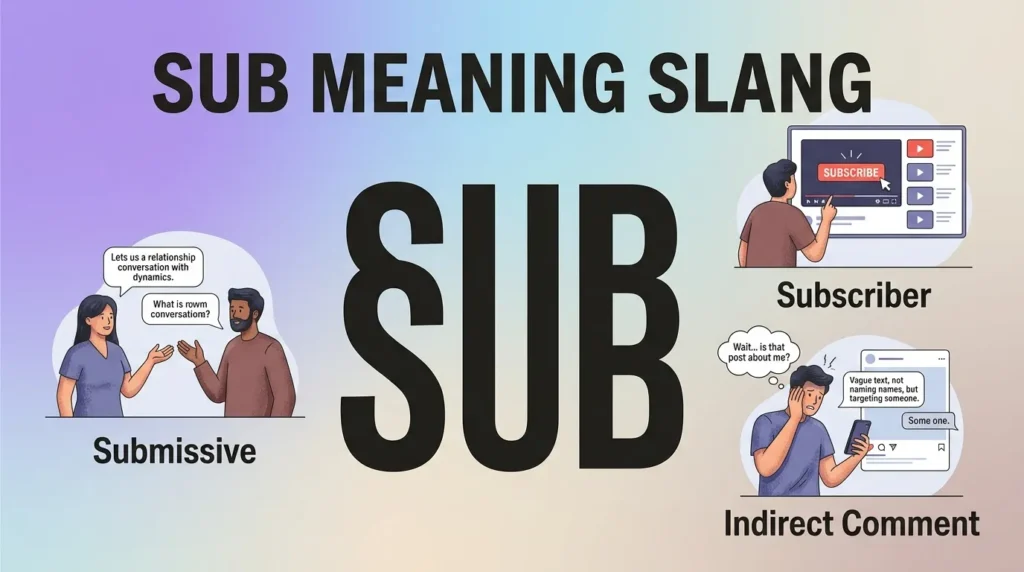

The slang term sub most commonly means submissive, describing someone who prefers taking a less dominant or more yielding role in a relationship or consensual power dynamic. It is particularly common in dating conversations and BDSM-related discussions. However, depending on the context, sub can also mean subscriber, substitute, or someone who makes indirect comments about another person.
The meaning of sub changes depending on where and how someone uses it. You might see it in a private message, a TikTok comment, a gaming conversation, or a discussion about relationships. Understanding the surrounding words helps you recognize whether someone means a submissive person, an online subscriber, a replacement, or something else entirely.
Quick Answer: What Does Sub Mean in Slang?
| Category | Meaning |
|---|---|
| Most common slang meaning | Submissive |
| Relationship context | Someone who prefers a submissive role |
| BDSM context | A person who consensually takes the submissive role |
| Social media | Subscriber or channel supporter |
| Texting | Context-dependent abbreviation |
| Indirect communication | Sometimes refers to indirectly targeting someone |
| Opposite in relationship dynamics | Dom (dominant) |
| Pronunciation | Sub (rhymes with club) |
| Formality | Informal |
| Offensive status | Not inherently offensive |
Remember: If someone uses sub while discussing dating, attraction, or relationship dynamics, they may mean submissive. If they use it while discussing YouTube or Twitch, they probably mean subscriber.
What Does Sub Mean in Slang?
In modern slang, sub has several interpretations, but its relationship-related meaning is particularly important.
Sub Means Submissive
The most recognizable slang meaning of sub is short for submissive.
A submissive person generally prefers a role in which another person takes the lead or has more control within an agreed relationship dynamic. This meaning frequently appears in conversations about dating preferences, personalities, intimacy, and BDSM.
For example:
- “He’s more of a sub than a dom.”
- “She told me she’s a sub.”
- “Are you into dominant or submissive partners?”
In these examples, sub describes a person’s preferred role rather than their entire personality.
Being submissive does not automatically mean someone is weak, insecure, shy, or unable to make decisions. It describes a particular preference within a dynamic between consenting adults.
Sub Means Subscriber
Another common meaning appears in online communities.
Sub can be short for subscriber, particularly on platforms where people follow creators through paid or free subscriptions.
For example:
- “Thanks for the sub!”
- “I just got another 100 subs.”
- “He’s been a sub to my channel for years.”
Here, the word has nothing to do with relationships or submissiveness.
A person might also say they are subbed to a creator, meaning they have subscribed to that creator’s content or channel.
Sub Means Someone Who Makes Indirect Comments
In social media conversations, sub can sometimes appear in expressions such as “subbing someone” or “subtweeting.”
This refers to making an indirect comment about someone without mentioning their name directly.
For example:
- “She’s subbing her ex again.”
- “That post was definitely a sub.”
- “Stop throwing subs and just say what you mean.”
The expression is connected to indirect criticism, shade, or references that a particular person is expected to recognize.
However, this interpretation is less universal than the established relationship and subscriber meanings. The exact expression and context matter.
Sub Means Substitute
In everyday conversations, sub can also be short for substitute.
It describes someone or something temporarily replacing another person or thing.
For example:
- “We have a new sub at school today.”
- “The coach brought in a sub.”
- “I’ll use honey as a sub for sugar.”
This meaning is particularly common in sports, education, and everyday American English.
Also Read: Whip Car Slang: What “Whip” Means When Talking About Cars
Quick Meaning of Sub in Different Contexts
The same three letters can communicate completely different ideas depending on the conversation.
| Context | Likely Meaning | Usage Level |
|---|---|---|
| Dating | Submissive person | Common |
| BDSM discussions | Consensual submissive role | Common |
| YouTube | Subscriber | Very common |
| Twitch | Subscriber | Very common |
| Gaming | Subscriber or substitute | Context-dependent |
| Social media drama | Indirect comment or subtweet | Context-dependent |
| School | Substitute teacher | Common |
| Sports | Substitute player | Common |
| Food conversations | Submarine sandwich | Common in the US |
One useful clue is the topic of the conversation. Words such as dom, dominant, and submissive usually point toward relationship terminology. Words such as channel, stream, and subscription point toward online communities.
What Does Sub Mean in Texting?
When someone sends sub in a text message, the intended meaning depends on what you were discussing.
In private messaging, it may refer to a relationship preference, a subscriber, or an indirect comment about another person.
For example:
Example 1: Relationship conversation
Person A: “What kind of dynamic do you prefer?”
Person B: “I’m more of a sub.”
Meaning: The person prefers a submissive role.
Example 2: Online content
Person A: “How many people follow your channel?”
Person B: “Around 500 subs.”
Meaning: The person has approximately 500 subscribers.
Example 3: Relationship drama
Person A: “Did you see her latest post?”
Person B: “Yeah, that was a sub.”
Meaning: The post appears to contain an indirect reference to someone.
Example 4: School conversation
Person A: “Who is teaching your class today?”
Person B: “We have a sub.”
Meaning: A substitute teacher is covering the class.
How to Identify the Meaning in a Private Message
If you are unsure what someone means, look at three things:
- The topic: Is the conversation about dating, social media, school, or entertainment?
- The surrounding words: Terms such as dom, power dynamic, and submissive suggest the relationship meaning.
- The sentence structure: “I’m a sub” differs from “Thanks for the sub” or “She’s subbing him.”
You do not need to assume that every use of sub has a romantic or intimate meaning.
If the message remains unclear, asking “What do you mean by sub?” is a perfectly natural response.
What Does Sub Mean in Relationships?
In relationship conversations, sub generally means a person who prefers a submissive role within a particular dynamic.
This terminology is often used by people discussing compatibility, attraction, intimacy, and consensual power exchange.
A person who identifies as a sub may enjoy having a partner take the lead in certain situations. However, this does not mean that they surrender their independence or decision-making abilities in everyday life.
What Is a Submissive Partner?
A submissive partner is someone who willingly prefers a dynamic in which their partner takes a more dominant role in agreed situations.
Different people have different preferences. Some may enjoy a more structured relationship dynamic, while others use the term only when discussing specific intimate experiences.
The label does not describe every aspect of someone’s identity.
For example:
“I like taking charge at work, but I’m more of a sub in my personal relationships.”
This illustrates how someone’s preferred role can vary across different situations.
What Is the Difference Between a Sub and a Dom?
Sub and dom are commonly used as contrasting terms in discussions about consensual power dynamics.
| Term | Meaning | General Role |
|---|---|---|
| Sub | Submissive | Prefers yielding control within agreed boundaries |
| Dom | Dominant | Prefers taking the lead within agreed boundaries |
| Switch | Someone comfortable with both roles | May enjoy either role depending on preference |
These labels describe preferences, not a person’s overall strength, confidence, or social status.
A dominant person is not automatically controlling in everyday life, and a submissive person is not automatically passive.
Does Being a Sub Mean Someone Is Weak?
No. Being a sub does not mean someone lacks confidence, intelligence, independence, or authority.
A person may be successful, outspoken, and highly independent while preferring a submissive role in a particular relationship dynamic.
The distinction is between personal identity and consensual relationship preferences.
It is also important to understand that healthy power-exchange dynamics involve communication, boundaries, mutual agreement, and the ability to withdraw consent.
What Does Sub Mean on Snapchat, TikTok, and Instagram?
On social media, sub can have different meanings depending on the feature, conversation, and community.
It is not a special platform-specific abbreviation with one universal definition.
Sub Meaning on Snapchat
On Snapchat, sub may refer to a subscriber or appear in a conversation about someone’s relationship preferences.
Someone might use the term while discussing their dating life or personal interests.
For example:
“He’s definitely a sub.”
This could describe someone’s perceived relationship preference.
However, if the conversation concerns following a creator or online community, subscriber may be the intended meaning.
Sub Meaning on TikTok
On TikTok, sub can appear in relationship discussions, livestream conversations, and creator communities.
Common examples include:
- “I’m a sub.”
- “Thanks for the sub!”
- “He’s a sub, not a dom.”
- “We just reached 1,000 subs.”
The first and third examples refer to submissive preferences. The second and fourth refer to subscriptions.
The surrounding video, caption, or comment usually provides enough information to understand the intended meaning.
Sub Meaning on Instagram
On Instagram, sub may appear in direct messages, comments, and conversations about relationships.
It can also appear when discussing subscribers to creator content or subscription-based communities.
For example:
“She posted a sub about her ex.”
This suggests an indirect reference to someone rather than a direct mention.
However, a post does not automatically become a subtweet or indirect insult simply because someone describes it as a sub. The actual content and situation matter.
Sub Meaning on YouTube and Twitch
On YouTube and Twitch, sub commonly refers to a subscriber.
Creators and viewers frequently use expressions such as:
- “New sub!”
- “Thanks for subscribing.”
- “I gifted five subs.”
- “How many subs does the channel have?”
A gifted sub is a subscription purchased for another viewer on a platform that supports gifted subscriptions.
In this environment, sub generally has a completely different meaning from its relationship-related use.
What Does Subbing Someone Mean?
The expression “subbing someone” can have different interpretations, especially in social media conversations.
One interpretation is indirectly criticizing or referring to someone without identifying them by name.
For example:
“She’s been subbing her former friend all week.”
This suggests that she has been making indirect comments about that person.
It is related to the expression subtweet, which describes posting about someone indirectly on a social platform.
What Is a Sub Post?
A sub post is an indirect message aimed at a particular person or group.
Instead of openly naming the target, the person makes a comment that the intended audience may recognize.
For example:
“Some people only remember you when they need something.”
If posted after a disagreement, someone might interpret it as a sub directed at the other person.
However, indirect posts can be ambiguous. A general statement does not necessarily target a specific individual.
What Is the Difference Between a Sub and a Subtweet?
A sub is a broader informal expression that may refer to indirect shade or criticism.
A subtweet is a more specific term for an indirect post about someone on X, formerly known as Twitter.
| Expression | Meaning |
|---|---|
| Sub | An indirect reference or comment |
| Subtweet | An indirect social media post about someone |
| Shade | Subtle criticism or disrespect |
| Direct callout | Openly addressing or identifying someone |
These expressions overlap, but they are not interchangeable in every situation.
Real Conversation Examples Using Sub
The following examples show how sub can appear naturally in different conversations.
Example 1: Discussing Relationship Preferences
Alex: “Do you prefer taking the lead in a relationship?”
Jordan: “Not really. I’m more of a sub.”
Meaning: Jordan prefers a submissive role in a relationship dynamic.
Example 2: Talking About a Creator
Mia: “How many subscribers does your favorite streamer have?”
Leo: “Almost 20k subs.”
Meaning: The streamer has approximately 20,000 subscribers.
Example 3: Discussing Social Media Drama
Emma: “Did you see that story she posted?”
Noah: “Yeah, I think it was a sub.”
Meaning: Noah believes the story contained an indirect reference to someone.
Example 4: Talking About School
Sam: “Is our regular teacher coming today?”
Chris: “No, we have a sub.”
Meaning: A substitute teacher is taking the class.
Example 5: Discussing Sports
Ryan: “Why did the coach change the lineup?”
Jake: “He brought in a sub because the other player was injured.”
Meaning: A replacement player entered the game.
Example 6: Talking About Dating
Lily: “Are you more into doms or subs?”
Ava: “It depends on the person and the dynamic.”
Meaning: They are discussing relationship and power-exchange preferences.
Example 7: Discussing Online Subscriptions
Max: “Did you subscribe to the channel?”
Ben: “Yeah, I’ve been a sub for months.”
Meaning: Ben has been subscribed to the channel for several months.
These examples demonstrate why interpreting the entire sentence is more useful than relying on the abbreviation alone.
Also Read: Fein Definition Slang: Meaning, Texting & Examples
How to Reply When Someone Calls You a Sub
Your response should depend on the person’s intention, your relationship with them, and whether you feel comfortable discussing the topic.
If someone uses the word sub to describe you, there is no requirement to accept the label.
Neutral Replies
Use these when you want to keep the conversation simple.
- “What makes you say that?”
- “What do you mean by sub?”
- “Interesting. Why do you think that?”
- “I wouldn’t describe myself that way.”
Friendly Replies
If you are comfortable with the conversation, you can respond casually.
- “Everyone has different preferences.”
- “It’s just about what works for someone.”
- “That’s one way to describe it.”
- “People have different personalities.”
Flirty Replies
If the conversation is mutually welcome and you want to flirt:
- “Maybe you’ll find out.”
- “Depends on who I’m talking to.”
- “That’s something we can discuss.”
- “Why are you so curious?”
These replies should only be used when both people are comfortable with the conversation.
Serious Replies
If someone is making assumptions about you:
- “I’d rather not be labeled.”
- “That’s a personal preference.”
- “You shouldn’t assume that about me.”
- “I’m not comfortable discussing that.”
You can always change the subject or set a boundary if the conversation becomes uncomfortable.
Grammar, Pronunciation, and Correct Usage of Sub
Understanding how sub works grammatically makes it easier to recognize in messages.
How Do You Pronounce Sub?
Sub is pronounced /sʌb/.
It sounds like the word “sub” in submarine or the first part of “substitute.”
It rhymes with:
- Club
- Rub
- Hub
- Pub
The pronunciation generally remains the same across its different meanings.
Is Sub a Noun or an Adjective?
Sub is most commonly used as a noun in relationship and online conversations.
Examples:
- “He’s a sub.”
- “She gained 200 subs.”
- “The coach needs another sub.”
It can also appear in informal verb forms.
Examples:
- “I subbed to that channel.”
- “He subbed for the injured player.”
- “She’s subbing him in her posts.”
The exact grammatical role depends on the sentence.
Should You Write Sub or SUB?
In everyday texting, lowercase sub is perfectly normal.
Capitalized SUB may appear in technical documents, abbreviations, or specialized contexts.
When discussing slang, lowercase spelling is generally natural.
What Is the Plural of Sub?
The standard plural is subs.
Examples:
- “The channel has thousands of subs.”
- “Two new subs joined the community.”
- “The team needs more subs.”
When discussing people who prefer submissive roles, subs can also be used as the plural form.
Is Sub Offensive or Inappropriate?
The word sub is not inherently offensive or insulting.
Its appropriateness depends on the intended meaning and the situation in which it appears.
Is Sub a Bad Word?
No. Sub is generally a neutral abbreviation.
It is not automatically profanity, an insult, or an offensive expression.
However, discussions involving intimate preferences can become inappropriate if they are introduced without consent or directed at someone who does not want to participate.
Is Sub Appropriate at Work?
It depends on the meaning.
If sub refers to a substitute employee, substitute teacher, or replacement, it is generally acceptable in ordinary workplace communication.
For example:
“We have a sub covering the afternoon shift.”
However, using the relationship-related meaning in a professional conversation may be inappropriate, especially if it creates discomfort or crosses personal boundaries.
Also Read: Pineapple Meaning Slang: What Does “Pineapple” Mean?
Is Sub Appropriate at School?
The substitute-related meaning is normal in educational settings.
For example:
“Our regular teacher is absent, so we have a sub today.”
The relationship-related meaning is different. It is best treated as personal terminology rather than something to introduce casually in an academic or classroom discussion.
Can Sub Be Used as an Insult?
Sometimes people use relationship labels sarcastically or disrespectfully.
For example, someone might call another person a sub to suggest that they are passive or easily controlled.
That does not make the word itself an insult.
The speaker’s tone, intention, and the surrounding conversation determine whether the comment is disrespectful.
Similar Terms and Commonly Confused Expressions
Several words appear alongside sub in online conversations. Understanding their differences helps avoid misunderstandings.
| Term | Meaning | Main Difference |
|---|---|---|
| Dom | Dominant | Prefers taking the lead |
| Switch | Someone who enjoys both roles | May prefer either role |
| Bottom | A person taking the receiving role in a particular context | Not necessarily submissive |
| Subscriber | Someone subscribed to content | Related to online platforms |
| Subtweet | An indirect social media post | Specifically an indirect post |
| Substitute | Someone or something replacing another | General replacement meaning |
Sub vs. Dom
Sub and dom describe contrasting preferences within certain consensual relationship dynamics.
A sub prefers the submissive role, while a dom prefers the dominant role.
Neither term automatically describes someone’s everyday personality.
Sub vs. Switch
A switch is someone who may enjoy both dominant and submissive roles.
For example, someone may prefer being dominant in one situation and submissive in another.
The term describes flexibility rather than a fixed preference.
Sub vs. Bottom
These terms can overlap, but they do not mean exactly the same thing.
Sub generally refers to a submissive role within a power dynamic.
Bottom usually describes the receiving or less active role in a particular intimate context.
A person can be a bottom without identifying as a sub, and the reverse can also be true.
Sub vs. Subscriber
This distinction is particularly important online.
A subscriber is someone who follows or pays for access to a creator’s content or service.
A sub can be a shortened form of subscriber, but it can also describe a submissive person.
The topic usually makes the intended meaning clear.
Who Uses the Slang Term Sub?
The word sub appears in several different communities, and its meaning changes depending on the audience.
Relationship and Dating Communities
People discussing relationship compatibility, intimacy, and consensual power dynamics may use sub as shorthand for submissive.
It can appear in dating profiles, private conversations, and discussions about personal preferences.
BDSM Communities
The term has an established role in BDSM terminology.
A sub is someone who consensually takes a submissive role within an agreed dynamic.
Communication, negotiation, boundaries, and consent are important parts of understanding this terminology.
Gaming and Streaming Communities
Gaming and streaming audiences often use sub to mean subscriber.
For example, a streamer might celebrate reaching a subscription milestone or thank viewers for gifting subscriptions.
General Social Media Users
People may use sub when discussing indirect criticism, subtweets, or online disagreements.
This usage is especially dependent on sentence structure and the surrounding social situation.
It is important not to assume that everyone who uses the abbreviation belongs to a particular community.
Origin and Evolution of the Word Sub
The word sub is an abbreviation rather than a completely new internet invention.
Its broader English-language history includes shortened forms of words such as substitute and submarine. It has also developed specialized meanings in areas such as subscriptions, education, sports, and relationships.
The submissive meaning developed within communities discussing dominance, submission, and consensual power exchange.
As online communication expanded, these different meanings became more visible in the same digital spaces.
Social media, private messaging, and streaming communities now bring together people who use the same abbreviation for entirely different purposes.
This explains why a short message containing sub can sometimes be confusing.
There is no single origin story that explains every modern use of the term. Its different meanings developed in different contexts.
Real-World Interpretation: Why Context Matters More Than the Abbreviation
One interesting thing about sub is that it can communicate completely different information without changing its spelling.
Imagine receiving these three messages:
- “I’m a sub.”
- “Thanks for the sub!”
- “She posted a sub about him.”
Although the same abbreviation appears in each sentence, the intended meanings are different.
The first describes a relationship preference. The second acknowledges a subscription. The third suggests an indirect social media comment.
This is why interpreting slang word by word can lead to misunderstandings.
A useful approach is to read the entire message, consider the conversation topic, and pay attention to how the speaker uses related expressions.
When the meaning is still unclear, asking for clarification is better than making an assumption.
Also Read: Funny British Slang: 35+ Hilarious UK Words and Phrases
Frequently Asked Questions
1. What does sub mean in slang?
Sub most commonly means submissive in relationship and BDSM-related conversations. It describes someone who prefers a submissive role within an agreed dynamic. However, sub can also mean subscriber, substitute, or an indirect comment on social media. The surrounding conversation determines which interpretation makes sense.
2. What does sub mean when someone calls you one?
When someone calls you a sub, they may be suggesting that you prefer a submissive role in a relationship dynamic. The meaning depends on the conversation and the speaker’s intention. It is not necessarily an insult, and you do not have to accept a label that does not describe you.
3. What does sub mean in a relationship?
In relationships, sub is short for submissive. It describes someone who prefers taking a submissive role within a consensual dynamic. A submissive partner may enjoy allowing their partner to take the lead in certain situations. This preference does not mean they lack independence, confidence, or personal boundaries.
4. What does sub mean on TikTok?
On TikTok, sub can refer to a submissive person in relationship discussions or a subscriber in creator-related conversations. It may also appear in conversations about indirect posts or comments. Look at the video’s topic, caption, and surrounding comments to identify the intended meaning.
5. What does sub mean on Snapchat?
On Snapchat, sub is an informal abbreviation that may mean submissive or subscriber. If someone uses it while discussing dating preferences, they probably mean submissive. If the conversation involves online creators or subscriptions, subscriber is more likely. The abbreviation does not have one exclusive Snapchat definition.
6. Is sub the opposite of dom?
Yes, in consensual dominance and submission dynamics, sub and dom describe contrasting roles. Sub means submissive, while dom means dominant. A sub prefers yielding control within agreed boundaries, whereas a dom prefers taking the lead. Both roles depend on mutual agreement and communication.
7. Does sub mean bottom?
Not necessarily. Sub generally describes a submissive role within a power dynamic, whereas bottom usually refers to a receiving role in a particular intimate context. Some people identify with both terms, but they are not interchangeable. Someone can be a bottom without identifying as submissive.
8. Is calling someone a sub disrespectful?
Not automatically. Sub is generally a neutral abbreviation, but using it to label someone without their agreement can feel disrespectful. It may also be inappropriate when introduced into an unrelated conversation. Consider the relationship between the speakers, the subject, and whether the person is comfortable discussing the terminology.
Conclusion
The slang term sub most commonly means submissive in relationship and BDSM-related conversations. It describes someone who prefers taking a submissive role within an agreed dynamic, rather than someone who is necessarily weak or passive. However, the abbreviation also has other established meanings, including subscriber, substitute, and indirect social media comments. The easiest way to understand it is to consider the topic and surrounding words. Whether you encounter sub in a text message, dating conversation, TikTok comment, or streaming community, context will help you identify what the person actually means.