
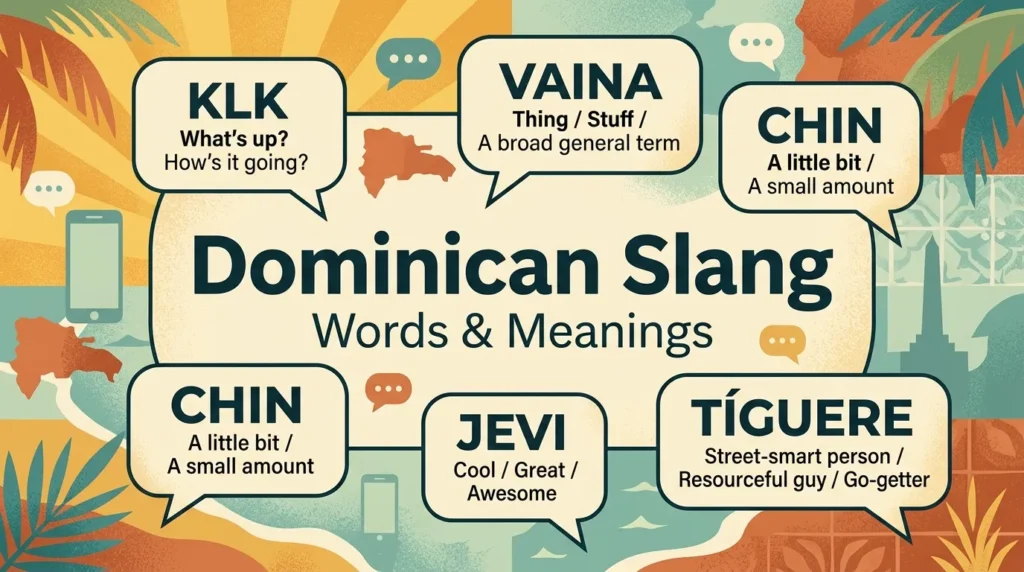

Dominican slang is the informal vocabulary, expressions, and conversational shortcuts used within Dominican Spanish. Common examples include qué lo qué (KLK) for “what’s up?,” vaina for “thing” or “situation,” chin for “a little,” jevi for “cool,” and tíguere for a street-smart or savvy person.
Not every expression is exclusive to the Dominican Republic. Some are shared with Puerto Rico, Cuba, Central America, or other parts of Latin America, while others have distinctly Dominican meanings. Age, region, relationship, tone, social media, and diaspora communities can also affect how a word sounds and when it feels natural.
| Quick Answer | Dominican Slang at a Glance |
|---|---|
| Language base | Dominican Spanish |
| Typical context | Friends, family, casual conversations, music, texting, social media |
| Common greeting | Qué lo qué / KLK |
| Common filler word | Vaina |
| “A little” | Chin |
| “Cool / great” | Jevi |
| General tone | Highly informal and context-dependent |
| Important warning | Labels for people can sound playful among friends but insulting with strangers |
| Texting influence | Abbreviations such as KLK are common in informal digital communication |
| Best approach for learners | Understand widely used slang first; imitate it only when the setting feels natural |
What Is Dominican Slang?
Dominican slang is part of Dominican Spanish, the variety of Spanish spoken in the Dominican Republic and throughout Dominican communities abroad.
It helps to separate slang from the wider dialect. Dominican Spanish includes pronunciation patterns, grammar tendencies, vocabulary, idioms, and local meanings. Slang is only one part of that larger system.
Some Dominican expressions are newly formed words. Others are ordinary Spanish words that developed an additional meaning in Dominican usage. For example, cuarto can mean “money,” while bulto can refer to boasting, exaggeration, or a made-up story rather than only a physical object.
Pronunciation is another reason Dominican conversations may initially sound difficult to learners. In relaxed speech, certain consonants may be weakened or omitted, including final s and intervocalic d. These are patterns of natural speech, not evidence that speakers are “speaking incorrectly.” Pronunciation also varies across regions and individuals.
Quick List of Popular Dominican Slang
| Slang Term | Simple Meaning | Tone | Usage Warning |
|---|---|---|---|
| Qué lo qué / KLK | What’s up? | Friendly, casual | Very informal |
| Vaina | Thing, stuff, matter, situation | Neutral to annoyed | Meaning depends heavily on context |
| Chin | A little bit | Casual | Also heard outside the DR |
| Jevi | Cool, great, awesome | Positive | Youthful/informal |
| Tíguere | Street-smart, savvy person | Admiring or critical | Tone changes the meaning |
| Pariguayo | Foolish, awkward, socially clueless person | Teasing or insulting | Avoid with strangers |
| Boche | Scolding or reprimand | Negative | Often implies a strong telling-off |
| Bulto | Boasting, exaggeration, bluff | Critical/playful | Can imply dishonesty |
| Coro | Hangout, gathering, social group | Friendly | Meaning changes with context |
| Teteo | Party, especially lively urban partying | Playful | Strongly informal |
| Pique | Anger or annoyance | Negative | Usually describes irritation |
| Quillao / quillá | Angry, annoyed | Negative | Informal pronunciation/spelling |
Several of these meanings are distinctly documented in Dominican usage, while words such as vaina, guagua, and jevi also occur elsewhere in the Spanish-speaking world.
Popular Dominican Slang Words and Meanings
1. Qué lo qué / KLK
Meaning: What’s up? / What’s going on?
Qué lo qué is one of the expressions most closely associated with casual Dominican greetings. In texts and social media, it is commonly shortened to KLK.
Example:
“KLK, ¿todo bien?”
“What’s up, everything good?”
Tone: Friendly and highly informal.
Use it with people you already have a casual relationship with rather than in a formal introduction. The abbreviation KLK is particularly natural in messaging.
2. Vaina
Meaning: Thing, stuff, issue, matter, situation, or an unnamed object.
Few words demonstrate the importance of context better than vaina.
Example:
“Pásame esa vaina.”
“Pass me that thing.”
In another conversation:
“Qué vaina.”
“What a pain.” / “What a situation.”
It can sound neutral, frustrated, dismissive, or humorous depending on the speaker. It is not uniquely Dominican, but it has a strong presence in everyday Dominican speech.
3. Chin / Chin Chin
Meaning: A little bit; a small amount.
Example:
“Dame un chin de agua.”
“Give me a little water.”
Adding repetition can make the amount feel even smaller:
“Un chin chin.”
“Just a tiny bit.”
This is one of the most useful expressions for learners because it fits ordinary conversations involving food, time, distance, quantities, and favors.
4. Jevi
Meaning: Cool, great, excellent, enjoyable.
Example:
“La fiesta estuvo jevi.”
“The party was great.”
It can describe a person, event, plan, place, or experience.
Tone: Positive, casual, and often youthful.
The spelling jebi also exists, although jevi is widely recognizable. The word developed from English heavy and is not limited exclusively to Dominican Spanish.
5. Dique
Meaning: Supposedly, allegedly, “like,” or “as if,” depending on context.
Example:
“Él dique viene temprano.”
“He supposedly says he’s coming early.”
It frequently communicates doubt, irony, distance, or disbelief rather than simply reporting information.
Someone might also exclaim:
“¡Dique!”
In that use, the tone may suggest something closer to “Yeah, right!”
Usage tip: Listen to the speaker’s tone before translating it literally.
6. Pila
Meaning: A lot; a large amount.
Example:
“Tengo una pila de cosas que hacer.”
“I have a ton of things to do.”
The ordinary Spanish meaning of pila can be “battery,” “pile,” or other things depending on context. In Dominican informal speech, it can function as an amount expression.
Tone: Casual.
7. Tirar
Meaning: To message, call, or contact someone.
Standard Spanish gives tirar many meanings involving throwing or pulling. Digital communication has added another useful Dominican sense.
Example:
“Te tiro por WhatsApp.”
“I’ll message you on WhatsApp.”
The surrounding words usually make the digital meaning obvious.
8. Cotorra
Meaning: A long spiel, persuasive talk, smooth talk, or chatter.
Example:
“No me vengas con cotorra.”
“Don’t give me that talk.”
It may suggest that someone is talking a lot because they are trying to convince, charm, excuse, or distract another person.
The exact tone ranges from playful to skeptical.
9. Coro
Meaning: A hangout, gathering, social group, conversation, or party-like get-together.
Example:
“Tenemos un coro esta noche.”
“We’re hanging out tonight.”
The literal Spanish word coro also means “choir,” so context matters.
Among friends, hacer coro or references to un coro often have a social meaning rather than anything musical.
10. Teteo
Meaning: A lively party or street-party atmosphere involving music, dancing, and socializing.
Example:
“Anoche había un teteo.”
“There was a big party last night.”
This is a more recent urban expression than many traditional Dominicanisms and became strongly associated with Dominican music and youth culture.
Because slang moves quickly through music and social media, its exact social associations may continue to evolve.
Also Read: SSA Meaning Slang: What It Means on TikTok & Text
Dominican Slang for Feelings, Problems, and Reactions
11. Boche
Meaning: A reprimand, scolding, or strong verbal correction.
Example:
“Me dieron un boche por llegar tarde.”
“I got told off for arriving late.”
A boche is stronger than a casual reminder. It suggests that someone seriously called attention to another person’s behavior.
12. Pique
Meaning: Anger, irritation, annoyance, or a bad mood.
Example:
“Él tiene un pique.”
“He’s annoyed.”
You may hear pique when someone is upset because of an argument, competition, insult, disappointment, or frustration.
13. Quillao / Quillá
Meaning: Angry, irritated, upset.
Example:
“Ella está quillá conmigo.”
“She’s mad at me.”
Quille can refer to the anger itself, while quillao or quillá describes the person experiencing it.
Spellings in casual writing often reflect relaxed pronunciation rather than formal orthography.
14. Rebú
Meaning: A mess, commotion, uproar, fight, or confused situation.
Example:
“Se armó un rebú.”
“A whole commotion broke out.”
It works well for situations involving noise, conflict, confusion, or disorder.
Tone: Informal and expressive.
Dominican Slang for Showing Off and Exaggerating
15. Bulto
Meaning: Boasting, exaggeration, bluff, empty talk, or a made-up story.
Example:
“Eso es bulto.”
“That’s just talk.” / “That’s an exaggeration.”
You may also hear hacer bulto, meaning to show off or make something seem more important than it is.
Because standard Spanish also uses bulto for physical objects or bundles, context is essential.
16. Bultero / Bultera
Meaning: Someone who exaggerates, boasts, or tells inflated stories.
Example:
“No le creas todo; él es muy bultero.”
“Don’t believe everything he says; he exaggerates a lot.”
It may be joking between friends, but it can also accuse someone of being dishonest or full of themselves.
17. Figureo
Meaning: Showing off, seeking attention, or making a conspicuous display of yourself.
Example:
“Eso fue puro figureo.”
“That was just showing off.”
The word can carry criticism, especially when someone seems more interested in being seen than in what is actually happening.
18. Aguaje
Meaning: Pretense, deceptive appearance, empty display, or misleading behavior.
Example:
“Mucho aguaje y poca cosa.”
“A lot of show and not much substance.”
The exact nuance varies by sentence. Related forms can describe people who exaggerate, pretend, or present an image that does not fully match reality.
Dominican Slang for People
19. Tíguere
Meaning: A street-smart, bold, resourceful, savvy person — sometimes with an implication of being unscrupulous.
Example:
“Ese tipo es un tíguere.”
“That guy really knows how to handle himself.”
This word cannot be translated accurately with one English adjective.
In an admiring tone, it can suggest cleverness, confidence, toughness, or social intelligence. In another setting, it can imply someone is opportunistic, shameless, aggressive, or involved in questionable behavior.
It can even function casually as a way of referring to a guy or individual.
That flexibility makes tíguere a good example of why tone matters as much as dictionary meaning in Dominican slang.
20. Pariguayo
Meaning: A foolish, socially awkward, timid, naive, or easily embarrassed person.
Example:
“No seas pariguayo.”
“Don’t be such a fool.”
Among close friends, it may be teasing. Directed seriously at a stranger, it can be insulting.
A famous explanation connects the word with the English expression “party watcher” and the U.S. military presence in the Dominican Republic. That account is deeply established in Dominican cultural discussion, but neat slang-origin stories should be treated cautiously when their earliest history cannot be independently reconstructed with certainty.
Also Read: Foid Slang Meaning: What It Means and Why It’s Offensive
21. Jeva
Meaning: A young woman; sometimes a woman being discussed in a romantic or attraction-related context.
Example:
“Él está hablando con una jeva.”
“He’s talking to a girl.”
It is casual and can sound objectifying depending on who says it, about whom, and in what situation.
It is also found elsewhere in the Caribbean and Central America, so it is not uniquely Dominican.
Dominican Slang About Money
22. Cuarto
Meaning: Money.
Example:
“Necesito conseguir cuarto.”
“I need to get some money.”
In standard Spanish, cuarto commonly means “room,” “quarter,” or “fourth.” Dominican context can give it the additional sense of money.
23. Chele
Meaning: A cent, a tiny amount of money, or money in general in certain expressions.
A particularly useful phrase is:
“No tengo un chele.”
“I don’t have a cent.”
Even though the original coin associated with the term is no longer part of everyday life, the expression remains useful as a figurative way to emphasize having very little or no money.
24. Estar en olla
Meaning: To be broke or in serious financial difficulty.
Example:
“Después del viaje estoy en olla.”
“After the trip, I’m broke.”
It is informal and more expressive than simply saying no tengo dinero.
Dominican Transportation Words You’ll Hear in Real Life
Some of the most useful “slang” searched by travelers is actually regional vocabulary rather than slang in the narrow sense.
25. Concho
Meaning: A public passenger car, shared taxi, or urban passenger-transport service.
Example:
“Voy a coger un concho.”
“I’m going to take a shared taxi.”
The word can refer both to the vehicle and to the transportation service, depending on context.
26. Motoconcho
Meaning: A motorcycle taxi.
Example:
“Llegamos en motoconcho.”
“We got there by motorcycle taxi.”
The driver may be called a motoconchista.
27. Guagua
Meaning: Bus.
Example:
“Vamos en guagua.”
“We’re going by bus.”
This meaning is common in the Dominican Republic but is also used in places including Cuba and Puerto Rico, so it should not be described as exclusively Dominican.
28. Yipeta
Meaning: An SUV or four-wheel-drive-style vehicle.
Example:
“Llegaron en una yipeta.”
“They arrived in an SUV.”
It is a well-established Dominican vehicle term and an example of how borrowed forms can become fully integrated into regional Spanish.
Dominican Slang Related to Drinking
29. Romo
Meaning: Rum.
Example:
“Compraron una botella de romo.”
“They bought a bottle of rum.”
The word is associated particularly with Dominican usage, although it has also appeared in Puerto Rican Spanish.
30. Jumo / Ajuma’o
Meaning: Drunkenness; being drunk.
Example:
“Se dio un jumo.”
“He got very drunk.”
Related forms include juma, jumera, and ajumarse.
Casual spellings such as ajumao may represent the way relaxed Dominican pronunciation removes or weakens sounds that would appear in more formal writing.
Also Read: Blue Waffles Slang: What Does “Blue Waffle” Mean Online?
How Dominican Slang Changes With Tone
Learning the English meaning of a word is only half the job.
Consider:
“Ese hombre es un tíguere.”
Said with admiration, this might suggest:
“He’s sharp. He knows how things work.”
Said suspiciously, it could suggest:
“Watch that guy. He’s slick.”
The same applies to vaina.
“Pásame esa vaina” may be completely neutral.
“¡Qué vaina!” said after something goes wrong expresses frustration.
With pariguayo, the relationship matters even more. A friend jokingly saying it after you refuse to dance is very different from a stranger using it to belittle you.
This is why translating Dominican slang word-for-word often removes the social meaning that the speaker actually intended.
Dominican Slang on Texts and Social Media
Digital communication tends to shorten expressions that are already informal.
The clearest example is:
Qué lo qué → KLK
A message might read:
“KLK, ¿vas pal coro?”
Natural meaning:
“What’s up, are you coming to the hangout?”
Another useful digital expression is tirar:
“Te tiro después.”
In context, that may mean:
“I’ll message/call you later.”
Social media and Dominican urban music also help expressions spread quickly. Words such as teteo, tirar, coro, bulto, and figureo can move between face-to-face conversation, songs, memes, videos, and messaging.
That does not mean every young Dominican uses the same slang. Online visibility and universal everyday usage are not the same thing.
How Dominican Pronunciation Affects Slang
Someone may know a Dominican expression on paper and still miss it in conversation.
Relaxed Dominican speech may reduce sounds. For example, an intervocalic d can disappear in words ending in -ado, so a written form may sound closer to -ao.
Final consonants, particularly s, may also be weakened or omitted in everyday pronunciation.
These patterns help explain spellings such as:
- quillado → quillao
- ajumado → ajumao
- para → pa’
- todo → to’
They should not be treated as rules that every Dominican follows in every situation. Pronunciation changes with region, social setting, speaking style, age, and individual identity.
Real Dominican Slang Conversations
Greeting a Friend
A: “KLK, ¿todo bien?”
B: “Todo jevi.”
Meaning:
A: “What’s up, everything good?”
B: “Everything’s great.”
Asking for a Small Amount
A: “¿Quieres café?”
B: “Sí, pero dame un chin.”
Meaning:
A: “Do you want coffee?”
B: “Yes, but just give me a little.”
Talking About a Party
A: “¿Hay coro hoy?”
B: “Sí, dicen que se va a armar un teteo.”
Meaning:
A: “Are people hanging out today?”
B: “Yeah, they say there’s going to be a big party.”
Someone Is Angry
A: “¿Qué le pasa?”
B: “Está quillao por lo de ayer.”
Meaning:
A: “What’s wrong with him?”
B: “He’s angry about what happened yesterday.”
Calling Out an Exaggeration
A: “Él dice que conoce a todo el mundo.”
B: “Eso es bulto.”
Meaning:
A: “He says he knows everybody.”
B: “That’s just talk.”
Talking About Money
A: “¿Vamos a salir?”
B: “Hoy no. Estoy en olla.”
Meaning:
A: “Want to go out?”
B: “Not today. I’m broke.”
Talking About Transportation
A: “¿Cómo llegamos?”
B: “Podemos ir en guagua y después coger un motoconcho.”
Meaning:
A: “How do we get there?”
B: “We can take the bus and then a motorcycle taxi.”
Formal vs. Informal Dominican Slang
Most expressions on this page belong in casual conversation.
Words such as KLK, jevi, teteo, quillao, bulto, pariguayo, and tíguere generally do not belong in formal business writing, academic papers, official correspondence, or first-time professional introductions.
Other regional words are different.
Saying guagua, concho, or motoconcho may simply be the clearest way to identify a type of transportation. Their regional character does not automatically make them rude.
A useful distinction is:
Informal does not always mean offensive.
Likewise:
Common does not always mean appropriate with everyone.
Which Dominican Slang Should Outsiders Use?
For learners, the safest expressions are usually practical words that do not label another person.
Relatively easy options include:
- Qué lo qué — in genuinely casual situations
- Chin
- Jevi
- Vaina — after you understand its tone
- Coro
- Guagua
- Concho
- Motoconcho
More caution is useful with:
- Tíguere
- Pariguayo
- Bultero
- Jeva
- Aguaje
Those terms can evaluate or categorize a person. What sounds funny between lifelong friends may sound disrespectful from someone who has just learned the word.
Understanding slang is more important than proving that you know how to use it.
Dominican Slang vs. Caribbean Slang
A major mistake is treating every expression heard in the Dominican Republic as uniquely Dominican.
Caribbean Spanish varieties have influenced one another for generations. Migration and digital communication create even more overlap.
For example:
Guagua means “bus” in Dominican, Cuban, and Puerto Rican usage.
Jevi appears in more than one Central American and Caribbean variety.
Vaina has regional meanings across numerous countries.
By contrast, expressions such as pariguayo, along with certain meanings of tíguere, concho, chele, and other words, have especially strong Dominican associations.
A better question than “Is this word 100% Dominican?” is:
“How is this word used in Dominican Spanish?”
That produces a much more accurate understanding of regional language.
Cultural Origin and Evolution
Dominican vocabulary did not develop in isolation.
Dominican Spanish grew through centuries of language contact, migration, local innovation, and changing social life. Speakers have created new words, altered existing meanings, shortened expressions, and adapted borrowed vocabulary into Spanish pronunciation and spelling.
That process continues today.
Older Dominicanisms can exist beside expressions spread through dembow, rap, memes, messaging apps, and diaspora communities.
This is why a Dominican grandparent, university student in Santo Domingo, Dominican-American teenager in New York, and resident of the Cibao may recognize many of the same words while still speaking differently.
Slang is not a fixed national phrasebook. It is a living layer of language.
Also Read: What Does BTA Mean? Slang, Texting, and Social Uses
Respectful Use and Cultural Sensitivity
Dominican slang is not an invitation to imitate a caricature of Dominican speech.
Avoid exaggerating pronunciation, dropping random letters, or constructing a fake accent simply because you have learned expressions such as KLK, tíguere, or vaina.
Use the vocabulary normally.
It is also useful to remember that some labels involve social judgment. Pariguayo can insult someone’s intelligence or social ability. Bultero questions someone’s honesty or authenticity. Tíguere can move between admiration and suspicion.
The safest method is simple:
Listen first.
Notice who uses the expression, who they use it with, and whether people are joking, arguing, flirting, complaining, or simply chatting.
Context teaches the part of slang that translation cannot.
Frequently Asked Questions
What does KLK mean in Dominican slang?
KLK is a texting abbreviation for qué lo qué, an informal Dominican greeting similar to “what’s up?” or “what’s going on?” It is especially common in casual messages and social media. It is best suited to friends, peers, and other relaxed conversations rather than formal communication.
What does vaina mean in the Dominican Republic?
Vaina can mean a thing, object, matter, issue, situation, or unspecified “stuff.” Its meaning depends strongly on context. “Pásame esa vaina” means “pass me that thing,” while an exclamation such as “qué vaina” can express frustration with an unpleasant situation.
What does tíguere mean in Dominican slang?
Tíguere generally describes a street-smart, bold, clever, socially savvy person. However, the word can also suggest someone aggressive, unscrupulous, or overly slick. Whether it sounds admiring or critical depends heavily on the relationship, tone, and situation.
Is pariguayo an insult?
It can be. Pariguayo usually describes someone considered foolish, naive, timid, awkward, or socially clueless. Close friends may use it jokingly, but saying it seriously to someone you do not know can be disrespectful. The social relationship matters as much as the literal definition.
What does chin mean in Dominican Spanish?
Chin means a small amount or “a little bit.” “Dame un chin de agua” means “give me a little water.” You may also hear chin chin, which emphasizes an even smaller quantity. The expression is especially associated with Dominican and Puerto Rican usage.
What does quillao mean?
Quillao, with the feminine form quillá, means angry, irritated, or in a bad mood. The related noun quille refers to anger or annoyance itself. These are highly informal forms and are especially natural in casual Dominican speech.
Is all Dominican slang unique to the Dominican Republic?
No. Dominican Spanish shares vocabulary with Puerto Rican, Cuban, Caribbean, Central American, and wider Latin American Spanish. Guagua, vaina, and jevi, for example, appear outside the Dominican Republic. Other expressions or specific meanings have much stronger Dominican associations.
Can tourists use Dominican slang?
Yes, but simple expressions are easier to use naturally than labels for people. Words such as chin, jevi, or a casual qué lo qué can work in the right situation. Expressions such as pariguayo, bultero, or tíguere require more sensitivity because tone can turn them into criticism or insults.
Conclusion
Dominican slang makes much more sense once you stop treating each expression as having one fixed English translation. KLK can open a casual conversation, chin describes a small amount, vaina changes meaning with the situation, and words such as tíguere or pariguayo depend heavily on tone and relationship.
The most useful goal is not to memorize every Dominican expression. Start with common terms, listen to how people actually use them, and pay attention to context. Dominican Spanish varies across regions, generations, social groups, online communities, and the diaspora, so understanding those differences will help you sound more natural—and avoid turning genuine local language into a stereotype.

Pingback: Philly Slang: 25 Words and Phrases Locals Actually Use