
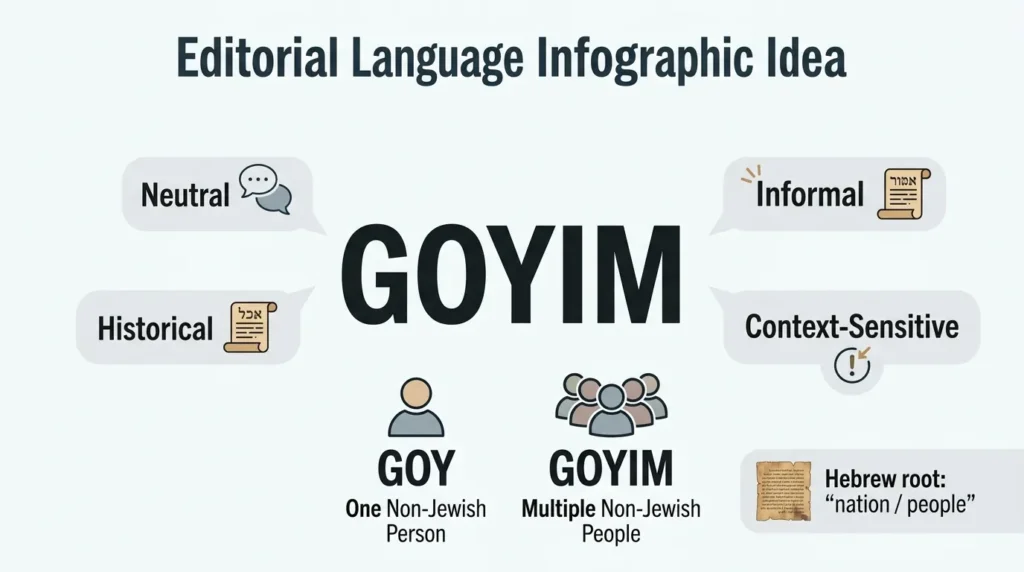

Goyim is the plural of goy and most commonly means non-Jewish people or Gentiles. The word comes from Hebrew and also became part of Yiddish and English usage. Although people sometimes describe goyim as slang, it is an established cultural and linguistic term rather than a recently invented internet expression.
Context matters because goyim can sound neutral, casual, humorous, dismissive, or insulting depending on who says it and how. It also appears in certain antisemitic internet memes, where the surrounding phrase is intended to mock or stereotype Jewish people rather than simply identify non-Jews.
| Quick Answer | Meaning |
|---|---|
| Most common meaning | Non-Jewish people; Gentiles |
| Singular form | Goy |
| Plural form | Goyim; “goys” also occurs in English |
| Original Hebrew sense | Nation or people |
| Typical context | Jewish, Hebrew, Yiddish, cultural, religious, and informal discussion |
| Tone | Neutral to disparaging depending on context |
| Formality | Usually informal in everyday English |
| Is it automatically a slur? | No, but it can be used contemptuously |
| Pronunciation | Varies with Hebrew, Yiddish, and English pronunciation |
What Does Goyim Mean?
In present-day everyday usage, goyim means people who are not Jewish. If someone says, “Most of the people at the event were goyim,” the basic meaning is simply that most attendees were non-Jewish.
The important grammar point is that goyim is already plural. One non-Jewish person may be called a goy. More than one may be called goyim or, especially in English, goys. Major English-language usage records both plural forms.
Example:
“He grew up around Jewish families, but he’s a goy.”
Here, goy means one non-Jewish person.
“There were Jews and goyim at the dinner.”
Here, goyim refers collectively to the non-Jewish people.
The word does not automatically tell you whether the speaker is being friendly or insulting. Tone comes from the surrounding sentence, relationship, and social context.
Quick Meaning by Context
| Context | Likely Meaning | Example | Usage Level |
|---|---|---|---|
| Jewish cultural conversation | Non-Jewish people | “Most of our neighbors are goyim.” | Common |
| Hebrew or Yiddish-related discussion | Gentiles or non-Jews | “The term distinguishes Jews from goyim.” | Established |
| Historical or biblical discussion | Nations or peoples | “Goyim can refer to nations in older Hebrew usage.” | Historical |
| Casual English | Non-Jewish people | “I’m the only goy in the group.” | Context-dependent |
| Joking conversation | Non-Jews, often used playfully | “We had to explain the holiday to the goyim.” | Context-dependent |
| Hostile speech | A dismissive label for non-Jews | “Those goyim…” | Potentially derogatory |
| Antisemitic meme culture | Part of a caricature or conspiracy reference | “The goyim know” | Hostile meme context |
The historical and modern meanings are connected but not identical. In older Hebrew, goy could mean a nation rather than specifically a non-Jew. The word was even used in contexts referring to Israel as a nation. Over time, however, the non-Jewish meaning became prominent in later Jewish usage.
Goy vs. Goyim: What Is the Difference?
This is one of the easiest details to get wrong.
Goy is singular.
Goyim is plural.
So:
- One person: a goy
- Several people: goyim
- Alternative English plural: goys
Saying “a goyim” is generally grammatically incorrect when goyim is being used in its normal sense.
Think of the difference as similar to person versus people. The exact grammar comes from Hebrew, even though the terms now appear in English-language conversations as well.
What Does Goy Mean?
A goy is generally a person who is not Jewish.
For example:
“Her husband is a goy, but he celebrates the Jewish holidays with her family.”
The sentence describes religious or cultural identity. It does not necessarily carry an insult.
What Does Goyim Mean Literally?
Historically, the Hebrew word goy means something closer to nation, people, or a group understood as a nation. Its plural, goyim, therefore literally referred to nations. The narrower meaning “non-Jew” developed through later usage.
That distinction explains why simply translating goyim as “Gentiles” can sometimes be misleading when reading an older Hebrew passage. The meaning depends on the period and context.
Also Read: Toronto Slang: Popular Words, Meanings, and Examples
Also Read: FAFO Slang Meaning: What It Means and How to Use It
Is Goyim Actually Slang?
Calling goyim “slang” is only partly accurate.
It is not slang in the same sense as a newly created texting abbreviation or viral TikTok expression. Goy has deep roots in Hebrew, entered Yiddish usage, and later became familiar in English as well.
In modern American English, however, it can function like informal cultural vocabulary. Someone might use non-Jewish person in formal writing but goy or goyim in a casual family conversation, joke, story, or social-media post.
A useful way to think about it is:
Goyim is an established Hebrew/Yiddish-derived term that can function informally or slang-like in English.
That is more accurate than treating it as purely internet slang.
What Does Goyim Mean in Text and Social Media?
In texts, Instagram captions, TikTok comments, X posts, Reddit discussions, Discord servers, and other casual online spaces, goyim usually keeps the same basic meaning: non-Jewish people.
There is no reliable separate definition such as “goyim meaning on Snapchat” versus “goyim meaning on TikTok.” The surrounding discussion matters more than the platform.
For example:
“My Jewish friends had to explain that tradition to us goyim 😂”
This is likely self-deprecating or playful.
Compare:
“You can’t trust the goyim.”
Here the word is being used negatively to generalize about a group.
The dictionary meaning has not changed. The attitude has.
That distinction is essential when interpreting the word online.
Why Does “The Goyim Know” Mean Something Different Online?
One particularly important internet context is the phrase “the goyim know,” sometimes combined with wording about “shutting it down.”
This is not simply an ordinary Jewish expression meaning “non-Jews know something.” Online, the phrase has been used as an antisemitic meme built around a caricature of Jewish people supposedly hiding secret conspiracies and panicking when non-Jews discover them.
That distinction prevents a common misunderstanding.
The basic word goyim means non-Jews. The hateful meaning comes from the larger meme and the conspiracy stereotype attached to it, not from the plural noun by itself.
A person seeing that phrase in a hostile political meme should therefore interpret the entire expression, rather than assuming it represents ordinary Jewish speech.
How Context Changes the Meaning
The easiest way to interpret goyim correctly is to look beyond the word itself.
Neutral description
“The community includes both Jews and goyim.”
This is primarily descriptive.
Casual cultural humor
“I’m the goy who somehow makes the best latkes.”
The speaker may simply be joking about being the non-Jewish person in a Jewish social setting.
Friendly teasing
“We’ll teach you goyim how the holiday works.”
Among close friends, this could be affectionate or playful.
Dismissive usage
“What would the goyim know about it?”
Depending on tone, this may create an insulting “us versus them” effect.
Antisemitic meme usage
A conspiratorial post using goyim while pretending to speak in the voice of Jewish people may actually be mocking Jews, not attacking non-Jews. This internet usage is especially easy to misread without knowing the meme context.
Tone and Emotional Meaning
Goyim has no single emotional tone.
The same word can function differently depending on delivery.
| Tone | How It May Sound |
|---|---|
| Neutral | A cultural or religious distinction |
| Familiar | Informal community vocabulary |
| Playful | Friendly teasing or self-description |
| Ironic | Used humorously by someone discussing cultural differences |
| Dismissive | Suggesting non-Jews are outsiders |
| Contemptuous | Used as an insult or negative generalization |
| Antisemitic meme context | Used to imitate or caricature Jews |
This is why arguments over whether goy or goyim is “offensive” often produce conflicting answers. Modern English references commonly flag the term as sometimes or often disparaging, rather than defining it as inherently insulting in every situation.
Also Read: New York Slang: 30 NYC Words and Phrases Explained
Real Conversation Examples
1. Neutral cultural discussion
Alex: “Is everyone in your family Jewish?”
Maya: “No. We have Jews and goyim in the family.”
Here, the meaning is simply non-Jewish relatives.
2. Self-description
Ben: “Do you know much about Hanukkah?”
Chris: “Not really. I’m a goy. You’ll have to explain it to me.”
The speaker is casually identifying himself as non-Jewish.
3. Friendly humor
Rachel: “You actually pronounced that correctly.”
Tom: “Not bad for a goy, right?”
The usage is playful rather than hostile.
4. Talking about a group
Sam: “Were most people at the dinner Jewish?”
Leah: “About half. The rest were goyim.”
Again, goyim is simply plural.
5. Negative tone
Person A: “Why are you calling them ‘those goyim’ like that?”
Person B: “I didn’t mean it as an insult.”
This example shows how tone can affect interpretation even when the literal definition stays the same.
6. Online misunderstanding
User A: “Why does that meme say ‘the goyim know’?”
User B: “It isn’t just using the word normally. The whole phrase is referencing an antisemitic conspiracy meme.”
Here, the surrounding meme determines the important interpretation.
Grammar, Spelling, and Pronunciation
Goy functions as a noun.
Common forms include:
| Form | Meaning |
|---|---|
| goy | One non-Jewish person |
| goyim | Multiple non-Jewish people |
| goys | Anglicized plural |
| goyish | Non-Jewish or associated with non-Jewish culture |
English pronunciation of goy is essentially “goy,” rhyming with boy. Pronunciation of goyim varies somewhat according to whether the speaker is following Hebrew, Yiddish, or Anglicized pronunciation. English dictionaries commonly represent it approximately as GOY-im.
Because the word travels across languages and communities, minor pronunciation differences should not automatically be treated as errors.
Similar and Commonly Confused Terms
| Term | Meaning | Main Difference | Typical Context |
|---|---|---|---|
| Goy | A non-Jewish person | Singular | Informal/cultural |
| Goyim | Non-Jewish people | Plural | Informal/cultural |
| Goys | Non-Jewish people | English plural of goy | Informal English |
| Gentile | A person outside a particular religious or ethnic group, especially a non-Jew in Jewish contexts | More familiar in formal English | Religious/historical |
| Non-Jew | Someone who is not Jewish | Direct, neutral English description | General use |
| Goyish | Non-Jewish or associated with non-Jews | Adjective rather than noun | Cultural/informal |
Goyim vs. Gentiles
In many modern Jewish contexts, goyim and Gentiles can refer to the same broad group: people who are not Jewish.
The difference is mainly linguistic and stylistic. Goyim comes through Hebrew and Jewish linguistic tradition, while Gentiles is a familiar English religious term.
Goyim vs. Non-Jews
Non-Jews is usually the clearest neutral English wording when there is no reason to use Hebrew- or Yiddish-derived vocabulary.
Someone writing a formal school paper, workplace document, or general-audience explanation will often find non-Jewish people more immediately understandable.
Who Uses the Term Goyim?
The word is strongly associated with Jewish linguistic and cultural contexts, particularly vocabulary influenced by Hebrew and Yiddish. It has also spread beyond those settings into general English, academic discussion, jokes, social media, and internet culture.
Non-Jewish people may also use goy to refer to themselves, particularly when joking with Jewish friends or discussing Jewish culture.
For example:
“As the only goy at the table, I had a lot of questions.”
That can sound natural in a friendly context.
Still, because the term can carry insider, outsider, ironic, or derogatory undertones, unfamiliar speakers should pay attention to the social setting rather than assuming it works exactly like the neutral phrase non-Jewish person.
Also Read: Spanish Slang: Common Words, Meanings, and Regional Differences
Also Read: Glazing Meaning Slang: Why People Say “Stop Glazing”
Origin and Evolution of Goyim
The history of goyim explains why its modern meaning can be confusing.
The Hebrew goy originally meant a nation or people. In biblical usage, it did not exclusively mean non-Jews; it could also describe Israel as a nation. The plural was goyim, meaning nations or peoples.
Over time, Jewish usage increasingly developed a distinction in which goy referred to someone outside the Jewish people. The word later became part of Yiddish vocabulary and entered English through that linguistic environment. Modern English now commonly recognizes goy as meaning a non-Jew and goyim as its plural.
This means the modern definition is not simply a direct translation of every historical occurrence.
When reading an ancient or religious text, “nation” may be the relevant sense.
When hearing it in contemporary American conversation, “non-Jew” is usually the relevant sense.
Is Goyim Offensive, Rude, or a Slur?
Goyim is not inherently offensive in every context, but it can absolutely be used in a disparaging way.
Modern English references differ somewhat in how strongly they warn about the word. Some describe it as potentially offensive, while others label it sometimes or often derogatory. That variation reflects real differences in tone and usage.
Consider the difference:
“She’s Jewish, but her boyfriend is a goy.”
This may simply describe him as non-Jewish.
Now compare:
“Typical goy.”
Said with contempt after criticizing someone’s behavior, the same noun may function as an insult.
So asking “Is goy a slur?” does not have a useful one-word answer.
A better answer is:
It is an established term for a non-Jew that can be neutral in some Jewish or linguistic contexts but can become insulting when used contemptuously, dismissively, or as a negative generalization.
Is Goyim Appropriate at Work or School?
For general formal communication, non-Jewish people is usually clearer and less likely to be misunderstood.
Using goyim may make sense when:
- discussing Hebrew or Yiddish vocabulary
- studying Jewish history or culture
- quoting or analyzing language
- explaining the meaning of a cultural expression
- using terminology that everyone in the conversation understands
It may be better to avoid it when casually categorizing coworkers, customers, students, or strangers, especially if the audience does not know the term or might interpret the wording as dismissive.
The safest choice is not based solely on whether a word is “allowed.” It is based on whether it communicates your meaning accurately without creating an unintended insult.
Respectful Usage and Cultural Sensitivity
Knowing the definition does not automatically mean every social situation calls for using the word.
If you are unfamiliar with Jewish cultural vocabulary, non-Jewish person is a straightforward alternative. If Jewish friends casually use goy or goyim, pay attention to the tone and relationship before copying the expression.
Also avoid assuming that every appearance of goyim represents the views of Jewish people generally. This is especially important online, where antisemitic accounts sometimes use fake or exaggerated Jewish-sounding language as part of conspiracy memes.
Understanding who is speaking, who is being described, and what the surrounding message says is far more useful than judging the word in isolation.
Real-World Interpretation
What makes goyim interesting linguistically is that its dictionary meaning is simpler than its social meaning.
At the literal level, modern speakers are usually distinguishing Jews from non-Jews. At the social level, however, the word can also signal familiarity with Jewish culture, an insider/outsider distinction, humor, irony, criticism, or prejudice.
That is why two people can hear the exact same word and react differently. They may not disagree about the definition at all. They may be reacting to the social relationship and attitude communicated through the word.
Also Read: Snow Bunny Meaning: Dating, Skiing, and Slang Explained
Frequently Asked Questions
What does goyim mean in slang?
In modern informal usage, goyim generally means non-Jewish people. It is the plural of goy. Although it may function like slang in casual English, the term itself is much older and comes from Hebrew, with additional usage through Yiddish.
Is goyim singular or plural?
Goyim is plural. The singular is goy. English speakers also sometimes use goys as the plural. Therefore, one person can be “a goy,” while several people may be described as “goyim” or “goys.”
Does goyim literally mean cattle?
No. The established linguistic meaning of Hebrew goy is connected with nation or people, with goyim as the plural. Claims that its basic meaning is “cattle” do not match the recognized etymology of the word.
Does goyim mean Gentiles?
Yes, Gentiles is often a reasonable English equivalent when goyim refers to non-Jewish people. However, in historical Hebrew contexts, the older sense of “nations” or “peoples” may sometimes be more accurate.
Is goyim an insult?
Not automatically. Goyim can be used neutrally, casually, humorously, or negatively. The surrounding sentence and tone determine whether it functions as an insult. In English, the term is commonly recognized as capable of being disparaging.
Can a non-Jew call themselves a goy?
Yes. Some non-Jewish people informally describe themselves as a goy, particularly in Jewish social or cultural settings. Whether it sounds natural depends on the relationship and context. In unfamiliar or formal settings, non-Jewish is usually clearer.
What does “the goyim know” mean?
Online, “the goyim know” is associated with an antisemitic conspiracy meme. It caricatures Jewish people as secretly controlling events and panicking because non-Jews have supposedly discovered the conspiracy. It should not be interpreted as an ordinary example of Jewish people using the word goyim.
How do you pronounce goyim?
Pronunciation varies somewhat by language and community. In English, it is commonly approximated as GOY-im, with goy sounding like the word boy with a “g.” Hebrew and Yiddish pronunciation traditions may sound somewhat different.
Conclusion
Goyim most commonly means non-Jewish people and is the plural of goy. Its roots reach back to a Hebrew word meaning “nation” or “people,” while later Jewish and Yiddish usage developed the familiar meaning “non-Jew.”
The term is not automatically a slur, but tone matters. It can sound neutral, familiar, humorous, dismissive, or insulting depending on the speaker and situation. Online, it may also appear inside antisemitic memes whose meaning comes from the larger conspiracy message. When context is uncertain, non-Jewish person is usually the clearest neutral English alternative.



Pingback: Cap Slang Meaning: What “Cap” and “No Cap” Really Mean
Pingback: ICL Meaning Slang: The Real Meaning and How to Use It
Pingback: Funny British Slang: 35+ Hilarious UK Words & Phrases