
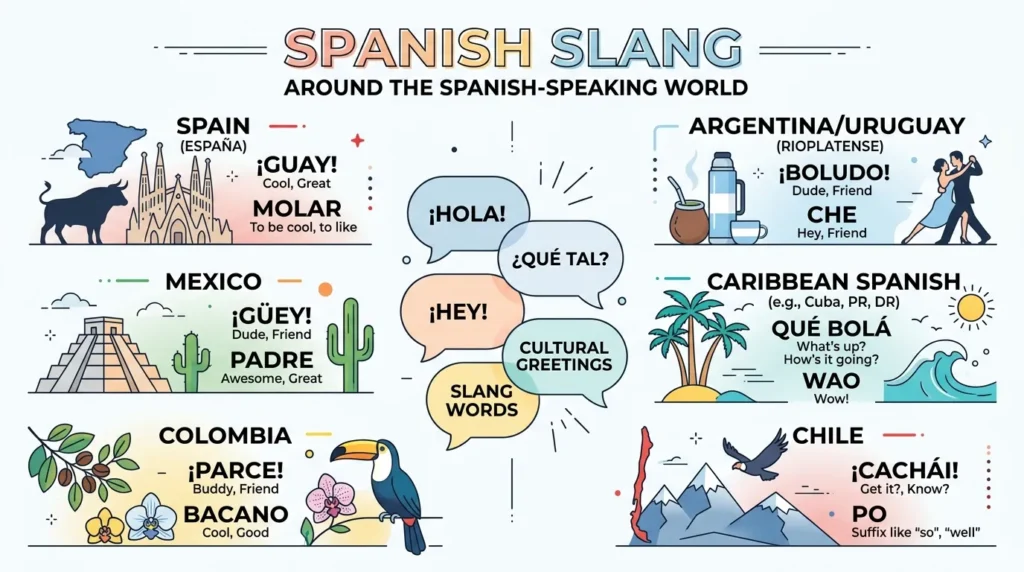

Spanish slang refers to the informal words, expressions, and conversational phrases people use in everyday Spanish. There is no single universal set of Spanish slang: words that sound completely natural in Spain may be uncommon, confusing, or mean something different in Mexico, Argentina, Colombia, Chile, or the Caribbean.
Some expressions are true regional slang, while others are better described as colloquialisms. Age, friendship, location, tone, and online culture can all affect how a phrase feels. The safest approach for learners is therefore to learn slang together with its region and social context rather than memorizing translations alone.
Quick Answer: Popular Spanish Slang at a Glance
| Slang Term | Simple Meaning | Main Usage | Tone or Warning |
|---|---|---|---|
| guay | cool, great | Spain | Friendly and casual |
| tío / tía | dude, guy, girl | Spain | Casual; literally uncle/aunt |
| currar | to work | Spain | Informal |
| flipar | to be amazed; love something | Spain | Very conversational |
| vale | okay, all right | Spain | Common casual response |
| güey / wey | dude, guy | Mexico | Friendly or insulting by tone |
| qué onda | what’s up? | Mexico and elsewhere | Casual greeting |
| no manches | no way; come on | Mexico | Informal exclamation |
| órale | wow; okay; come on | Mexico | Meaning depends on tone |
| chamba | work, job | Mexico and much of Latin America | Informal |
| che | hey; buddy | Argentina and Uruguay | Very common conversational marker |
| boludo / boluda | dude; idiot | Argentina and nearby regions | Can be friendly or insulting |
| pibe / piba | guy, girl, kid | Argentina and Uruguay | Casual |
| laburo | work, job | Argentina, Uruguay and nearby areas | Informal |
| parce / parcero | buddy, friend | Colombia | Friendly and informal |
| bacano | cool, great | Colombia, Ecuador and some Caribbean usage | Positive |
| chévere | cool, great | Many Latin American regions | Friendly and positive |
| pana | close friend, buddy | Caribbean and parts of Latin America | Friendly |
| vaina | thing, stuff, matter | Many Latin American regions | Meaning varies greatly |
| janguear | to hang out | Puerto Rico and U.S. Spanish | Very informal |
| cachái | you know?; you get it? | Chile | Highly conversational |
| fome | boring, dull | Chile | Informal |
| luca | a thousand pesos; money | Chile, Argentina and Uruguay | Informal money term |
| pololo / polola | boyfriend / girlfriend | Chile | Everyday informal term |
These regional labels describe established usage patterns rather than rigid borders. Several expressions travel through migration, entertainment, music, and online conversation, while others remain strongly associated with particular countries.
What Is Spanish Slang?
Spanish slang is informal language used within particular social groups, regions, generations, and everyday situations. It can include greetings, reactions, nicknames, words for friends, expressions of surprise, money terms, relationship vocabulary, insults, and shortened forms.
The important distinction is that Spanish is not linguistically uniform. Vocabulary varies substantially across Spanish-speaking regions, even when speakers share the same basic grammar. Slang increases that variation because informal language often develops locally.
For example, English speakers might use “dude” almost anywhere in the United States. Spanish speakers have several possible equivalents depending on location:
- tío in Spain
- güey in Mexico
- parce in Colombia
- pana in several Caribbean and Latin American communities
- boludo among friends in Argentina, although it carries more risk
That is why asking “How do you say this in Spanish slang?” usually needs a second question: Spanish from where?
Spanish Slang From Spain
Slang from Spain, sometimes called Peninsular Spanish slang, has many expressions that are less common in Latin America. Words such as guay, currar, and flipar are strongly associated with informal speech in Spain.
Guay — Cool or Great
Guay means “cool,” “great,” or “really good.”
Example:
La fiesta estuvo guay.
“The party was cool.”
It is informal but generally harmless. It can describe experiences, objects, plans, or situations.
Tío / Tía — Dude or Girl
Tío literally means “uncle,” while tía means “aunt.” In casual speech in Spain, however, they can work more like “dude,” “man,” “guy,” or “girl.”
Example:
Tío, no me lo puedo creer.
“Dude, I can’t believe it.”
The relationship between the speakers matters. It sounds much more natural among friends than in formal communication.
Currar — To Work
Currar is an informal Spain-specific verb meaning “to work.”
Example:
Tengo que currar mañana.
“I have to work tomorrow.”
The related noun curro can refer informally to work or a job.
Flipar — Be Amazed or Really Like Something
Flipar can express amazement, surprise, or strong enthusiasm.
Example:
Vas a flipar cuando lo veas.
“You’re going to be amazed when you see it.”
It can also describe liking something intensely:
Me flipa esa canción.
“I love that song.”
Its exact interpretation comes from the sentence around it.
Vale — Okay
Vale is an extremely useful conversational response in Spain meaning “okay,” “all right,” or “sounds good.”
Example:
Nos vemos a las ocho.
Vale.
“See you at eight.”
“Okay.”
It is better understood as a common colloquial expression than as highly marked slang.
Also Read: Snow Bunny Meaning: Dating, Skiing, and Slang Explained
Also Read: Millenial Slang: Meanings, Examples, and Cultural Context
Mexican Spanish Slang
Mexican Spanish has an especially rich informal vocabulary. Some Mexican expressions have also become recognizable outside Mexico through entertainment, migration, music, and online conversation, but that does not make them universal Spanish.
Güey / Wey — Dude, Guy, or Fool
Güey, frequently written wey in informal digital communication, is one of the most recognizable Mexican slang words.
Among friends, it can function like “dude”:
¿Qué haces, güey?
“What are you doing, dude?”
The same word can refer negatively to someone considered foolish. Tone and relationship therefore matter enormously.
If you are learning Mexican Spanish, understanding güey is useful. Using it freely with strangers is a different matter.
Qué Onda — What’s Up?
¿Qué onda? is a casual greeting similar to:
- “What’s up?”
- “How’s it going?”
- “What’s happening?”
Example:
¿Qué onda? ¿Todo bien?
“What’s up? Everything good?”
It can also appear in other Spanish-speaking communities, so it is not exclusively Mexican.
No Manches — No Way or Come On
No manches expresses surprise, disbelief, frustration, or excitement.
Example:
¡No manches! ¿Ganaste?
“No way! You won?”
It is commonly treated as a milder conversational alternative to a more vulgar Mexican expression. It is still informal and usually belongs in relaxed conversation rather than professional writing.
Órale — Wow, Okay, Hurry Up, or Come On
Órale demonstrates why literal slang translations can fail.
Depending on delivery, it may express:
- surprise
- approval
- encouragement
- agreement
- impatience
¡Órale, qué bonito! can convey something like “Wow, that’s beautiful!”
¡Órale, vámonos! can feel closer to “Come on, let’s go!”
Context matters more than any single English equivalent.
Chamba — Work or Job
Chamba commonly means “work” or “a job” in Mexico, but its geographic range is much wider. Forms of the word are documented across Central America, the Caribbean, and several South American countries.
Example:
Conseguí una nueva chamba.
“I got a new job.”
This is a good example of a word often marketed as “Mexican slang” even though real usage extends beyond one country.
Argentine and Uruguayan Spanish Slang
Argentina and Uruguay share many features of Rioplatense Spanish. Informal vocabulary from the region can sound noticeably different from Spanish used elsewhere.
Che — Hey
Che is a familiar attention-getter or conversational marker strongly associated with Argentina and Uruguay.
It can function somewhat like:
- “hey”
- “man”
- “listen”
- “buddy”
Example:
Che, ¿venís mañana?
“Hey, are you coming tomorrow?”
It often carries more conversational flavor than literal meaning.
Boludo / Boluda — Dude or Idiot
Few Spanish slang words show the importance of tone better than boludo.
Its insulting sense can describe someone as foolish or stupid. Yet among friends in Argentina, it can also be used as an informal form of address.
Compare:
¡Sos un boludo!
“You’re an idiot!”
with a friendly:
Che, boludo, escuchame.
“Hey, dude, listen.”
A learner should not assume that hearing friends use it affectionately means it is safe with everyone. It remains vulgar and relationship-dependent.
Pibe / Piba — Guy, Girl, Kid
Pibe and piba refer casually to a young man, woman, boy, girl, or young person depending on context.
Example:
Ese pibe juega muy bien.
“That kid/guy plays really well.”
The word is particularly established in Argentina and Uruguay, although it appears elsewhere too.
Laburo — Work or Job
Laburo means “work” or “job.”
Example:
Estoy buscando laburo.
“I’m looking for work.”
The related verb laburar means “to work.” Both are strongly associated with Argentina and Uruguay while also occurring in neighboring regions.
Colombian Spanish Slang
Colombian Spanish contains substantial regional variation of its own, so slang from one Colombian community should not automatically be treated as universal throughout the country.
Parce / Parcero — Friend or Buddy
Parcero and its shortened conversational form parce can mean “friend,” “buddy,” or “mate.”
Example:
¿Todo bien, parce?
“Everything good, buddy?”
The term is strongly associated with informal Colombian speech and can function as a friendly form of address.
Bacano — Cool or Awesome
Bacano describes something excellent, enjoyable, or cool.
Example:
Ese lugar está muy bacano.
“That place is really cool.”
The word is documented particularly in Colombia and Ecuador, with usage elsewhere as well.
Parche — Friend Group or Social Hangout
In Colombian youth usage, parche can refer to a social place, gathering, activity, or group of friends depending on context.
The related verb parcharse can describe getting together or hanging out with friends.
That makes parche difficult to translate with one English word. Sometimes “crew,” “hangout,” “group,” or “plan” will communicate the idea better.
Also Read: RTPS Meaning: What Does RTPS Stand For?
Caribbean and Other Latin American Slang
Some words cross several countries around the Caribbean, Central America, and northern South America. Their precise frequency and tone still vary locally.
Chévere — Cool or Great
Chévere broadly means “cool,” “great,” “excellent,” or “nice.”
Example:
La película estuvo chévere.
“The movie was great.”
It occurs across multiple Latin American varieties rather than belonging exclusively to one country.
Pana — Close Friend
Pana means a close friend or buddy in several parts of the Spanish-speaking Americas, including Puerto Rico, the Dominican Republic, Venezuela, Ecuador, Panama, and other communities.
Example:
Él es mi pana.
“He’s my buddy.”
Because the word has unrelated meanings in some regions, location remains important.
Vaina — Thing, Stuff, or Matter
Vaina is one of the most context-sensitive informal Spanish words.
Across different countries it can stand in for an unnamed “thing,” “matter,” “situation,” or “stuff.”
Example:
¿Qué es esa vaina?
“What is that thing?”
Its tone ranges from ordinary informal speech to vulgar usage depending on the country and expression surrounding it. It is especially risky to assume that every use has the same emotional force.
Janguear — To Hang Out
Janguear comes from English “hang” and is associated particularly with Puerto Rican and U.S. Spanish.
Example:
Vamos a janguear esta noche.
“We’re going to hang out tonight.”
Alternate informal spellings exist because the term developed through spoken bilingual contact.
Chilean Spanish Slang
Chilean conversational Spanish has many locally recognizable expressions. Learners may find some especially challenging because informal pronunciation and vocabulary can differ considerably from textbook Spanish.
Cachái — You Get It?
¿Cachái? can function like:
- “You know?”
- “You get it?”
- “Understand?”
Example:
Es difícil de explicar, ¿cachái?
“It’s hard to explain, you know?”
The expression is closely associated with conversational Chilean Spanish.
Fome — Boring or Dull
Fome describes a person, thing, event, or situation as boring, dull, or lacking fun.
Example:
La película estuvo fome.
“The movie was boring.”
It is strongly associated with Chile.
Luca — A Thousand Pesos
Luca can refer to one thousand pesos in Chile, Argentina, and Uruguay.
Example:
Me costó diez lucas.
“It cost me ten thousand pesos.”
In Colombia, the plural lucas can also have a broader connection with money, illustrating again how regional meanings overlap without being identical.
Pololo / Polola — Boyfriend or Girlfriend
In Chile, pololo and polola commonly refer to romantic partners.
Example:
Ella es mi polola.
“She’s my girlfriend.”
The word is also documented in parts of Bolivia.
Spanish Slang on Social Media and Messaging Apps
Spanish slang appears heavily in texts, comments, videos, gaming chats, memes, and private messages, but there is no separate universal “TikTok Spanish” or “WhatsApp Spanish.”
The underlying regional vocabulary usually remains important. A Mexican speaker may type wey where a Colombian speaker might use parce and an Argentine speaker might use boludo. Online communication increases exposure across borders, so speakers may understand expressions they would not naturally use themselves.
Informal spelling also becomes more flexible online. Accent marks may disappear, words may be shortened, and English may mix with Spanish. That does not mean every creative spelling represents a new slang definition.
Understanding a Word Is Not the Same as Using It
This distinction matters especially online.
A Spanish speaker might recognize güey, parce, or boludo because of music, memes, television, or friends from another country. Recognition does not necessarily mean the word belongs naturally to that person’s own dialect.
For learners, passive vocabulary should usually grow faster than active slang vocabulary. Understand many expressions. Use fewer until you know how people around you actually speak.
Real Spanish Slang Conversations
Friends in Spain
A: ¿Vamos al concierto?
B: Vale, tío. Va a estar guay.
Translation:
“Want to go to the concert?”
“Sure, dude. It’s going to be cool.”
Friends in Mexico
A: Güey, conseguí una nueva chamba.
B: ¡No manches! Qué bueno.
Translation:
“Dude, I got a new job.”
“No way! That’s great.”
Here, güey is friendly because the speakers have an established casual relationship.
Friends in Argentina
A: Che, ¿tenés laburo mañana?
B: Sí, boludo. Todo el día.
Translation:
“Hey, do you work tomorrow?”
“Yeah, dude. All day.”
The friendly translation of boludo depends entirely on familiarity and tone.
Friends in Colombia
A: Parce, ¿salimos esta noche?
B: Sí, el plan está bacano.
Translation:
“Buddy, are we going out tonight?”
“Yeah, the plan sounds cool.”
Friends in Puerto Rico
A: Pana, ¿qué haces hoy?
B: Voy a janguear con unos amigos.
Translation:
“Buddy, what are you doing today?”
“I’m going to hang out with some friends.”
Friends in Chile
A: La fiesta estuvo fome, ¿cachái?
B: Sí, nos fuimos temprano.
Translation:
“The party was boring, you know?”
“Yeah, we left early.”
Formal Versus Informal Spanish Slang
Slang belongs primarily in informal communication.
Words such as guay, chévere, and bacano are generally positive and relatively low-risk in relaxed settings. Others require much more caution.
Usually Low-Risk in Friendly Conversation
Examples include:
- guay
- chévere
- bacano
- vale
- pibe
- pana
- fome
They are still regional and informal, but they are not inherently strong insults.
Best Used After Hearing Locals
Expressions such as:
- güey
- tío/tía
- parce
- cachái
- vaina
- órale
can sound natural in the right community and forced outside it.
Use With Particular Caution
Boludo is the clearest example. It can be affectionate between close friends, yet its insulting meaning remains real.
A useful rule is simple: do not judge a slang word’s safety only by its English translation.
“Dude” may appear harmless in a translation, while the Spanish expression being translated carries stronger social or vulgar undertones.
Also Read: Ohio Slang Meaning: What Does “Ohio” Mean Online?
Similar Spanish Slang Terms and Regional Differences
| Meaning | Spain | Mexico | Argentina | Colombia | Other Common Options |
|---|---|---|---|---|---|
| dude / friend | tío | güey | boludo, pibe | parce | pana in several regions |
| cool / great | guay | padre and others | copado | bacano | chévere in many regions |
| work / job | curro | chamba | laburo | trabajo/camello in some usage | chamba appears widely |
| okay | vale | va / okay in casual speech | dale often appears in conversational use | listo can work in some contexts | varies widely |
| thing / stuff | cosa | cosa | cosa | vaina may appear | vaina across several countries |
The biggest mistake learners make with tables like this is treating each cell as a perfect translation. These words overlap semantically, but they do not necessarily have identical grammar, tone, frequency, or social meaning.
For example, güey, boludo, and parce can all become “dude” in English. That does not make them culturally interchangeable. Their emotional range and risk level differ.
How Spanish Slang Changes Across Regions
Slang changes because communities develop their own linguistic identities. Migration, bilingual contact, local history, music, entertainment, and online communication can all help expressions move between regions.
Some words remain strongly local. Others spread while retaining an association with their place of origin. Still others develop multiple meanings.
One especially important distinction is between international understanding and native usage. A speaker in one country may understand slang from another country without ever using it naturally. Research into Spanish lexical variation consistently shows substantial geographic differentiation rather than one homogeneous vocabulary.
That makes region labels more useful than claims such as “every Spanish speaker says this.”
How to Use Spanish Slang Respectfully
Slang can make your Spanish sound more natural, but copying every expression you hear can have the opposite effect.
First, identify the region. Learn whether the speaker is Mexican, Spanish, Colombian, Chilean, Argentine, Puerto Rican, Venezuelan, or from somewhere else.
Next, notice who is speaking to whom. Friends may use language with each other that would sound disrespectful toward strangers, teachers, customers, older relatives, or coworkers.
Pay attention to reactions too. If native speakers consistently use a term with you, that gives you better evidence about its social fit than a literal English definition.
Finally, do not treat regional Spanish as a costume. Using one or two expressions naturally is usually more convincing than filling every sentence with imported slang.
Also Read: Mexican Slang: Common Words, Meanings, and How to Use Them
Also Read: NSFW Meaning Slang: Definition, Examples, and Usage
Frequently Asked Questions
What does Spanish slang mean?
Spanish slang means informal vocabulary and expressions used in everyday Spanish-speaking communities. It is not a separate language and it is not universal. Slang varies by country, city, age group, relationship, and situation, so expressions should normally be learned together with their regional and social context.
What are the most common Spanish slang words?
Frequently encountered examples include guay, tío, güey, qué onda, chamba, che, boludo, parce, chévere, pana, vaina, fome, and cachái. However, no honest list can rank these as universally common because their usage differs substantially across Spanish-speaking regions.
Is Spanish slang the same in Spain and Mexico?
No. Spain and Mexico share the Spanish language but use many different informal expressions. Guay, currar, and flipar are strongly associated with Spain, while güey, no manches, and órale are associated much more closely with Mexican Spanish.
What is Spanish slang for “dude”?
There is no single universal translation. Depending on the region and relationship, you might hear tío in Spain, güey in Mexico, parce in Colombia, pana in several Latin American regions, or even boludo among friends in Argentina. Some options can become insulting when tone changes.
What is Spanish slang for “cool”?
Common regional options include guay in Spain, bacano in Colombia and Ecuador, and chévere across several Latin American varieties. Different countries also have additional local expressions. Choosing the region first produces a more natural translation than searching for one universal Spanish slang word.
Is Spanish slang appropriate at work or school?
Most slang is better suited to informal conversation than formal academic, professional, or business writing. Mild colloquial words may appear naturally among coworkers or classmates who know each other well, but vulgar or strongly regional expressions can easily sound unprofessional or overly familiar.
Is güey offensive?
It can be. In Mexican Spanish, güey can refer casually to a friend or companion, but it also has negative senses connected with foolishness or dismissive references to another person. Relationship, delivery, and context determine whether it sounds friendly or insulting.
Can non-native speakers use Spanish slang?
Yes, but selective use sounds more natural than forcing slang into every conversation. Start by learning expressions from the region whose Spanish you actually hear or speak. Pay particular attention to insults and friendship terms because a word that sounds affectionate between close friends may be inappropriate with strangers.
Conclusion
Spanish slang is best understood as a collection of regional and social expressions rather than one universal informal vocabulary. Guay may sound natural in Spain, güey in Mexico, boludo among Argentine friends, parce in Colombia, and cachái in Chile.
The most useful skill is not memorizing the longest possible slang list. It is recognizing where a word is used, who is using it, and what tone surrounds it. Learn widely for comprehension, but use new expressions selectively. That approach helps you understand natural Spanish without assuming that every Spanish-speaking community talks the same way.

Pingback: Eiffel Tower Slang Meaning: What Does It Really Mean?
Pingback: New York Slang Words: Meanings, Examples, and Usage
Pingback: Mexican Slang: Common Words, Meanings, and How to Use Them
Pingback: Goyim Slang Meaning: Definition, Usage, Tone, and Context