

In slang, “GOAT” means the Greatest Of All Time, the single best person or thing in a whole field, and it is the highest praise sports fans, music fans, and group chats have to offer.
You have seen it a hundred times. A basketball player hits a shot that makes the whole arena stand up, and the comments fill with four letters: GOAT. A singer drops an album that fans play on repeat for a month, and someone posts a goat emoji underneath it with no other words. A friend cooks a meal so good the table goes quiet, and somebody at the table says, “Okay, you are the GOAT.” The word is short, it is loud, and everyone in the room knows exactly what it means. It is not just “great.” It is the best there has ever been, and the person saying it is ready to argue about it.
That is the fun of the word, and also the risk. GOAT is a claim, not a compliment, and a claim that big invites a debate. Call your favorite player the GOAT and you will get likes from people who agree and a long reply from someone who thinks you are wrong. Call a friend the GOAT for making dinner and everyone laughs, because the joke is that the praise is far too big for the moment, and that is exactly what makes it funny. The same four letters can crown a champion, start a fight, or land a joke, and the difference is all in the context.
This guide covers the GOAT slang meaning in text and online, where the acronym came from and how Muhammad Ali’s nickname became a piece of internet slang, how hip-hop and sports television spread it, the grammar of GOAT and GOATed, how GOAT compares with legend, icon, best, elite, and mid, the great GOAT debates in sports and music, the old negative meaning of “goat” that meant the exact opposite, who says it and where it shows up, how to use it naturally, what to say when someone calls you the GOAT, and when to leave the word alone. If you want the same kind of praise word explained in a softer key, our guide to awesome slang covers a word that cheers without starting an argument.
Table of Contents
- What Does GOAT Mean in Slang?
- Where Did GOAT Come From?
- How GOAT Spread: Hip-Hop, Sports TV, and the Internet
- GOAT Grammar: Noun, Adjective, GOATed, and the Goat Emoji
- GOAT vs Legend, Icon, Best, Elite, and Mid
- GOAT in Sports, Music, and Everyday Chat
- The Great GOAT Debates
- The Old Negative “Goat”: The Scapegoat Meaning
- Who Says GOAT, and Where Does It Show Up?
- How to Use GOAT Naturally
- What to Say When Someone Calls You the GOAT
- GOAT Inflation and When NOT to Use GOAT
- Myths vs Facts About GOAT
- FAQs About GOAT Slang
- Sources and Further Reading
What Does GOAT Mean in Slang?
GOAT is an acronym for Greatest Of All Time, and in slang it names the single best person or thing in a category, the one above every rival past and present. HowToGeek puts it plainly in its explainer: GOAT stands for Greatest Of All Time, and it is used to describe someone or something considered the best in their field. It is almost always written in capitals, and it usually takes “the” in front of it, as in “the GOAT.”
The capitals matter more than they seem to. A goat is a farm animal, and a lowercase “goat” in a sentence about sports will make a reader picture the animal first. GOAT in full capitals tells the reader instantly that this is the acronym, not the animal, and it also gives the word its visual punch. The capitals are the whole joke and the whole claim at once. They say, this is not a normal word, this is a title, and the person wearing it sits above everyone else.
The “the” matters too. People rarely say “a GOAT” when they mean the slang sense, because the word claims a single top spot, and a single top spot needs a definite article. “He is the GOAT” is a claim that there is one greatest and it is him. “He is a GOAT” sounds softer, like one of several greats, and purists will tell you that softens the word into something else. In everyday chat people do say “a GOAT” sometimes, especially about a song or a meal, but the classic form, the one that starts arguments, is “the GOAT,” and it always has been.
What makes GOAT different from ordinary praise is that it is a ranking, not a feeling. Saying someone is great is a feeling, and nobody can prove a feeling wrong. Saying someone is the GOAT is a ranking that covers every person who ever did the thing, and that ranking can be argued about forever, which is exactly why people love saying it. The word hands you a debate in four letters. You do not need to list stats or name rivals. You just say the word, and the argument starts itself.
It also works as a kind of shorthand for a whole paragraph of praise. Instead of saying “he has the most titles, the longest peak, the best numbers against the toughest rivals, and nobody else comes close,” you can say “GOAT” and the crowd fills in the rest. That is why it is so popular in comments, where space is short and speed matters. One word does the work of a paragraph, and it does it louder.
GOAT as a Noun
As a noun, GOAT is a title you give a person, a team, an album, a meal, or even a moment. “Jordan is the GOAT.” “That album is the GOAT.” “This sandwich is the GOAT, no debate.” The noun form is the most common use, and it is the one that starts the most arguments, because naming someone the GOAT is a claim about history, not just about today. It says that across all the years and all the rivals, this one sits on top.
The noun also shows up in the plural, though it sounds a little odd to purists. “The GOATs of hip-hop” means the handful of artists who belong in the all-time conversation, and the plural admits what the singular refuses to admit, that the top spot might be shared. Fans use the plural when they want to praise a group without picking a winner, and they use the singular when they want a fight. Both are common, and the context tells you which game is being played.
GOAT as an Adjective
As an adjective, GOAT describes a performance, a moment, or a thing that belongs in the all-time conversation. “That was a GOAT performance.” “A GOAT-level goal.” “GOAT-tier pizza.” Used this way, the word softens a little. It no longer says this is the single greatest ever. It says this belongs in the same league as the greatest ever, which is still enormous praise, but it leaves room for other greats. The adjective form is the one people reach for when they want huge praise without starting a war.
The adjective form is also how the word escapes sports and music and lands in everyday life. A “GOAT nap” is the best nap you have ever had. A “GOAT playlist” is the one you play on every road trip. A “GOAT sandwich” is the one you still think about a week later. In these uses the word is mostly a joke, a way of saying “this was really, really good” with a smile, and nobody is going to argue about sandwich history. The humor comes from the size of the claim meeting the size of the thing, and the gap between them is the joke.
GOAT in Text and Online
In text and online, GOAT is usually written on its own, or with a goat emoji, or with a short sentence after it. “GOAT.” “GOAT fr.” “He really is the GOAT.” “No debate, GOAT.” The word is so well known now that it needs no explanation, and that is part of its power. A single word in a comment section can carry a whole argument, and everyone reading it knows which side of the argument the writer is on. The goat emoji does the same job without words at all, and it shows up constantly under sports highlights and music posts, where a picture of a goat says what a paragraph could not say faster.
The word also travels well across platforms because it is short enough for any format. It fits in a tweet, a TikTok comment, a Twitch chat message, a group chat, and a caption. Longer praise words get shortened or dropped in fast-moving chats, but GOAT survives because it is already as short as praise can get. Four letters, one claim, done.
Where Did GOAT Come From?
GOAT comes from Muhammad Ali, who called himself “The Greatest” through the 1960s and 1970s, and the acronym took its modern shape in September 1992, when Ali’s wife Lonnie Ali incorporated G.O.A.T. Inc., Greatest of All Time, Inc., to manage his name and image rights. That company name is widely cited as the first clear public use of the acronym, and it turned a boxer’s nickname into a piece of language that would outlive his career.
Ali matters here because he did not just say he was the greatest. He said it constantly, loudly, and in public, at a time when athletes were expected to be humble. He called himself “The Greatest” before the world agreed with him, and then he went out and won the fights that made the claim true. The nickname stuck because the performances backed it up, and the name became part of his identity in a way that few athlete nicknames ever do. When people said “The Greatest,” they meant Ali, and they did not need to add his name.
The step from “The Greatest” to “GOAT” is a small one on paper and a big one in practice. An acronym is easier to chant, easier to print on a shirt, and easier to drop into a comment. Know Your Meme traces the acronym to Ali’s company, G.O.A.T. Inc., and that is the link most histories of the word point to. A boxer’s business name became the word the whole internet uses to crown champions, and the path runs straight through Ali’s self-belief. He named himself the greatest, his wife put it on a company letterhead, and the culture did the rest.
There is a neat irony in this origin that I think about every time I see the word in a comment section. Ali’s claim was controversial when he made it, and people argued about it for years, just like people argue about every GOAT claim today. The word was born in an argument, and it has stayed in arguments ever since. That is not an accident. A word that means “the best ever” is a word that invites disagreement, and it has been doing that since the day it was invented.
Muhammad Ali and “The Greatest”
Ali started calling himself “The Greatest” in the 1960s, when he was still Cassius Clay to some and a loud young champion to everyone else. The nickname was a provocation as much as a boast. Boxing in that era expected its champions to be modest in public, and Ali refused. He wrote poems about his opponents, he predicted the round he would win in, and he said he was the greatest before the record proved it. The crowd loved it or hated it, and either way they talked about it, which was the point.
By the 1970s, the nickname had become part of his public identity, and the fights gave it weight. The Rumble in the Jungle, the Thrilla in Manila, the comeback after losing his license, all of it fed the idea that Ali was not just a great boxer but a figure above the sport. When he retired, “The Greatest” stayed attached to his name in a way that felt less like a nickname and more like a job title. Other athletes have nicknames. Ali had a verdict, and the verdict was his own.
The important thing for the slang word is that Ali’s nickname was a sentence, not an acronym. “The Greatest” is a claim you can say out loud. “GOAT” is a claim you can print, chant, and type. The acronym made the claim portable, and portability is what turns a nickname into slang. A sentence belongs to one person. An acronym belongs to anyone who wants to use it, and that is why the word spread far beyond boxing.
G.O.A.T. Inc. in 1992
In September 1992, Lonnie Ali incorporated G.O.A.T. Inc., Greatest of All Time, Inc., to manage her husband’s name, image, and business rights. MeansToday notes this incorporation as the key moment in the word’s history, and it is the date most accounts of the acronym point to as the first clear public use. A company name is a public record, and a public record is hard to argue with, which is why this date shows up in so many histories of the word.
It is worth pausing on what a strange thing this is. A boxer’s wife registers a company with an acronym as its name, and thirty years later that acronym is the most common way teenagers on the internet say “the best.” Nobody planned that. The company was a business move, a way to protect Ali’s name and control how it was used. The slang was a side effect, a piece of business language that escaped into the culture and took on a life of its own. Language does that sometimes. A word built for a contract ends up in a group chat, and nobody remembers the contract.
De La Soul and the 1993 Hip-Hop Link
Hip-hop picked the word up early. De La Soul’s 1993 album Buhloone Mindstate includes a line that uses “goat” in the positive sense, praising rather than blaming, and that line is often cited as one of the first uses of the word in rap. The album is a classic of early nineties hip-hop, and the line sits in a song about skill and status, exactly the kind of setting where a word for “the best” belongs.
This matters because hip-hop has always been the engine room of American slang. A word that gets used in a rap song gets heard by millions of people who would never read a boxing history, and it gets repeated in a setting where boasting is part of the art form. Rappers compete over who is the greatest, and a word that means “greatest of all time” fits that competition perfectly. De La Soul did not invent the word, but they gave it a home in a culture that would carry it for the next thirty years.
LL Cool J and the Album That Made It Famous
The word went mainstream in music with LL Cool J’s album G.O.A.T., short for Greatest of All Time, released on September 12, 2000. The album reached number one in the United States, and the title put the acronym in front of a mass audience that had never heard it before. Bustle and MeansToday both point to this album as the moment the word moved from a niche term into the wider culture, and the chart position backs that up. A number one album with GOAT on the cover is hard to miss.
LL Cool J was a smart choice of messenger. He was a veteran by 2000, a rapper who had been famous since the eighties, and an album called G.O.A.T. from a veteran was a claim about his own place in history. The title said, I have been here since the start, and I am still the greatest. Fans and critics argued about whether the claim was true, which is exactly the argument the word is built to start, and the argument kept the word in circulation long after the album left the charts.
After 2000, the word was no longer a boxing term or a hip-hop term. It was a pop culture term, and it was ready for the internet. The next step was a dictionary entry, and that step came soon after.
How GOAT Spread: Hip-Hop, Sports TV, and the Internet
GOAT spread in three waves: hip-hop carried it through the nineties, sports television made it a household word in the 2000s, and the internet turned it into everyday slang in the 2010s, with an Urban Dictionary entry in 2003 marking the moment it became a word anyone could look up. Each wave made the word bigger, and each wave changed what it meant a little.
The hip-hop wave is the one people forget, but it did the hardest work. Rap is a genre built on ranking, and rappers have argued about who is the greatest since the first rap battles. A word that means “greatest of all time” was made for that argument, and once it entered rap lyrics, it entered the vocabulary of every fan who listened. De La Soul used it in 1993, LL Cool J put it on an album cover in 2000, and between those two dates the word moved from a line in a song to a term fans used about the artists themselves. By the time the album came out, hip-hop fans were already arguing about who the GOAT of rap was, and they had a word for the argument.
Sports television did the next wave, and it did it by accident. Sports shows are built on debate, and debate shows need short, punchy words for big claims. GOAT is perfect for television because it is four letters, it sounds confident, and it guarantees a reaction. A host who says “he is the GOAT” on a debate show knows the phones will light up, and the show’s producers know it too. The word moved from the studio to the bar to the group chat, and each step made it more familiar. By the late 2000s, sports fans were using it as naturally as they used “MVP” or “champion.”
The internet did the final wave, and it did it fastest. An Urban Dictionary entry for GOAT as an acronym dates to 2003, which means the word was already being defined by internet users before social media existed in its modern form. That entry matters because Urban Dictionary is where slang gets written down by the people who use it, and an entry there is a sign that a word has left its home culture and entered the general internet vocabulary. From there, the word spread to forums, to Twitter, to Instagram, to TikTok, and to every comment section in between. Each platform gave it a new setting, and each setting made it feel more normal.
The internet also changed the word in a subtle way. On television, GOAT was a claim about athletes and artists, people with careers and records. On the internet, GOAT became a claim about anything, a sandwich, a nap, a meme, a moment. The word got funnier as it got broader, and the humor helped it spread even faster. A word that can crown a champion and also crown a sandwich is a word that can go anywhere, and GOAT went everywhere.
The 2003 Urban Dictionary Entry
The Urban Dictionary entry for GOAT as an acronym dates to 2003, and it is a useful marker for when the word stopped being insider language. Urban Dictionary entries are written by users, not editors, so an entry there means ordinary people were already using the word and wanted it explained. The 2003 date puts the word’s internet life about a decade after the Ali company and three years after the LL Cool J album, which is a sensible timeline. A word needs a few years in the culture before people start writing it down.
It is also a reminder that slang histories are often approximate. Nobody sat down in 2003 and decided GOAT was now official. People just started using it, and someone wrote it down, and the entry stayed. The date is a clue, not a birthday, and it tells us the word was already in circulation by the early 2000s, moving from hip-hop and sports into the wider internet.
Sports TV and the Debate Show Era
Sports debate shows were the word’s best friend in the 2000s and 2010s. A show built around two hosts arguing about athletes needs a word for “the best ever,” and GOAT is the shortest, loudest version of that word. The hosts used it, the callers used it, the graphics departments put it on screen, and the audience picked it up. The word fit the format so well that it became part of the furniture, and a generation of sports fans learned it from television before they ever saw it online.
Television also gave the word its visual language. A graphic that says “GOAT” next to a player’s face, with a crown or a goat emoji, is a picture that sticks in the mind. Fans started making their own versions of those graphics, and the word moved from the screen to the meme. By the time social media took over, the word already had a visual identity, and that identity made it easy to share.
Bustle, Tom Brady, and the Dictionary in 2018
Bustle credits Tom Brady’s frequent GOAT label with helping push the term into the dictionary in 2018, and that story says something interesting about how slang becomes official. Brady was called the GOAT so often, in so many places, that the label became part of his public identity, and the word rode along with him into the dictionary. The dictionary did not invent the word. It recognized a word that was already everywhere, and Brady’s career gave it a reason to look.
Whether one athlete can push a word into the dictionary is a question for linguists, and the claim is best read as a story about timing, not a single cause. The word was already common by 2018, and Brady was the most visible example of it in use. The two facts together made a good story, and the story stuck. What matters for the reader is the date: by 2018, GOAT was no longer slang in the underground sense. It was a word the dictionary had to deal with, and that is a long way from a company registration in 1992.
GOAT Grammar: Noun, Adjective, GOATed, and the Goat Emoji
GOAT works as a noun for the title itself, as an adjective for GOAT-level things, as GOATed for something that has reached all-time-great status, and as a goat emoji for wordless praise, and the four forms together cover almost every way people use the word online. Learning the forms is the fastest way to sound natural with the word, because each form has its own setting and its own tone.
The noun is the title. “He is the GOAT.” The adjective is the level. “That was a GOAT performance.” GOATed is the process, the moment something crosses the line into all-time status. “That album just got GOATed.” The emoji is the reaction, the wordless version of the same claim. Each form does a different job, and mixing them up is the most common mistake people make with the word. Saying “that was a GOATed sandwich” when you mean “that sandwich was amazing” is fine, and people will laugh, but saying “he GOATed” when you mean “he is the GOAT” will confuse the room.
The grammar also has a social layer. Using GOAT correctly signals that you know the culture, and using it wrong signals that you are trying too hard. The word is simple, but the rules around it are real, and they are worth learning before you use it in a debate, where a mistake will be noticed and used against you.
GOATed: The Newer Verb and Adjective
GOATed is the newer form, a verb and adjective that means something has reached all-time-great status, and it is the form that shows the word is still growing. “That goal just GOATed him.” “That album is GOATed.” “The whole night was GOATed.” The form is young, it is mostly online, and it is used by people who grew up with the word rather than people who learned it from television.
GOATed works because it turns a title into an event. Being the GOAT is a state, a permanent claim about history. Getting GOATed is a moment, a single performance or a single night that lifts someone into the conversation. A player can be GOATed by one great game, even if he is not the GOAT overall, and that distinction is useful. It lets fans praise a moment without committing to a lifetime claim, and it lets them change their minds later without looking foolish.
The form also shows up in the passive voice, which is a little odd and a little charming. “He got GOATed” means he was crowned by the crowd, not by himself, and the passive form admits that the title comes from the audience. Nobody crowns themselves the GOAT without getting laughed at, and the grammar knows it. GOATed is something that happens to you, not something you do to yourself, and that rule keeps the word honest.
The GOAT Debate
The “GOAT debate” is a phrase in its own right, and it means the endless argument about who is the greatest of all time in a sport, a genre, or a field. “The GOAT debate in basketball.” “The GOAT debate in rap.” “The GOAT debate is over.” The phrase is so common that it has become a genre of content, with videos, podcasts, and articles built entirely around it. The debate is the point, and the word is the fuel.
The GOAT debate has its own rules, and they are worth knowing. First, the debate never ends, because there is no official judge and no final score. Second, the debate is mostly about criteria, not about players. One side argues for titles, the other for stats, the other for peak performance, and they are really arguing about what “greatest” means. Third, the debate is fun precisely because it cannot be settled, and the fun is the reason people keep having it. A debate that could be settled would be boring. A debate that cannot be settled is a hobby.
The Goat Emoji
The goat emoji is common shorthand under sports and music posts, and it does the work of the word without any letters at all. A goat emoji under a highlight means “GOAT,” and everyone reading it knows that. The emoji is popular because it is visual, it is funny, and it fits in a comment where words would take too long. A row of goat emojis under a post is a crowd chanting without typing a word.
The emoji also has a playful edge that the word does not always have. A goat emoji is a joke as much as a claim, and it lets the writer praise someone hugely while keeping the tone light. The animal picture reminds the reader that the word is, at its root, a little bit silly, a farm animal pressed into service as a crown. That silliness is part of the charm. A word that takes itself too seriously would not survive in a comment section. A word with a goat emoji next to it will survive anywhere.
There is also a practical side. The emoji works across languages, which matters on a global platform. A fan in Brazil and a fan in Japan can both post a goat emoji under the same highlight, and both mean the same thing, even if they do not share a language. The word is English, but the emoji is universal, and that universality helped the word travel far beyond English-speaking fans.
Capital Letters and “The”
Always write GOAT in capitals for the slang meaning, so readers do not picture the animal, and it usually takes “the” in front of it for a person. “The GOAT” is the classic form, and it is the one that carries the most weight. Lowercase “goat” in a slang sentence will confuse readers, and it will also confuse search engines, which is a problem for a word that lives online. The capitals are not a style choice. They are the definition.
The “the” is a smaller rule, but it matters too. “He is the GOAT” is a claim about a single top spot. “He is GOAT” sounds like a nickname, and it is used, but it is less formal and less forceful. In a debate, use “the GOAT.” In a joke, either works. In a caption, the emoji does the job on its own.
GOAT vs Legend, Icon, Best, Elite, and Mid
GOAT means the single greatest of all time, while legend means a figure whose story outlives their career, icon means a symbol of a whole era, best means the top of a current ranking, elite means one of the top few, and mid means average or below. The words overlap, but they are not the same, and using the wrong one changes the claim you are making.
| Term | Meaning | Tone | Where It Is Used Most | Example |
|---|---|---|---|---|
| GOAT | The single greatest of all time, above every rival | Bold, absolute, debate-starting | Sports talk, music debates, TikTok comments, X | “Jordan is the GOAT, end of discussion.” |
| Legend | A figure whose story and reputation outlive their career | Respectful, warm, a little nostalgic | Sports tributes, music history, fan posts | “He is a legend of the game.” |
| Icon | A symbol who stands for a whole era or style | Admiring, cultural, broad | Fashion, music, film, pop culture writing | “She is an icon of the nineties.” |
| Best | Top of a current ranking or a specific season | Plain, factual, easy to agree with | Everyday speech, reviews, rankings | “He is the best player in the league right now.” |
| Elite | One of the top few, in the highest tier | Serious, measured, analyst-style | Sports analysis, scouting, serious debate | “She is an elite defender, top five in the league.” |
| Mid | Average, mediocre, nothing special | Dismissive, teasing, negative | TikTok comments, group chats, X | “That album was mid, honestly.” |
The closest pair is GOAT and legend, and the difference is time and rank. A legend is someone whose story lasts, and there can be many legends in one sport. A GOAT is one person, and the claim is that nobody else comes close. Every GOAT is a legend, but most legends are not the GOAT, and calling someone a legend is a safer compliment because it does not start a fight. If you want to praise someone without arguing, call them a legend. If you want to argue, call them the GOAT.
Icon is the broadest word in the group, and it is the one that has the least to do with skill. An icon is a symbol, someone who stands for a whole era, a style, or a movement, and their fame can come from fashion, attitude, or cultural impact as much as from talent. A GOAT has to be the best at the thing itself. An icon has to matter to the culture. Those are different tests, and a person can pass one and fail the other. A singer can be an icon without being the GOAT of singing, and a GOAT can be unknown to the wider culture.
Best is the word people reach for when they want to be precise, and it is the most flexible of the group. “Best right now” is a claim about today. “Best this season” is a claim about a year. “Best ever” is the same as GOAT, but it sounds less like slang and more like a normal sentence. Best is the safe version of the claim, the one you use when you want to be understood by everyone, including people who do not know the slang. GOAT is the loud version, the one you use when you want the room to react.
Elite is the analyst’s word, and it is useful because it admits that the top tier has more than one person in it. Saying someone is elite means they belong in the highest group, and it is a compliment that does not force you to pick a winner. Sports writers love the word because it lets them praise several players at once without starting a GOAT debate. Fans love GOAT because it forces a choice. The two words serve opposite purposes, and knowing which one to use tells people whether you are analyzing or arguing.
Mid is the opposite end of the scale, and it belongs in the comparison because GOAT and mid are the two poles of internet praise. Mid means average, mediocre, nothing special, and it is the word people use to dismiss something that was hyped too much. Our guide to mid slang explains the full story of that word, and it is worth reading alongside this one, because the two words define each other. GOAT is the top of the scale. Mid is the middle, and the distance between them is the whole range of internet opinion.
GOAT in Sports, Music, and Everyday Chat
In sports, GOAT is a career verdict argued over titles and stats, in music it is a debate about influence and catalogs, and in everyday chat it is a joke and a compliment, huge praise shrunk down to fit a sandwich or a nap. The word is the same in all three settings, but the stakes are very different, and the setting decides how seriously the claim should be taken.
Sports is the word’s home, and it is where the claim is taken most seriously. A sports GOAT debate is about careers that lasted decades, and the evidence is public: titles, records, head-to-head results, longevity, and performance in the biggest moments. Fans argue with numbers, and the numbers are real, which is why the debates last so long. Nobody can agree on which numbers matter most, so the debate never ends, and the word stays alive because the debate stays alive.
Music is the second home, and the debate there is messier, because music has no scoreboard. A music GOAT debate is about influence, catalogs, sales, longevity, and cultural impact, and those things are harder to measure than a championship count. Fans argue about who changed the genre, who has the best albums, who influenced the most artists, and who still matters decades later. The argument is less about numbers and more about taste, which makes it louder and less settled than the sports version. That is part of the fun.
Everyday chat is where the word relaxes. A friend who makes a great meal is “the GOAT” for the night, and nobody is going to check the history of cooking to dispute it. A playlist that carries a road trip is “the GOAT playlist,” and the claim is a joke, not a ranking. In these settings the word is a compliment with a wink, and the humor comes from using the biggest word in the language on the smallest thing in the room. The word works in everyday chat because everyone knows it is a joke, and the joke works because everyone knows the word is serious somewhere else.
GOAT in Sports
In sports, GOAT is a career claim, and it is argued with titles, records, and longevity. A player becomes the GOAT by winning more than anyone else, by lasting longer than anyone else, or by playing better than anyone else at their peak, and different fans weight those things differently. That is why the debates never end. One fan counts rings, another counts stats, another counts the eye test, and they are all arguing about different things while using the same word.
The word also has a ritual side in sports. When a player retires, the GOAT debate flares up, because retirement is the moment a career becomes a finished story, and a finished story can be judged as a whole. When a young player breaks out, the debate flares up again, because fans want to know whether the new star belongs in the conversation. The word is a way of placing a player in history, and history is the thing sports fans care about most.
Sports is also where the goat emoji lives most. A highlight clip of a great goal or a great dunk will collect goat emojis in the comments within minutes, and the emojis are a crowd reaction, a way of saying “that was all-time great” without typing a sentence. The emoji and the word work together, and the combination is the visual language of sports fandom online. If you want a tour of the football side of this world, our guide to football slang covers the words fans use around the game itself.
GOAT in Music
In music, GOAT is a debate about influence and catalogs, and it is argued with albums, not trophies. A rapper becomes the GOAT by changing the genre, by releasing a run of classic albums, by influencing the next generation, and by still mattering years after their peak. The evidence is messier than in sports, because there is no final score, and the debate is mostly about taste, which is why it gets so heated. Taste feels personal, and a GOAT claim about music feels like a claim about the person making it.
Hip-hop is where the music debate is loudest, and that makes sense, because hip-hop gave the word its first home outside boxing. Rappers compete over status as part of the art form, and a word that means “greatest of all time” fits that competition perfectly. The GOAT debate in rap has been running for decades, and it has its own cast of usual suspects, its own arguments, and its own unwritten rules. New fans learn the debate the way they learn the music, by listening to older fans argue about it.
Pop, rock, and R and B have their own versions of the debate, and the word travels easily between genres. A singer can be the GOAT of pop, a guitarist can be the GOAT of rock, and a producer can be the GOAT of their era, and each claim uses the same word in the same way. The word is flexible enough to cover any field, and that flexibility is why it escaped sports and music and landed in everyday chat.
GOAT in Everyday Chat
In everyday chat, GOAT is a joke and a compliment at the same time, and the joke is that the praise is far too big for the thing being praised. “You are the GOAT for picking me up.” “This coffee is the GOAT.” “GOAT nap, I feel like a new person.” Nobody is claiming that a cup of coffee is the greatest coffee in history. They are saying it was really good, and they are saying it in the loudest way possible, because the loudness is the joke.
Everyday GOAT also works as a thank you. Calling someone the GOAT for a favor is a warmer, funnier way of saying thanks, and it lands better than a plain “thank you” because it has a smile built into it. The person who gets called the GOAT for bringing snacks to a study session knows the title is a joke, and the joke is the point. It says, you did something small, and I am going to praise you like you won a championship, because that is how much I appreciated it.
The everyday use is also the safest use. A GOAT claim about a sandwich cannot start a real argument, because nobody is going to defend sandwich history. A GOAT claim about a basketball player can start an argument that lasts for hours. The setting decides the stakes, and everyday chat is the low-stakes home of the word, where it can be funny without being a fight.
The Great GOAT Debates
The great GOAT debates are the endless arguments about who is the greatest of all time in basketball, football, tennis, rap, and other fields, and they never end because there is no official judge, no agreed criteria, and no final score, so the debate itself has become a permanent part of fan culture. The debates are the word’s natural habitat, and understanding them is understanding the word.
Every GOAT debate has the same shape. One side argues for the player with the most titles, another side argues for the player with the best stats, another side argues for the player with the highest peak, and another side argues for the player who changed the game. Each side is right about its own criteria, and each side is wrong about the other side’s criteria, and the argument goes in circles because nobody agrees on what “greatest” means. That is the whole game, and it is a game people love playing.
The debates also have a social function that is easy to miss. A GOAT debate is a way for fans to show what they know, to prove they watched the old games, to prove they understand the history, and to prove they belong in the conversation. Saying “he is the GOAT” is a claim about a player, but it is also a claim about the speaker, a way of saying “I know this sport, and I have an opinion worth hearing.” The debate is a test, and the word is the entry ticket.
Basketball: Jordan vs LeBron
The basketball GOAT debate is mostly Jordan versus LeBron, and it is the most famous GOAT debate in the world. Jordan’s side argues for six titles in six Finals, a perfect record on the biggest stage, and a peak that nobody has matched. LeBron’s side argues for longevity, total points, versatility across positions, and a career that has lasted more than two decades at the top. Both sides have real evidence, and neither side is going to change its mind, which is why the debate has lasted for years and will last for years more.
What makes this debate special is that it is also a debate about eras. Jordan played in a different league, with different rules, different defenses, and different styles, and comparing the two players means comparing two versions of the same sport. That comparison is impossible to settle, because the game changed, and the players changed with it. The debate is really about which era was harder, which style was better, and which kind of greatness counts more, and those are questions with no answer.
Football: Messi vs Ronaldo
The football GOAT debate is mostly Messi versus Ronaldo, and it has the same shape as the basketball one, with two all-time greats who played at the same time and split the world into two camps. Messi’s side argues for natural talent, vision, and a World Cup win that completed his story. Ronaldo’s side argues for goals, athleticism, success in multiple leagues, and a career built on relentless work. The two players are so different that the debate is really about what kind of greatness you value, and that is a question of taste, not of fact.
This debate also has a global scale that the others do not. Football is the world’s game, and the Messi versus Ronaldo argument has been had in every country, in every language, and on every platform. The goat emoji appears under highlights from both players within minutes of the highlights being posted, and the comments underneath are a permanent, rolling argument that never pauses. The debate is a part of football culture now, as much as the game itself.
Music: The Rap GOAT Debate
The rap GOAT debate has been running since the genre began, and it has no clear front-runner, which is part of what makes it so durable. Some fans argue for the pioneers who built the genre, some argue for the lyricists with the sharpest pens, some argue for the artists with the biggest catalogs, and some argue for the ones who changed the sound. The debate is less about numbers than the sports debates, and more about influence and taste, which makes it louder and less settled.
The rap debate also has a generational layer. Older fans argue for the artists they grew up with, younger fans argue for the artists they grew up with, and each generation thinks the other one does not understand the genre. The word GOAT becomes a way of defending a whole era, not just a single artist, and the debate becomes a proxy for a larger argument about how music changes. That is why the rap GOAT debate never ends. It is not really about one rapper. It is about what rap is.
Why the Debates Never End
The debates never end because there is no agreed definition of “greatest,” no official judge, and no way to compare players from different eras fairly. Titles, stats, peak performance, longevity, influence, and the eye test all point in different directions, and different fans weight them differently. A debate with no shared criteria cannot be settled, and a debate that cannot be settled is a debate that can run forever.
That is not a flaw. It is the feature. The debates are fun because they cannot be settled, and they are a permanent part of fan culture because they give fans something to argue about between games. The word GOAT is the fuel for that argument, and the argument is the reason the word stays alive. If someone ever settled a GOAT debate for good, the word would lose half its purpose, and nobody wants that.
The Old Negative “Goat”: The Scapegoat Meaning
The older sports meaning of lowercase “goat” was the exact opposite of the slang: the player blamed for losing, the scapegoat, the one whose mistake cost the team the game. The Idioms explains this older sense in its entry on the phrase, noting that in sports a “goat” was the player held responsible for a defeat. Same animal, same word, opposite meaning, and the flip from blame to praise is one of the strangest stories in slang.
The old meaning came from the word “scapegoat,” the animal in the old ritual that carried the sins of the community into the desert. In sports, the scapegoat was the player who carried the blame for a loss, the one whose error everyone remembered and nobody forgave. A dropped catch, a missed free throw, a bad pass at the wrong moment, any of those could turn a player into the goat, and the label would follow him for weeks. It was a cruel word, and it was used cruelly.
The flip happened slowly, and it happened because the acronym gave the word a new meaning that was louder than the old one. Once GOAT meant Greatest Of All Time, the old meaning could not survive in the same sentence. A word cannot mean both the best and the worst at the same time, and the new meaning won because it was more useful, more fun, and more positive. The old meaning faded into history, and most young fans today have never heard it.
There is a lesson in that flip that I find hard to forget. Words are not fixed. They can reverse themselves completely, and the reversal can happen within a single lifetime. A player who was called a goat in 1970 was being insulted. A player who is called the GOAT today is being crowned. The letters are the same, the animal is the same, and the meaning is the opposite. That is slang doing what slang does best: taking an old word and giving it a new life.
How the Meaning Flipped
The flip happened because the acronym was stronger than the old slang. “GOAT” as an acronym has a clear, positive meaning, and it is easy to explain, easy to chant, and easy to print. The old meaning was a piece of sports jargon, used by insiders and rarely explained. When the two meanings met, the acronym won, because it had a better story behind it: Ali, hip-hop, LL Cool J, and the internet, against a word that meant “the guy who messed up.” There was no contest.
The flip also happened because sports culture changed. The old meaning belonged to an era when fans blamed individual players for losses in a harsh, personal way. The new meaning belongs to an era when fans celebrate individual players in a loud, public way. The word changed because the culture changed, and the culture changed because the way fans talk about athletes changed. The word is a small mirror of a bigger shift, from blame to praise, from the team to the star.
Does the Old Meaning Still Appear?
The old meaning still appears in older writing and in the phrase “scapegoat,” which is alive and well, but the standalone sports sense of “goat” as the blamed player is mostly gone. You will find it in old newspaper columns, in books about sports history, and in the memories of older fans, but you will rarely hear it in a modern comment section. The new meaning has taken the word over completely, and the old meaning survives only as a piece of trivia.
That is worth knowing, because it explains why some older readers are confused by the word. If you learned “goat” as an insult, seeing it as praise feels wrong, and the confusion is understandable. The word really did mean the opposite, and the people who remember that are not wrong. They are just reading an older version of the language, and the language has moved on without them.
Who Says GOAT, and Where Does It Show Up?
GOAT is said most by sports fans, music fans, Gen Z and millennials, TikTok and X users, and group chat regulars, and it shows up in comment sections, livestream chats, group chats, captions, and sports broadcasts, usually aimed at an athlete, an artist, or a friend who just did something impressive. The diagram below maps the whole picture in one glance: who says it, where it shows up, who it is aimed at, and what it claims.
Start with the speakers. Sports fans are the word’s core users, and they use it the most seriously. A sports fan who calls a player the GOAT is making a claim about history, and they expect to defend it. Music fans are close behind, and they use it with the same seriousness, though the evidence is messier. Gen Z and millennials use it in everyday chat, where the tone is lighter and the claims are jokes. The word crosses generations now, but it still feels youngest in the hands of the people who grew up with it online.
Then look at the places. Comment sections are the word’s natural habitat, under highlights, edits, and music videos, where a short claim fits the format and the crowd can react instantly. X is where the word lives in reactions to live games, with fans posting GOAT claims in real time as the action unfolds. TikTok comments carry it under edits and clips, where a goat emoji can do the work of a paragraph. Twitch chat uses it during live games and streams, where the praise is instant and the debate starts in seconds. Group chats use it as a joke and a thank you, between friends who know the word is a bit too big for the moment and love it for that reason.
The audience matters as much as the speaker. GOAT is almost always aimed at someone the speaker thinks deserves the biggest praise available: a player who just won a title, an artist who just dropped a classic, a friend who just did something kind, or a creator whose work the speaker loves. The word needs a target who has earned it, or at least a target the speaker thinks has earned it, and a crowd that can see the claim and react to it. Without the crowd, the word is just a compliment. With the crowd, it is a debate.

What gets claimed is broad. Athletes sit at the top of the list, since their careers are public and their records are real. Musicians follow close behind, especially in hip-hop, where the word was born. Creators, YouTubers, and streamers round out the list, and so do ordinary friends, when one friend does something worth celebrating. If someone has done something impressive, the word fits, and the crowd is usually ready to use it.
There is also a status game underneath all of this. Calling someone the GOAT is a way to show that you know the history, that you understand the field, and that your opinion is worth hearing. It is a confident move, a way to position yourself as someone with taste. That is part of why the word spread so fast. It does not just praise the target. It flatters the speaker, and in a comment section full of strangers, a little flattery goes a long way.
How to Use GOAT Naturally
To use GOAT naturally, save it for moments that deserve the biggest praise, keep it short, and match the claim to the setting: “the GOAT” for a serious sports or music claim, “GOAT” on its own in a comment, a goat emoji for wordless praise, and “GOAT” as a joke for everyday things like food and naps. The word works best when the praise fits the moment and the crowd can see why you said it.
Start with the classic form. “He is the GOAT.” “She is the GOAT.” “That album is the GOAT.” The sentence is short, it is confident, and it needs nothing after it. Drop it in a comment or a group chat when someone does something impressive, and let the room react. “GOAT.” on its own is the comment version, a single word that says everything, good for TikTok and X. “No debate, GOAT.” is the stronger version, the one that dares the crowd to disagree, and it works best when you are sure of your claim.
Use it as an adjective when you want huge praise without starting a war. “That was a GOAT performance.” “A GOAT-level goal.” “GOAT-tier pizza.” The adjective form says this belongs in the all-time conversation, which is still enormous praise, but it leaves room for other greats, and the room will notice that you left the room. It is the diplomatic version of the word, and it is useful in settings where a full GOAT claim would be too much.
Use GOATed when a single moment lifts someone into the conversation. “That goal just GOATed him.” “That album is GOATed.” “The whole night was GOATed.” The form is young and mostly online, and it works best with people who know the slang well. Use it with older readers and they may not know what you mean, so save it for chats and comments where the audience is fluent.
Here are a few more examples in real sentences. In a sports comment: “That shot was unreal. GOAT.” In a music comment: “This album is the GOAT, no debate.” In a group chat: “You are the GOAT for bringing snacks.” In a caption: a goat emoji, nothing else. In a joke: “Best nap of my life. GOAT nap.” Each one is short, specific, and aimed at a real moment. That is the whole trick. GOAT works when the praise is obvious and the claim is quick. Compare it with the praise word in our guide to cool slang, which is calm approval with no argument attached, and the difference between the two words becomes clear.
One more tip: do not overexplain the word when you use it. If you write “he is the GOAT, which means the Greatest Of All Time, because he has won six titles and has the best stats,” you have turned a chant into a lecture. The word works because everyone in the room already knows what it means. Say it, let it land, and move on. The best GOAT claims are two or three words long, and the rest is silence.
What Not to Do When Using GOAT
Do not use GOAT for ordinary things and expect people to take it seriously, because the word is the biggest praise in the language, and using it on small things makes the big things sound smaller. If everything is the GOAT, nothing is, and the word loses the power that makes it worth using. Save it for the moments that deserve it, and the moments will feel bigger when you do.
Do not call yourself the GOAT. The title comes from the crowd, not from the person wearing it, and self-crowning is the fastest way to get laughed at. Ali could call himself the greatest because he backed it up in the ring, and even he got mocked for it before the record proved him right. If you have to say you are the GOAT, you probably are not, and the crowd will tell you so.
Do not use GOAT in a serious argument as your only evidence. “He is the GOAT” is a claim, not a proof, and a smart reader will ask for the titles, the stats, and the reasons. The word opens the debate. It does not close it, and using it as if it closes the debate makes you look like you have no case beyond the word itself.
What to Say When Someone Calls You the GOAT
When someone calls you the GOAT, the best reply is short, warm, and a little humble: thank them, laugh it off, or pass the praise along, because the worst reply is a long speech about how right they are. The word is a gift, and the gracious way to receive a gift is to accept it simply and move on.
The simplest reply is a thank you with a smile. “Thank you, that means a lot.” “Appreciate you.” “That is kind of you to say.” These answers work because they accept the praise without claiming it, and the crowd respects that. A person who accepts a huge compliment gracefully looks better than a person who argues about whether they deserve it, and the moment passes nicely for everyone.
A joke is another good option. “I will take it.” “Tell my mom.” “Finally, someone gets it.” These replies lean into the praise instead of running from it, and leaning in takes the pressure out. The caller wanted to make you smile, and a joke says they succeeded. The humor also keeps the moment light, which matters, because a huge compliment can feel awkward if it is taken too seriously.
Passing the praise along is the classiest reply of all. “Thank you, but the team did it.” “I had a lot of help.” “The real GOAT is the person who taught me.” These replies share the credit, and sharing the credit makes you look bigger, not smaller. People remember a person who deflects praise gracefully far longer than they remember a person who collects it.
What you should not do is agree too loudly. “I know, I am the GOAT.” “Obviously.” “Took you long enough to notice.” These replies turn a compliment into a boast, and the crowd will notice the change. A person who agrees that they are the greatest of all time sounds like they believe it, and believing it is a different thing from hearing it. Short, warm, and humble beats loud and certain every time.
If the praise keeps coming, and it starts to feel like too much, it is fine to say so gently. “You are too kind.” “I am just doing my best.” “Let us not go that far.” These replies set a boundary without rejecting the compliment, and they show that you are comfortable with yourself. The crowd will respect the honesty, and the praise will mean more next time because you did not chase it.
Reply Scripts for Different Situations
In a group chat, keep it light: “Thank you, I will take it.” “Appreciate you, honestly.” In a sports argument, stick to the team: “The team earned it, not just me.” In a comment section, a joke works best: “GOAT certified, thank you.” In person, warmth wins: “That means a lot, thank you.” Each setting has its own rhythm, but the rule is the same everywhere: short, warm, and done.
GOAT Inflation and When NOT to Use GOAT
GOAT inflation is the habit of calling everything the GOAT until the word means nothing, and it is the biggest threat to the word’s power, so do not use GOAT in formal writing, work messages, school assignments, serious conversations, or around people who do not know the slang, and do not use it for ordinary things that do not deserve the biggest praise in the language. The word is casual, young, and absolute, and outside its home turf it lands wrong.
Inflation is easy to spot. A new song comes out on Friday, and by Saturday someone has called it the GOAT. A player has one good game, and the comments call him the GOAT. A meal is good, and the group chat calls it the GOAT. Each claim on its own is harmless, and most of them are jokes, but together they wear the word down. If every album is the GOAT, then no album is, and the word stops meaning “greatest of all time” and starts meaning “pretty good,” which is a much smaller thing.
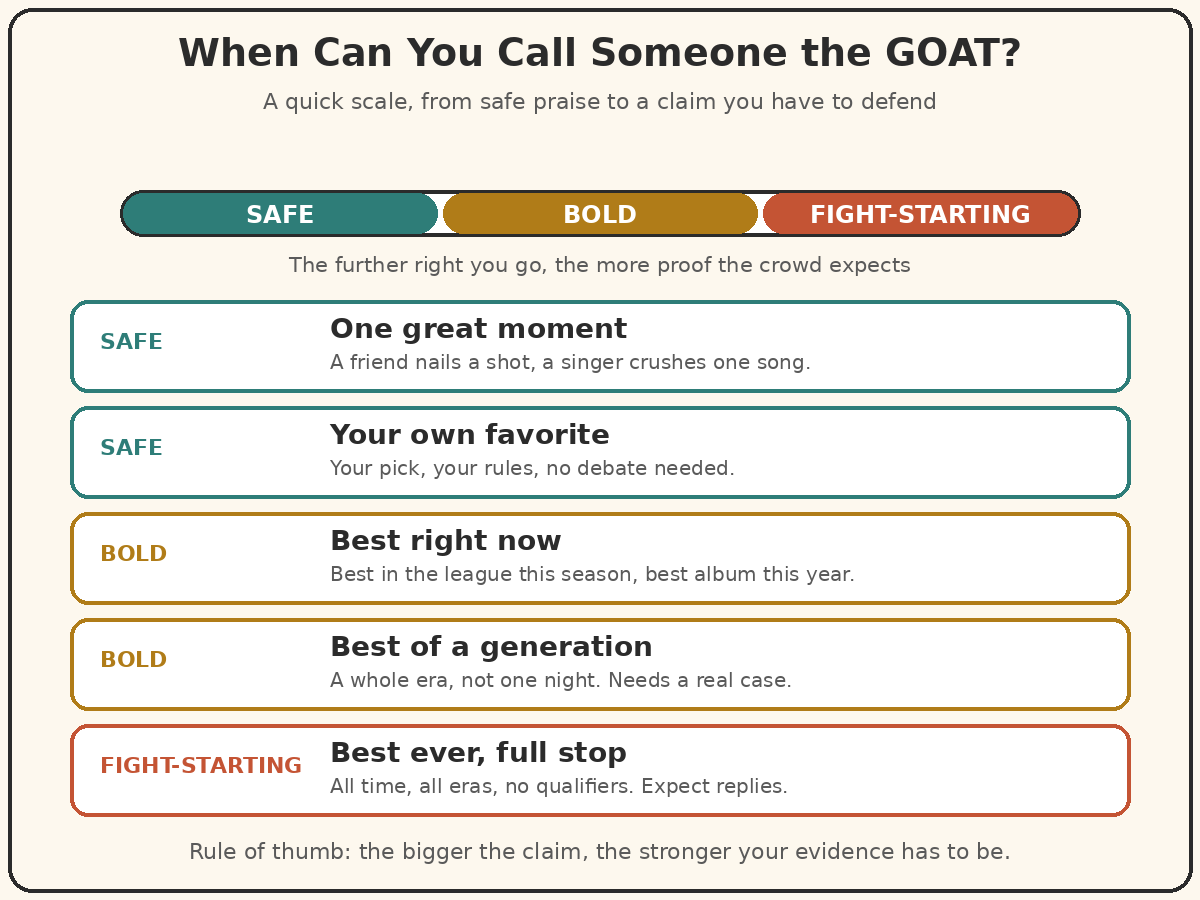
The diagram above shows the scale, and it is worth keeping in mind. Safe praise, one great moment or your own favorite, costs nothing. Bold praise, best right now or best of a generation, needs a real case. A fight-starting claim, best ever with no qualifiers, needs evidence and a willingness to defend it. The further right you go on the scale, the more proof the crowd expects, and the more the word costs. Spend it carefully, and it keeps its value. Spend it on everything, and it becomes pocket change.
Work is the clearest no. A work email, a report, a presentation, or a message to a client should never contain “GOAT.” It reads as unprofessional, and it can make the reader wonder whether you are taking the work seriously. The same goes for academic writing. A teacher marking an essay will not be impressed by slang, no matter how accurate the claim is. Save the word for chats and comments, where it belongs.
Serious moments are another no. Do not call someone the GOAT during a difficult conversation, a condolence, or a discussion about something painful. The word is a celebration, and celebrations aimed at the wrong target read as careless. If someone is sharing real feelings, the last thing they need is a slang crown. Read the room first. If the room is celebrating, GOAT fits. If the room is serious, it does not.
There is also the question of timing. A GOAT claim made too early, before a career is finished or an album has had time to settle, is a claim that ages badly. The word means “of all time,” and “all time” includes the future, which nobody can see. A player who looks like the GOAT at twenty-five can look ordinary at thirty, and a claim made too soon becomes a joke later. The safest GOAT claims are about finished careers and settled history, where the evidence is complete and the debate is about the record, not about a guess.
Formal Alternatives to GOAT
When the setting is formal, use the plainer words that say the same thing without the slang. “The greatest of all time” is the full phrase, and it works in writing where GOAT would look out of place. “The best ever” is shorter and just as clear. “Unmatched” says the same thing in one word, and it sounds serious. “Legendary” praises a career without claiming a single top spot, and it is the safest choice when you want huge praise without starting an argument. Our guide to tuff slang covers another praise word with its own formal alternatives, and the pattern is the same: slang for the chat, plain words for the room where the chat does not belong.
The point of the alternatives is not to hide what you mean. It is to match the words to the room. A word that is perfect in a comment section can be wrong in a meeting, and knowing the difference is a skill, not a compromise. The praise stays the same. Only the packaging changes.
Myths vs Facts About GOAT
Short words collect tall tales, and GOAT has picked up a few. This section takes the most common misunderstandings and corrects them, so you do not repeat a mistake that sounds confident and is wrong.
Myth: GOAT Was Invented on the Internet
Wrong. The acronym traces back to Muhammad Ali and the G.O.A.T. Inc. company registered in September 1992, years before social media existed, and it passed through hip-hop and sports television before it reached the internet. The internet made the word famous, and it gave the word its modern life, but it did not invent it. The word is older than the platforms that spread it, and its roots run through boxing, not through a comment section.
Myth: GOAT Always Meant the Best
Wrong. The older sports meaning of lowercase “goat” was the exact opposite: the player blamed for losing, the scapegoat. The Idioms records this older sense, and it is a reminder that words can reverse themselves completely. The new meaning won because the acronym was louder and more useful, but the old meaning was real, and it lasted for decades before the flip happened.
Myth: Only One Person Can Be the GOAT
Wrong in practice, right in theory. The word claims a single top spot, and purists will tell you there can only be one, but in everyday use people call several people the GOAT of different things: the GOAT of basketball, the GOAT of rap, the GOAT of cooking, the GOAT of naps. The word splits by category, and each category can have its own GOAT. The argument starts when two people claim the same category, and that is where the word earns its reputation as a fight-starter.
Myth: Calling Someone the GOAT Is Always Serious
Wrong. In everyday chat the word is often a joke, a way of saying “that was really good” in the loudest way possible. A GOAT sandwich is not a claim about sandwich history. It is a compliment with a wink, and everyone in the room knows it. The serious version lives in sports and music debates, where the claim is argued with evidence. The joke version lives in group chats, where the claim is a laugh. The setting decides which one you are hearing.
Myth: GOATed Means the Same Thing as GOAT
Wrong. GOAT is a title, a state, a claim about a whole career or a whole category. GOATed is an event, a moment when something crosses the line into all-time status. A player can be GOATed by one great game without being the GOAT overall, and that distinction is the whole point of the newer form. Mixing them up is a common mistake, and it is worth learning the difference before you use the newer form in a debate.
Myth: The GOAT Debates Have a Right Answer
Wrong. The debates have no right answer, because there is no agreed definition of “greatest,” no official judge, and no way to compare players from different eras fairly. Titles, stats, peak performance, longevity, and influence all point in different directions, and different fans weight them differently. The debates are fun because they cannot be settled, and they are a permanent part of fan culture for that reason. Anyone who tells you the debate is over is selling you their opinion, not a fact.
FAQs About GOAT Slang
What does GOAT mean in slang?
GOAT means Greatest Of All Time, the single best person or thing in a whole field. HowToGeek puts it plainly: GOAT stands for Greatest Of All Time, and it describes someone or something considered the best in their field. It is almost always written in capitals, and it usually takes “the” in front of it, as in “the GOAT.”
Where did GOAT come from?
GOAT comes from Muhammad Ali, who called himself “The Greatest” through the 1960s and 1970s, and the acronym took shape in September 1992, when his wife Lonnie Ali incorporated G.O.A.T. Inc., Greatest of All Time, Inc. Know Your Meme traces the acronym to that company, and hip-hop, especially LL Cool J’s number one album G.O.A.T. in 2000, carried it into the wider culture.
What does GOATed mean?
GOATed is a newer verb and adjective form meaning something has reached all-time-great status. “That album is GOATed” means the album belongs in the all-time conversation, and “that goal just GOATed him” means one great moment lifted a player into the debate. It describes an event, a crossing of the line, while GOAT itself is the title.
Is GOAT always about sports?
No, GOAT started in sports and music, but it is now used for anything, from albums and movies to sandwiches, naps, and playlists. In sports and music the claim is serious and argued with evidence, while in everyday chat it is often a joke, huge praise shrunk down to fit a small thing, and the humor comes from the gap between the claim and the thing.
Why do people use a goat emoji for GOAT?
People use the goat emoji as wordless shorthand for GOAT, because the animal picture says the same thing as the acronym without any letters. The emoji is common under sports highlights and music posts, where it works across languages and fits in a comment where words would take too long. A row of goat emojis is a crowd chanting without typing a word.
What is the opposite of GOAT?
The opposite of GOAT in internet slang is mid, which means average or mediocre, and our guide to mid slang explains that word in full. The old opposite was the lowercase “goat” of sports, the player blamed for losing, but that meaning has mostly faded, and today mid is the word people reach for when something is nothing special.
Can there be more than one GOAT?
Yes, in everyday use there can be more than one GOAT, because the word splits by category: the GOAT of basketball, the GOAT of rap, the GOAT of cooking. The argument starts when two people claim the same category, and purists will say there can only be one per category. In practice, the word is used for several greats at once, and the debate is about which one sits on top.



Pingback: Green Meaning Slang: 5 Meanings, Examples & How to Use It
Pingback: HG Meaning Slang: What Does HG Mean in Text?