
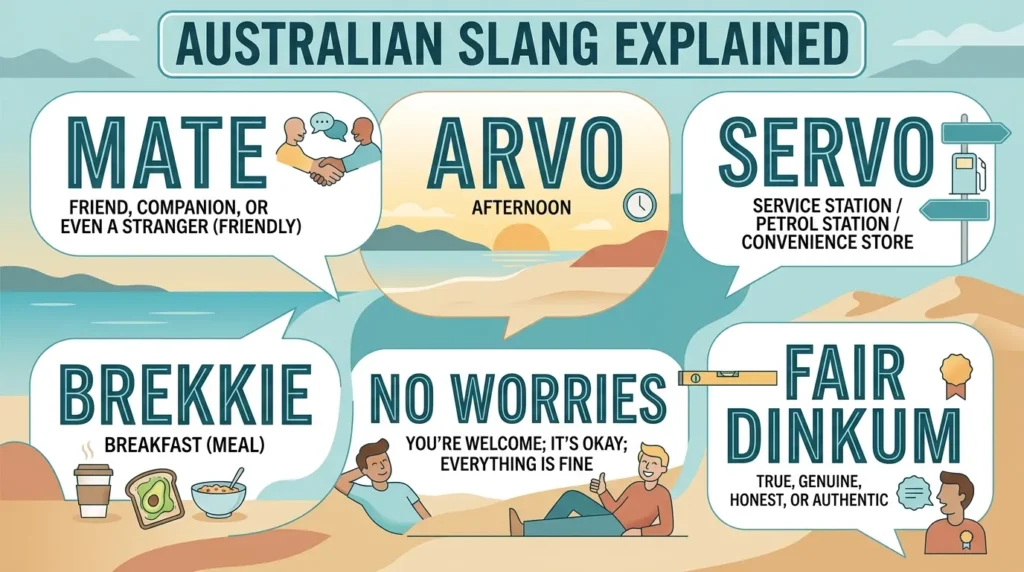

Australian slang is the informal vocabulary, shortened words, expressions, and conversational phrases associated with Australian English. Common examples include arvo for afternoon, servo for a gas station, mate for a friend or person being addressed, and no worries for “no problem” or “that’s okay.”
But Australian slang is not one fixed vocabulary spoken identically by everyone. Age, region, social setting, familiarity, and tone all matter. Some expressions remain part of everyday Australian speech while others sound old-fashioned, exaggerated, regional, or more like cultural stereotypes than something every Australian regularly says.
| Quick Answer | Meaning |
|---|---|
| What is Australian slang? | Informal words, phrases, abbreviations, and idioms associated with Australian English |
| Common examples | Mate, arvo, brekkie, servo, no worries, reckon, bottle-o |
| Typical tone | Casual, friendly, humorous, blunt, or playful |
| Formality | Mostly informal |
| Regional variation | Yes, especially for everyday vocabulary |
| Can it sound rude? | Some terms can, depending on the word, relationship, and tone |
| Is every “Aussie slang” term uniquely Australian? | No. Some expressions are shared with other varieties of English |
What Is Australian Slang?
Australian slang is one part of Australian English, not a separate language or the entirety of the Australian dialect. It includes informal vocabulary, distinctive idioms, humorous expressions, regional words, and a particularly noticeable habit of shortening longer words.
A common pattern is turning ordinary words into forms ending in -ie, -y, -o, or -a. This helps explain everyday forms such as tradie, mozzie, servo, arvo, and brekkie. These shortened forms can make conversation sound relaxed and familiar rather than simply saving syllables.
Australian English also includes words inherited from British and Irish varieties, expressions developed locally, words connected with Australian history and sport, and borrowings from Aboriginal languages. That mixed history is one reason an expression can feel strongly Australian without necessarily having originated entirely within modern Australia.
Quick List of Popular Australian Slang
| Slang Term | Simple Meaning | Tone | Usage Warning |
|---|---|---|---|
| Mate | Friend; informal way to address someone | Friendly or neutral | Tone can make it confrontational |
| G’day | Hello | Friendly | Very informal |
| Arvo | Afternoon | Casual | Generally safe |
| Brekkie | Breakfast | Casual | Generally safe |
| Servo | Gas/petrol station | Casual | Common informal vocabulary |
| Bottle-o | Liquor store | Casual | Informal |
| Barbie | Barbecue | Casual | Generally safe |
| Snag | Sausage | Casual | Context-dependent |
| Mozzie | Mosquito | Casual | Generally safe |
| Tradie | Tradesperson | Casual | Common occupational shorthand |
| No worries | No problem; that’s okay | Friendly | Usually safe |
| Good on ya | Well done; good for you | Positive | Can be sarcastic |
| Reckon | Think; suppose; believe | Informal | Not exclusively Australian |
| Heaps | A lot; very | Casual | Not exclusively Australian |
| Fair dinkum | Genuine; true; seriously | Informal | Can sound deliberately “Aussie” in some settings |
| Hard yakka | Hard work | Informal | Strongly Australian expression |
| Bludger | Lazy person; someone avoiding work | Negative | Insulting |
| Bogan | Person viewed as uncultured or unsophisticated | Teasing to insulting | Class-sensitive |
| Drongo | Fool; idiot | Insulting/playful | Relationship matters |
| Larrikin | Mischievous, irreverent but often likeable person | Often affectionate | Meaning has changed historically |
| Chook | Chicken | Casual | Common informal word |
| Dunny | Toilet | Informal | Crude in formal settings |
| Thongs | Flip-flops | Neutral in Australia | Means something different in American English |
| Woop Woop | A very remote place | Humorous | Informal |
| Yeah nah | Usually “no,” often after acknowledging a point | Conversational | Meaning depends on discourse |
| Nah yeah | Usually “yes,” after initial hesitation | Conversational | Context matters |
Popular Australian Slang Words and Meanings
Greetings and Everyday Expressions
Mate
Mate can mean a friend, companion, coworker, or simply the person someone is addressing. In Australian interaction, it often communicates familiarity, equality, or goodwill.
Example:
“Thanks for helping me move, mate.”
The word is highly dependent on tone. A cheerful “Thanks, mate” sounds friendly. A clipped “Listen, mate” during an argument may signal irritation rather than friendship.
That distinction is important for learners: mate describes the relationship less reliably than the speaker’s tone does.
G’day
G’day is an informal greeting meaning hello or good day.
Example:
“G’day, how’s it going?”
It is widely recognized as Australian English, although individual Australians differ in how frequently they personally use it.
No Worries
No worries can mean:
- No problem
- You’re welcome
- Don’t worry about it
- Everything is fine
- I can handle it
It has been well established in Australian informal speech since at least the twentieth century and is especially useful because its meaning adjusts naturally to the situation.
Example:
“Sorry I’m five minutes late.”
“No worries.”
Good on Ya
Good on ya, from “good on you,” generally means well done, good for you, or nice work.
Example:
“You finally finished the course? Good on ya.”
Tone matters. It can become sarcastic if said after someone does something foolish.
Reckon
Reckon means think, believe, or suppose.
Example:
“Do you reckon it’ll rain later?”
The word is strongly associated with casual Australian conversation but is not uniquely Australian.
Yeah Nah
Yeah nah is a useful example of how conversational meaning cannot always be understood word by word. It often begins by acknowledging what the other person said before moving to a negative answer.
Example:
“Want to stay for another drink?”
“Yeah nah, I should head home.”
The final negative element generally carries the answer. Australian English has a documented history of using yeah-no as a conversational discourse pattern.
Nah Yeah
Nah yeah generally works in the opposite direction. A speaker may begin with hesitation, correction, or qualification before ending affirmatively.
Example:
“Did you end up liking the movie?”
“Nah yeah, it was actually pretty good.”
Neither construction should be treated as a mathematical rule. Tone and surrounding sentences still matter.
Also Read: What Does Huzz Mean in Slang? Meaning, Use & Examples
Australian Shortened Words
One of the most recognizable features of informal Australian English is playful shortening. The shortened form often does more than save time; it can make an interaction sound familiar and relaxed.
Arvo
Arvo means afternoon.
Example:
“I’ll see you this arvo.”
Brekkie
Brekkie means breakfast.
Example:
“Want to grab brekkie before work?”
Servo
Servo means a service station, particularly a petrol or gas station.
Example:
“We need to stop at the servo for fuel.”
Bottle-o
A bottle-o is a liquor store or bottle shop.
Example:
“He stopped at the bottle-o on the way home.”
Mozzie
A mozzie is a mosquito.
Example:
“There are heaps of mozzies outside tonight.”
Tradie
A tradie is a tradesperson, such as someone working in construction, plumbing, electrical work, or another skilled trade.
The formation is part of a much wider Australian preference for familiar shortened occupational names.
Ambo
Ambo commonly refers informally to an ambulance worker or paramedic.
Firie
Firie is an informal shortened form of firefighter. Australian English contains many comparable occupational abbreviations.
Food and Social-Life Slang
Barbie
A barbie is a barbecue.
Example:
“We’re having a barbie on Saturday.”
The famous expression does not mean a doll in this context.
Snag
A snag can mean a sausage, particularly in casual food-related conversation.
Example:
“Chuck a few snags on the barbie.”
Because snag has other meanings in standard English, context makes the Australian food meaning clear.
Sanga
Sanga is an informal word for sandwich.
Example:
“I made a chicken sanga for lunch.”
Chook
A chook is a chicken.
Example:
“We’ve got four chooks in the backyard.”
Cuppa
A cuppa means a cup of tea or, depending on context, another hot drink.
Example:
“Come inside and have a cuppa.”
Shout
In a social setting, your shout means it is your turn to pay, particularly for drinks or a round.
Example:
“I bought the last round. Your shout.”
This meaning can confuse learners who expect shout only to mean speaking loudly.
Work and Effort
Hard Yakka
Hard yakka means hard work or strenuous labor.
Example:
“Moving all those boxes was hard yakka.”
Yakka developed from a word meaning work in the Yagara language of the Brisbane region and entered Australian English through nineteenth-century contact language.
This is a useful reminder that Australian English has been shaped not only by British varieties but also by Aboriginal languages.
Chuck a Sickie
To chuck a sickie means to take a day off work by reporting that you are sick, particularly when the illness may not be genuine.
Example:
“He’s talking about chucking a sickie on Friday.”
It is firmly informal and not language you would normally use in formal workplace communication.
Bludger
A bludger is someone considered lazy, unwilling to work, or unwilling to contribute their fair share.
Example:
“Don’t be a bludger—help us carry these.”
It is an insult, even when friends sometimes use it jokingly.
Also Read: Eiffel Tower Slang Meaning: What Does “Eiffel Tower” Mean?
Also Read: Snow Bunny Meaning: Dating, Skiing, and Slang Explained
Reactions, Compliments, and Descriptions
Fair Dinkum
Fair dinkum can express genuineness, truthfulness, or sincerity. Dinkum itself can mean genuine, reliable, or true, with Australian use documented from the nineteenth century.
Example:
“Is that fair dinkum?”
Meaning: “Is that really true?”
It can also describe something genuine:
“She’s a fair-dinkum expert.”
The expression remains culturally recognizable, although frequency and naturalness vary considerably by speaker.
Ripper
Ripper can describe something excellent or impressive.
Example:
“That was a ripper game.”
It has a distinctly enthusiastic, informal feel.
Beauty
Beauty! or You beauty! expresses excitement or approval.
Example:
“You got the tickets?”
“You beauty!”
Heaps
Heaps means a lot and can sometimes function similarly to “very.”
Examples:
“Thanks heaps.”
“There were heaps of people there.”
It is common in Australia but is not exclusively Australian.
Crook
Crook can mean sick, bad, unpleasant, or in poor condition in Australian informal usage.
Example:
“I’ve been feeling a bit crook today.”
Context matters because crook also has the international meaning of a dishonest person.
Australian Insults and Teasing Words
These expressions require more care because Australian conversational teasing can sound surprisingly harsh to outsiders.
Drongo
A drongo is a fool, idiot, or person who has done something stupid. The slang sense became established in Australian English during the twentieth century.
Example:
“You left your keys inside again, you drongo.”
Among close friends it may be playful. Directed seriously at a stranger, it is plainly insulting.
Bogan
Bogan describes someone perceived as uncultured, unsophisticated, or associated with particular working-class cultural stereotypes.
It can be used jokingly or even self-referentially, but it also carries a history of social and class judgment. Treating it as a neutral synonym for “Australian person” is inaccurate.
Example:
“He jokes that his old tracksuit makes him look bogan.”
Because the term can judge someone’s social background, appearance, taste, or behavior, outsiders should use it carefully.
Galah
Calling someone a galah can mean that they are foolish or behaving ridiculously.
Example:
“Stop acting like a galah.”
It is colorful and informal rather than suitable for professional conversation.
Larrikin
A larrikin today often describes a mischievous, cheeky, irreverent, somewhat rule-breaking person who is nevertheless considered likeable.
Historically, however, the word was more negative and could refer to a hooligan or street rough. Its later affectionate sense demonstrates how Australian expressions can soften dramatically over time.
Australian Slang for Places and Things
Dunny
A dunny is a toilet.
Example:
“Where’s the dunny?”
It is familiar and informal. In a professional or formal environment, toilet or restroom is safer.
Thongs
In Australia, thongs usually means the footwear Americans call flip-flops.
Example:
“I left my thongs near the beach.”
This is one of the most useful Australian-American English differences to know because thong commonly refers to underwear in American English.
Woop Woop
Woop Woop means somewhere extremely remote or far from major population centers—the Australian equivalent of saying “the middle of nowhere.” The expression has roots going back to the late nineteenth century.
Example:
“They bought a property out in Woop Woop.”
Also Read: What Does Unc Mean? Slang, Texting, and Social Media
Regional Australian Slang Differences
Australian English is relatively similar across much of the country, but vocabulary can still reveal regional differences.
Swimwear provides a famous example. Depending on where someone lives, you may hear bathers, swimmers, togs, or cossies. Swimmers has traditionally been particularly associated with New South Wales, togs with Queensland, and bathers with several southern and western areas.
That means a vocabulary list should not automatically label one form as “the Australian word.”
The same principle applies to food, sport, school vocabulary, and local nicknames. Australian slang can be national, regional, generational, or restricted to a particular social group.
“Footy” Does Not Always Mean the Same Sport
Footy means football, but which football code it refers to can depend heavily on location and conversation.
Someone using footy may be talking about Australian rules football, rugby league, or another football code familiar to the people involved.
This makes footy a useful example of a word whose dictionary definition is less useful than its local context.
Australian Slang on Social Media and Messaging Apps
Australian expressions appear naturally in texts, group chats, comments, TikTok videos, Instagram posts, Discord servers, gaming conversations, and other online spaces.
However, there usually is not a separate “TikTok meaning” or “Snapchat meaning” for ordinary expressions such as arvo, mate, servo, or no worries. Their meanings generally remain the same online and offline.
At the same time, younger Australians participate in global internet culture, so Australian conversations also contain international slang. A term used by Australian teenagers is therefore not automatically Australian slang. Recent youth language circulating in Australia includes expressions that developed through wider global music, gaming, meme, and social-media culture rather than specifically Australian English.
This distinction matters because many online “Australian slang” lists accidentally mix three different things:
- Distinctive Australian English
- General informal English commonly used in Australia
- Global internet slang that Australians happen to use
They are related but not identical categories.
Real Australian Slang Conversations
1. Making Plans
Alex: “What are you doing this arvo?”
Jordan: “Nothing much. Keen for a coffee?”
Meaning:
“What are you doing this afternoon?”
“Nothing much. Would you like to get coffee?”
2. At the Gas Station
Sam: “We’re nearly empty.”
Chris: “No worries. There’s a servo up the road.”
Meaning:
The car needs fuel and there is a gas station nearby.
3. Helping a Friend
Taylor: “Thanks for giving me a hand.”
Morgan: “No worries, mate.”
Here, mate and no worries both reinforce friendliness.
4. Complimenting Someone
Jamie: “I finally got the job.”
Casey: “Good on ya!”
The response means “Well done” or “I’m happy for you.”
5. Turning Down an Invitation
Lee: “Want another drink?”
Pat: “Yeah nah, I’ve got work early.”
The speaker acknowledges the invitation before declining it.
6. Teasing a Friend
Kim: “I locked my keys in the car.”
Drew: “You drongo.”
This can sound affectionate between close friends but insulting without that relationship.
7. Weekend Food
Ari: “What’s happening Saturday?”
Ben: “Just a barbie at my place. I’ll grab some snags.”
Meaning: a barbecue with sausages.
Formal Versus Informal Australian Usage
Many everyday Australian expressions are completely normal in relaxed conversation but unsuitable for formal writing.
Usually safe in casual conversation:
- Arvo
- Brekkie
- Servo
- Mate
- No worries
- Good on ya
- Mozzie
- Tradie
Better used when you understand the relationship:
- Drongo
- Bogan
- Bludger
- Galah
- Bloody oath
- Stronger profanity
Usually avoid in formal professional writing:
- Chuck a sickie
- Dunny
- Insults
- Heavy profanity
- Highly colloquial spellings
Australian workplaces can be quite conversational, so informal vocabulary may appear even in professional environments. That does not mean every casual expression suits every boss, client, classroom, interview, or written document.
Cultural Origin and Evolution
Australian slang developed through several overlapping influences rather than one single source.
Early Australian English inherited vocabulary from multiple varieties of British and Irish English. Local occupations, mining, rural life, military culture, sport, urban life, and changing social identities then created or reshaped many expressions. Some terms entered English through contact with Aboriginal languages, while others began elsewhere but developed particularly Australian meanings.
Hard yakka is an especially clear example of Indigenous-language influence, while fair dinkum demonstrates how an older British dialect expression could develop a particularly strong Australian identity.
Slang also disappears. Expressions that once sounded ordinary can become historical, comic, or recognizable mainly to older speakers. New forms meanwhile develop through ordinary conversation, sport, media, workplaces, and online communities.
So a century-old “Aussie slang dictionary” and a conversation between Australians today will never perfectly match.
Respectful Usage and Cultural Sensitivity
The safest approach for non-Australians is to understand more slang than you actively try to use.
Using arvo, brekkie, no worries, or servo naturally is unlikely to cause trouble. Deliberately filling every sentence with mate, fair dinkum, bloody oath, and exaggerated “Aussie” expressions can sound performative rather than natural.
Be particularly careful with terms describing social class, ethnicity, gender, or identity. Some expressions found in historical Australian slang collections are now derogatory or offensive and should not be revived simply because they once appeared in Australian speech.
It also helps to distinguish affectionate teasing from permission to insult. Australians may use surprisingly blunt language among close friends, but familiarity changes what is acceptable. Copying the same insult with strangers does not automatically reproduce the friendly tone.
Also Read: What Does OP Mean in Slang, Texting, and Social Media?
Also Read: DSL Meaning Slang: What Does DSL Mean?
Similar Australian Terms Learners Often Confuse
| Term | Meaning | Main Difference | Typical Context |
|---|---|---|---|
| Mate | Friend/person addressed | Relationship or address term | Everyday conversation |
| Cobber | Friend/companion | More old-fashioned to many ears | Traditional Australian English |
| Bloke | Man/guy | Describes a person, not necessarily a friend | Informal speech |
| Bogan | Person considered unsophisticated | Can carry class judgment | Teasing or criticism |
| Drongo | Fool/idiot | Criticizes intelligence or behavior | Teasing or insult |
| Larrikin | Mischievous, irreverent person | Often contains affection | Cultural description |
| Arvo | Afternoon | Time expression | Everyday speech |
| Servo | Service/gas station | Place | Everyday speech |
| Bottle-o | Liquor store | Place | Informal conversation |
The most important distinction is between descriptive slang and evaluative slang. Servo simply identifies a place. Bogan evaluates a person. That makes the second word much more socially sensitive even though both are informal Australian English.
Frequently Asked Questions
What is the most common Australian slang?
There is no reliable single ranking that applies to every Australian, but widely recognized everyday expressions include mate, arvo, no worries, brekkie, servo, reckon, mozzie, tradie, and good on ya. Several of these appear naturally in everyday conversation rather than functioning as novelty expressions used only for tourists.
What does “arvo” mean in Australian slang?
Arvo means afternoon. For example, “See you this arvo” means “See you this afternoon.” It belongs to a productive Australian habit of forming casual shortened words, many of which end in sounds such as -o, -ie, or -y.
What does “mate” mean in Australia?
Mate can mean a friend, companion, coworker, or simply someone being addressed informally. It often conveys equality or friendliness, but tone matters. “Thanks, mate” can sound warm while “Listen, mate” may sound confrontational.
What does “yeah nah” mean in Australia?
Yeah nah commonly ends in a negative position, roughly meaning “I understand what you’re saying, but no” or simply “no.” The yeah may acknowledge the previous statement rather than reverse the final answer. Context and intonation still determine the exact effect.
Is Australian slang the same everywhere in Australia?
No. Many expressions are widely understood nationally, but vocabulary can vary by region. Swimwear, for example, may be called bathers, swimmers, togs, or cossies, with different terms traditionally favored in different parts of the country.
Is “bogan” offensive?
It can be. Bogan traditionally describes someone viewed as uncultured or unsophisticated and can carry judgments about class, appearance, taste, or behavior. Friends may use it humorously or people may apply it to themselves, but that does not make it neutral in every situation.
Do Australians really say “fair dinkum”?
The expression is genuinely part of Australian English and means something like genuine, true, honest, or seriously?, depending on the sentence. However, not every Australian uses it frequently, and deliberately overusing it can sound stereotyped.
Can non-Australians use Australian slang?
Yes, particularly straightforward everyday words such as arvo, brekkie, servo, and no worries. The safest approach is to learn how Australians around you use an expression before copying insults, profanity, strongly regional vocabulary, or language tied to social identity.
Conclusion
Australian slang is best understood as a flexible part of Australian English rather than a fixed collection of funny expressions. Words such as arvo, servo, mate, brekkie, no worries, and good on ya can appear naturally in everyday communication, while expressions such as bogan, drongo, and bludger depend much more heavily on tone and familiarity.
Regional variation matters too: even ordinary objects may have different names across Australia. The practical rule is simple—learn the context and tone, not just the translation. Understanding when Australians use a word is often more valuable than memorizing a hundred slang definitions.



Pingback: Chud Meaning Slang: Definition, Origin & Online Use
Pingback: Millennial Slang Words: Meanings, Examples, and Origins
Pingback: POS Meaning Slang: What It Means in Text and Online
Pingback: Snow Bunny Meaning: Dating, Skiing, and Slang Explained
Pingback: Mexican Slang: Common Words, Meanings, and How to Use Them
Pingback: Drip Meaning Slang: What It Means and How to Use It