


In slang, “ff” most often means “forfeit” in gaming, a team’s vote to surrender a match, but it has several other meanings depending on where you see it: Follow Friday on social media, fast forward for media, friendly fire in shooters, and fanfiction in fandoms.
Two letters, half a dozen meanings, and the wrong guess can make you look lost. A teammate types “ff” in a League of Legends match and means “let’s give up.” A friend posts “#FF” on a Friday and means “follow these accounts.” Someone in a group chat says “just ff past the boring part” and means “fast forward.” All three are correct, and none of them is the “real” meaning, because “ff” is a shape-shifter. It takes its meaning from the room it is in. This guide decodes every major sense, explains where each one came from, and gives you a fast way to tell them apart.
The good news is that the confusion is easy to fix. In gaming, “ff” almost always means forfeit. On social media on a Friday, it almost always means Follow Friday. Everywhere else, the sentence around it gives the answer. Once you know the five main meanings, you will never have to guess again.
Table of Contents
- What Does “FF” Mean in Slang?
- Where Did “FF” Come From?
- FF vs Similar Shorthand
- How to Use “FF” in Real Conversations
- What to Say Back When Someone Types “FF”
- Myths About “FF”
- When NOT to Use “FF”
- FAQs About “FF” Slang
- Sources and Further Reading
What Does “FF” Mean in Slang?
In slang, “ff” most commonly means “forfeit,” a short way of saying “let’s surrender this match” in competitive games like League of Legends and Valorant. Outside gaming, the most common meanings are “Follow Friday” on social media, “fast forward” for videos and audio, “friendly fire” in shooters, and “fanfiction” in fandom spaces. The setting decides the meaning, and the sentence around it almost always gives the answer.
Forfeit: The Gaming Meaning
The most common slang use of “ff” is the surrender call. 33rd Square calls it the most ubiquitous use of the abbreviation: shorthand for “forfeit” or “surrender” in competitive multiplayer games. When a team is losing badly in a ranked match, a player types “ff” in chat to signal to teammates that they want to give up and end the game early rather than drag out an inevitable defeat. SlangSphere describes it the same way: a shorthand way of saying “I quit” without dropping a whole paragraph. The typical exchange is short. One player writes “ff?” or “ff at 15?” and the team answers yes or no. In League of Legends, players type “/ff” or “/forfeit” in chat to trigger a surrender vote at 20 minutes, and if the vote gets a majority, the game ends early with a loss. In Valorant, players can type “/ff” at any time during a match to forfeit and concede defeat. In games without an official surrender option, like Overwatch, players still ask teammates to “ff” when they feel the match is unwinnable.
The word carries a tone, and the tone matters. Typing “ff” early, five minutes into a winnable game, reads as giving up, and teammates will often react badly. Typing it late, when the game is clearly lost, reads as practical, a way to save everyone’s time. Goong lists the synonyms plainly: concede and surrender, with the antonyms “play on” and “continue.” That is the real choice behind the two letters. When someone types “ff,” they are asking the team to choose surrender over continuing, and the answer is a vote, not a fact. If you are new to a competitive game, do not type “ff” on your own. Wait for a teammate to suggest it, or ask the team first with “ff?” and a question mark, which reads as a suggestion rather than a demand. For more gaming slang in the same family, see our guide to cracked slang, which covers what it means to be cracked in a game and beyond.
Follow Friday: The Social Media Meaning
On social media, especially on a Friday, “ff” usually means something completely different: Follow Friday. 33rd Square describes it as a weekly tradition on Twitter and Instagram where users recommend accounts for their followers to check out, typically by posting a list of handles with the hashtag #FF. A classic post looks like this: “FF @awesomegamer123 @esportsdaily, some great gaming accounts worth following this #FollowFriday!” The idea is simple and generous. You spotlight creators you like, they get new followers, and your own followers find accounts worth their time. The tradition is old by internet standards, and it still shows up every Friday, though it is quieter now than it was in the early 2010s, when #FF was one of the biggest weekly hashtags on Twitter.
The day of the week is your best clue. If you see “ff” or “#FF” on a Friday, in a post that lists usernames, it is Follow Friday. If you see it on a Tuesday in a game lobby, it is not. The abbreviation also shows up in a related form, “F4F,” which means “follow for follow,” a deal where two accounts agree to follow each other. That one is different from Follow Friday, and it carries a worse reputation, because it is about trading followers rather than recommending good accounts. If someone writes “ff” in a bio or a comment outside of a Friday post, check the context before assuming. A list of handles means Follow Friday. A losing game means forfeit.
Fast Forward, Friendly Fire, and the Rest
The remaining meanings are smaller but still common. “Fast forward” is the oldest non-gaming use. SlangSphere notes that “ff” as fast forward has been around since the days of old media players and DVDs, when the FF button skipped ahead through content. People still type it today when watching a video with friends: “Let’s just ff past the boring parts.” It is rarely the first meaning in a chat, but it is the first meaning when the conversation is about a video, a podcast, or a song.
“Friendly fire” is the shooter-game meaning. In games like Call of Duty and Counter-Strike, “ff” means you damaged or killed your own teammate, by accident or on purpose. SlangSphere gives the classic complaint: “Bro, stop ff’ing me.” The verb form “ff’ing” is a giveaway. If you see “ff” used as a verb, with an “-ing” ending, it is almost always friendly fire, because nobody says “we are forfeiting” as “ff’ing.” Goong adds one more gaming sense: “for fun,” a casual play style, as in “we are just ff tonight,” though this one is rarer and easy to confuse with forfeit, so use it carefully.
Then there are the niche meanings. In fandoms, “FF” means fanfiction or fanfic, as in “read my FF” or “an FF fic,” and in LGBTQ+ online communities it can mean female/female, a story or relationship between two women. In Roblox, “FF” stands for forcefield, the glowing blue sphere that shields a player’s avatar. In music notation, “ff” means fortissimo, very loud, from the Italian “forte fortissimo.” In academic citations, “p. 22 ff.” means page 22 and the following pages, from the Latin word for leaves or pages. And in the Final Fantasy fandom, “FF” is simply the franchise: “the new FF game,” “FF7,” “FF14.” None of these is the “real” meaning. They are all real, and the room decides which one applies.
Where Did “FF” Come From?
“FF” did not come from one place. It came from at least three separate traditions that happened to use the same two letters: competitive gaming, social media, and the much older worlds of music and publishing. Each tradition built its own meaning, and the internet smashed them together in one chat box.
The Surrender Vote: How “/ff” Was Born in MOBAs
The gaming meaning grew out of competitive multiplayer games, especially MOBAs like League of Legends and Dota 2. SlangSphere traces it to those communities, where the concept of forfeiting a game early became a normal part of ranked play. League of Legends built the surrender vote into the game itself: type “/ff” and the team votes. That design choice matters, because it turned two letters into a button. Players did not have to type “I think we should surrender” anymore. They typed “ff,” and the game did the rest. Valorant copied the pattern, and the shorthand spread to every competitive game, even ones without an official surrender option. In CS:GO, players just say “ff” in text or voice chat and expect teammates to agree. The abbreviation became a universal signal, understood across games, languages, and skill levels, because the situation it describes is universal: a lost game, a tired team, and a vote to stop.
Follow Friday: A Twitter Tradition
The social media meaning is older than the gaming one, and it comes from a different internet. Follow Friday started on Twitter in the late 2000s, when users began recommending accounts to follow every Friday, usually with the hashtag #FF. The tradition spread to Instagram and Facebook, and it became a weekly ritual: on Friday, you posted a few handles you liked, and your followers discovered new accounts. 33rd Square describes it as a way for folks to give back to their community, spotlighting other creators and helping each other grow. The hashtag still appears every Friday, though the ritual is quieter now, and many of the people who use it do not know how old it is. If you see “#FF” in a post, you are looking at one of the oldest surviving traditions on social media.
The Older Meanings: Music, Books, and Movies
Two of the meanings are much older than the internet. In music, “ff” has meant fortissimo, very loud, for centuries, a direction written in sheet music that tells the orchestra to play with intensity. Goong notes that “forte” comes from the Italian word for strong, and “fortissimo” means very strong or very loud. In publishing, “ff.” has meant “and the following pages” for just as long, from the Latin “folio,” meaning leaves or pages. A citation that reads “p. 332 ff.” points to page 332 and whatever follows. These two uses are not slang, but they explain why the letters feel so familiar. People had been writing “ff” for generations before gamers and Twitter users gave it new jobs. The abbreviation was waiting, and the internet filled it with meaning.
FF vs Similar Shorthand
“FF” is not the only two-letter shorthand in gaming and social media, and the differences are worth knowing. The table below compares it with the closest alternatives.
| Term | Meaning | Tone | Where you see it | Example |
|---|---|---|---|---|
| FF | Forfeit, surrender the match | Practical or defeated | LoL, Valorant, ranked lobbies | “ff at 20, this is lost.” |
| GG | Good game, said at the end | Sportsmanlike, polite | Every competitive game | “gg, well played.” |
| Surrender | The full word for giving up | Formal, clear | Game menus, votes, chat | “Vote surrender, please.” |
| F4F | Follow for follow | Transactional, pushy | Instagram, TikTok bios | “F4F, I follow back.” |
| #FF | Follow Friday, a recommendation | Generous, social | Twitter/X, Instagram on Fridays | “#FF @gamer123, great clips.” |
The important contrast is between “ff” and “gg.” They are neighbors, not twins. “GG” means good game, and it is said at the end, win or lose, as a sign of respect. “FF” means forfeit, and it is said during the game, as a request to stop early. A player who types “gg” is closing the match politely. A player who types “ff” is asking the team to end it. Our guide to CTFU slang covers another gaming-adjacent abbreviation that lives in the same chat boxes, and the comparison article CTFU vs LMAO shows how these short forms compete for the same space. If you remember one rule, make it this one: “gg” ends a game, “ff” tries to end it early, and “F4F” has nothing to do with either.
How to Use “FF” in Real Conversations
Using “ff” well is mostly about reading the room. The diagram below maps the five places where you will meet it.
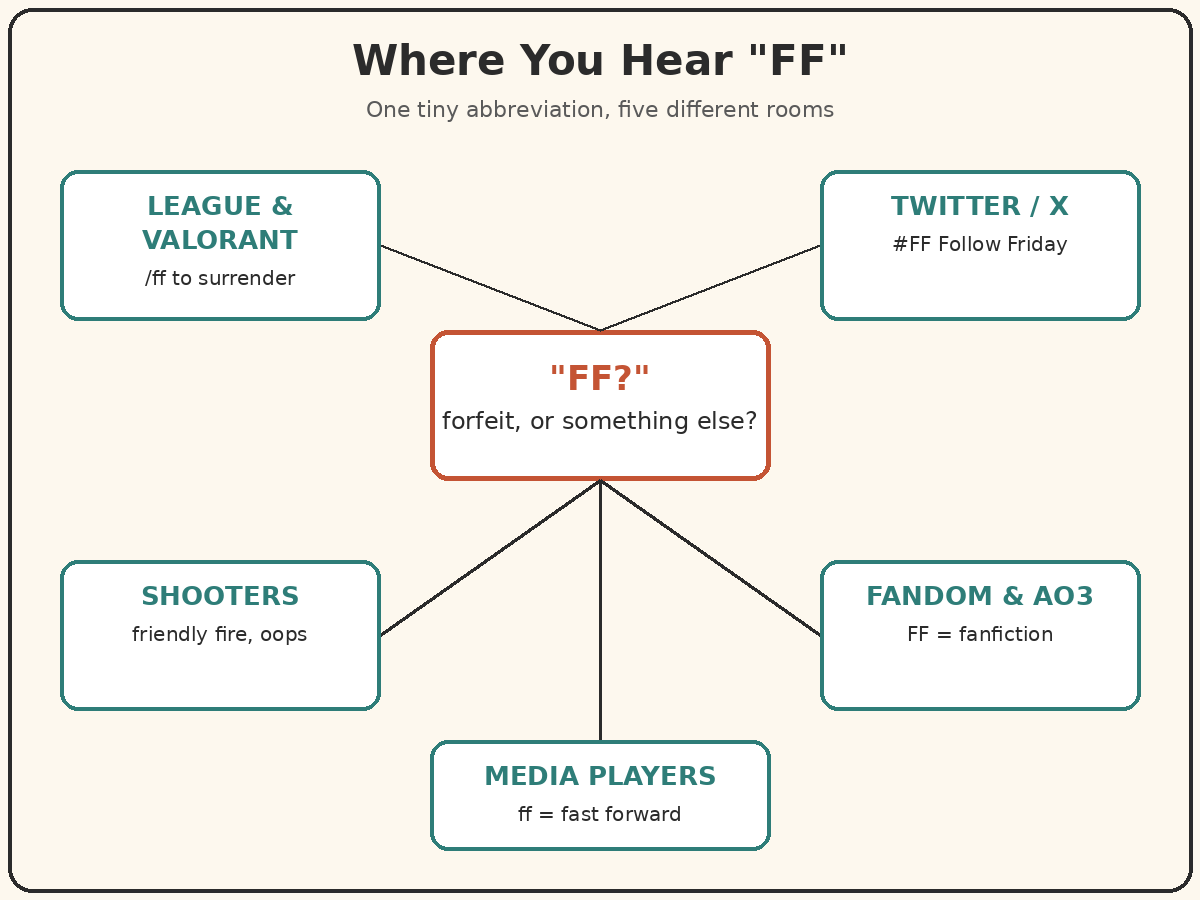
In a ranked match, the pattern is simple. Someone types “ff?” and the team votes with yes or no. A good call sounds like this: “ff at 15, we are down 10k gold and two lanes.” A bad call sounds like this: “ff” typed three minutes into a game your team is winning. The first one respects the team. The second one tells the team you have already quit in your head. In a Discord call with friends, “ff” is softer, often a joke: “Bro, I just got one-shot again, ff me.” In a Twitter post on Friday, it is a recommendation: “FF @awesomegamer123, best clips on the timeline.” In a group chat about a video, it is a request: “ff to 2:30, that is where it gets good.” And in a shooter, it is a complaint: “Stop ff’ing me, I am on your team.”

The tense and the punctuation change the meaning. “FF” in all caps, typed alone, reads as a demand. “ff?” with a question mark reads as a suggestion. “ff at 15” reads as a plan, with a time attached. “/ff” with a slash is the game command itself, and in League of Legends it opens the vote. If you are learning the word, start with “ff?” and let the team answer. That one question mark is the difference between a teammate and a quitter.
What to Say Back When Someone Types “FF”
The reply depends on the meaning, and the meaning depends on the room. In a game, if a teammate types “ff?” and you agree the game is lost, type “yes” or “ff” back, and the vote goes through. If you disagree, type “no” or “we can still win, just play safe.” Do not argue for five minutes. The vote is the argument, and the team has already decided how it works. If someone types “ff” early and angrily, the best reply is usually nothing, or a short “we are fine, chill.” Engaging with a tilted teammate rarely helps, and it often makes the game worse.
On social media, the reply is easier. If someone includes you in a Follow Friday post, say thank you, repost it, or return the favor next Friday. It is a gift, and gifts deserve a reply. If someone in a group chat says “ff to 2:30,” just skip to 2:30. And if someone complains about friendly fire, apologize if it was your fault, and move on. “My bad, sorry” is the whole reply. The word is small, and the replies should be small too.
Myths About “FF”
Myth: “FF” always means forfeit
It is the most common meaning in gaming, but it is not the only one. On a Friday, in a post full of usernames, it means Follow Friday. In a conversation about a video, it means fast forward. In a shooter, it means friendly fire. The setting decides, and guessing “forfeit” everywhere will get you the wrong answer about half the time outside a game lobby.
Myth: Typing “ff” ends the game
It does not, at least not on its own. In League of Legends, “/ff” opens a surrender vote, and the vote needs a majority to pass. In Valorant, the forfeit also needs the team to agree. Typing “ff” is a request, not a command. If your team votes no, the game continues, and you are expected to keep playing. Quitting after a failed vote is the fastest way to get reported.
Myth: Follow Friday is dead
It is quieter than it was in the early 2010s, but it is not dead. The hashtag #FF still appears every Friday on Twitter/X and Instagram, and the tradition still does what it always did: help people find accounts worth following. It is one of the oldest rituals on social media, and it survives because it is useful, not because it is trendy.
Myth: “FF” is the same as “F4F”
They share letters, but they are opposites in spirit. Follow Friday is a recommendation: you tell your followers about accounts you genuinely like. Follow for follow is a trade: you follow me, I follow you, and neither of you cares about the content. The first one builds a community. The second one builds a number. People can tell the difference, and they judge accordingly.
When NOT to Use “FF”
There are clear lines. Do not type “ff” in the first few minutes of a ranked game, because it tells your team you have given up before the game has really started, and it can tilt the whole lobby. Do not type it as a weapon, to punish teammates you are angry with, because the surrender vote is a team decision, not a way to express frustration. Do not use it in formal or professional chats, where nobody will know what it means and the abbreviation will read as a typo. And do not use “ff” to mean “for fun” unless your friends already know that sense, because most people will read it as forfeit, and you will spend the next five minutes explaining a joke.
On social media, do not post a Follow Friday list full of accounts you have never actually looked at. The tradition works because it is a real recommendation, and a lazy list is obvious. And do not use “#FF” on a Tuesday. The joke will not land, and people will assume you do not know what the hashtag means. The word is small, but the context is everything. Use it where it belongs, and it does its job. Use it anywhere else, and it just creates confusion.
FAQs About “FF” Slang
What does “ff” mean in slang?
In slang, “ff” most often means “forfeit” in gaming, a team’s vote to surrender a match in games like League of Legends and Valorant. It can also mean Follow Friday on social media, fast forward for media, friendly fire in shooters, or fanfiction in fandoms. The setting decides which meaning applies.
What does “ff” mean in League of Legends?
In League of Legends, “ff” means forfeit. Players type “/ff” or “/forfeit” in chat to trigger a surrender vote at 20 minutes, and if the vote gets a majority, the game ends early with a loss. Typing “ff?” with a question mark is a suggestion to the team, not a command.
What does “ff” mean in texting?
In texting, “ff” usually means “forfeit” if the conversation is about a game, “Follow Friday” if it is a Friday post recommending accounts, or “fast forward” if the conversation is about a video or song. If you are unsure, look at the sentence around it: a losing game means forfeit, a list of usernames means Follow Friday, and a timestamp means fast forward.
What does “#FF” mean on Twitter?
“#FF” means Follow Friday, a weekly tradition where users recommend accounts for their followers to check out, typically on Fridays. A Follow Friday post lists a few handles with the hashtag, as a way to spotlight creators and help them grow. It is one of the oldest traditions on Twitter.
What does “ff” mean in Roblox?
In Roblox, “FF” stands for forcefield, an in-game object that appears as a glowing blue sphere around a player’s avatar and blocks attacks and projectiles. The abbreviation has stuck through several visual redesigns of the forcefield effect.
Is “ff” rude?
It can be, depending on timing. Typing “ff” early in a winnable game reads as giving up and can upset teammates. Typing it late, when the game is clearly lost, reads as practical. The word itself is neutral. The rudeness comes from when you say it and whether the team agrees.
What is the difference between “ff” and “gg”?
“GG” means good game and is said at the end of a match as a sign of respect, win or lose. “FF” means forfeit and is said during a match as a request to end it early. “GG” closes a game, “ff” tries to close it before it is over. For more gaming slang, see our cracked slang guide and our chat slang guide.
Sources and Further Reading
- 33rd Square on what FF means in gaming, with the forfeit meaning, the League of Legends and Valorant surrender votes, Follow Friday, forcefields in Roblox, and Final Fantasy
- SlangSphere on FF meaning slang, with the forfeit and friendly fire senses, the MOBA origin, and real chat examples
- Goong on ff meaning, with the musical fortissimo sense, the publishing “following pages” sense, the gaming forfeit sense, and the “for fun” variant
- Yan Krukau’s photo of a neon-lit gaming room on Pexels, used as the featured image
- RDNE Stock project’s photo of a woman playing League of Legends on Pexels, used in the article body



Pingback: FN Meaning Slang: What Does FN Mean in Text?
Pingback: FS Meaning Slang: What Does FS Mean in Text?