


In slang, “eat” means to perform something flawlessly, so well that there is nothing left to criticize, as in “she ate that performance” or “he ate and left no crumbs.”
You have probably seen it in a TikTok comment or a tweet: a video of a dancer nailing a routine, a perfect red-carpet look, a goal that breaks the internet, and the top comment just says “she ate.” It is short, certain, and everywhere. If you are seeing “eat” or “ate” all over your feed and wondering what it means, this guide explains it in plain English: the definition, where it came from, how people use it in real conversations, and the other meanings you should know so you do not mix them up.
But eat is a tricky word, because it has more than one slang life. It can mean praise, it can mean dominating someone in an argument, and it has an older meaning that is almost the opposite of the new one. It also has a vulgar meaning that dictionaries flag, so context matters a lot. This guide covers the main meaning first, then the origin story, the other senses, and the lines you should not cross. If you want the past-tense form on its own, our guide to ate slang covers “ate” in more depth.
Table of Contents
- What Does “Eat” Mean in Slang?
- Where Did “Eat” Slang Come From?
- Eat vs Similar Praise Words
- How to Use “Eat” in Real Conversations
- What to Say Back When Someone Says You Ate
- The Other Meanings of “Eat” You Should Know
- Myths About “Eat” Slang
- When NOT to Use “Eat”
- FAQs About “Eat” Slang
- Sources and Further Reading
What Does “Eat” Mean in Slang?
In modern slang, “eat” means to do something exceptionally well, to dominate a moment with skill, style, and confidence. It is the highest form of praise for a performance, and it can also apply to a look, an outfit, or a confident entrance. If someone “ate,” they did it flawlessly, and everyone watching knew it. Grokipedia calls it slang from African American Vernacular English for performing excellently, and gives examples like “She ate that performance” and “Beyoncé ate the halftime show.” The word works as a verb, and the praise is in the performance, not in the eating.
The Core Meaning: Flawless Performance
The heart of the word is performance. Grokipedia describes eating as a slang term from African American Vernacular English meaning to perform excellently or dominate. The key part is “dominate”: eating is not just doing well, it is doing so well that nobody else in the room comes close. A dancer who “ate” a routine did not just finish it, she owned it. A singer who “ate” a song did not just hit the notes, she made the song hers. The word carries that sense of total command, and that is why it lands so hard as a compliment.
It also carries a specific tone. “She ate” is not polite applause, it is excited, certain, and a little dramatic. It fits moments that are visible: a performance, an outfit, a routine, a highlight. You would not usually say someone “ate” a spreadsheet, because the word needs an audience and a moment. The praise lands best when other people can see what happened and agree it was flawless.
The Forms: Ate, Ate That, Ate Down, Left No Crumbs
The word changes shape depending on what you want to stress. “She ate” is the simplest form, a standalone compliment for a performance. “She ate that” points at a specific thing, like a routine or an outfit. “She ate down” is a stronger version, used when the performance was even more complete. “She ate and left no crumbs” is the strongest version of all: it means the performance was so perfect that nothing was left to criticize. The crumbs are the flaws, the weak spots, the leftovers. If someone left no crumbs, there was nothing for a critic to pick at.
The grammar is flexible in a useful way. The show A Way with Words notes that eat can be transitive, where you ate something and did well at that thing, or intransitive, where it just means your general presence is awesome. A caller named Angela, a hair and wig designer for Broadway tours, told the show that young actors kept telling her “you ate that haircut” and “you ate that wig,” and the hosts found written examples of the praise sense going back to 2008. That range, from a specific compliment to a general statement about someone’s whole vibe, is part of why the word spread so far.
Where Did “Eat” Slang Come From?
“Eat” as praise comes from African American Vernacular English, and more specifically from Black and Latinx ballroom culture in New York City, where it praised flawless, dominating performances in categories like drag, vogue, and runway. It then traveled through Black online spaces, hit mainstream social media in the 2020s, and became one of the most used praise words on TikTok, Instagram, and X. The path matters, because the word carries its history with it: it started as community praise inside a specific culture, not as a random internet invention.
AAVE and Ballroom Roots
The slang grows out of AAVE patterns of metaphor, where vivid, hyperbolic images praise outstanding skill. Grokipedia explains that eating sits in the same family as “killed it,” “slayed,” and “murdered it,” all of which praise overwhelming excellence through images of total domination. In ballroom, a Black and Latino LGBTQ+ subculture that started in New York in the 1970s and 1980s, “ate” was high praise for a flawless performance in a competitive category. The idea was that the performer had completely consumed the competition, leaving nothing behind. The phrase “ate and left no crumbs” grew from the same scene, and it made the metaphor literal: a perfect performance leaves no crumbs, no mistakes, no leftovers for critics.
It is funny, but it is also specific. The crumbs are the mistakes, the weak spots, the things a critic could pick at. Saying someone left no crumbs means there was nothing to criticize, and the performance was complete. Grokipedia notes the phrase has roots in ballroom culture and began appearing on social media in the mid-2010s. It is an intensifier with a real meaning, not just decoration.
From the Ballroom to the Timeline
The earliest documented online form is “ate that,” defined in a July 2008 Urban Dictionary entry as doing a great job or pulling something off well. The entry noted the term was used by teens in New York City, which fits the ballroom path: the word was already in use in New York’s Black and Latinx communities before it hit the wider internet. From there, it moved through Black Twitter, Black TikTok, and Black Instagram, then into mainstream feeds. By the early 2020s, it was everywhere, used by celebrities, athletes, brands, and comment sections in every language.
One detail worth knowing: the word was already old in its home community by the time the mainstream found it. Grokipedia traces “eat” back to ballroom’s “eating” as a way of praising a performance that dominated its category, and notes that the slang spread through social media in the 2020s, including TikTok and sports highlights. The mainstream version is not a new invention; it is a borrowing, and the borrowing is part of the word’s story. If you use it, you are using a word with a real history, and that history is worth knowing.
Eat vs Similar Praise Words
Eat is not the only praise word in this family, and picking the right one matters. The table below compares “eat” with the closest alternatives, so you can see which word fits which moment.
| Word | Meaning | Tone | Where you hear it | Example |
|---|---|---|---|---|
| “Eat” | To perform flawlessly | Excited, certain | TikTok, Instagram, X, sports, fashion | “She ate that performance.” |
| “Slay” | To look or perform with confidence | Confident, stylish | Fashion, drag, pop culture | “She slayed that look.” |
| “Kill it” | To do something very well | General, upbeat | Work, sports, everyday life | “You killed that presentation.” |
| “Devour” | To dominate completely | Intense, dramatic | Performance, competition | “She devoured that routine.” |
| “Snatched” | To look sharp and put together | Admiring, focused on looks | Fashion, beauty, drag | “That outfit is snatched.” |
The differences are small but real. Eat stresses flawless execution and domination: the person did not just succeed, they owned the moment. Slay is closer to confidence and attitude, and it works for a look as much as a performance. “Kill it” is the most general of the group, and it works for anything from a presentation to a workout. “Devour” is the most intense, and it is usually about a performance that was overwhelming. Snatched, which we cover in our snatched slang guide, is about appearance and a look that is sharp, tight, and put together. The words overlap, but they are not interchangeable, and the right choice depends on what you are praising.
How to Use “Eat” in Real Conversations
Using eat well is mostly about picking the right moment. It works best when someone has just done something visible and impressive, and you want to praise them in a way that feels current and excited. The diagram below maps the places where you hear it most.
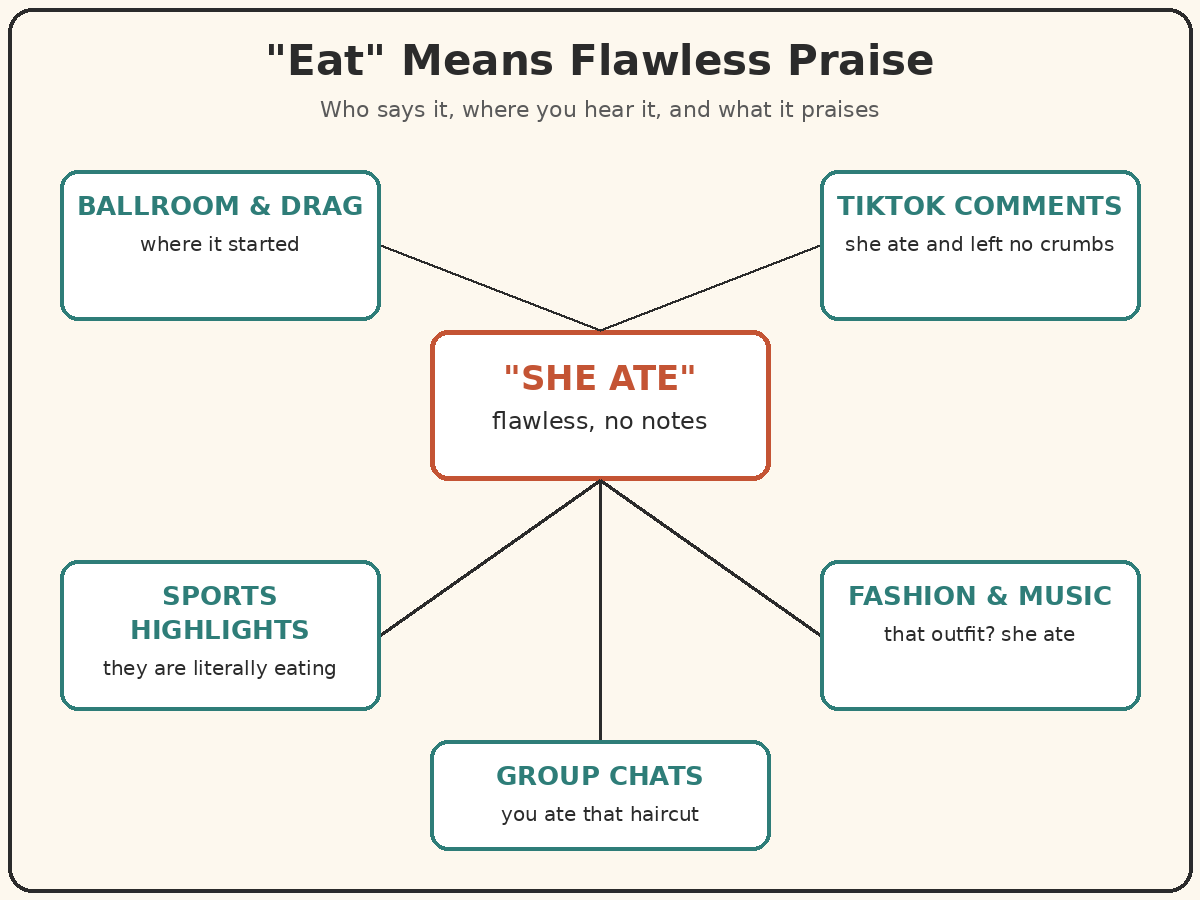
In fashion and beauty, it is the default compliment: “That outfit? She ate.” “Her makeup today, she ate.” The same applies to music, dance, and performance: a singer who hits every note, a dancer who lands a routine, a rapper who delivers a verse without missing a beat. In sports, a player who dominates a game “ate”: a buzzer-beater, a hat trick, a highlight-reel play. In group chats, the phrase shows up as a reaction: someone drops a selfie, a clip, or a result, and the reply is simply “you ate” or “she ate.” It also works as a caption: “Ate this look” under a photo says the outfit was flawless, and “Ate and left no crumbs” under a performance video says the whole thing was perfect. The contexts are different, but the rule is the same: the moment has to be visible, and the praise has to be deserved.
The tense matters. People usually say “ate” about something that just happened, because the praise lands after the performance is over. You can also say “eat” in the present tense, as in “She eats every time she performs,” which means she is consistently excellent. The future tense is rarer, but it works as a prediction: “She is going to eat tonight.” The past tense is the one you will hear most, because most praise comes after the moment, not before it.

What to Say Back When Someone Says You Ate
Getting told you ate is a real compliment, so the reply should accept it without being awkward. The simplest answers work best. “Thank you” is always fine. “Period” adds agreement and confidence. “I know, right?” plays along with the energy. If you want to return the hype, try “And you ate too” or “We all ate.” What you should not do is argue with it or shrink from it: “No, I was terrible” kills the moment, and “I guess” sounds unsure. The person who said it is celebrating you, so let them. If the compliment came in a comment section, a like or a short reply is enough. If it came from a friend in person, a smile and a thank you does the job.
If someone says it about a group effort, share the credit: “We ate, all of us.” That keeps the energy up and avoids taking praise that belongs to the team. And if you want to hype someone back with the same word, be specific about what they did: “You ate that solo” hits harder than a plain “you ate,” because it shows you actually watched.
The Other Meanings of “Eat” You Should Know
Eat is a word with several slang lives, and mixing them up can cause real confusion. The praise meaning is the one you will hear most, but the other senses are real, and they show up in comments, lyrics, and conversations. Here is the full picture, so you know what you are hearing.
Eat Someone Up: Roasting and Dominating
The second slang meaning is about defeating someone, usually with words. SlangSphere defines it plainly: to “eat” someone in a debate, argument, or roast means to outclass them so completely that they have nothing left to say. It is the same domination image as the praise sense, but pointed at a person instead of a performance. “She ate him in that debate” means she won it so clearly that the other person looked lost. “We ate them in that game” means the win was not close. The tone is playful and competitive, not cruel, but it is still about winning, and the loser is the one who got eaten.
“You Ate It”: The Older, Opposite Meaning
Here is the confusing part. For people who grew up in the 1980s, “you ate it” meant you fell flat on your face, literally. The phrase comes from skateboarding and BMX culture, where “eating it” meant crashing hard, and it spread into general slang for failing badly. “He tried the trick and ate it” meant he crashed, not that he nailed it. The older meaning is the opposite of the new praise sense, and the two can sit in the same sentence without contradicting each other, because the context tells you which one is meant. If someone says “she ate it” about a performance, it is praise. If they say it about a fall, it is a crash.
Eat Someone’s Lunch, and What’s Eating You
Two idioms use eat in the defeat and worry senses. Dictionary.com lists “eat someone’s lunch” as slang for outclassing a competitor, often in business or sports, as in “the startup ate the old firm’s lunch.” The phrase means the winner took the loser’s business, customers, or advantage. “What’s eating you?” is older and gentler: it asks what is bothering you, what is worrying you, and it comes from the idea of something gnawing at you from the inside. Both phrases are standard English, not new slang, and they show how flexible the word “eat” has always been.
The Vulgar Meaning: A Warning
One more sense needs a clear warning. Dictionary.com lists eat as vulgar slang for performing oral sex, and that meaning is old, well known, and still in use. It is not the meaning most people intend when they say “she ate” about a performance, but it is always in the background, and it is the reason some sentences can sound wrong even when you meant them as praise. “I’m gonna eat” on its own can sound sexual, and “eat me” is an insult in most contexts. The rule is simple: keep the praise attached to a performance, a look, or a specific thing, and the vulgar sense stays out of the way.
Myths About “Eat” Slang
Myth: Eat is just a TikTok word
No. TikTok made it mainstream, but the word is older than the app. The 2008 Urban Dictionary entry for “ate that” predates TikTok by almost a decade, and the ballroom roots go back to the 1970s and 1980s. TikTok spread the word, it did not invent it, and the history is part of what makes it worth knowing.
Myth: Eat and slay mean the same thing
They overlap, but they are not identical. Slay is about confidence, attitude, and looking good, and it works for a look as much as a performance. Eat is about flawless execution and domination, and it needs a moment to praise. You can slay an outfit without eating it, and you can eat a performance without slaying it. The words are cousins, not twins, and the table above shows the difference.
Myth: “Ate and left no crumbs” is just a funny phrase
It is funny, but it is also specific. The crumbs are the mistakes, the weak spots, the things a critic could pick at. Saying someone left no crumbs means there was nothing to criticize, and the performance was complete. Grokipedia notes the phrase has roots in ballroom culture and began appearing on social media in the mid-2010s. It is an intensifier with a real meaning, not just decoration.
Myth: Anyone can use it anywhere
Mostly true, but not completely. The praise sense is widely used and widely understood, and nobody will mind if you use it in a comment or a chat. But the word comes from Black and Latinx ballroom culture, and using it without knowing that history is a missed chance to respect where it came from. The other meanings also limit where it fits: the vulgar sense makes it a bad choice in formal settings, and the roasting sense makes it a bad choice when someone is already upset. The word is flexible, but it is not free of context.
When NOT to Use “Eat”
There are clear lines. Do not use eat as praise in formal settings: a work email, a job interview, a presentation to a client, or a message to a teacher. The word is casual and current, and it will sound out of place in a room that expects formal language. Do not use it to praise yourself, either. “I ate” sounds like bragging, and “I ate and left no crumbs” sounds like you are rating your own performance, which is a bad look. Let other people say it about you. The praise lands better when it comes from someone else.
Do not use the roasting sense to genuinely hurt someone. “I ate you in that argument” is fun banter between friends, but it is a bad line to use on a stranger, a coworker, or someone who is already upset. SlangSphere warns against using it in a bullying way, and that is the right call: the slang is for playful competition, not for putting people down. And never use “eat” with a sexual meaning as a joke to someone you do not know well, because the vulgar sense is always sitting there, and the joke will not land the way you meant it. When in doubt, keep it to praise, keep it public and positive, and keep it about a performance you actually watched.
FAQs About “Eat” Slang
What does “eat” mean in slang?
In slang, “eat” means to perform something flawlessly, so well that there is nothing left to criticize. When someone says “she ate,” they mean she did it perfectly, with confidence and style. The phrase usually appears as “ate,” “ate that,” “ate down,” or “ate and left no crumbs,” and it comes from African American Vernacular English and ballroom culture.
What does “ate and left no crumbs” mean?
It means she performed something perfectly, with no mistakes and nothing left for critics to pick at. The crumbs are the flaws, the weak spots, the leftovers. The phrase comes from ballroom culture and started appearing on social media in the mid-2010s. It is the strongest version of the praise, used when a performance, outfit, or moment was completely flawless.
What does “ate that” mean?
“Ate that” means someone did a specific thing very well, as in “she ate that routine” or “you ate that haircut.” The earliest documented online use appeared in a 2008 Urban Dictionary entry, defined as doing a great job or pulling something off well, with usage noted among teens in New York City. The “that” points at the specific thing being praised.
Is “eat” a bad word?
Not in its praise sense. Saying someone “ate” is a compliment, and it is widely used in casual conversation and comments. But eat has other meanings, including a vulgar sexual sense listed in dictionaries, so the sentence around it matters. “She ate that performance” is clearly praise. “I’m gonna eat you” on its own can sound threatening or vulgar, so keep the praise attached to a performance or a look.
What does “thought you ate” mean?
“Thought you ate” is a mocking reply to someone who believes they did something great when they actually did not. It is the opposite of “she ate”: instead of praising a flawless performance, it says the person overestimated themselves. People use it in comments and replies to call out a failed attempt at being impressive, so it is a reason not to hype your own work too hard.
Where did “eat” slang come from?
It comes from African American Vernacular English, and specifically from Black and Latinx ballroom culture in New York City, which began in the 1970s and 1980s. In ballroom, “ate” praised a flawless, dominating performance in categories like drag, vogue, and runway. It spread through Black online spaces, then went mainstream on TikTok and Instagram in the 2020s. If you want the past-tense form in more detail, see our ate slang guide.
Can I say “eat” about a guy?
Yes. “He ate” and “he ate that” are used just as often as “she ate,” and the word is not gendered. It applies to anyone who performs something flawlessly: a dancer, a player, a singer, a friend in a great outfit. The examples in this article use “she” because that is the most common form online, but the praise works the same way for anyone. For more praise words in the same family, see our guides to diva and cool slang.
Sources and Further Reading
- Grokipedia on eating as slang, with AAVE and ballroom origins, the 2008 “ate that” attestation, and the spread through TikTok and sports highlights
- A Way with Words on when “to eat something” means to do well, with the caller Angela’s story, the older “you ate it” meaning, and examples back to 2008
- Dictionary.com on eat, with the standard definitions, the vulgar slang sense, idioms like “eat someone’s lunch” and “what’s eating you”
- SlangSphere on the eat definition in slang, with the roasting sense, usage examples, and what not to do
- Leung Kwok Tung Ktleung’s photo of an energetic dancer on stage on Pexels, used as the featured image
- Osman Arabacı’s photo of a dancer leaping in a spotlight on Pexels, used in the article body



Pingback: Fries Meaning Slang: What Does Fries Mean on TikTok?