
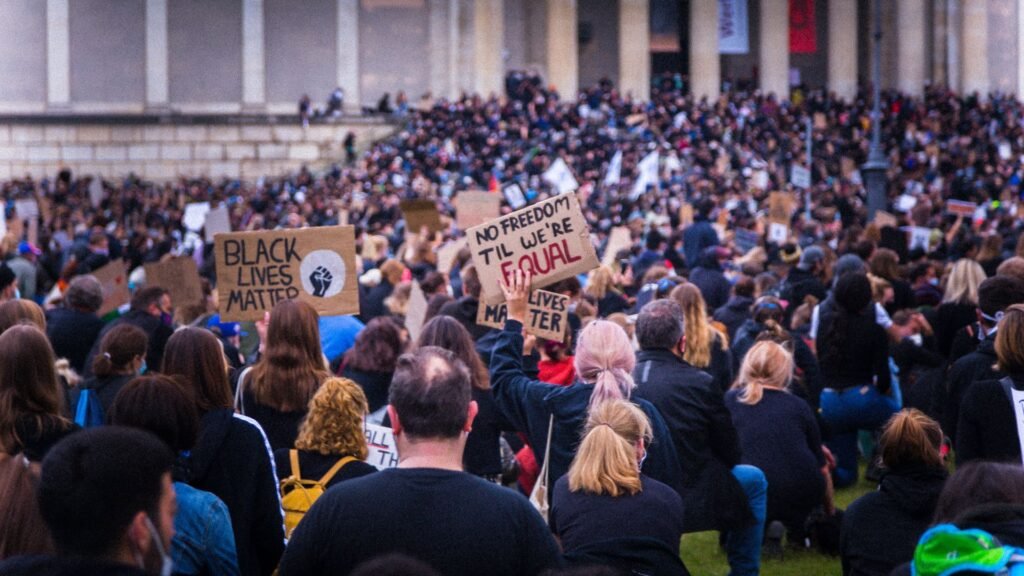

In slang, FTP stands for “fuck the police,” a blunt protest phrase that grew out of N.W.A’s 1988 song “Fuck tha Police” and later became a chant, a hashtag, and a piece of graffiti, though the same three letters can also mean File Transfer Protocol in tech or free-to-play in gaming, so the room you are in decides which meaning applies.
Three letters should not be this confusing, and yet FTP might be the most misunderstood abbreviation on the internet. Type it into a search bar and you will get two completely different answers fighting for the top spot. One answer comes from computer science, where FTP has meant File Transfer Protocol since 1971. The other comes from hip-hop and protest culture, where FTP has meant something far angrier since 1988. Both answers are correct. Neither one is the whole story.
I have seen the confusion play out in real time. Someone drops “FTP” in a group chat after a story about a traffic stop, and a well-meaning friend replies with a question about file servers. Someone else uses it in a gaming Discord and gets asked why they are suddenly so political. The letters are the same, but the conversations could not be further apart. This guide sorts out every version, traces the slang back to its roots, and gives you a fast way to tell which meaning is in play before you reply.

Table of Contents
- What Does FTP Mean in Slang?
- FTP Meaning in Text: How to Tell Which One It Is
- Where Did “Fuck the Police” Come From?
- FTP in Protests and Hip-Hop: From Song to Street Slogan
- FTP as File Transfer Protocol: The Tech Meaning
- The Other Meanings of FTP: Patriarchy, People, and Play
- FTP vs Similar Slang: How It Compares
- Who Says FTP, and Where?
- Real Examples of FTP in Texts and Comments
- How to Reply When Someone Says FTP to You
- Myths About FTP Slang
- When NOT to Use FTP
- FAQs About FTP Slang
- Sources and Further Reading
What Does FTP Mean in Slang?
In slang, FTP means “fuck the police.” It is a short, angry way to express distrust of law enforcement, used in protest chants, song lyrics, graffiti, and social media posts. It is not a polite phrase, and it is not a joke. It carries real history, so people use it when they mean it, not as casual filler.
The phrase works as a slogan more than a sentence. Nobody says FTP to start a detailed policy debate. They say it to signal where they stand in one breath. Know Your Meme describes “Fuck the Police” as a catchphrase used in times of contempt for authority figures and general disregard for public opinion, in a similar vein to the expression “haters gonna hate.” That comparison is useful, because it shows how the phrase functions: it is a dismissal of the other side, not an argument with it.
It also matters that FTP is almost never a literal instruction. When someone chants it at a march or captions a photo with it, they are expressing anger at policing as an institution, not telling anyone to do something specific to an individual officer. That distinction is part of why the phrase has lasted so long. It is short enough to fit on a sign, strong enough to carry real feeling, and vague enough to cover everything from a bad traffic stop to a whole system people want changed.
The tone is serious, even when the setting is casual. A teenager might drop it in a TikTok comment, and a protester might spray it on a wall, and the feeling behind both is the same. That is different from most slang, which usually softens as it spreads. FTP has not softened much in nearly forty years. If anything, each new generation of protests gives it fresh weight, which is why it still hits hard when you see it.
One more thing to know upfront: FTP is profanity, and it reads as profanity wherever it appears. There is no clean version that carries the same meaning. Some people write “F the police” or use the asterisks, and those versions soften the language, but they point at the same idea. If you are writing for a mixed audience, a workplace, or a classroom, the letters alone can still cause trouble, because most readers know exactly what they stand for.
FTP Meaning in Text: How to Tell Which One It Is
When you see FTP in a text, look at the words around it before you decide what it means. If the conversation mentions servers, uploads, or ports, it is the tech meaning. If it mentions games or playing for free, it is the gaming meaning. If it mentions police, protests, or injustice, it is the slang meaning.
The confusion is real because all three meanings live in the same places. Discord servers host both gamers and activists. Twitter threads mix tech talk with politics. A group chat can jump from a file transfer to a protest in the same afternoon. That is why the same three letters keep tripping people up, and why a quick context check beats guessing every time.
| Meaning | Full form | Where you will see it | Clue words nearby |
|---|---|---|---|
| Slang / protest | Fuck the police | Protest chants, captions, graffiti, lyrics | police, protest, justice, march, ticket |
| Tech | File Transfer Protocol | Web hosting, server setup, IT chats | server, upload, port 21, SFTP, FileZilla |
| Gaming | Free-to-play | Game stores, gaming chats, reviews | free, download, game, pay-to-win, F2P |
| Activist variant | Fuck the patriarchy | Feminist slogans, caps, tattoos | patriarchy, feminism, women, rights |
The slang meaning is the one most people are looking for when they search “FTP meaning slang,” and it is the one this guide focuses on. But the tech meaning is older, and it is still the default in any conversation about computers. If your coworker writes “send it over FTP,” they are talking about a file transfer, not making a political statement. The safest habit is simple: read the sentence, not just the letters.
A useful test is to swap in the full phrase and see if the sentence still makes sense. “FTP, that ticket was unfair” works with “fuck the police” and sounds natural. “FTP the files to the client” only works with “File Transfer Protocol.” “This game is FTP” only works with “free-to-play.” If the swap sounds wrong, you have the wrong meaning, and the right one is usually obvious once you try it.
Where Did “Fuck the Police” Come From?
The phrase “Fuck tha Police” entered popular culture through N.W.A’s 1988 album Straight Outta Compton, where the track of the same name called out police brutality and racial profiling in Los Angeles. The song drew heavy media attention, and it turned a street-level complaint into a national conversation.
Know Your Meme traces that spread through the 1990s, when the song was covered by a number of well-known hip-hop artists and the expression gradually came to represent the tension between law enforcement and urban area residents, fueled by accusations of racial profiling. The phrase also rose to prominence as a fashion statement, printed on t-shirts worn by counterculture musicians and celebrities. By that point it was no longer just a song lyric. It was a badge, a way to say which side you were on without saying another word.
The phrase kept resurfacing at moments of public anger. Wiktionary cites the book Police: A Field Guide, which notes that “fuck the police” emerged as the unofficial motto of the 1992 riots in Los Angeles, and that following the murder of Michael Brown in Ferguson, street signs and businesses were frequently tagged with FTP. That pattern tells you something important about how the phrase works. It does not spread through marketing or trends. It spreads when people feel unheard, and it shows up on walls and signs before it shows up in headlines.
The internet gave it a second life in the 2000s. The earliest Urban Dictionary definition was submitted on August 11, 2003, describing it plainly as a term used by people who deal with the police and do not like them. In 2005, artist Dash Snow put together a gallery exhibition titled “Fuck the Police,” built from newspaper clippings reporting episodes of police brutality. By 2007, dozens of Facebook groups had formed around the phrase, and the largest had tens of thousands of followers. The slogan had moved from the street to the screen without losing its edge.
Then came the memes, and they showed how flexible the phrase had become. In 2010, a photo of the children’s book characters Frog and Toad riding a tandem bicycle, with the words “Fuck the Police” photoshopped underneath, spread across Reddit and Tumblr. It was funny precisely because the characters were so gentle and the words were so harsh. The joke worked because everyone already knew the phrase. A slogan that can be both a protest chant and a punchline has fully entered the culture, and FTP had done exactly that.
FTP in Protests and Hip-Hop: From Song to Street Slogan
FTP surged back into public view in 2020, when rapper YG released a protest song titled “FTP” in the weeks after the death of George Floyd. As NME reported at the time, the video showed YG protesting with thousands of others in the streets of Los Angeles, cut with footage of incidents involving police brutality.
The video ended with a statement that put the song in context. On June 7, 2020, YG joined Black Lives Matter Los Angeles and BLD PWR to organize a peaceful protest for 100,000 people, described as one of the largest anti-racism marches in Los Angeles history. That detail matters, because it shows FTP working as an organizing tool, not just a lyric. The song promoted the march, the march carried the slogan, and the slogan carried the message further than either could alone.
YG was not the only one reaching for those three letters in 2020. The phrase was everywhere that summer: on signs, on masks, in captions, in chants. For a lot of younger people, that was their first real encounter with FTP. But the phrase they were discovering was already more than thirty years old. The 2020 protests did not invent it. They reminded everyone it was still there.
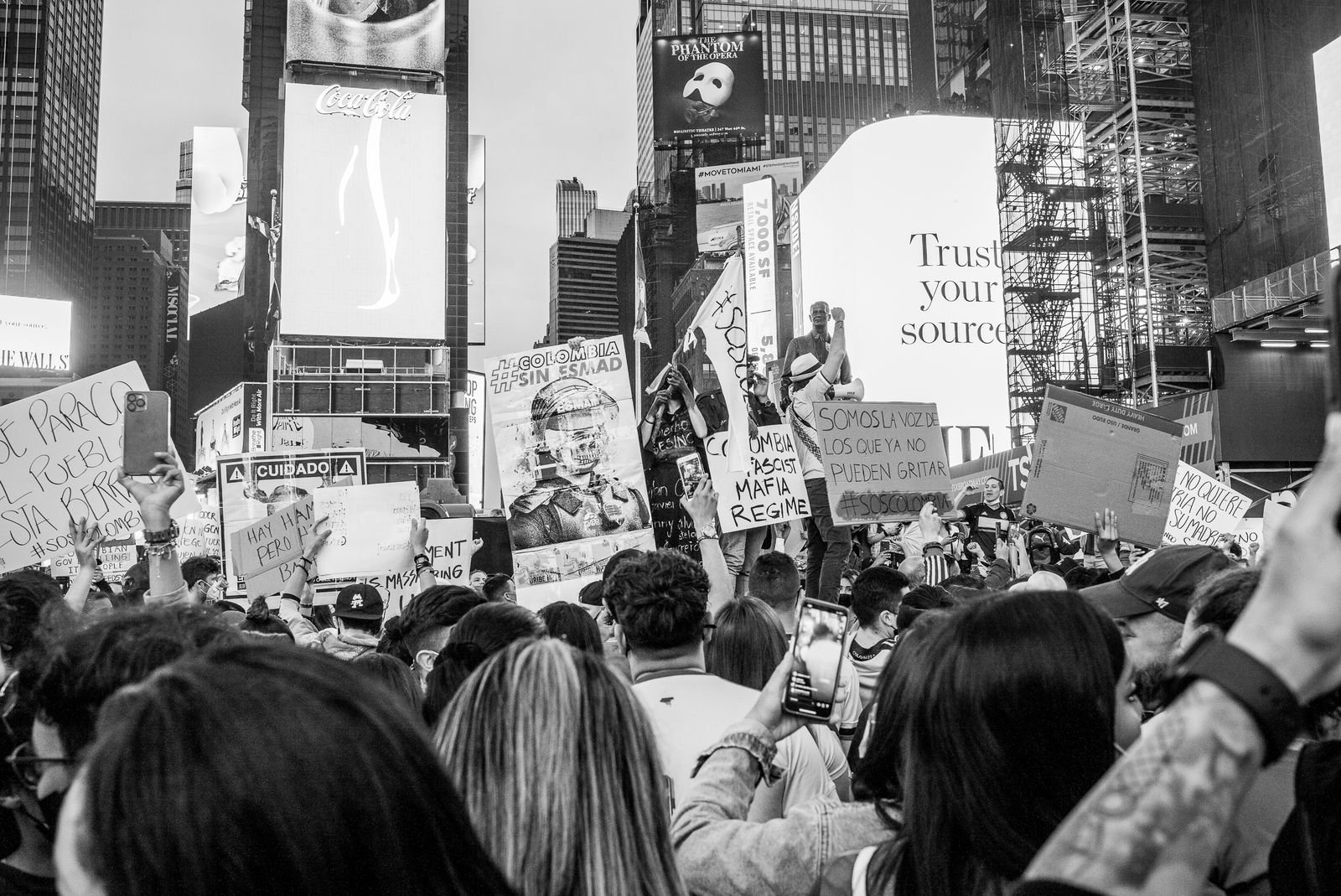
The slogan also grew into an organized movement in New York City. Writing in Verso Books, organizers described how a movement known as FTP had unsettled the city establishment with a series of transit actions starting in November 2019, including mass fare evasion and other acts of defiance toward the MTA and NYPD. The catalyst was the MTA’s decision to place 500 additional police officers in the subways, followed by a rise in police harassment of Black and brown riders.
That movement had concrete demands, not just a chant. According to the same Verso account, the FTP actions called for free transit, an end to the harassment of vendors, performers, and the unhoused, full accessibility, and cops out of the MTA. The actions were led by what the organizers called a collection of abolitionist organizations, and a major action on January 31, 2020, marched from Grand Central Station to Bed-Stuy. Here FTP was not a lyric or a meme. It was the name of a campaign with a plan, and the letters on the signs stood for a whole set of demands.
Hip-hop keeps the phrase alive between protest waves. Every few years, a new artist samples the N.W.A track, references the phrase in a verse, or titles a song FTP, and a new audience learns what the letters mean. That cycle is a big reason the slang has survived while so many other 1980s phrases faded. The music carries it forward, and each new protest gives it a new reason to be shouted.
FTP as File Transfer Protocol: The Tech Meaning
In tech, FTP stands for File Transfer Protocol, a standard way to move computer files between a server and a client over a network. It is the oldest meaning of the abbreviation by a wide margin, and in any conversation about websites, hosting, or servers, it is the meaning people assume first.
The protocol has a long, well-documented history. Wikipedia notes that the original specification was written by Abhay Bhushan and published as RFC 114 on April 16, 1971. FTP runs on two ports, 21 for control and 20 for data transfer, and it was once built into web browsers, so you could browse a file server by typing an address starting with ftp:// into the URL bar. That era is over now. Google Chrome removed FTP support in 2021, and Firefox followed, because the protocol sends usernames and passwords without encryption, and safer replacements like SFTP and FTPS took its place.
Even so, the tech meaning is far from dead. Web developers still use FTP clients like FileZilla to upload files to a server, and hosting companies still offer FTP access as a standard feature. If you have ever built a website, you have probably seen an FTP username and password in your hosting dashboard.
For our purposes, the tech meaning matters for one reason: it is the main source of confusion. A search for “FTP” without the word “slang” will return tech results first, because the protocol has decades of documentation behind it. Add “slang” or “meaning” to the search, and the protest meaning takes over. Knowing both meanings, and knowing which room you are in, is the whole trick to reading FTP correctly.
The Other Meanings of FTP: Patriarchy, People, and Play
Once a phrase as flexible as FTP takes hold, people start remixing it, and the letters have picked up several other meanings along the way. The most established of these is “fuck the patriarchy,” a feminist slogan that borrows the same defiant energy and points it at a different target.
Writer Mona Eltahawy imagined an underground movement called Fuck the Patriarchy (FTP) in her 2019 book The Seven Necessary Sins for Women and Girls, using the letters as a provocation in an essay about violence against women. The Verso account of the New York FTP movement makes the same connection from the other direction, writing that FTP stands as much for Fuck the Patriarchy as Fuck the Police. You will see this version on caps, tote bags, tattoos, and protest signs at women’s marches, where the context makes the meaning clear.
The New York movement also showed how many readings the letters can hold at once. One organizer explained that depending on your ideology, FTP could mean Feed the People, or Fight the Power, but at this juncture for the group it meant Fuck the Police. “Feed the People” frames the slogan as mutual aid, and “Fight the Power” borrows from Public Enemy’s famous anthem. Both readings keep the defiant tone while aiming it at different goals, which is exactly why the letters work so well as a banner: different groups can march under the same three letters and mean slightly different things by them.
In everyday texting, you may also run into “for the people,” a positive, community-focused reading that shows up in captions and group chats. Some slang dictionaries list “fuck the population” as another variant, a general expression of frustration with society, though this one is far rarer than the police meaning and mostly shows up in brand names and niche corners of the internet. And in gaming, FTP means free-to-play, describing a game you can download and play without paying upfront, with Wiktionary listing that sense alongside the others.
None of these variants replaces the main slang meaning. If someone writes FTP with no other context, most readers will assume the police version first, because it is the oldest slang use and the most widely known. The variants only take over when the context points clearly at them, like a feminist rally, a food drive, or a game store page. When in doubt, the police meaning is the safe bet.
FTP vs Similar Slang: How It Compares
FTP belongs to a family of short, angry acronyms, and people mix them up constantly. Each one has its own target, its own tone, and its own history, and using the wrong one can change what you are saying entirely. The table below lays out the differences at a glance.
| Term | Meaning | Tone | Where you will see it | Example |
|---|---|---|---|---|
| FTP | Fuck the police | Defiant, angry, political | Protests, lyrics, graffiti, captions | “FTP. No justice, no peace.” |
| FAFO | Fuck around and find out | Warning, confrontational | Comments, captions, street talk | “Keep pushing me. FAFO.” |
| ACAB | All cops are bastards | Blanket rejection, political | Protests, stickers, tattoos, punk scenes | “ACAB” sprayed on a wall at a march |
| FDT | Fuck Donald Trump | Political, specific target | YG songs, rallies, merch | “FDT” chanted at a rally |
| Defund the police | Cut police budgets, fund services | Policy demand, reformist | Protest signs, debates, petitions | “Defund the police, fund the community.” |
The closest cousin is ACAB, and the two often appear side by side at protests. The difference is scope. FTP is aimed at the police as an institution in a moment of anger, while ACAB makes a blanket claim about every officer. They are allies, not twins, and plenty of people use one without using the other. If you want to understand the whole family, our guide to what opps means in slang covers another police-adjacent term that shows up in the same conversations.
FAFO is the one people confuse with FTP most often, because both start with F and both sound like a threat. They are not the same at all. FAFO is a personal warning: keep messing with me and you will regret it. FTP is a political statement aimed at an institution, not at one person. Our guide to what FAFO means in slang breaks that term down in full, and it is worth reading if you keep mixing the two up.
FDT is the easiest to place, because it has a single, specific target. YG released “FDT” with Nipsey Hussle in 2016, four years before his “FTP” track, and both songs work the same way: a short, chantable acronym that turns a political feeling into a hook. “Defund the police” is the odd one out in the table, because it is not slang at all. It is a policy demand, and it shows up in the same marches as FTP, usually on the more formal signs. Knowing all five keeps you from using the wrong one at the wrong moment, like replying “FAFO” when you meant to make a political point, or “FTP” when you meant to warn one person to back off.
Who Says FTP, and Where?
FTP lives in three main places, and each one uses it a little differently. At protests and marches, it is a chant and a sign, shouted by a crowd or carried on cardboard. The people saying it there are activists, organizers, and ordinary people who showed up because something happened in their community.
In hip-hop, it is a lyric and a title, used by artists and repeated by fans. The audience is the listener, and the phrase works as shorthand for a whole worldview: distrust of authority, loyalty to the neighborhood, and a refusal to stay quiet. Fans quote it in captions and comments, and the line between the song and the slogan blurs. When someone captions a photo with FTP and a song lyric, they are borrowing the artist’s voice to say something about their own life.
Online, it is a caption, a comment, and a hashtag, used by a much wider crowd. You will see it under news posts about police encounters, in TikTok comments during protest waves, and in bios of people who want their politics visible at a glance. The tone shifts with the platform. On X it reads as a hot take. On Instagram it reads as a statement. In a group chat it reads as venting after a bad day. The letters stay the same, but the volume changes.
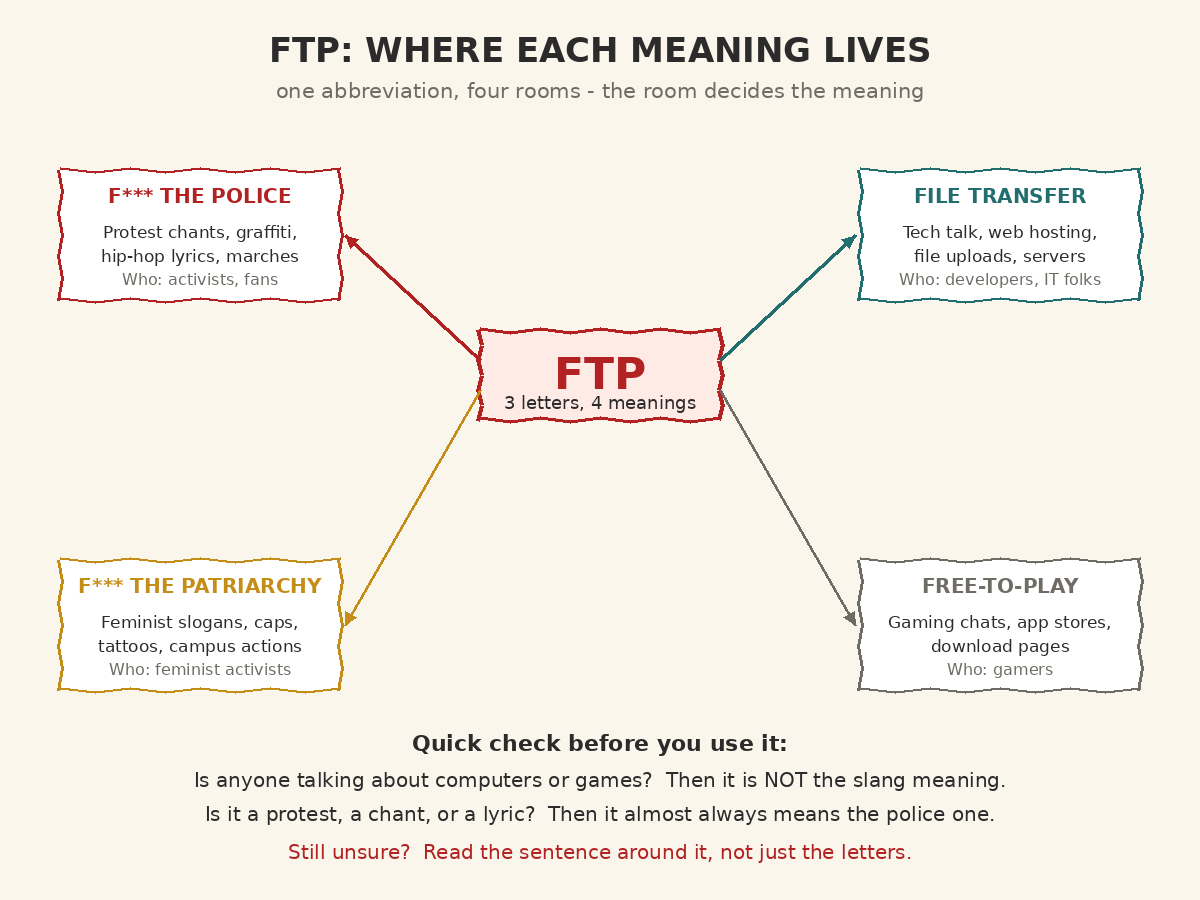
The usage map is simple once you see it. At a march, FTP means the police version, aimed at the system. In a tech chat, it means the file protocol, aimed at a server. In a gaming lobby, it means free-to-play, aimed at a download page. At a feminist rally, it can mean the patriarchy version, aimed at a different system entirely. The same three letters move between all four rooms, and the room decides the meaning every time. If you are unsure which room you are in, read the sentence around the word before you react to it.
One more pattern is worth noting. FTP rarely travels alone. At protests it shows up next to phrases like “no justice, no peace” and “Black Lives Matter.” Online it shows up next to hashtags about specific cases and causes. In hip-hop it shows up next to other acronyms from the same family, like FDT and ACAB. The neighboring words are the fastest clue you will get, and they usually settle the meaning before you have finished reading the post.
Real Examples of FTP in Texts and Comments
The examples below show the four most common situations where FTP appears, so you can recognize the pattern the next time you see it in the wild.
At a protest or march
Person A: “What are they chanting over there?”
Person B: “FTP. It started after the march reached the precinct.”
Here the phrase is a chant, and the crowd is the speaker. Nobody is talking to one officer. The chant is aimed at the institution, and the repetition is the point.
In a social media caption
Person A: “Saw this mural on my walk today. FTP. No justice, no peace.”
The caption pairs the letters with a photo of street art, and the meaning is clear from the picture. The person is not explaining anything. They are stating a position in three letters.
In a text after a bad encounter
Person A: “Just got a ticket for nothing. Sat there for 40 minutes.”
Person B: “That is ridiculous. FTP.”
This is the venting use, the most common one in private chats. The phrase works as sympathy and agreement at the same time: I hear you, and I agree that was unfair. For a similar word that people use when a situation with authority goes wrong, our guide to what beef means in slang covers another term that turns a conflict into a word.
In a tech chat, where it means something else entirely
Person A: “Can you FTP the new files to the staging server?”
Person B: “On it. Port 21 is open.”
Same letters, no politics at all. The mention of a server and a port number makes the meaning obvious, and nobody in that chat is confused for a second. This is why the neighbors matter more than the letters.
How to Reply When Someone Says FTP to You
The right reply depends entirely on which FTP you just heard. If someone used the slang meaning and you agree with them, a simple acknowledgment is enough. Something like “exactly” or “say it louder” keeps the conversation going without adding noise.
If someone used it in the venting sense, after a bad encounter with the police, the best reply is sympathy first and politics second. “That sounds awful, are you okay?” lands better than jumping straight into a debate about policing. The person is usually telling you about their day, not inviting you to argue about a system. Listen to the story before you react to the slogan.
If the message was about tech or gaming, just answer the question in front of you. “Can you FTP the files?” needs a yes or a no, not a political take. And if you are the one who got confused, there is no shame in asking. “Do you mean the file protocol or the other thing?” is a normal question, and it is far better than replying to the wrong meaning.
If you disagree with the slang meaning, think about the setting before you reply. Under a stranger’s protest post, a counter-argument will not change anyone’s mind, and it will probably start a fight. In a private conversation with a friend, a calm “I see it differently, here is why” can work, because the relationship can carry the disagreement. The phrase is designed to be a statement, not an invitation to debate, so treat it that way and pick your moments.
Myths About FTP Slang
Myth: FTP is just a TikTok trend from 2020
TikTok and the 2020 protests made the phrase visible to a new generation, but they did not invent it. The slogan comes from N.W.A’s 1988 song, it was the unofficial motto of the 1992 Los Angeles riots, and it was already on t-shirts and in Facebook groups years before TikTok existed. The 2020 wave was a revival, not a birth.
Myth: FTP always means File Transfer Protocol
In a tech conversation, yes. Everywhere else, no. The slang meaning is older in popular culture than most people realize, and it is the meaning most people want when they search for it. Context decides, and a protest sign is not a server manual.
Myth: Saying FTP is a crime
Saying or chanting a slogan is generally protected speech in the United States, and the same is true of printing it on a shirt or a sign. That does not mean there are no consequences anywhere. Shouting it at an officer during a tense encounter can escalate the situation, and using it at work or school can still get you in trouble with a boss or a teacher. The law and the room are two different things, and both matter.
Myth: FTP means “fuck the population” as its main meaning
A few slang dictionaries list “fuck the population” as a variant, and a sportswear brand has used the letters that way, but it is a rare reading. The main slang meaning, the one in the dictionaries, the songs, and the protest history, is “fuck the police.” If someone tells you the population version is the real one, they are working from a much smaller corner of the internet.
Myth: YG invented FTP in 2020
YG’s 2020 song gave the phrase a powerful new moment, and for many younger listeners it was their first encounter with it. But the song was a tribute, not an invention. It nodded directly to N.W.A’s 1988 track, and the phrase had already spent three decades on signs, shirts, and walls before YG recorded his version.
When NOT to Use FTP
The biggest reason to hold back is that the phrase contains profanity aimed at an institution people interact with every day. At work, in school, or in any formal setting, it reads as aggressive and unprofessional, and it can cost you credibility even when your point is fair.
A manager who reads FTP in an email will not hear a political argument. They will hear a swear word. If you need to criticize policing in a formal setting, plain language does the job better. Our guide to what dope means in slang covers another hip-hop term with a similar split between casual and formal settings, and the same care applies here.
Do not use it during a live encounter with the police either. Shouting FTP at an officer who has pulled you over or stopped you on the street is likely to make a tense situation worse, not better. The slogan was built for crowds, signs, and songs, where it speaks to the public. Aimed at one officer in a one-on-one moment, it reads as a personal provocation, and the officer in front of you may not hear the thirty years of history behind it. Save it for the march, the caption, or the conversation where it can be heard as a statement.
Do not use it when you mean the tech protocol in an activist space, or the slang in a tech space. The mix-up is funny in a group chat and embarrassing in a work meeting. A quick check of the room before you type the letters saves you from both. And do not use it as a casual insult toward an individual officer you disagree with. The phrase targets a system, and aiming it at one person turns a slogan into a confrontation, which is not what it is for.
Finally, remember that the letters are easy to misread. A reader who only knows the tech meaning will be confused by your protest post, and a reader who only knows the slang meaning will be confused by your server question. A few extra words of context cost you nothing and save everyone a misunderstanding. If the meaning matters, spell it out.
FAQs About FTP Slang
What does FTP mean in slang?
In slang, FTP stands for “fuck the police.” It is a protest phrase that comes from N.W.A’s 1988 song “Fuck tha Police” and is used in chants, graffiti, lyrics, and social media to express distrust of law enforcement. It is a political slogan, not a casual filler word.
What does FTP mean in texting?
In texting, FTP usually means “fuck the police” when the conversation is about police, tickets, protests, or injustice. In a tech conversation it means File Transfer Protocol, and in a gaming chat it can mean free-to-play. Read the words around it to tell which one applies.
Is FTP offensive?
Yes, it is. The phrase contains profanity and is aimed at law enforcement, so many people find it disrespectful or aggressive. At the same time, it has a long history as a protest slogan, and the people who use it usually mean it as a political statement rather than a personal insult. The setting and the audience decide how it lands.
What does FTP mean in gaming?
In gaming, FTP means free-to-play, describing a game you can download and play without paying upfront. Games like this often sell optional items or upgrades inside the game. If someone says “this game is FTP,” they are talking about the price, not the police.
What does FTP mean on Instagram and TikTok?
On Instagram and TikTok, FTP almost always means “fuck the police.” It shows up in captions, comments, and hashtags during protest waves and under news posts about police encounters. If the post is about a game or a file transfer, the other meanings apply, but on social media the slang meaning is the default.
What is the difference between FTP and ACAB?
FTP means “fuck the police” and ACAB means “all cops are bastards.” Both are protest slogans aimed at policing, and they often appear together, but ACAB makes a blanket claim about every officer, while FTP works more like a chant of anger at the institution. Many people use one without the other, and neither one is a polite phrase.
Where did FTP come from?
FTP comes from N.W.A’s 1988 song “Fuck tha Police” on the album Straight Outta Compton. The phrase became a slogan through the 1990s, was the unofficial motto of the 1992 Los Angeles riots, and has been revived at every major protest wave since, including the 2020 protests after the death of George Floyd. For another acronym with hip-hop roots and a warning tone, our guide to what FNF means in slang is a good next read.
Sources and Further Reading
- Know Your Meme’s entry on “Fuck The Police / FTP” traces the phrase to N.W.A’s 1988 song and follows its spread through the 1990s, the 2003 Urban Dictionary definition, the 2005 Dash Snow exhibition, and the 2010 Frog and Toad meme.
- Wiktionary’s entry on FTP lists the slang meaning alongside free-to-play and File Transfer Protocol, and cites the 1992 Los Angeles riots and the Ferguson tagging after the murder of Michael Brown.
- NME reports on YG’s 2020 protest track “FTP”, released after the death of George Floyd, and the June 7, 2020 Los Angeles march it helped organize.
- Verso Books on the New York FTP movement describes the 2019-2020 transit actions, the movement’s four demands, and the readings “Feed the People,” “Fight the Power,” and “Fuck the Patriarchy.”
- Mona Eltahawy’s excerpt from The Seven Necessary Sins for Women and Girls imagines an underground movement called Fuck the Patriarchy (FTP) in her 2019 book.
- Wikipedia’s entry on File Transfer Protocol records the original specification as RFC 114, written by Abhay Bhushan and published on April 16, 1971, and the removal of FTP support from Chrome and Firefox in 2021.
- Pexels photo by Three Throne Productions, a large crowd at a Black Lives Matter protest holding signs, used as the featured image.
- Pexels photo by David Wilson, a black and white image of a protest in Times Square, New York City, used in the body of this article.