
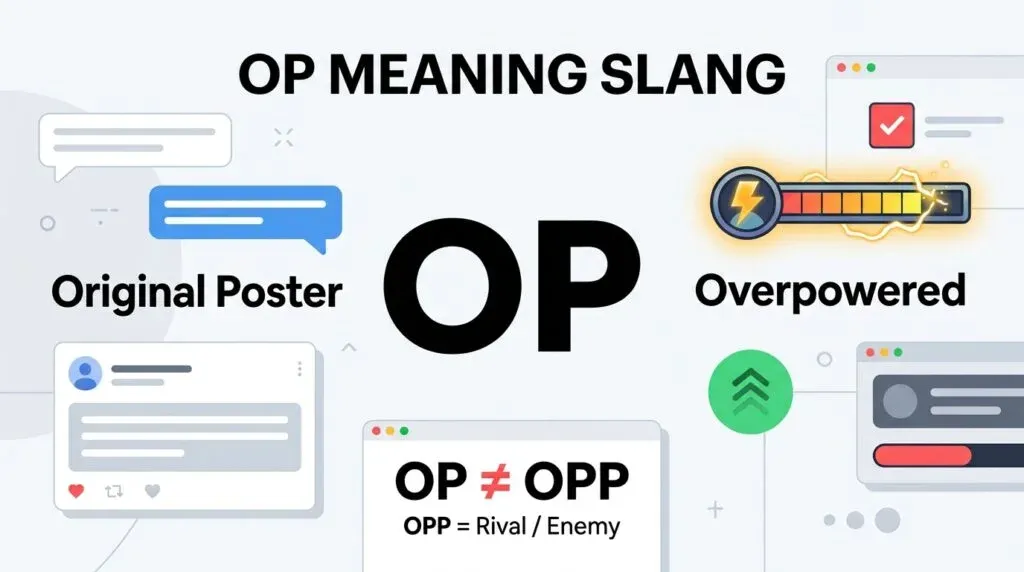

OP most commonly means “original poster” in online discussions—the person who created the post, thread, or topic being discussed. In gaming, however, OP usually means “overpowered,” describing a character, weapon, strategy, or ability that seems unusually strong.
Context matters because the same two letters can describe either a person who made a post or something considered excessively powerful. There is also a commonly confused slang word, “opp,” usually spelled with two p’s, which means an opponent, rival, or enemy.
| Quick Answer | Meaning |
|---|---|
| Most common online meaning | Original poster |
| Gaming meaning | Overpowered |
| Related form | Original post |
| Commonly confused term | Opp = opponent, rival, or enemy |
| Typical pronunciation | OP: “oh-pee” |
| Tone | Usually neutral; evaluative in gaming |
| Formality | Informal internet language |
| Offensive? | No, although “opp” can sound confrontational |
What Does OP Mean in Slang?
The meaning of OP depends mainly on what people are discussing.
In a comment section, forum thread, or social-media discussion, OP usually means “original poster.” It identifies the person who created the post everyone is responding to.
For example:
“OP explained what happened in the comments.”
Here, OP means the person who originally published the post.
In gaming, OP usually means “overpowered.” Players use it when a character, weapon, skill, strategy, or other game element seems much stronger than it should be compared with the alternatives.
For example:
“That new weapon is seriously OP.”
Here, OP has nothing to do with whoever made a post. It means the weapon seems excessively powerful.
The easiest way to understand OP is therefore not to memorize one definition but to look at what the abbreviation is describing.
Quick Meaning of OP by Context
| Context | Likely Meaning | Example | Usage Level |
|---|---|---|---|
| Forums and discussion threads | Original poster | “OP added an update.” | Very common |
| Social-media comments | Original poster | “I agree with OP.” | Common |
| Discussion about content | Original post | “Read the OP again.” | Context-dependent |
| Video games | Overpowered | “That character is OP.” | Very common |
| Gaming communities | Operator | “Ask the op/admin.” | Uncommon |
| Rival or enemy slang | Usually opp, not OP | “He’s an opp.” | Common as “opp” |
The grammatical pattern often gives away the meaning before you even consider the platform.
OP Meaning as “Original Poster”
The original poster is the person who started an online discussion by publishing the first post.
Someone might say:
“OP needs to clarify what they meant.”
The speaker is referring to the person who created the original content, not necessarily the person currently replying.
Another example:
“Based on OP’s update, everything worked out.”
The possessive form OP’s simply means “the original poster’s.”
This usage is especially useful in long discussions because many people may participate. Rather than repeatedly writing the creator’s username, commenters can simply call that person OP.
Does OP Ever Mean “Original Post”?
Yes. Depending on the sentence, OP can occasionally refer to the original post itself rather than the person who wrote it.
Compare:
“OP answered that question already.”
Here, OP is a person.
“The details are in the OP.”
Here, OP most naturally refers to the original post.
You can usually distinguish the two through grammar.
If OP is doing something, it probably means the poster:
- “OP replied.”
- “OP deleted their comment.”
- “OP explained the situation.”
If someone is reading, quoting, or referring back to OP, it may mean the original post:
- “Check the OP.”
- “That detail is in the OP.”
- “The OP was edited later.”
The distinction rarely causes serious confusion because the surrounding sentence usually makes the intended meaning obvious.
Also Read: What Does Bougie Mean in Slang? Examples and Usage
What Does OP Mean in Gaming?
In gaming, OP means “overpowered.” It describes something players consider disproportionately strong compared with other options.
Players may call almost anything OP:
- A character
- A weapon
- An ability
- A class
- A strategy
- An item
- A combination of abilities
- Occasionally, an exceptionally strong player
For example:
“That character becomes OP after level ten.”
The speaker believes the character becomes unusually powerful.
Or:
“This build is OP right now.”
The speaker thinks that particular combination of equipment, abilities, or strategy performs exceptionally well.
Does OP Always Mean Something Is Unfair?
Not necessarily.
In competitive gaming, OP often carries a negative implication because calling something overpowered suggests that game balance may be off.
However, people also use it casually as exaggerated praise.
For example:
“This sword is OP. I love it.”
The player may simply mean the weapon is extremely effective.
Tone therefore matters. OP can mean:
- Too strong
- Unfairly strong
- Extremely effective
- Impressively powerful
The literal idea stays similar while the attitude changes.
OP Meaning on Social Media and Messaging Apps
On social platforms, comment sections, discussion communities, and group chats, OP usually refers to the person who created the content being discussed when the conversation centers on a post.
For example:
“Why is everyone blaming OP?”
OP means the creator of the post.
“OP came back with an update.”
Again, OP means the original poster.
This meaning remains broadly consistent across platforms, so separate definitions for every social app are usually unnecessary.
However, gaming discussions on those same platforms can change the meaning immediately.
Consider:
“OP really needs to explain this.”
Likely meaning: original poster.
“That new character looks OP.”
Likely meaning: overpowered.
The platform alone does not determine the meaning. The subject of the sentence matters more.
OP vs. Opp: They Are Easy to Confuse
One of the most important distinctions is between OP and opp.
OP generally functions as an initialism pronounced “oh-pee.”
Opp, usually pronounced as a short word rather than as separate letters, is slang for an opponent, opposition, rival, or enemy. The plural is usually opps.
Compare:
“OP said he’ll update the thread tomorrow.”
Meaning: original poster.
“That hero is OP after the update.”
Meaning: overpowered.
“He switched sides, so they call him an opp now.”
Meaning: rival or enemy.
The spelling difference is especially useful in writing.
Also Read: What Does Opp Mean? Slang Meaning, Uses, and Examples
Why Does “Opp” Mean Enemy?
“Opp” is generally understood as a shortened form connected with opponent or opposition. It became especially recognizable through hip-hop and drill-related slang before spreading further into memes, social media, casual speech, and youth slang.
In serious contexts, an opp can mean an actual adversary or someone from an opposing group.
In lighter internet usage, people may exaggerate and call someone an opp over something trivial.
For example:
“You put ketchup on eggs? You’re an opp now.”
The speaker is probably joking. They do not literally mean the other person is an enemy.
This is a good example of how internet culture can soften or exaggerate language that may carry a more serious meaning in its original context.
How Context Changes the Meaning of OP
Three clues usually identify the correct meaning: grammar, subject, and conversation topic.
1. Look at what OP refers to
If OP seems to refer to the creator of content, it probably means original poster.
“OP hasn’t replied yet.”
A person can reply, so original poster fits.
If OP describes a weapon, character, ability, or strategy, it probably means overpowered.
“That ability is OP.”
An ability cannot be an original poster, so overpowered is obvious.
2. Look for “the”
When someone says “the OP,” they are often referring to the original poster or original post.
“Ask the OP for more information.”
When something “is OP,” the intended meaning is often overpowered.
“That strategy is OP.”
This is one of the fastest context clues.
3. Look at the spelling “opp”
When the term is written as opp or opps, particularly after words such as “an,” “my,” “your,” or “the,” it may mean rival or enemy.
“He’s an opp.”
That is different from:
“He’s OP.”
The second sentence could mean he is extremely powerful, particularly in gaming.
One extra letter can completely change the interpretation.
Tone and Emotional Meaning
OP itself is normally neutral when it means original poster.
“OP posted an update.”
There is no built-in approval or criticism.
However, surrounding words can change the tone:
“OP handled that really well.”
Supportive.
“OP is completely missing the point.”
Critical.
“OP woke up and chose chaos.”
Playful or sarcastic.
When OP means overpowered, it carries more judgment because the speaker is evaluating strength or balance.
“That weapon is OP.”
Depending on tone, that can express:
- Frustration
- Admiration
- Excitement
- Criticism
- Exaggeration
The abbreviation itself does not tell you which emotion is intended.
Real Conversation Examples
Example 1: Comment Section
Maya: Did the situation ever get resolved?
Chris: Yeah, OP added an update this morning.
Meaning: OP = original poster.
Example 2: Discussion Thread
Alex: Who actually made the original claim?
Jordan: OP did. Everyone else is responding to it.
Meaning: OP = original poster.
Example 3: Gaming
Evan: Why does everyone keep choosing that character?
Noah: Because the ultimate ability is OP.
Meaning: OP = overpowered.
Example 4: Competitive Game
Kai: Did they buff that weapon again?
Liam: Yeah. It’s completely OP now.
Meaning: OP = excessively strong.
Example 5: Ambiguous Social Comment
“OP is wild for this.”
Here, OP almost certainly means original poster because the comment judges something the creator posted.
Example 6: Rival Slang
“After what happened, they treat him like an opp.”
Here, the spelling opp signals rival or enemy.
Example 7: Playful Use of “Opp”
“You skipped my favorite song? Certified opp behavior.”
The word “opp” is being used jokingly to call someone an enemy over a minor disagreement.
OP Grammar, Pronunciation, and Capitalization
When OP means original poster or overpowered, it is generally treated as an abbreviation or initialism.
It is normally pronounced:
O-P → “oh-pee.”
Uppercase OP is the clearest spelling, especially in edited writing.
However, lowercase op frequently appears in casual messages because people often skip capitalization online.
Common forms include:
- OP
- op
- OP’s
- OPs
When referring to enemies or rivals, opp and opps are clearer spellings.
OP’s or OPs?
OP’s with an apostrophe can show possession:
“OP’s explanation makes sense.”
Meaning: the original poster’s explanation.
OPs without an apostrophe can refer to multiple original posters in unusual contexts, although the plural is not needed often.
Meanwhile:
opps usually means multiple rivals or enemies.
Keeping these spellings distinct improves clarity.
Similar and Commonly Confused Terms
| Term | Meaning | Main Difference | Typical Context |
|---|---|---|---|
| OP | Original poster | Refers to content creator | Threads and comments |
| OP | Overpowered | Describes excessive strength | Gaming |
| Opp | Opponent, rival, enemy | Refers to someone against you | Slang, music, social media |
| OC | Original content | Describes content created by the poster | Online communities |
| NPC | Non-player character | Gaming term also used metaphorically online | Gaming and internet slang |
| Nerf | Make something weaker | Often discussed when something is considered OP | Gaming |
OP vs. OC
OP identifies the original poster.
OC commonly means original content.
A person can be the OP without necessarily posting something they personally created from scratch.
For example, someone may start a discussion by sharing a question or reposting material. They are still the original poster of that thread.
OP vs. Opp
This is the most important distinction.
OP: original poster or overpowered.
Opp: opponent, rival, or enemy.
If someone writes:
“The OP is wrong.”
They are probably criticizing the person who made the post.
If someone writes:
“He’s an opp.”
They are identifying the person as an adversary.
Is OP Offensive or Rude?
OP is not inherently offensive.
Calling someone the OP simply identifies them as the person who started the discussion.
Calling something OP in gaming is also normally harmless. It is an opinion about strength or balance.
However, the related slang word opp can be more sensitive because it may label someone an enemy or adversary. The seriousness varies dramatically by situation. In memes and friend groups, it may be playful. In conflict-related contexts, it can carry a genuinely hostile meaning.
That makes context particularly important when using opp about real people.
Is OP Appropriate at Work or School?
OP is fine in casual digital communication when everyone understands the abbreviation.
For example, in an informal workplace discussion about an online thread:
“The OP clarified the issue later.”
That is understandable, although “original poster” may be clearer in formal reports or professional documentation.
Gaming-related OP is highly informal. You might use it naturally with coworkers discussing a game but probably not in formal business writing unless you define it first.
The word opp is much more casual and can sound confrontational. It is generally better avoided in professional communication when you simply mean competitor, opponent, critic, or rival.
Who Uses OP?
OP is strongly associated with online communication rather than one specific age group.
It appears wherever people discuss posts, comments, threads, games, online communities, and shared content.
The two major meanings also tend to follow different communities:
Original poster appears most naturally in:
- Discussion boards
- Comment sections
- Online communities
- Social-media discussions
- Group conversations about posts
Overpowered appears most naturally in:
- Gaming chats
- Strategy discussions
- Reviews
- Competitive gaming communities
- Streams and game-related comments
The related term opp is more closely associated with informal speech, hip-hop and drill-influenced slang, memes, social media, and youth internet culture. Usage varies by community and situation.
Also Read: Ohio Slang Meaning: What Does “Ohio” Mean Online?
How OP Functions in Real Online Conversation
The most useful thing about OP is that readers rarely need to consciously “translate” it once they notice the sentence structure.
Three patterns cover most situations:
The OP + action → original poster
“The OP deleted the comment.”
Something + is OP → overpowered
“That weapon is OP.”
An/my/the opp → rival or enemy
“He’s an opp.”
This grammar-based approach is often more reliable than trying to memorize platform-specific definitions.
A single platform may contain all three uses at once. A gaming discussion on a social network could mention the OP who published a video, describe the featured weapon as OP, and jokingly call another player an opp.
The conversation tells you which meaning applies.
Frequently Asked Questions
What does OP mean in text?
In texting, OP most commonly means “original poster” when people are discussing an online post, thread, screenshot, or conversation. In a gaming-related message, OP usually means “overpowered.” Look at what OP describes: a person who published something suggests original poster, while a weapon, character, or ability suggests overpowered.
What does OP mean on TikTok?
In TikTok comments, OP can refer to the person who originally posted the video or content. For example, “OP is hilarious” usually means the creator of the post being discussed. If the video concerns gaming, however, “that character is OP” will normally mean the character is overpowered.
What does OP mean on Snapchat?
There is no unique universal Snapchat definition of OP. If people are discussing a post or piece of shared content, it can mean original poster. If the conversation is about gaming, it can mean overpowered. The surrounding sentence is more reliable than the platform name when determining the intended meaning.
Does OP mean enemy?
Usually, OP itself does not primarily mean enemy. The slang term for an enemy, rival, or opponent is more commonly spelled opp, with two p’s. The plural is opps. Because people do not always use standard spelling in casual messages, context can occasionally blur the distinction.
What does “OP is wild” mean?
If someone comments “OP is wild,” OP normally means the original poster. The commenter is saying the person who created the post did or said something surprising, extreme, funny, inappropriate, or unusual. The word “wild” determines the judgment while OP simply identifies the person being discussed.
What does “this is OP” mean?
In a gaming conversation, “this is OP” almost always means “this is overpowered.” The speaker thinks a character, weapon, ability, item, or strategy is extremely strong. Outside gaming, you need more context because OP may instead be referring to an original post or poster.
How do you pronounce OP?
When OP means original poster or overpowered, it is normally pronounced as the individual letters: “oh-pee.” The separate slang word opp, meaning opponent or enemy, is normally pronounced as a single short word rather than as the letters O-P. Keeping the pronunciation and spelling separate helps avoid confusion.
Is OP still used?
Yes. OP remains useful because both of its major meanings describe common online situations: identifying the person who started a discussion and describing something excessively powerful in gaming. The exact interpretation continues to depend on the surrounding topic rather than on a single universal definition.
Conclusion
The OP meaning in slang and internet language depends mainly on context. In threads, comments, and online discussions, OP usually means original poster, the person who created the original content. In gaming, OP means overpowered, describing something unusually strong. The spelling opp is different and usually refers to an opponent, rival, or enemy.
The fastest way to decode the term is to look at the sentence: “the OP” usually points to a poster, “is OP” often means overpowered, and “an opp” usually means a rival. Those simple context clues solve most of the ambiguity.


Pingback: Unc Meaning Slang: What It Means in Text and Online
Pingback: Eiffel Tower Slang Meaning: What Does It Really Mean?
Pingback: Australian Slang: 50 Aussie Words and Phrases Explained
Pingback: Philly Slang: 25 Words and Phrases Locals Actually Use