

Boof is a slang word with at least five unrelated meanings: an adjective for something fake, trash, or uncool; a crude word for flatulence; a verb for rectal drug use; a cannabis-strain joke; and a whitewater kayaking move.
Ask ten people what “boof” means and you might get ten different answers. Most of the time, someone texting you that something “is boof” means it is bad, fake, or disappointing. But the word also shows up in old yearbooks, dispensary menus, and kayaking forums, each time wearing a completely different hat. I have seen it called everything from a 1980s fart joke to a modern strain name, and half of those claims deserve a closer look. Here is every meaning, where each one came from, how to tell them apart, and the spots where you should not use the word at all.
On This Page
- The Five Meanings of Boof in 30 Seconds
- Meaning 1: Fake, Trash, or Uncool
- Meaning 2: Boof Weed and the Reclaimed Strain
- Meaning 3: Boofing, the Drug-Use Meaning
- Meaning 4: Farts and the Yearbook Saga
- Meaning 5: The Kayak Stroke, the Dog Bark, and the Aussie Insult
- Boof vs. Similar Words
- The Usage-Context Map: Who Says Boof, Where, and To Whom
- What to Say When Someone Calls Something Boof
- Myths vs. Facts About Boof
- When NOT to Use Boof
- People Also Ask About “Boof”
- Sources and Further Reading
The Five Meanings of Boof in 30 Seconds
Boof has five main meanings: an adjective meaning fake, trash, or uncool (“that movie was boof”); cannabis slang for low-quality weed; “boofing,” a verb for rectal drug or alcohol use; a crude word for flatulence popularized by a 2018 Senate hearing; and a whitewater kayaking stroke named for the sound it makes. Context decides which one you are hearing.
| Meaning | Part of speech | Example | Vibe |
|---|---|---|---|
| Fake, trash, uncool | Adjective | “That sneaker drop was boof.” | Dismissive, playful |
| Low-quality weed | Noun / adjective | “All they had was a boof pack.” | Insulting (weed culture) |
| Rectal drug/alcohol use | Verb (“boofing”) | Rarely said casually; mostly a warning term | Taboo, risky |
| Flatulence | Noun / verb | “Have you boofed yet?” (1980s yearbook slang) | Crude joke |
| Kayak stroke | Verb / noun | “She boofed the ledge clean.” | Wholesome, technical |
If someone is reviewing or rating something and calls it boof, stop there: that is meaning one, and it is the one you will run into the most. The other four only show up in specific rooms: weed culture, a news cycle from 2018, and whitewater rivers. Keep the table above in your back pocket and the rest of this guide sorts itself out.
Meaning 1: Fake, Trash, or Uncool
As an adjective, “boof” means fake, low-quality, or uncool, and it comes out of African American Vernacular English before spreading into mainstream internet slang. Saying something “is boof” is a quick dismissal, roughly “that is trash,” and it lands on products, events, movies, outfits, and people with equal ease.
SlangSphere traces this usage back to AAVE, where boof became a handy one-word quality rating, and it has since spread to mainstream culture. The template is dead simple: “That [thing] was boof.” A movie that wasted your evening was boof. The knockoff sneakers from the flea market are boof. A party that died by midnight was boof. It carries a judgmental edge without sounding like a full argument, which is why it survives so well in group chats and comment sections.
This is also the closest relative of mid, slang’s other one-word quality rating, but boof hits harder. Mid says something was average and forgettable. Boof says it was actively bad, fake, or a rip-off. If a streamer calls a game boof, they are not saying it was okay. They are saying do not buy it.
“That pack is boof”: where the weed connection started
The insult grew teeth in cannabis culture. For years, “boof” was weed slang for low-quality flower: dry, flavorless, full of stems and seeds, weak. Cannabis retailer Mood describes it as the opposite of “loud,” “fire,” and “top-shelf”: the stuff you smoked only when you had no other choice. From there it spread as a general adjective for anything counterfeit or disappointing. Ganjapreneur’s cannabis glossary notes that “boof carts” means counterfeit vape cartridges, the sketchy unregulated kind, which shows how naturally the word attaches itself to anything fake.
“Boofed”: the past-tense version
You will also see “boofed.” In most contexts it means messed up or botched: “I boofed that presentation.” SlangSphere also records a second past-tense sense, “I was so boofed last night,” meaning heavily intoxicated or under the influence. Same word, same past-tense trick as English everywhere, so read the room: a friend who says “I boofed the shot” missed; a friend who says “I was boofed” got wasted.
And yes, this is the one people usually mean. If you searched “what does boof mean in slang” because someone texted you “that was so boof,” congratulations: they were calling something trash, not confessing anything. You already have your answer.
Where you hear this one
This is the streetwear-era boof: group chats, TikTok comments, Discord servers, rap lyrics, and sneaker forums. It sounds natural coming from teens and twenty-somethings roasting a product, and it sounds like trying too hard coming from a corporate brand account. Cap behaves the same way: cap, the classic AAVE way to call out a lie, moved from rap verses to the mainstream with its edge intact, and boof is walking the same path.
Meaning 2: Boof Weed and the Reclaimed Strain
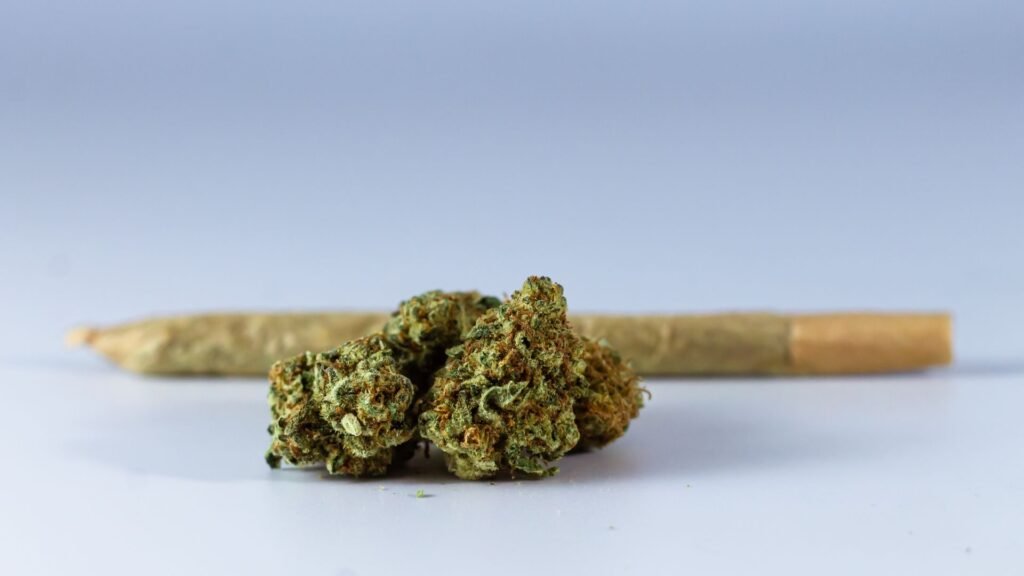
In cannabis culture, “boof” means low-quality weed: dry, weak, flavorless flower or counterfeit products. In a twist, growers have reclaimed the word as the actual name of real strains, including Boof and Super Boof, turning the insult into an inside joke. Context decides whether someone is insulting weed or praising a strain.
The original insult is old-school. For years “boof” was what smokers called the worst bag in the room. Mood’s guide to the term puts it plainly: boof weed is dry, weak, and not worth the smoke. It is the opposite of loud, fire, and top-shelf. The slang likely grew from how bad weed feels to smoke: harsh and unsatisfying, the kind of word that sounds as bad as the thing it names.
From diss to strain name: how Boof got reclaimed
At some point the joke flipped. Someone in cannabis culture started naming strains Boof on purpose, the way a confident restaurant might call a dish “Trash Plates.” Mood describes it as a flex: “This weed is so good, we can call it Boof and people will still smoke it.” The most famous version is Super Boof, and its story is genuinely fun. Hashtag Cannabis traces the strain’s history: a breeder known as Blockhead released a cross of Black Cherry Punch and Tropicana Cookies under the name Blockberry, and when smokers joked the strain hit so hard it “boofed” them, the ironic nickname Super Boof stuck and swallowed the original name whole.
It is not the first reclamation in weed slang, either. Mood points out that “dank” used to mean damp and gross before it became a compliment for potent weed. Boof is following the same arc, from negative slang to cult favorite, just with better jokes.
How to tell the slang from the strain
The difference is context, and the article above will not help you if you mix them up. If someone is reviewing quality (“this plug only sells boof”), it is the insult. If someone is naming a product (“pick up an eighth of Super Boof”) or describing cherry-citrus flavor, it is the strain. Mood’s warning is the practical one: if someone tries to sell you actual low-grade weed and calls it Boof as a joke, know the difference between the strain and the slang.
Meaning 3: Boofing, the Drug-Use Meaning
“Boofing” refers to ingesting alcohol or drugs rectally to get intoxicated faster, and Dictionary.com lists it as one of the word’s verb definitions. It is a taboo, risky practice: medical professionals warn it can cause tissue damage, overdose, and infections, and it comes with none of the safeguards of normal dosing. This section explains the term, not the method.
The word’s history here is tangled. FluentSlang’s boof guide reports the Urban Dictionary sense of concealing drugs in the rectum, and traces a possible origin in “butt” plus a vulgar word for anal sex. MEL Magazine’s deep dive into the word’s history found older layers: Green’s Slang Dictionary records “boof” as prison slang for contraband hidden in the rectum around the year 2000, and forum users from the 2000s trace a path from “buttfuck” to the clipped “bufu” to “boof.” Somewhere along the way the smuggling sense became a consumption sense, and “boofing” entered the slang lexicon.
What “boofing” actually refers to
As a noun and verb, it describes administering a substance through the rectum so it absorbs quickly. You will see it mentioned in harm-reduction forums, Reddit threads, and news stories about college party culture. It is sometimes called “butt chugging” with alcohol. In conversation it almost never comes up casually; it appears in warnings, news coverage, and “do not try this” threads. If you hear the word in a party setting, the person talking about it is usually either warning someone or joking about something dangerous.
It is worth knowing the vocabulary here because it overlaps with other drug-adjacent slang. Tweaking, a word tied to drug-adjacent slang, and fein, the word for someone craving a substance, swim in the same waters, and all of them show up in contexts where somebody is either asking for help or making a bad decision.
Why you should not do it: the short version
No lecture, just facts. Medical professionals and harm-reduction sources consistently warn that this method bypasses the body’s normal safeguards: it is hard to control the dose, absorption can be faster and stronger than expected, the tissue involved tears and absorbs infections easily, and alcohol in particular can cause alcohol poisoning fast because there is no vomiting reflex to stop it. If someone you know is talking about trying it, the useful move is not to joke along. Tell them plainly that it is one of the riskier ways to use a substance, full stop.
Meaning 4: Farts and the Yearbook Saga
The flatulence meaning of “boof” became nationally famous in 2018, when Supreme Court nominee Brett Kavanaugh told a Senate hearing that “boofed” in his 1983 high school yearbook meant farting. His classmates disputed the claim, and journalists found older evidence suggesting the word meant something cruder. Either way, “boof” as a fart joke has real 1980s roots.
Here is what happened. Kavanaugh’s 1983 Georgetown Prep yearbook carried the line “Judge, have you boofed yet?” (and a matching “Bart, have you boofed yet?” on his friend Mark Judge’s page). Dictionary.com cites the 2018 Fox News coverage where Senator Whitehouse asked Kavanaugh to define the word, and Kavanaugh said it referred to flatulence. MEL Magazine, in a long feature on the word’s history, notes that classmates publicly disputed his explanation, and the magazine’s own research suggested there was a strong chance the yearbook joke was not about farts at all.
What “boof” meant in the 1980s
MEL’s research turned up several 1980s threads that point away from the fart theory. Some East Coast users of that era understood “boof” as a derivative of “bufu,” meaning anal sex. A 1983 Stanford Daily quote uses “boofed” as a stand-in for a cruder past-tense verb (“either you’re really set for three years or you’re boofed”). And in the 1985 movie Teen Wolf, Michael J. Fox’s character calls one of his girlfriends “Boof,” which message-board veterans of the era read as the same crude nickname. None of this proves what two teenagers meant in a yearbook. It does show the word already had dirty connotations decades before the hearing.
The flatulence sense does exist independently, though. MEL found an Urban Dictionary definition of boof as a “wet fart” first appearing in 2006, which is late enough to be its own joke rather than the yearbook’s meaning. So if someone today says “he boofed,” meaning farted, they are probably just being crude and funny, not quoting a Supreme Court hearing. Probably.
Meaning 5: The Kayak Stroke, the Dog Bark, and the Aussie Insult
The oldest documented “boof” is a whitewater kayaking term for launching a kayak over a drop or ledge, named for the sound the boat makes when it lands, and Dictionary.com still lists it as the primary definition. The same onomatopoeia also names a dog’s low bark, and Australia has “boofhead” for a dim-witted person.
The kayak “boof” stroke
Whitewater kayakers have used “boof” since at least the 1970s. It names the move of driving the kayak’s bow over a drop or hole so the boat lands flat instead of nose-diving, and it is named for the noise the hull makes when it slaps back onto the water. Dictionary.com defines the verb plainly: to launch a kayak over a drop or difficult water formation, using a forward paddle stroke to raise the bow out of the water. MEL Magazine notes that whitewater forums credit the sound itself: the kayak goes “boof” as it bounces off the wave below. On a river, “nice boof” is a compliment, and it is the only meaning of the word with zero awkwardness attached.
“Boof” as a dog’s bark
Say it out loud: “boof.” It is a muffled, low bark, the sound a big dog makes through a closed door. Nobody owns this meaning; it is just what the syllable sounds like. It shows up in cartoons, dog memes, and parents narrating the family labrador. If you ever hear “boof” in a context with zero edge to it, this is probably the one.
Australia’s “boofhead”
Australian slang has “boofhead” (and the adjective “boofy”) for a brawny, dim-witted person, and Wiktionary notes the Australian colloquial use of “boof” for an idiot. It is a separate branch of the word’s family tree, closer to “meathead” than to anything American, and worth knowing if an Aussie drops it on you. File it under: same sound, different slang ecosystem.
Boof vs. Similar Words
Boof sits in a crowded neighborhood of one-word verdicts. It is harsher than “mid,” cruder than “cap,” and narrower than “wack”: this table lines it up against four similar terms so you can pick the right one. Boof always carries a quality judgment, while its cousins split into mediocrity, lies, and style.
| Term | What it means | Tone | Where you hear it | Example |
|---|---|---|---|---|
| Boof | Fake, trash, low-quality; also fart, drug use | Dismissive to crude | Group chats, TikTok, rap lyrics | “That link is boof, do not click it.” |
| Mid | Mediocre, average, forgettable | Mild, teasing | TikTok, school hallways | “The sequel was mid.” |
| Wack | Lame, uncool, corny | Dismissive | Hip-hop, casual roasting | “His pickup lines are wack.” |
| Cap | A lie; also “no cap” means for real | Confrontational | AAVE, TikTok, streaming chats | “He said he bench presses 300? Cap.” |
| Zaza | Premium, exotic weed | Hype, positive | Weed culture, rap lyrics | “We only smoke zaza now.” |
Notice the pattern: boof is the only one in the list that can also mean something physical. Mid, wack, cap, and zaza all stay in the realm of judgment. Boof doubles as a body joke and a river move, which is exactly why people keep asking what it means. If you want the deeper file on the closest cousin, see my full breakdown of what mid means in slang, because the two get confused constantly.
The Usage-Context Map: Who Says Boof, Where, and To Whom
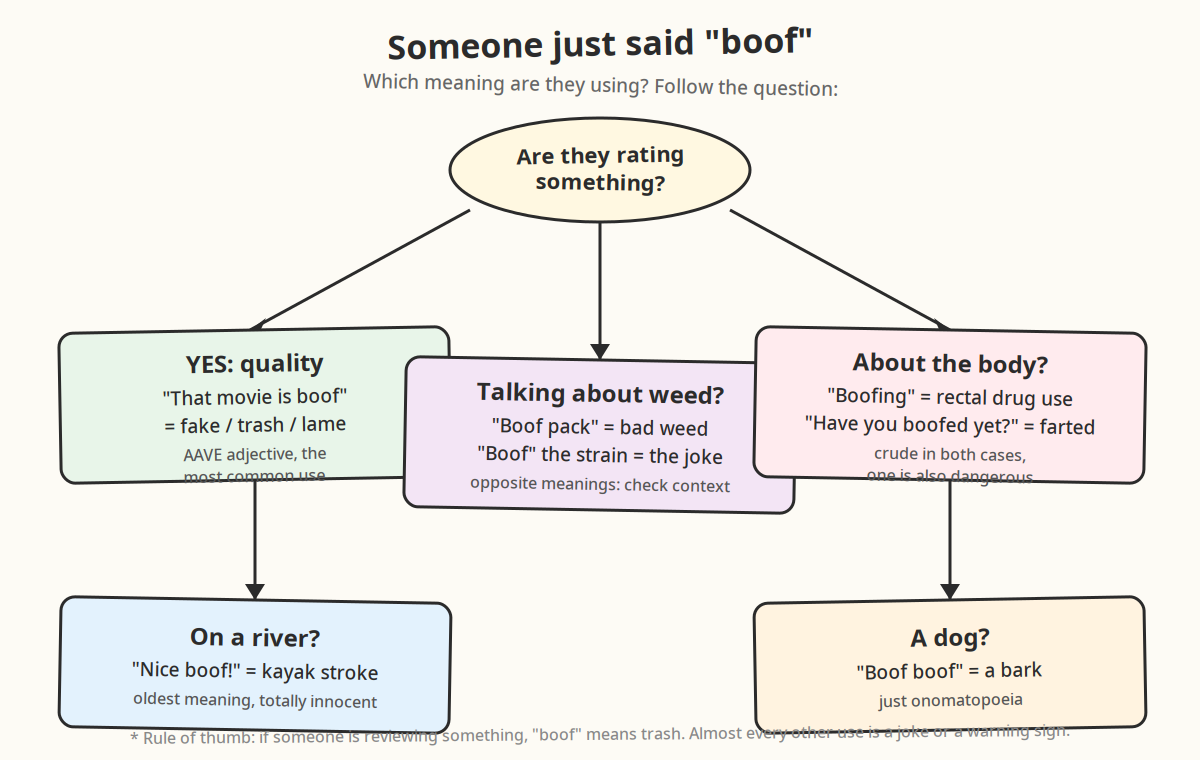
Knowing the definitions is half the job. The other half is reading the room. “Boof” is almost entirely a spoken, informal word: it lives in group chats, voice notes, comments, and lyrics, and it almost never appears in workplaces, classrooms, or family dinners. Here is how the meanings map onto real life.
Who says it, where, and to whom
- The “trash” meaning: said by teens and twenty-somethings, mostly to friends, in group chats, TikTok and Instagram comments, Discord, and sneaker or streetwear forums. The audience is always peers. Nobody says it to a teacher, a boss, or their mom.
- The weed meaning: said by smokers and dispensary regulars, to other smokers, in real-life hangouts, Reddit threads, and dispensary menus (where the strain name lives). The audience is people in the know.
- The “boofing” meaning: said in harm-reduction forums, news coverage, and party-whisper contexts, usually as a warning. The audience is someone who needs to hear the warning.
- The fart meaning: said as a crude joke between close friends, or referenced in political arguments about the 2018 hearing. The audience is people who will not be offended by a fart joke.
- The kayak meaning: said by whitewater paddlers, to other paddlers, on rivers and in paddling forums. The audience is gear people. This is the only meaning that is safe at a family dinner.
How boof shows up in text
In writing, the “trash” meaning is almost always a one-word verdict or a short sentence: “boof,” “that was boof,” “whole album is boof ngl.” It often lands at the end of a review as the punchline. “Boofed” shows up as the past tense of a fail: “I boofed my lines.” The flatulence meaning shows up as a joke among close friends. The drug meaning shows up with question marks, warnings, or news-article gravity. If the text around the word is a review, it is the adjective. If the text is a news headline, it is one of the other four.
What to Say When Someone Calls Something Boof
The reply depends on the meaning, and misreading it is how group chats go sideways. Here is the cheat sheet.
If they mean “trash” (the common one)
They are giving a verdict, not starting a debate. Natural replies: “fr, I was not impressed either,” “lmao hard agree,” or, if you disagree, “nah that was not boof, you are tripping.” It is casual, so match the energy. Nobody writes a paragraph defending a movie someone called boof.
If they mean “boofed” (messed up)
They are confessing a fail. “I boofed that test” wants sympathy or a laugh: “same,” “we move,” “bro same.” This is the same slot as cooked, another way to say someone or something is done: the reply is comfort, not grammar.
If they mean the fart joke
Someone close to you being gross. Laugh, groan, or change the subject. “Boof” as a fart word is crude but low-stakes; the only rule is that it stays between friends who joke like that.
If they are talking about “boofing” as drug use
Do not joke along. If it is a warning context, listen. If someone is considering it, the useful reply is plain: “do not, that is one of the riskier ways to do that.” You do not need a speech. One clear sentence beats a meme every time.
Myths vs. Facts About Boof
Myth: Boof only has one meaning
Fact: it has at least five unrelated ones, from kayaking to flatulence to cannabis. Most slang words have one or two senses; boof is unusually scattered, which is why it confuses people. The upside is that context almost always picks the right one instantly.
Myth: “Boof weed” is a strain you can buy and enjoy
Fact: as slang, “boof weed” means BAD weed, the stuff nobody wants. The strain names Boof and Super Boof are the joke: growers reclaimed the insult. If a seller offers you “boof” without naming a strain, they are warning you about the quality, not doing you a favor.
Myth: Kavanaugh invented the fart meaning in 2018
Fact: the hearing made it famous, but flatulence jokes and cruder senses of the word go back to the 1980s and earlier. MEL Magazine’s history of the word found the “bufu” theory, a 1983 newspaper quote, and a 1985 movie nickname, all predating the Senate hearing. The hearing put “boof” on the news; it did not invent the joke.
Myth: Boofing is just a funny party trick
Fact: medical professionals treat rectal drug and alcohol use as one of the riskier consumption methods, with real overdose and injury risk. The jokes online make it sound like a prank; the harm-reduction literature does not.
Myth: Boof is a brand-new internet word
Fact: the kayaking sense has been on whitewater rivers since at least the 1970s, the crude senses circulated in the 1980s, and the AAVE adjective sense grew up in real neighborhoods before the internet found it. The word is older than most of the people arguing about it on TikTok.
When NOT to Use Boof
Most meanings of boof are fine between friends. But the word has sharp edges, and this is where they are.
- Do not use the drug or flatulence meanings at work, at school, or around family. They read as crude, and the drug one can read as encouragement. Both will follow you in screenshots.
- Do not call a person’s work “boof” unless you are close. As an insult it lands like “trash” or “fake.” Funny between friends, genuinely hurtful as a review of someone’s art, business, or effort.
- Do not assume the meaning when someone else says it. If a kayaker friend says “nice boof” and you hear the other meaning, you will have a confusing afternoon. Ask if you are not sure.
- Do not use “boofing” as a joke to pressure anyone. Joking about a risky drug practice can nudge curious people toward it. This is the one spot where the funny version of the word is not worth it.
- Do not use it in writing that lasts. Resumes, applications, emails, public posts with your name on them. Slang ages badly in permanent ink, and boof’s crudest meanings will outlive the funny ones in a search result.
People Also Ask About “Boof”
Is boof a bad word?
It depends on the meaning. The “fake or trash” sense is mild, an insult but not a swear word. The flatulence and drug-use senses are crude and can offend, so keep them out of polite company, work, and school. None of the meanings belong in formal writing.
What does “boofed” mean?
“Boofed” is the past tense, and it has three common senses: messed up (“I boofed that shot”), intoxicated (“I was so boofed last night”), and flatulence (“he boofed,” meaning farted). The “messed up” sense is the most common in texting. Context tells you which one someone means.
What is boofing?
“Boofing” refers to ingesting drugs or alcohol rectally for faster intoxication. Medical professionals warn it is risky: dosing is hard to control, absorption is fast, and it can cause tissue damage, infections, and overdose. It is mostly discussed as a warning term, not as casual slang.
Is boof weed good or bad?
As slang, “boof weed” means bad weed: dry, weak, low-quality flower or counterfeit products. But Boof and Super Boof are also real cannabis strain names, created as an ironic joke by growers who reclaimed the insult. If someone is rating quality, boof is bad. If someone is naming a product, it is the strain.
Where did the word boof come from?
Nobody agrees on one origin, because the meanings grew up separately. The kayak sense is onomatopoeia from the 1970s whitewater scene. The crude senses are often traced to “bufu,” a clipped form of a vulgar phrase for anal sex, circulating by the 1980s. The adjective sense grew out of AAVE before spreading online. Same sound, several birthplaces.
Why was “boof” in the news in 2018?
During Brett Kavanaugh’s Supreme Court confirmation hearing, he was asked about “boofed” in his 1983 high school yearbook and said it meant flatulence. Classmates disputed the claim, journalists dug into the word’s history, and “boof” spent a news cycle as America’s most-discussed fart joke. Dictionary.com’s entry on boof still cites the 2018 coverage in its example sentences.
What is the difference between boof and mid?
Both are one-word quality ratings, but boof is harsher. “Mid” means average or forgettable, while “boof” means actively bad, fake, or disappointing. A mid movie was boring. A boof movie was a waste of your evening. See the full mid meaning in slang breakdown for the finer points.
Sources and Further Reading
- Dictionary.com’s entry on boof, listing the kayaking, anal sex, and rectal-ingestion verb senses with 2018 example coverage
- MEL Magazine’s long history of the word “boof,” from the Kavanaugh yearbook to 1980s pop culture and prison slang
- Mood’s guide to boof weed and the reclaimed strain, covering the insult-to-cultivar flip
- Hashtag Cannabis on how Super Boof got its name, from Blockberry to the ironic nickname
- Ganjapreneur’s glossary entry on boof carts, on counterfeit vape cartridges
- FluentSlang’s boof meaning guide, covering the crude senses and usage warnings
- SlangSphere’s boof meaning guide, tracing the AAVE adjective sense and the “boofed” intoxication sense