
“Big back” is slang for someone who eats a lot or shows greedy, food-obsessed behavior, and it can double as a body-size insult aimed at someone perceived as overweight.
You have probably seen it in a TikTok comment section or a group chat. A food video goes up, someone demolishes a plate of wings, and a reply pops up: “big back behavior.” Maybe you laughed. Maybe you flinched. “Big back” sits between playful food humor and genuine body shaming, and the line moves depending on who says it, where, and to whom. This guide covers what it means today, where it came from, how people use it, and when it crosses the line.
On This Page
- What “Big Back” Means Today
- Where “Big Back” Came From: A 30-Year Story
- The “Big Back” Usage Map: Who Says It, Where, and to Whom
- “Big Back” Variations You Will Actually Hear
- Joke or Insult? How to Tell
- “Big Back” vs Similar Terms: What’s the Difference
- When NOT to Use “Big Back”
- What to Say If Someone Calls You “Big Back”
- “Big Back” Myths vs Facts
- “Big Back” FAQs
- Sources and Further Reading
What “Big Back” Means Today
Online, “big back” describes someone who eats a lot or acts greedy about food, often as a joke. It can also work as a body-size insult toward someone perceived as overweight. The meaning lives between playful food roasting and genuine body shaming, and context decides which one the speaker intends.
Wiktionary defines “big back” as slang, derogatory: “an obese person, or someone with gluttonous eating habits.” Modern usage leans into the second half. The joke targets behavior, not anatomy, working through cartoonish exaggeration, like calling a hungry friend a “bottomless pit.”
In texts it is shorthand: a friend admits they ate dinner and then ordered fries, and the reply is “big back tendencies.” Self-directed versions are everywhere too, like captioning your own food haul “unbig my back.” That self-deprecating use is a big reason the phrase spread.
“You finished that whole pizza? Big back alert.”
For the moment the cravings win, see our guide to fein, slang for an intense craving.
Where “Big Back” Came From: A 30-Year Story
The phrase started as British slang for a prominent backside in the 1990s, moved through AAVE and Black queer culture, and flipped into its current food-focused meaning after Charlamagne Tha God called ReesaTeesa’s viral TikTok series “big back behavior” in early 2024. TikTok’s April 2024 “Bigbacked Trend” then made it mainstream.
Most viral slang feels brand new. This one is not, and the timeline explains why the phrase is so slippery today.
British slang and “Baby Got Back” (1990s)
The earliest documented use is British slang for a person, often a woman, with prominent buttocks. That usage crossed into African-American Vernacular English and went mainstream-adjacent through Sir Mix-a-Lot’s 1992 hit “Baby Got Back.” As Wiktionary’s entry traces, the song gave the term wide recognition, although it never uses the exact phrase. The 90s vibe was admiration, a 180-degree flip from today, and that era is the cultural soil behind the BBL slang and the Brazilian butt lift aesthetic.
AAVE and Black queer culture roots
Between the 90s song and the TikTok era, the phrase lived on in AAVE and, per Parade’s reporting, Black queer culture. Nobody can pinpoint when the meaning shifted from “big butt” to “big appetite,” which is normal for slang. By the early 2020s, the food-related sense was circulating there. The mainstream just had not noticed yet.
The Charlamagne and ReesaTeesa moment (early 2024)
The mainstream break came when ReesaTeesa’s multi-part TikTok series “Who TF Did I Marry?” became a cultural event. Radio personality Charlamagne Tha God described the behavior in it as “big back behavior,” a moment Vibe covered and Parade cites as the mainstream launch. The phrase jumped to national vocabulary almost overnight, and SaferLoop’s guide describes the same spark: after the reference, videos under the big back hashtag flooded TikTok.
The “Bigbacked Trend” takes over TikTok (April 2024)
Know Your Meme documents the “Bigbacked Trend” exploding in April 2024 on a simple visual gag: people stuffing pillows under their shirts to fake a fat back, then filming skits about eating excessively. The trend sound passed 22,000 uses in two weeks. The memes mostly show off eating habits or goofy food situations with family, which is why the phrase reads so food-focused today. The trend split opinion, with critics calling it fatphobic while fans insisted it was just comedy.
The thecincomedy parody song (July 2024)
The trend grew big enough to inspire a parody track. In July 2024, thecincomedy (creator Clarence Lomax III) released “Big Back (The Original Parody)” on TikTok and Instagram. Plenty of teens assume the song is where the phrase started. It is not. The song is a symptom of the trend, not the cause, and the phrase was decades old before the parody existed.
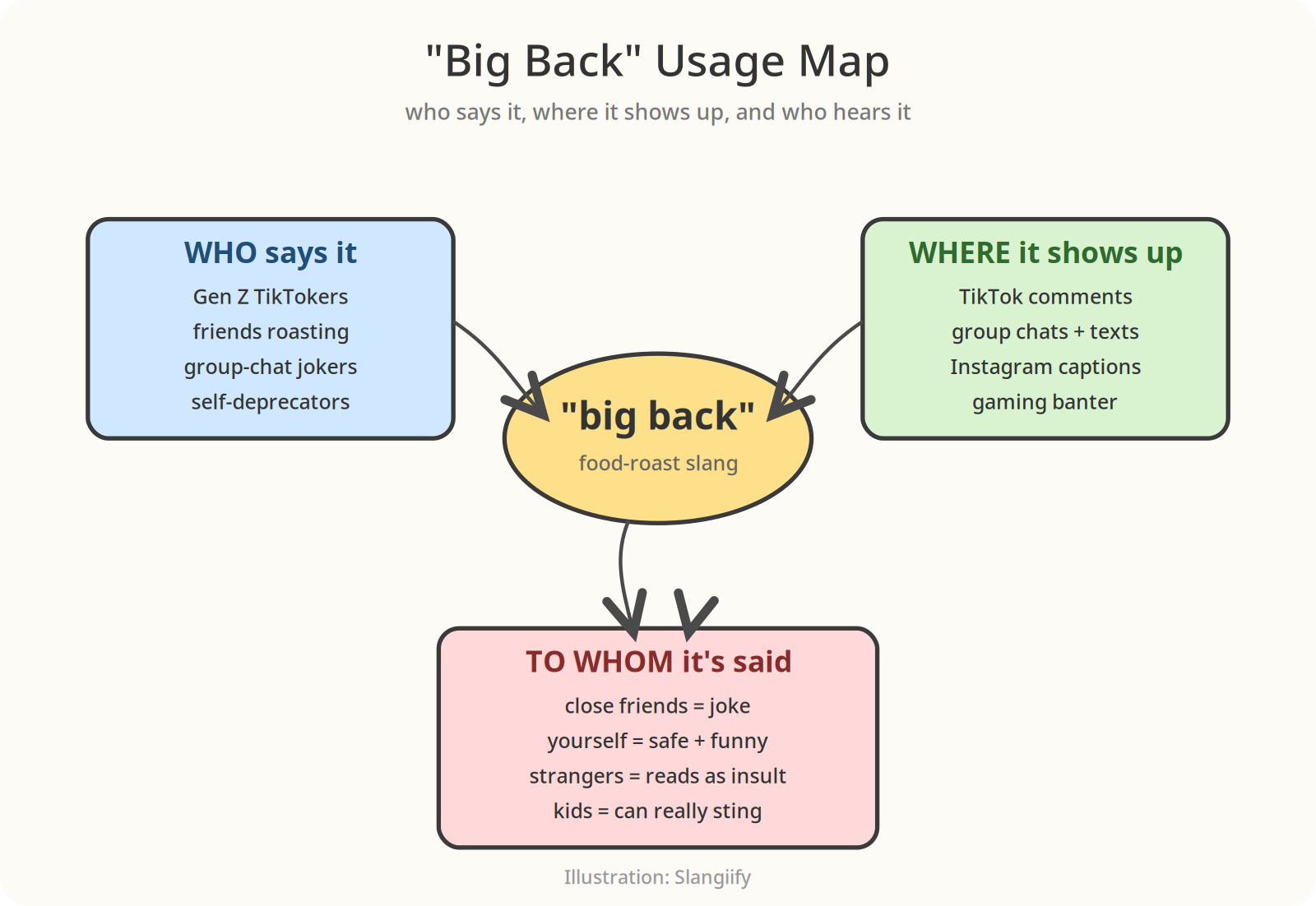
The “Big Back” Usage Map: Who Says It, Where, and to Whom
The phrase lives mostly on TikTok, in group chats, and in Instagram captions, used by Gen Z and younger millennials for friendly food roasting among peers. It is aimed at friends, at oneself, and too often at strangers. Knowing the three sides of the map, who, where, and to whom, is what separates a funny joke from an unwanted jab.
Who says it
The core speakers are Gen Z and younger millennials who live in meme culture. TikTok commenters drop the phrase under mukbangs and “what I eat in a day” clips. In private, it is the friend in the group chat who always calls out the extra order. Kids and tweens have picked it up too, often without grasping the body-shaming edge.
Where it shows up
TikTok comments are ground zero, collecting replies like “big back energy” under food videos. Instagram captions use it for food dumps and cheat-day posts. In group chats it appears as a quick callout after someone eats twice. GrammerWay notes gamers use it too, for someone hoarding loot. The common thread: casual, fast, visual spaces where exaggeration earns attention.
To whom it is said
Three targets, three readings. Said to a close friend with a mutual roasting history, it reads as affection. Said about yourself, it is self-deprecating humor that invites others in on the joke. Said to a stranger, or about someone’s body rather than their behavior, it reads as an attack. Dr. Bethany Cook told Parade that kids absorb labels instead of just hearing them, and body-based language can quietly shape a child’s self-image even when meant as a joke.
“Big Back” Variations You Will Actually Hear
“Big back” rarely travels alone. It has spawned a small family of phrases.
Big back behavior
The classic. It labels an action, not a person: ordering dessert after a full meal, finishing everyone’s leftovers.
Big backed
The adjective form, usually past tense and self-directed: “I am so big backed after that buffet.”
Unbig my back
The redemption arc. Said when the food coma sets in and you jokingly want to undo the damage.
Big back energy
Borrowed from the “X energy” trend. It describes a vibe, not a body: “He packed three lunches, that is big back energy.”
Certified big back moment
The award ceremony. When someone commits so hard to the food cause that it deserves recognition, the group chat certifies it.
Big back activities
The group version: a snack run, a buffet, appetizers as the main course.
Joke or Insult? How to Tell
It is a joke when the target is behavior, the relationship is close, and everyone is laughing together. It is an insult when the target is someone’s body, the relationship is distant, or the person looks hurt. Same words, different physics.
When it reads as a joke
The safe zone is close friends with a running roast dynamic, where the joke targets a specific funny behavior and everyone is in on it. Commenting “big back energy” under a staged food video where the creator set up the joke is participation, not punching. GrammerWay’s rule of thumb: if you would not joke about someone’s eating habits face to face, do not type it.
When it lands as an insult
Said to a stranger, it reads as body commentary from someone with no standing to make it. Aimed at appearance rather than actions, it becomes plain body shaming. Parade reports it gets used to embarrass kids in school cafeterias over their lunches. Dr. Cook told Parade that even joke-shaped words can plant insecurity in a kid who looks confident on the outside. When in doubt, plan for the insult reading.
“Big Back” vs Similar Terms: What’s the Difference
“Big back” overlaps with several food and body terms, but each carries its own tone and baggage. BBW is a body-positive identity label, FUPA is blunt body slang, foodie is pure compliment, and glutton is old-fashioned moral judgment. “Big back” sits between them as meme-first teasing that can tilt either way.
See our guides to BBW slang and FUPA slang for the deeper dive.
| Term | Meaning | Tone | Where Used | Example |
|---|---|---|---|---|
| Big Back | Someone who eats a lot or acts greedy about food; sometimes a dig at body size | Teasing, swings funny to hurtful | TikTok comments, group chats, memes | “Ordered dessert after a full meal? Big back behavior.” |
| BBW | Big Beautiful Woman, a label for plus-size women, often used with admiration | Positive or neutral, identity-affirming | Dating profiles, body-positive spaces | “She runs a BBW fashion page.” |
| FUPA | Blunt slang for lower belly fat, usually self-directed | Crude, can be shaming | Group chats, self-deprecating humor | “My jeans gave me the worst fupa today.” |
| Foodie | Someone who genuinely loves food and dining culture | Positive, respectful | Reviews, bios, travel talk | “He is a total foodie.” |
| Glutton | Someone who eats excessively, with moral judgment attached | Negative, old-fashioned | Criticism, lectures | “Stop being such a glutton.” |
Foodie and BBW describe a person with warmth, glutton judges them, and big back plus FUPA aim for laughs but can bruise. For humor without the risk, “foodie” is safest.
When NOT to Use “Big Back”
Skip it with strangers, in professional settings, around sensitive body or food topics, and whenever you are unsure the other person will find it funny. The joke needs trust, and without it, it just lands as commentary on someone’s body or appetite.
Avoid it on someone’s selfie, in work chats, with people you just met, or around anyone who has struggled with food or body image. Parade’s psychologists flag school cafeterias, where lunch callouts are a common real-world misuse. Aim the joke at the situation, never at a body.
What to Say If Someone Calls You “Big Back”
Match your reply to the situation. If a friend is roasting and you are unbothered, a playful comeback keeps the vibe. If it stings, say so plainly and early. Most people back off fast when they hear it landed wrong.
For the friendly roast, own it and flip it: “And I would do it again,” or “Big back and proud, pass the fries.” For the version that hurts, directness beats a comeback: “That actually bothered me, please do not call me that.” Dr. Deborah Gilman, quoted in Parade’s coverage, suggests a house rule: “In our family, we do not make jokes about people’s bodies.” Online, block or report, and talk to someone you trust.
“Big Back” Myths vs Facts
Viral phrases collect wrong stories. Here is what checks out.
Myth: It came from the thecincomedy parody song
Fact: The song came from the phrase, not the other way around. Thecincomedy released “Big Back (The Original Parody)” in July 2024, months after the trend exploded and decades after the phrase’s first uses.
Myth: TikTok invented it in 2024
Fact: TikTok mainstreamed it, but the phrase is about 30 years old. It started as British slang, entered American usage around Sir Mix-a-Lot’s “Baby Got Back” era in 1992, and circulated in AAVE and Black queer culture before hitting TikTok. The 2024 wave was a spotlight, not a birth.
Myth: It is only about body size
Fact: Online, it is mostly about behavior. Wiktionary’s definition covers both an obese person and someone with gluttonous eating habits, but daily use leans into the eating-habits half. Still, the body-size reading never fully leaves the room, which is why it can sting.
Myth: It is always offensive, or never offensive
Fact: Neither extreme holds. Psychologists Dr. Bethany Cook and Dr. Deborah Gilman, quoted in Parade’s coverage, warn it functions as body shaming even when meant as a joke. At the same time, millions use it self-deprecatingly among friends with zero harm done.
“Big Back” FAQs
What does “big back” mean in texting?
In texts it is a quick roast for a friend eating a lot or acting greedy about food. Someone admits they ate dinner and then ordered fries, and the reply is “big back tendencies.” It is almost always about the behavior in that moment.
Is “big back” an insult?
It can be. Between close friends or aimed at yourself, it usually reads as a joke. Aimed at a stranger, said with a mocking tone, or directed at someone’s body, it lands as an insult.
What is “big back behavior”?
It is the most common variation, labeling an action rather than a person: ordering dessert after a full meal, finishing everyone’s leftovers. It traces back to Charlamagne Tha God’s early 2024 comment on ReesaTeesa’s viral “Who TF Did I Marry?” series, the mainstream moment per Parade via Vibe.
Does “big back” mean fat?
Not exactly, but the reading exists. Everyday use focuses on eating behavior and appetite, while Wiktionary’s formal definition covers both an obese person and someone with gluttonous eating habits. In practice “fat” describes a body and “big back” describes a food moment, but listeners can hear the body-size version anyway.
Where did “big back” originate?
It started as British slang for a prominent backside, entered American usage through AAVE around Sir Mix-a-Lot’s “Baby Got Back” era in 1992, and circulated in AAVE and Black queer culture. It went mainstream in early 2024 after Charlamagne Tha God’s “big back behavior” comment on ReesaTeesa’s viral series, and TikTok’s April 2024 “Bigbacked Trend” blasted it into everyday slang.
Can you say “big back” about yourself?
Yes, and that is the safest way to use it. Self-directed jokes like “I am so big backed after that buffet” read as confident, self-aware humor. The creators who nailed the pillow-stuffing skits showed it at its best, the flawless timing our guide to “ate” slang for a perfect performance is all about.
Sources and Further Reading
- Wiktionary entry for “big back,” with the slang definition and usage history
- Parade’s breakdown of “big back” with psychologist commentary from Dr. Bethany Cook and Dr. Deborah Gilman
- Know Your Meme’s guide to the “big back” TikTok trend and its origins
- GrammerWay’s guide to “big back” meaning in slang, text, and social media
- SaferLoop’s parent-focused guide to “big back” slang and its risks for kids