

CTFU vs LMAO is a choice between two laughter reactions: CTFU means “cracking the f*** up” and signals intense, almost uncontrollable laughter, while LMAO means “laughing my ass off” and signals strong laughter in a form most people already know. They are close cousins, not twins. If you pick the wrong one, your message can still be understood, but it can also sound harsher, more confusing, or more formal than you meant. This guide settles the difference once and for all, with a head-to-head table, a full laughter scale, real chat examples, and clear advice on when each term wins.
Most comparison pages give you a one-line answer and stop there. That is not enough, because the real question behind “CTFU vs LMAO” is rarely just about definitions. People want to know which one sounds natural in a group chat, which one is safe with family, which one fits a TikTok comment, and which one will make an older reader ask what you just typed. You will find all of that here, plus the less common meanings of CTFU, the myths that keep spreading about both terms, and what to reply when someone sends you either one.
Contents
- Quick Answer: CTFU vs LMAO at a Glance
- What Does CTFU Mean?
- What Does LMAO Mean?
- CTFU vs LMAO: The Head-to-Head Comparison
- The Full Laughter Scale: LOL to CTFU and Beyond
- When CTFU Wins and When LMAO Wins
- Who Says Each One, Where, and to Whom
- CTFU vs LMAO in Real Chats
- What to Reply When Someone Sends CTFU or LMAO
- When NOT to Use CTFU
- Myths vs Facts About CTFU and LMAO
- Frequently Asked Questions About CTFU vs LMAO
- Sources and Further Reading
Quick Answer: CTFU vs LMAO at a Glance
CTFU is stronger, edgier, and less widely known than LMAO. LMAO is strong too, but it is mainstream, widely understood across ages, and the safer default in most chats. If something made you laugh hard and you are texting close friends, either term works, with CTFU marking a slightly bigger reaction. If you are unsure whether your reader knows the term or is comfortable with profanity, pick LMAO, or pick a plain phrase like “that made me laugh so hard.” That one choice removes the whole risk.
| Feature | CTFU | LMAO |
|---|---|---|
| Full form | Cracking the f*** up | Laughing my ass off |
| Core feeling | Intense, sudden, hard-to-stop laughter | Strong laughter, often used loosely |
| Intensity | Very high | High |
| Profanity level | Higher, hidden in the F | Milder, widely tolerated in casual chat |
| How widely known | Niche, mostly younger online users | Mainstream, known across ages |
| Best setting | Close friends, memes, TikTok comments | Friends, group chats, most casual settings |
That table is the short version. The rest of this article explains why those differences exist, because intensity alone does not decide which term fits. A term can be stronger on paper and still be the wrong pick if your reader has never seen it, or if the setting punishes profanity more than it rewards emphasis.
What Does CTFU Mean?
CTFU stands for “cracking the f*** up,” a phrase for laughing so hard you feel like you are losing control of it. The “cracking up” part already means laughing hard in everyday speech. Adding “the f***” turns the volume up. It tells the reader this was not a polite chuckle and not a small smile at a phone screen. It was the kind of laugh where you snort, tear up, or have to reread the message because you missed half of it the first time.
CTFU Meaning records the term on Urban Dictionary since 2005 as “cracking the f*** up”, which fits its history as a piece of texting and forum slang that spread through memes and comment sections rather than through television or print. MeanTextz describes CTFU as a stronger version of LOL and LMAO, used when something is extremely funny, and that matches how most people use it now: as a top-end reaction, saved for jokes that actually land hard.
CTFU has a few rare alternative readings, and you should know them so a strange message does not confuse you. Some people use it for “cheer the f*** up,” as in telling a sad friend to perk up, and a few use “cut the f*** up” in specific regional or group contexts. Those uses are uncommon, and in most chats the laughter meaning wins by a wide margin. If someone writes “CTFU, you got this” after you share bad news, they probably mean the cheer-up version, but if they write “CTFU, that video killed me,” they mean laughter, full stop.
How CTFU feels in a message
CTFU feels raw and immediate. It reads like a reaction typed mid-laugh, not a considered review of a joke. That is its strength and its weakness. In a meme thread, that rawness is perfect. In a message to a teacher, a boss, or a grandparent, that rawness can read as careless or rude, because the hidden swear word is still understood even when it is not spelled out. Most readers decode the F without thinking about it.
What Does LMAO Mean?
LMAO stands for “laughing my ass off,” and it has been one of the most common laughter reactions online for years. It sits a step below CTFU in raw intensity for many users, but it sits far above LOL in the same scale. Where LOL can mean anything from a real laugh to a polite “I noticed your joke,” LMAO usually means the joke actually got a laugh, or at least a strong smile.
LMAO also has a longer mainstream life than CTFU. It moved from early chat rooms and texting into social media captions, TV dialogue, and everyday speech, so people of many ages recognize it without needing a dictionary. That familiarity is a practical advantage. A term only works if the reader knows it, and LMAO passes that test with far more readers than CTFU does.
Like most laughter slang, LMAO is rarely literal. People type LMAO while sitting perfectly still, just as they type LOL without laughing out loud. The term marks tone, not a medical report on their body. It says “this was funny” in a way that feels warm and casual, and it often softens a teasing message. “You really did that? LMAO” reads as affectionate teasing, while the same sentence with no laughter marker can read as judgment.
Why LMAO became the default
LMAO became a default because it balances strength and safety. It is strong enough to show real amusement, mild enough that most casual settings tolerate it, and known enough that it rarely needs explaining. CTFU is stronger, but strength is not always what a message needs. Sometimes a message needs to be understood by everyone in the chat, including the one person who does not follow meme slang, and that is where LMAO wins without trying.
CTFU vs LMAO: The Head-to-Head Comparison
Put side by side, the two terms differ in four ways that matter: intensity, profanity, familiarity, and tone. Intensity is the smallest difference. Many users treat CTFU as a notch above LMAO, a laugh that felt sudden or uncontrollable, while LMAO covers a broader range of strong laughs. If you rank them, CTFU edges ahead, but the gap is not huge, and some friend groups use them interchangeably without noticing any difference at all.
Profanity is a bigger difference. Both terms contain a swear word in their full form, but the F in CTFU hits harder than the ass in LMAO for most readers. That is why CTFU feels edgier even when the laugh behind it is the same size. Familiarity is the biggest practical difference. LMAO is understood by teens, parents, coworkers in a casual chat, and people who only use slang occasionally. CTFU is understood mainly by younger, heavily online users, and it can confuse or put off everyone else.
| Question | CTFU | LMAO |
|---|---|---|
| Does it mean laughter? | Yes, intense laughter | Yes, strong laughter |
| Is it literal? | No, almost never literal | No, almost never literal |
| Is it safe at work? | No | Usually no, but less risky than CTFU |
| Is it safe with family? | Only with close, slang-friendly family | With most casual family chats |
| Will older readers know it? | Often not | Usually yes |
| Best paired with | Memes, crying-laughing emoji, “no way” | Any funny story, teasing, light roasts |
Tone is the fourth difference, and it is subtle. CTFU sounds like a burst: short, punchy, a little chaotic. LMAO sounds like a reaction: warm, a little worn in from years of use, easy to drop into any sentence. Neither tone is better in general. The right tone depends on whether you want your message to feel like a sudden laugh or a steady, friendly reaction.
The Full Laughter Scale: LOL to CTFU and Beyond
CTFU vs LMAO makes more sense inside the full scale, because no one uses these terms alone. Here is how the common laughter reactions stack up, from mildest to strongest, with notes on where each one fits.
| Term | Full meaning | Intensity | Formality |
|---|---|---|---|
| LOL | Laughing out loud | Mild | Safe in most casual settings |
| Haha | Written laughter | Mild to medium | Safe almost everywhere casual |
| LMAO | Laughing my ass off | Strong | Informal, widely accepted |
| ROFL | Rolling on the floor laughing | Strong, dramatic | Informal, a little dated |
| CTFU | Cracking the f*** up | Very strong | Very informal, edgy |
| LMFAO | Laughing my f***ing ass off | Very strong | Very informal, profane |
| I’m dead / I’m weak | So funny it “killed” me | Very strong | Informal, very current |
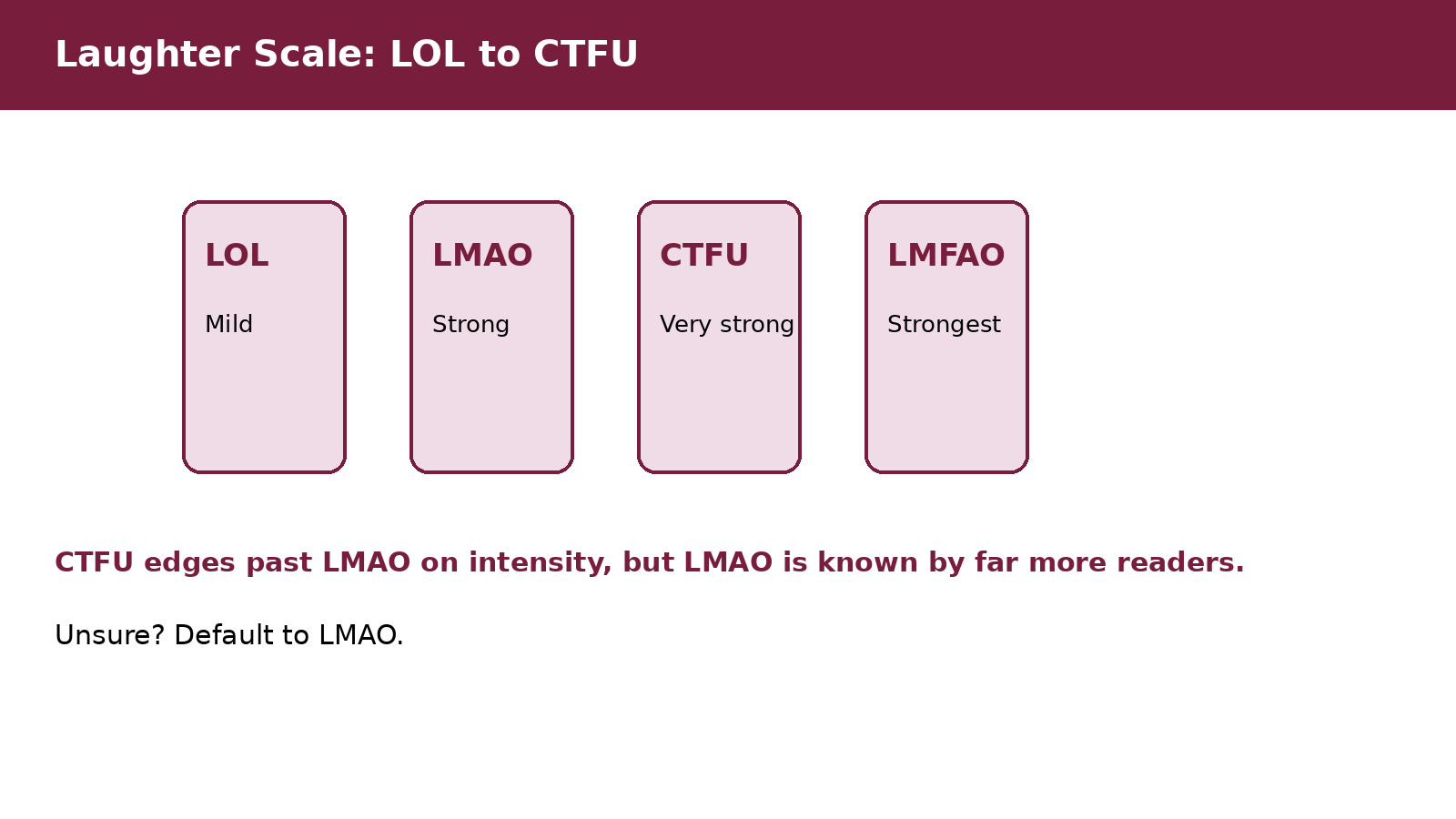
Two patterns stand out. First, the scale is not just about how hard you laughed, it is about how much profanity and how much current slang you are willing to use. Second, the top of the scale keeps changing. “I’m dead” and “I’m weak” now compete with CTFU and LMFAO for the strongest reaction, and they do it without a swear word in the main phrase, which makes them useful in chats where CTFU would feel too raw. If you want maximum emphasis with minimum profanity, those phrases are often the smarter pick.
When CTFU Wins and When LMAO Wins
CTFU wins when the laugh was sudden and the audience is close. A meme that caught you off guard, a friend’s voice note that made you snort in public, a plot twist in a group chat story: those moments fit CTFU because the term itself sounds like a burst. It also wins in TikTok and Instagram comments, where short, punchy reactions get more traction than long sentences, and where the audience already speaks meme slang.
LMAO wins almost everywhere else. It wins in mixed-age group chats, where someone’s parent might be reading. It wins when you are teasing a friend and want the tease to feel affectionate rather than chaotic. It wins when you are replying quickly and do not want to stop and think about whether the reader knows the term. And it wins as a default: if you are not sure, LMAO is the choice that is least likely to confuse or offend.
A simple decision rule
Ask yourself two questions. First, does everyone reading this know CTFU? Second, would anyone reading this mind the hidden swear word? If the answer to the first is yes and the second is no, CTFU is fine and will probably land harder. If either answer is uncertain, use LMAO. That rule takes two seconds and prevents most of the awkwardness around this pair.
Who Says Each One, Where, and to Whom
| Term | Who says it most | Where | To whom |
|---|---|---|---|
| CTFU | Younger users, meme fans | TikTok, Discord, Instagram comments | Close friends, followers who get the joke |
| LMAO | A wide age range | Texting, group chats, social media | Friends, family, coworkers in casual chats |
Platform matters as much as age. TikTok comments reward the newest, punchiest reaction, so CTFU feels at home there. Instagram captions and group chats are more mixed, so LMAO fits a wider audience there. Snapchat and Discord sit in between, depending on how close the friend group is.
For more slang that shows up in the same chats, see our guides to what CTFU means in text, what chat means in slang, what cringe means in slang, and what cool means in slang. They cover the terms that sit next to CTFU and LMAO in real conversations.
CTFU vs LMAO in Real Chats
Examples show the difference better than definitions do. Read each pair and notice how the same laugh changes when you swap the term.
- Friend: “I waved at someone who was waving at the person behind me.” You: “CTFU, no way, I would have died.” That reaction is loud, immediate, and it matches a story told between close friends.
- Friend: “I waved at someone who was waving at the person behind me.” You: “LMAO, that is the worst feeling.” That reaction is warm, widely understood, and it does not add extra edge to an already embarrassing story.
- Group chat meme: “The cat knocked over the whole setup mid-call.” Comment: “CTFU, the cat had zero remorse.” That comment is punchy and fits meme-thread culture.
- Group chat meme: “The cat knocked over the whole setup mid-call.” Comment: “LMAO, the cat is unbothered.” That comment is clear, funny, and safe for a mixed group.
- Teasing a friend: “You really thought that was a good idea? LMAO.” That tease reads as playful.
- Teasing a friend: “You really thought that was a good idea? CTFU.” That tease reads as louder and a little more chaotic, so it fits better with a friend who already jokes that way.
The lesson is not that one term is always better. It is that the same laugh can be framed as a burst or as a warm reaction, and the frame changes how the message lands.
What to Reply When Someone Sends CTFU or LMAO
If someone sends CTFU, they are telling you your joke landed hard. You do not need to match their exact term. A laughing emoji, “I know, right?”, or a follow-up detail keeps the conversation going. If someone sends LMAO, the same replies work, because both terms are invitations to keep laughing, not tests of your slang knowledge.
If you do not know what CTFU means and someone sends it to you, there is no shame in asking, and a quick “Wait, what does that mean?” is better than guessing. Most friends will explain it in one line, and you will know it next time.
When NOT to Use CTFU
Do not use CTFU at work, in school assignments, in messages to teachers or managers, or with people who dislike profanity. Do not use it in public comments on brand pages, in formal emails, or in any message that could be screenshotted and shared out of context. The hidden swear word is still a swear word, even when it is abbreviated.
LMAO has softer limits, but it still has limits. Avoid it in formal emails, job applications, and academic writing, where plain language fits better. In casual chats, though, LMAO is one of the safest strong reactions you can pick, which is why it has lasted so long while edgier terms come and go.
Myths vs Facts About CTFU and LMAO
| Myth | Fact |
|---|---|
| CTFU means someone is angry | CTFU means intense laughter, not anger, unless the surrounding message clearly changes the tone |
| LMAO is literal | Almost no one is literally laughing their body part off; it is a tone marker for strong amusement |
| Using CTFU makes you sound funnier | Using the right term for the audience makes you sound funnier; a stronger term in the wrong chat can sound forced |
| LOL, LMAO, and CTFU are interchangeable | They sit at different points on the intensity scale, and swapping them changes the feeling of the message |
Frequently Asked Questions About CTFU vs LMAO
What is the difference between CTFU and LMAO?
CTFU means “cracking the f*** up” and LMAO means “laughing my ass off.” CTFU is usually stronger and edgier, while LMAO is more widely known and safer in mixed chats. Both signal strong laughter, not a literal physical action.
Is CTFU stronger than LMAO?
Yes, in most uses. CTFU points to a sudden, hard-to-stop laugh, while LMAO covers a broader range of strong laughs. The gap is not huge, and some groups use them interchangeably, but CTFU generally sits higher on the intensity scale.
Is CTFU offensive?
CTFU can feel offensive in formal or professional settings because it hides a swear word, even though the word is abbreviated. In close-friend chats and meme threads, it usually reads as playful emphasis. Context decides whether it is offensive, not the letters alone.
Can CTFU mean something other than laughter?
Rarely, yes. Some people use CTFU for “cheer the f*** up” when encouraging a sad friend, and a few use “cut the f*** up” in specific contexts. In most online chats, though, the laughter meaning is the default, and the surrounding message usually makes the rare meanings clear.
Which one should I use on TikTok?
On TikTok, CTFU fits the fast, punchy comment culture, especially when the audience already uses meme slang. LMAO also works and is safer if your comment could be seen by a wider, mixed audience. Choose CTFU for close meme communities and LMAO for broader posts.
Which one should I use with family?
With family, LMAO is usually the better choice, because it is widely understood and less likely to sound rude. Use CTFU only with family members who already use slang that way and who will not mind the hidden swear word.
Is LMAO outdated?
No. LMAO is still widely used, even though newer phrases like “I’m dead” and “I’m weak” are also popular. Its long history is an advantage: it is recognized across ages, while newer or edgier terms can confuse readers who do not follow meme slang closely.
Sources and Further Reading
- MeanTextz – What Does CTFU Mean?
- CTFU Meaning – CTFU Meaning in Text: What Does CTFU Mean?
- Slangiify: CTFU Meaning Slang – Cracking the F*** Up
Final Answer: CTFU vs LMAO, Which One Should You Use?
The final answer to CTFU vs LMAO is simple once you stop treating it as a trivia question and start treating it as a tone choice. CTFU is the louder, edgier burst for close friends and meme threads. LMAO is the strong, widely understood reaction for almost every other casual chat. Know both, use both, pick CTFU when the laugh and the audience both fit it, and default to LMAO when you are unsure. That habit will make your messages land the way you meant them, with no confused replies and no accidental rudeness.