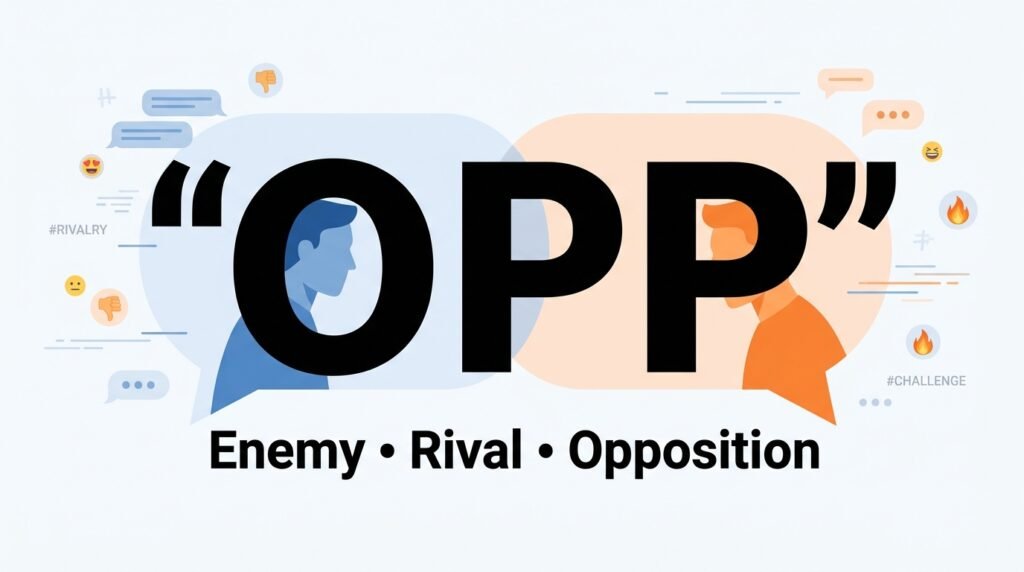

In slang, “opp” means an enemy, rival, opponent, or someone considered to be against you. It comes from the idea of “opposition” and is especially common in hip-hop, texting, memes, and social-media conversations. The plural form is “opps.”
The strength of the word depends heavily on context. In rap or street-related conversations, an opp may be a genuine adversary. In everyday internet slang, however, people often exaggerate for humor and call anything from an annoying classmate to a malfunctioning alarm clock their “opp.”
| Quick Answer | Meaning |
|---|---|
| Most common meaning | Enemy, rival, opponent, or opposition |
| Plural | Opps |
| Typical contexts | Texting, social media, hip-hop, memes, gaming |
| Tone | Serious, hostile, competitive, or joking |
| Formality | Very informal slang |
| Pronunciation | “Op,” one syllable |
| Offensive? | Not inherently, but it can sound confrontational |
| Key context clue | Whether the rivalry is real or exaggerated for humor |
What Does Opp Mean in Slang?
An opp is basically a person who is on the other side of a rivalry or conflict.
For example:
“I don’t mess with him anymore. He’s an opp.”
Here, the speaker is saying the other person is now considered an enemy, rival, or someone outside their circle.
The word can describe different levels of opposition. Someone might call a serious rival an opp, but people also use it casually for a friend they are temporarily arguing with.
A playful example would be:
“My brother ate the last slice of pizza. He’s officially an opp.”
Nobody necessarily believes the brother is an actual enemy. The exaggerated wording creates the joke.
That difference between literal rivalry and humorous exaggeration is one of the most important things to understand about modern “opp” usage.
Quick Meaning of Opp by Context
| Context | Likely Meaning | Example | Usage Level |
|---|---|---|---|
| Texting | Enemy or person you’re against | “She’s an opp now.” | Common |
| TikTok and memes | Rival, hater, or joking enemy | “My alarm is my biggest opp.” | Common |
| Hip-hop / rap | Enemy or serious rival | “He’s talking about his opps.” | Very common |
| Gaming | Opponent or opposing player/team | “Watch the opp on the left.” | Context-dependent |
| School / friend groups | Rival or someone disliked | “Why are you hanging with the opps?” | Informal |
| Workplace joke | Person or thing causing trouble | “This printer is my opp today.” | Playful |
Does Opp Mean Enemy or Opponent?
It can mean both, but “enemy” usually captures the slang tone better.
The literal idea behind the word is an opponent or opposition. In actual conversations, however, an opp often feels stronger than simply saying “competitor.”
Consider the difference:
“They’re our opponents tonight.”
This could simply describe another basketball team.
“They’re the opps.”
This sounds more personal, hostile, street-influenced, or intentionally dramatic.
So while opponent helps explain the word’s basic meaning, enemy, rival, or adversary often better communicates how it functions as slang.
What Does Opp Mean in Text Messages?
In texting, opp normally means someone the speaker dislikes, distrusts, competes with, or considers to be against them.
For example:
A: Why didn’t you invite Jay?
B: Bro’s an opp now.
The exact seriousness cannot be determined from the word alone. They may have had a genuine falling-out, or the speaker could be exaggerating something minor.
Emojis can provide useful clues.
“You’re an opp 😂” often sounds playful.
“He’s an opp. Don’t tell him anything.” sounds much more serious.
That is why surrounding language matters more than simply spotting the word.
What Does Opp Mean on TikTok, Instagram, and Other Social Media?
Across TikTok, Instagram, X, Discord, and similar social platforms, opp generally keeps the same basic meaning: an enemy, rival, hater, or person on the opposing side.
The biggest difference online is not the definition but the tone.
Social-media users frequently turn the word into exaggerated humor.
For instance:
“The mosquito in my room is my biggest opp.”
The mosquito obviously is not an opponent in the traditional sense. Calling it an opp humorously treats an everyday annoyance like a serious rivalry.
You might see the same pattern with:
- A difficult teacher
- A sibling
- An alarm clock
- A rival sports team
- A video-game character
- Bad Wi-Fi
- Someone who keeps disagreeing in the comments
This playful expansion has helped “opp” move beyond its more serious hip-hop and street-related associations.
What Does Opp Mean in Rap?
In rap and especially drill-related language, opps traditionally refers to enemies or members of an opposing group.
This context can be much more serious than casual TikTok jokes. Lyrics involving “opps” may describe genuine feuds, neighborhood rivalries, interpersonal conflicts, or fictionalized confrontations.
The term became particularly visible through hip-hop and was strongly associated with Chicago drill during the early 2010s before spreading much more widely through music and internet culture.
Because of that history, interpreting every rap use as merely “someone I don’t like” can erase some of the word’s original intensity.
The surrounding song, artist, conflict, and cultural context matter.
Also Read: Ohio Slang Meaning: What Does “Ohio” Mean Online?
How Context Changes the Meaning of Opp
“Opp” has one central idea—someone or something positioned against you—but its emotional weight can change dramatically.
Serious Rivalry
“Don’t give him our location. He’s an opp.”
Here, the speaker appears to consider the person a genuine adversary.
Personal Conflict
“We used to be cool, but she’s an opp now.”
This may describe a friendship that ended badly.
Competition
“They’re the opps in tonight’s match.”
Here, “opps” may simply mean opponents.
Playful Insult
“You finished my fries? You’re an opp.”
The exaggerated enemy language creates humor.
Meme Usage
“Monday mornings are the opps.”
No actual person is involved. The speaker jokingly personifies something unpleasant as an enemy.
This flexibility explains why reading only the dictionary-style definition is not always enough.
Tone and Emotional Meaning of “Opp”
The literal meaning stays fairly stable, but the emotional meaning changes with delivery.
Hostile:
Calling a person an opp during a genuine conflict can communicate distrust or hostility.
Competitive:
In sports or gaming, the word may simply describe the opposing side.
Playful:
Friends sometimes call each other opps after minor disagreements.
Sarcastic:
Someone may label an everyday inconvenience an “opp” to make the problem sound absurdly serious.
Dismissive:
Calling someone an opp can also signal that the speaker no longer views that person as part of their social circle.
So “opp” does not automatically indicate actual danger or hatred. Context determines how seriously it should be interpreted.
Real Conversation Examples
1. Friends
“You watched the new episode without me? You’re an opp.”
This is clearly exaggerated and playful.
2. Friendship Conflict
“I stopped telling her anything. She’s been moving like an opp lately.”
Here, “opp” suggests distrust.
3. Social Media
“Every time I post, the same opp is in my comments.”
The speaker considers the commenter a hater or recurring rival.
4. Gaming
“There’s an opp behind that wall.”
Depending on the game or group, “opp” may simply mean an enemy player.
5. School
“Why are you sitting with the opps?”
This can jokingly or seriously refer to another social group.
6. Everyday Humor
“My Wi-Fi cut out during the game. The router is officially an opp.”
The word is being applied to an object for comic effect.
Is Opp an Acronym or a Slang Word?
In its modern enemy/rival sense, opp is best understood as a shortened slang form connected to “opposition” or “opponent,” rather than an acronym whose individual letters each represent separate words.
It normally functions as a noun:
“He’s an opp.”
The plural is:
“They’re opps.”
It is commonly written lowercase:
opp / opps
Capitalization does not normally change the slang meaning, although writing OPP can create confusion with unrelated acronyms.
Opp vs. Opps
The difference is simply singular versus plural.
Opp: one enemy or rival
Opps: multiple enemies or rivals
Examples:
“He’s my opp.”
“Those guys are his opps.”
You’ll often encounter opps more frequently because speakers commonly refer to an opposing group collectively.
Don’t Confuse Opp With OP
Opp and OP look similar online but usually mean different things.
| Term | Meaning | Main Difference | Typical Context |
|---|---|---|---|
| opp | Enemy, rival, opposition | Slang for someone against you | Rap, texting, social media |
| opps | Multiple enemies or rivals | Plural of opp | Same contexts |
| OP | Original poster | Person who created a post or thread | Forums and social media |
| opponent | Person or team you compete against | Standard English, more neutral | Sports, games, debates |
| rival | Someone competing against you | Doesn’t necessarily imply hostility | Sports, business, relationships |
For example:
“OP explained the situation.”
means the person who originally posted something.
“The guy is an opp.”
means the speaker considers him an enemy or rival.
Adding that second p makes a major difference online.
Who Uses the Term “Opp”?
“Opp” is strongly associated with hip-hop and Black American popular language, particularly the development and spread of drill-related vocabulary. Its modern popularity expanded well beyond those original cultural contexts through music, memes, gaming, and social media.
Today, someone using “opp” does not necessarily belong to a particular community or age group.
It can appear among:
- Hip-hop and drill listeners
- Social-media users
- Gamers
- Teen and young-adult conversations
- Meme communities
- Casual friend groups
It is therefore misleading to treat “opp” as simply a newly invented TikTok or Gen Z word. Its wider internet visibility is newer than its roots in hip-hop culture.
Also Read: Chud Meaning Slang: What Does “Chud” Mean?
Also Read: What Does Torta Mean in Slang, Texts, and Spanish?
Where Did the Slang “Opp” Come From?
The exact first appearance of slang is difficult to establish with certainty, but the modern usage of opp/opps developed through hip-hop language and became especially prominent through Chicago drill culture in the early 2010s. It later spread far beyond that setting.
As the word entered broader internet culture, its meaning softened in many situations.
Originally serious language describing opposition can now appear in sentences such as:
“My cat knocked my drink over. He’s my opp.”
That evolution is useful because it explains why two people can use exactly the same word with completely different levels of seriousness.
Is “Opp” Offensive or Rude?
Opp is not inherently a slur or profanity.
However, calling a real person an opp can sound confrontational because you are identifying them as an enemy, adversary, or someone you distrust.
Whether it is inappropriate depends on the situation.
Among close friends, “You’re an opp for eating my snacks” may be harmless joking.
During an actual dispute, “He’s an opp” may communicate genuine hostility.
In professional communication, the term is usually unsuitable because it is highly informal and can make ordinary disagreement sound unnecessarily personal.
For formal writing, use words such as:
- Opponent
- Rival
- Competitor
- Adversary
- Opposition
Choose the word that accurately reflects the relationship.
How Should You Reply If Someone Calls You an Opp?
Your response should match the tone.
If the person is clearly joking, you could say:
“Since when did I become the opp? 😂”
If you’re unsure:
“What do you mean by opp?”
If the conversation sounds serious:
“I’m not looking for any conflict.”
Avoid assuming the term is a joke when the surrounding conversation includes threats, real-world disputes, or references to serious rivalries.
Likewise, don’t assume every casual “opp” comment represents a genuine feud. Online humor often deliberately exaggerates small disagreements.
Real-World Interpretation: “Opp” Describes a Relationship, Not a Personality
A useful way to understand “opp” is to remember that it usually describes someone’s position relative to the speaker rather than a permanent type of person.
Someone is not automatically “an opp” because they are mean, annoying, or unpopular.
They become the speaker’s “opp” because the speaker perceives them as being on the opposing side.
That explains phrases such as:
“We’re cool now. He’s not an opp anymore.”
The person’s identity did not change. The relationship did.
It also explains why “opp” works so well in jokes. People can temporarily frame almost anyone—or anything—as being “against” them.
FAQs
What does opp mean in slang?
“Opp” means an enemy, rival, opponent, or person considered part of the opposition. It is commonly used in hip-hop, social media, texting, gaming, and memes. The plural is “opps.” Its tone can range from genuinely hostile to completely playful depending on the conversation.
What does opp mean in a text from a guy?
It usually means the same thing regardless of the speaker’s gender: enemy, rival, hater, or someone they consider to be against them. Look at the surrounding message to determine whether the speaker is describing serious conflict or joking about a minor disagreement.
What does opp mean on TikTok?
On TikTok, an opp is generally an enemy, rival, hater, or opposing person. Users also apply the term jokingly to friends, parents, fictional characters, objects, and everyday annoyances, so a TikTok use may be far less serious than the word’s traditional street or rap context.
Does opp mean opponent?
Yes. “Opponent” can help explain the slang meaning, although “opp” often carries a stronger sense of enemy, rival, or opposition than the neutral word “opponent.” In a gaming or sports context, however, it may be used more literally for whoever someone is competing against.
Is opp a bad word?
No. “Opp” is not inherently profanity or a slur. It can still sound disrespectful or hostile when directed at a real person because it labels them as an enemy or rival. Among friends, it may instead be used as harmless exaggerated slang.
What is the difference between opp and OP?
Opp means an enemy or rival. OP commonly means “original poster” in online discussions—the person who started the post or thread. Because the terms differ by only one letter, readers unfamiliar with internet slang sometimes confuse them.
Why do rappers say “opps”?
In hip-hop and drill contexts, “opps” refers to enemies, rivals, or people associated with the opposing side of a conflict. The term became especially prominent through drill culture before spreading into mainstream internet slang, where it can now have much lighter and more humorous meanings.
Can you jokingly call someone an opp?
Yes. Modern casual usage frequently treats “opp” humorously. A friend who steals your fries, beats you at a game, or disagrees with your movie choice might jokingly become “the opp.” Tone, emojis, and the relationship between speakers usually reveal whether the word is playful or serious.
Conclusion
The slang “opp” means an enemy, rival, opponent, or someone perceived as being on the opposing side. Its plural form is “opps.” Although the word has strong roots in hip-hop and drill-related language, its modern use extends into texting, TikTok, memes, gaming, and everyday jokes.
Context is the key to interpreting it correctly. Calling someone an opp may describe genuine hostility, but it can just as easily exaggerate a tiny disagreement for humor. Look at the surrounding words, relationship between the speakers, topic, and tone before deciding how seriously the word is being used.



Pingback: Bougie Slang Meaning: What It Means and How to Use It
Pingback: OP Meaning Slang: What Does OP Mean in Text and Gaming?