
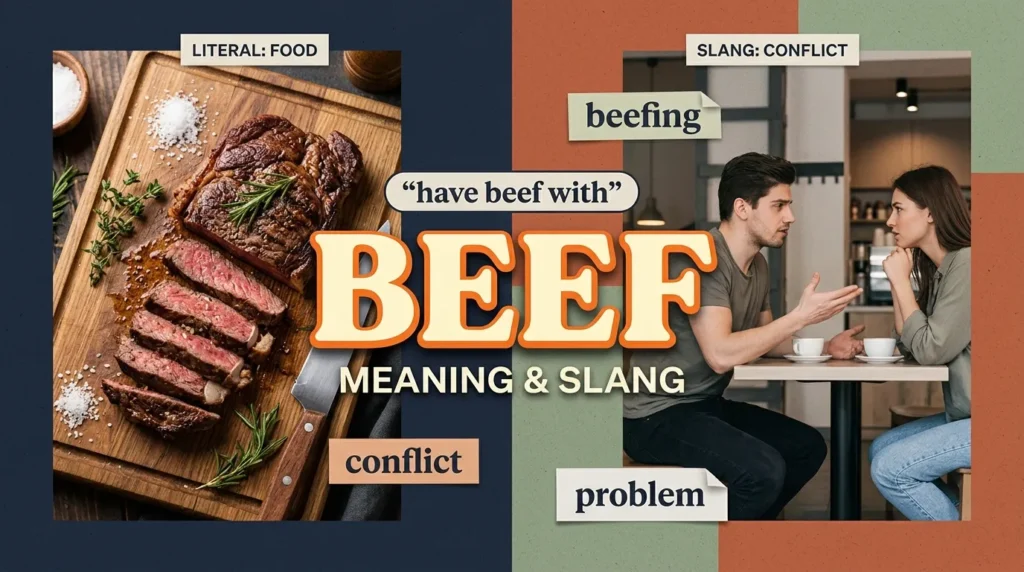

In slang, “beef” usually means a problem, argument, disagreement, or ongoing conflict between people or groups. If someone says, “They have beef,” they mean the people involved are not getting along. The word can describe anything from a minor personal disagreement to a highly public feud.
The meaning depends on context. “Beef” can be a noun or a verb: someone can have beef with another person, or they can beef with someone. In casual conversation, texting, social media, music, and internet culture, it often refers to interpersonal drama or a public dispute rather than physical fighting.
Quick-Answer Box
| Question | Answer |
|---|---|
| Most common slang meaning | A disagreement, conflict, or grudge |
| “Have beef with” | Have a problem or issue with someone |
| “Beef with someone” | Argue or have ongoing conflict with them |
| Tone | Casual, informal |
| Typical contexts | Texting, social media, music, gaming, everyday conversation |
| Can it be serious? | Yes; context can range from minor drama to serious conflict |
| Is it vulgar? | No, but it is informal |
| Literal meaning | Meat from cattle; unrelated to the slang meaning in most casual contexts |
What Does “Beef” Mean in Slang?
The most common slang meaning of beef is a disagreement, conflict, grudge, or personal problem between people.
For example:
“Why does Sarah have beef with Mike?”
This means:
“Why does Sarah have a problem with Mike?”
Likewise:
“Those two have been beefing all week.”
This means they have been arguing or dealing with some kind of ongoing conflict.
The expression can describe a private disagreement, an argument between friends, rivalry between groups, or a public dispute between celebrities, musicians, influencers, or other public figures.
“Beef” as a Noun
As a noun, beef refers to the conflict itself.
Examples:
- “I don’t know what their beef is.”
- “They’ve had beef for years.”
- “There is some serious beef between those teams.”
- “What’s your beef with me?”
Here, beef essentially means problem, issue, disagreement, or conflict.
“Beef” as a Verb
Beef can also function as a verb in informal English.
Examples:
- “Why are you beefing with him?”
- “They’ve been beefing since last summer.”
- “She doesn’t beef with anyone.”
- “Those two are always beefing online.”
In these examples, beefing means arguing, fighting verbally, or being in conflict.
“Have Beef With Someone”
One of the most common expressions is “have beef with someone.”
It means:
to have a problem, disagreement, or grudge against someone.
For example:
“I don’t have any beef with her.”
This means:
“I don’t have a problem with her.”
Another example:
“He has beef with his former teammate.”
This indicates that some disagreement or unresolved issue exists between them.
“What’s Your Beef?”
When someone asks:
“What’s your beef?”
they are essentially asking:
“What’s your problem?” or “Why are you upset with me?”
Depending on tone, the question can sound:
- Curious
- Confrontational
- Playful
- Defensive
- Sarcastic
For example, a friend might jokingly say, “What’s your beef with pineapple?” after noticing that someone strongly dislikes it. In a serious argument, however, the same phrase can sound challenging.
Quick Meaning by Context
| Context | Likely Meaning | Example | Usage Level |
|---|---|---|---|
| Friends | Personal disagreement | “Do you two have beef?” | Very common |
| Texting | Problem with someone | “Why does he have beef with me?” | Very common |
| Social media | Public dispute or drama | “They’re beefing online.” | Common |
| Music | Rivalry or public feud | “The rappers have beef.” | Common |
| Gaming | Conflict or rivalry | “Why are those players beefing?” | Common |
| Sports | Rivalry or disagreement | “The teams have some beef.” | Common |
| Workplace | Informal reference to conflict | “They have beef.” | Context-dependent |
| Formal writing | Usually inappropriate | — | Uncommon |
| Literal English | Beef as meat | “We bought beef.” | Very common outside slang |
Other Meanings of “Beef”
The slang sense is the focus of this phrase, but beef has other established meanings in English. Context is important because the same spelling can refer to completely different things.
Beef as Meat
The ordinary literal meaning of beef is meat from cattle.
For example:
“We had beef tacos for dinner.”
There is no slang meaning in this sentence.
The surrounding words usually make the intended meaning obvious. Food-related words such as cook, eat, steak, burger, or meat strongly indicate the literal meaning.
Beef as a Complaint or Grievance
There is also a broader informal use of beef meaning a complaint, objection, or grievance.
For example:
“My biggest beef with the new system is how slow it is.”
Here, beef means complaint or criticism, rather than a personal feud.
This use is related to the slang idea of having a problem, but it does not necessarily involve two people fighting.
Also Read: Laced Meaning Slang: What It Means in Text and Everyday Use
Beef as a Public Feud
In entertainment and internet culture, beef often describes a public dispute between two people or groups.
For example:
“The two artists have been in a public beef for months.”
This can involve:
- Public accusations
- Diss tracks
- Social-media posts
- Interviews
- Arguments
- Rivalries
- Responses and counter-responses
A public beef is usually more visible than an ordinary personal disagreement.
What Does “Beef” Mean in Texting?
In texting, beef usually means a problem, disagreement, or conflict with another person.
Someone might text:
“Do you have beef with me?”
They are asking whether you have some kind of problem or disagreement with them.
Another person might write:
“I don’t know why she’s beefing with me.”
That means:
“I don’t know why she’s upset with me or having a problem with me.”
Texting often leaves out details, so beef can be intentionally vague. The speaker may know exactly what the conflict is without explaining it.
Common Texting Examples
Person A: “Why isn’t Jake talking to you?”
Person B: “We have some beef.”
Meaning: They have a disagreement or unresolved issue.
Another example:
“You still beefing with him?”
Meaning:
“Are you still having a problem with him?”
And:
“No beef, we’re good.”
Meaning:
“There is no problem between us.”
Beef Meaning on Social Media
On social media, beef often refers to visible drama or conflict between users, creators, celebrities, musicians, or communities.
For example:
“Those two creators are beefing again.”
This suggests that they are publicly arguing, criticizing each other, or otherwise involved in an ongoing dispute.
Social-media beef can be:
- Serious
- Performative
- Personal
- Promotional
- Humorous
- Exaggerated
- Short-lived
- Long-running
The word itself does not tell you how serious the conflict is.
That is an important distinction. Calling something “beef” does not automatically mean the people involved are enemies or that the dispute is dangerous.
Beef Meaning on TikTok
On TikTok, beef generally has the same basic slang meaning: a conflict, dispute, or drama between people.
You may see phrases such as:
- “TikTok beef”
- “They have beef”
- “Creator beef”
- “Beefing in the comments”
- “The beef is still going”
- “What’s the beef about?”
The platform does not create a completely separate dictionary meaning. Instead, its short-form video culture can make existing conflicts more visible.
A creator might respond to another person’s video, viewers might discuss the disagreement, and the situation can become known as “beef.”
Beef Meaning on Snapchat
On Snapchat, beef usually means having a problem or disagreement with someone.
For example:
“Why do you have beef with Alex?”
means:
“Why do you have a problem with Alex?”
Because Snapchat conversations are often informal and personal, beef can refer to anything from a small argument to a more serious falling-out.
There is no special Snapchat-only definition that changes the basic slang meaning.
Beef Meaning in Music
The word beef is especially associated with music culture, where it can describe a public rivalry or feud between artists.
A musical beef may involve:
- Diss tracks
- Lyrics aimed at another artist
- Interviews
- Social-media exchanges
- Public accusations
- Competitive responses
The phrase “rap beef” is particularly recognizable.
A beef in music can be part of artistic competition, personal conflict, or both. The word itself does not tell you whether the dispute is genuine, promotional, or exaggerated.
“Diss” vs. “Beef”
These terms are related but not identical.
A diss is generally an insult, criticism, or deliberate act of disrespect toward someone.
A beef is the broader conflict or feud.
So, a diss can be part of a beef, but the two words are not interchangeable in every situation.
Beef in Gaming
In gaming communities, beef can refer to a dispute between players, teams, creators, or communities.
For example:
“Those two streamers have beef.”
This means they have some kind of ongoing conflict.
A player might also say:
“I don’t have beef with that team.”
Meaning:
“I don’t have a problem with that team.”
Gaming use is generally informal and often overlaps with broader internet slang.
Beef in Sports
In sports, beef can describe a personal disagreement or rivalry between athletes, teams, coaches, or fan communities.
For example:
“The two players have some beef.”
This could mean they argued, criticized each other, or have an ongoing personal rivalry.
However, not every sports rivalry is a beef. A normal competitive rivalry can exist without personal hostility.
That distinction matters: rivalry can simply mean two sides regularly compete, while beef usually suggests some form of interpersonal tension or grievance.
Also Read: Sub Meaning Slang: What Does “Sub” Mean in Text and Online?
How Context Changes the Meaning of “Beef”
Context is one of the easiest ways to understand beef.
Look at the Words Around It
Compare:
“I bought some beef.”
This almost certainly refers to food.
Now compare:
“I have beef with him.”
This refers to conflict.
The preposition “with” is a particularly strong clue that the slang meaning is intended.
Look at the Topic
If people are discussing:
- Dinner
- Cooking
- Recipes
- Restaurants
- Meat
then beef probably has its literal meaning.
If they are discussing:
- Arguments
- Friends
- Celebrities
- Drama
- Social media
- Rivalries
then the slang meaning becomes much more likely.
Look at the Grammar
These constructions commonly signal the slang meaning:
- have beef with someone
- beef with someone
- beefing with someone
- what’s the beef?
- their beef
- some beef between them
For example:
“Why are you beefing with me?”
The -ing form clearly indicates the informal verb.
Look at the Tone
A speaker can use beef seriously or casually.
“They’ve had beef for years.”
sounds like a real, ongoing disagreement.
But:
“What’s your beef with pineapple?”
could simply be playful teasing.
The word does not determine the emotional intensity by itself.
Beef vs. Drama
Beef and drama overlap, but they are not exactly the same.
Beef usually points to a conflict or grievance between particular people or groups.
Drama is broader. It can include:
- Gossip
- Emotional situations
- Arguments
- Relationship problems
- Public controversy
- Social tension
For example:
“They have beef.”
suggests a conflict between them.
“There’s a lot of drama.”
could describe an entire complicated situation involving several people.
Beef vs. Feud
A feud usually sounds more serious or sustained than beef.
A feud may continue for a long time and involve repeated hostility.
Beef is more casual and flexible.
For example:
“They’ve got beef.”
sounds conversational.
“The families have been engaged in a feud for decades.”
sounds much more serious and formal.
Beef vs. Argument
An argument is usually a specific disagreement or confrontation.
Beef can describe an argument, but it can also describe a broader unresolved problem.
For example:
“We had an argument yesterday.”
describes a particular event.
“We have beef.”
suggests an ongoing problem or tension.
Beef vs. Grudge
A grudge is usually a lasting feeling of resentment toward someone.
Beef can involve a grudge, but it does not necessarily mean one person is secretly holding resentment.
Someone can have temporary beef with another person after an argument and later move on.
| Term | Basic Meaning | Main Difference |
|---|---|---|
| Beef | Conflict or problem | Casual and broad |
| Drama | Complicated social conflict | Broader than beef |
| Argument | Specific disagreement | Often describes one event |
| Feud | Ongoing serious conflict | Usually stronger and longer-lasting |
| Grudge | Lasting resentment | Focuses more on lingering feelings |
| Rivalry | Competition between sides | Does not necessarily involve personal conflict |
| Diss | Insult or criticism | Can be an action within a beef |
Tone and Emotional Meaning
The word beef is inherently informal, but its emotional tone depends on how it is used.
Friendly or Playful
Friends may use it jokingly:
“Bro, what’s your beef with my playlist?”
The speaker may not actually be angry.
Serious
It can describe genuine conflict:
“They’ve had beef since the argument last year.”
Here, the word suggests an unresolved problem.
Sarcastic
Someone might exaggerate a tiny disagreement:
“You didn’t save me a slice? We have beef now.”
The exaggerated use makes the conflict humorous.
Confrontational
When someone says:
“What’s your beef with me?”
they may genuinely be challenging the other person to explain their behavior.
Therefore, the phrase alone does not determine whether someone is joking or angry. Tone, relationship, and surrounding conversation matter.
Real Conversation Examples
Friends
A: “Are you still beefing with Tom?”
B: “Nah, we’re cool now.”
Meaning: They previously had a problem, but it has been resolved.
Texting
A: “Why did she unfollow you?”
B: “I think she has beef with me.”
Meaning: The speaker believes she has a problem with them.
Social Media
A: “Why are those creators posting about each other?”
B: “They’ve got some beef.”
Meaning: They appear to be involved in a public dispute.
Dating
A: “Why doesn’t your friend like your boyfriend?”
B: “They’ve had beef since college.”
Meaning: They have an old unresolved conflict.
Gaming
A: “Why won’t those two play together?”
B: “They have beef.”
Meaning: They have a personal disagreement.
Workplace
A: “Why don’t Mark and Dana work together anymore?”
B: “I heard they have some beef.”
Meaning: They apparently have an interpersonal problem.
This is casual workplace language, however, and would not be ideal for formal communication.
Also Read: Whip Car Slang: What “Whip” Means When Talking About Cars
Humor
A: “You put ketchup on that?”
B: “Yeah.”
A: “We have beef now.”
Here, beef is obviously being used jokingly.
How to Use “Beef” Naturally
The safest everyday constructions are straightforward.
“Have Beef With”
Use this when saying someone has a problem with another person.
“She has beef with him.”
“Beef With”
Use this as an informal verb.
“Why are you beefing with me?”
“Beefing”
Use it when describing an ongoing argument or conflict.
“They’re always beefing.”
“What’s the Beef?”
Use this to ask what the problem is.
“Okay, what’s the beef?”
This can sound casual or confrontational depending on tone.
“No Beef”
This can mean no problem, no hard feelings, or no conflict.
For example:
“No beef, man. We’re good.”
It is a casual way to indicate that a disagreement is not being held against someone.
Is “Beef” Offensive or Rude?
“Beef” itself is not generally a swear word, slur, or inherently offensive expression. It is informal slang.
However, it can sound rude or confrontational depending on how it is used.
For example:
“What’s your beef with me?”
can sound challenging.
By contrast:
“I don’t have any beef with her.”
is relatively neutral in casual conversation.
Is It Appropriate at Work?
Use caution.
You might hear coworkers casually say:
“I think they have beef.”
But in formal communication, terms such as disagreement, conflict, concern, or issue are usually clearer and more professional.
Instead of:
“What’s your beef with the manager?”
a professional alternative would be:
“Is there an issue with the manager?”
Is It Appropriate at School?
Among friends, it is generally understandable as casual slang.
For an assignment, formal presentation, or official communication, a more precise word such as conflict, disagreement, or dispute is usually better.
How to Reply When Someone Says “Do You Have Beef With Me?”
Your response depends on whether there actually is a problem.
If You Don’t Have a Problem
You can say:
“No, we’re good.”
or:
“Nah, no beef.”
If There Is a Small Issue
Try:
“Not really. I was just annoyed about what happened.”
This is clearer than escalating the slang.
If You Want to Discuss It
You could say:
“I don’t want beef. Let’s talk about what happened.”
This signals that you want to resolve the disagreement.
If They’re Being Confrontational
A calm response can prevent the situation from escalating:
“I don’t have a problem with you. If something seemed wrong, we can talk about it.”
The key is to match the tone rather than automatically responding aggressively.
Who Uses the Slang “Beef”?
Beef is widely recognizable in informal English and appears across different types of casual communication.
It can occur in:
- Everyday conversation
- Text messages
- Social media
- Music culture
- Gaming
- Sports discussions
- Online communities
- Entertainment commentary
Its use is especially natural when people are talking about interpersonal conflict in a casual way.
However, frequency and style can vary by age, community, region, and platform. It should not be treated as language used identically by every English-speaking group.
Origin and Evolution of the Slang Meaning
The slang history of beef is more complicated than simply saying that the word suddenly became slang for an argument.
The word has long had literal and figurative uses in English. The modern informal sense connected with a complaint, grievance, or conflict developed through earlier expressions involving having a problem or objection.
Over time, the expression became especially recognizable in popular music and urban speech, and later spread widely through television, entertainment, social media, and internet culture.
Today, “beef” is not restricted to one music genre or one community. It is broadly understood in informal English, although the exact style and frequency of use vary.
The important point is that modern users generally understand beef as a casual way of describing a conflict, especially when used in phrases such as “have beef with” or “beefing with.”
Why Does “Beef” Mean Conflict?
The slang meaning works as a figurative expression for a problem or grievance.
When someone says:
“I have beef with him,”
they are not talking about food. They are describing an unresolved issue between themselves and another person.
The expression became useful because it offers a short, informal way to refer to interpersonal tension without spelling out the entire disagreement.
That also explains why the word can cover a wide range of situations. A person might have beef over something trivial, or the conflict might be much more serious.
Real-World Interpretation
One useful way to understand beef is to think of it as a casual label for conflict rather than a precise description of the conflict itself.
If someone says, “They have beef,” you know there is some kind of problem, but you do not yet know:
- Who started it
- What caused it
- How serious it is
- Whether it is still happening
- Whether either person is actually angry
- Whether the situation is private or public
You need the surrounding conversation to determine those details.
That makes beef convenient in casual speech, but less precise than words such as argument, dispute, grievance, feud, or rivalry.
Common Mistakes With “Beef”
Assuming It Always Means a Serious Fight
It doesn’t.
Someone can jokingly say:
“I have beef with this restaurant.”
That may simply mean they dislike something about the restaurant.
Assuming Beef Always Means Physical Fighting
Usually, it refers to conflict or disagreement, not necessarily physical violence.
Context is essential before interpreting it as something more serious.
Treating “Beef” and “Rivalry” as Identical
A rivalry can be completely friendly and competitive.
Beef normally suggests that there is some kind of problem or tension.
Using It in Formal Writing
Although widely understood, beef is informal slang. Formal writing usually benefits from a more precise term.
Assuming “Beef” Has a Special Meaning on Every Platform
Most major social and messaging platforms do not give the word a fundamentally different definition.
TikTok beef, Snapchat beef, and texting beef generally point back to the same basic concept: conflict, drama, or a problem between people.
Frequently Asked Questions
What does “beef” mean in slang?
In slang, beef usually means a disagreement, conflict, grievance, or problem between people. For example, “They have beef” means they are experiencing some kind of interpersonal conflict. The word is informal and can describe anything from a minor disagreement to a public feud.
What does “have beef with someone” mean?
“Have beef with someone” means to have a problem, disagreement, or grudge against that person. For example, “Why does she have beef with him?” means “Why does she have a problem with him?” The phrase is casual and common in conversation and online communication.
What does “beefing with someone” mean?
“Beefing with someone” means arguing with them or being involved in a conflict with them. For example, “Why are you beefing with Jake?” means “Why are you having a problem or conflict with Jake?” It is an informal verb form.
Does “beef” mean drama?
It can. Beef and drama overlap, but beef usually focuses on a conflict between particular people or groups. Drama is broader and can include gossip, relationship problems, controversy, or complicated social situations that do not necessarily involve a direct feud.
Is “beef” a bad word?
No. Beef is not inherently a swear word or slur. In its slang sense, it is an informal term for conflict or disagreement. However, phrases such as “What’s your beef with me?” can sound confrontational depending on tone and circumstances.
Can “beef” mean a complaint?
Yes. In informal English, beef can mean a complaint, objection, or grievance. For example, “My beef with the app is that it crashes constantly” means “My main complaint about the app is that it crashes constantly.”
What does “no beef” mean?
“No beef” generally means there is no problem, conflict, or hard feeling. Someone might say, “No beef, we’re good,” to indicate that they are not holding a disagreement against another person.
Is “beef” appropriate at work?
It can appear in casual workplace conversation, but it is not ideal for formal workplace communication. If precision matters, use terms such as issue, disagreement, concern, conflict, or dispute instead.
Conclusion
The beef meaning slang most commonly refers to a problem, disagreement, grudge, or conflict between people. Expressions such as “have beef with someone,” “beefing with someone,” and “what’s your beef?” are informal ways to talk about interpersonal tension. The word can also describe public disputes in music, entertainment, gaming, sports, and social media.
Context determines how serious the situation is. Beef might describe a genuine long-term feud, a minor disagreement, or even a joke between friends. It is also different from related terms such as drama, rivalry, argument, and feud. For everyday casual English, however, the core idea is simple: if someone has “beef” with another person, they have some kind of problem with them.



Pingback: Flex Slang Meaning: What “Flex” Means in Text and Social Media -