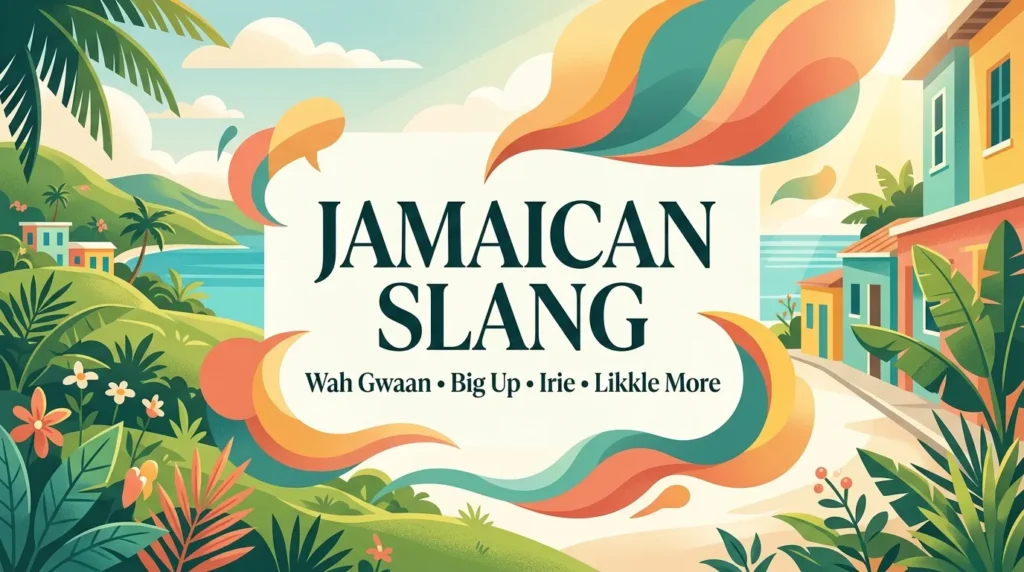

Jamaican slang refers to the informal words, expressions, and phrases commonly associated with Jamaican speech, especially Jamaican Patois, also called Patwa. Expressions such as “Wah gwaan?”, “Mi deh yah,” “big up,” “irie,” and “likkle more” can sound unfamiliar to English speakers, but their meanings become much easier to understand when you consider context, tone, and pronunciation.
One important distinction is that Jamaican Patois is more than a collection of slang words. It is a living English-lexified creole language with its own vocabulary, grammar, pronunciation, and patterns of expression. Jamaican slang can also spread beyond Jamaica through music, migration, entertainment, social media, and Caribbean communities, so a phrase heard online may not always reflect how every Jamaican would use it.
Quick Answer: Jamaican Slang at a Glance
| Category | Quick Answer |
|---|---|
| Common language variety | Jamaican Patois / Patwa |
| Most recognizable greeting | Wah gwaan? |
| Common response | Mi deh yah |
| Common goodbye | Likkle more |
| Respect/praise | Big up |
| Positive expression | Irie |
| Friend/brother | Bredren |
| Girl/woman | Gyal |
| Small/little | Likkle |
| Make | Mek |
| Look/pay attention | Pree |
| Formality | Mostly informal |
| Tone | Highly context-dependent |
| Best approach for learners | Understand the context before trying to imitate the expression |
What Is Jamaican Slang?
Jamaican slang is the informal vocabulary and expressive language associated with Jamaican communication. A large portion of what people casually call “Jamaican slang” comes from Jamaican Patois, or Patwa. That distinction matters because Patois is not simply English with a few unusual slang words added to it. It has developed as a distinct creole variety with its own linguistic structure.
For an English speaker, some Jamaican expressions may look like altered spellings of familiar English words. “Wah” relates to “what,” “mek” relates to “make,” “nuh” can mean “not” or “no,” and “mi” commonly corresponds to “I” or “me.” But translating every word individually does not always produce the natural English meaning.
For example, “Wah gwaan?” is literally built from words that may look unfamiliar, but in everyday conversation it functions naturally as a casual greeting meaning roughly “What’s going on?” or “How are you?”
That is why Jamaican slang is best learned through meaning + context + tone, rather than through vocabulary alone.
50+ Jamaican Slang Words and Phrases
The following list focuses on recognizable expressions that are useful for understanding Jamaican speech and informal conversations. Meanings can shift with context, speaker, region, and tone, so the English equivalents are practical approximations rather than word-for-word translations.
Wah Gwaan
Meaning: What’s going on? / How are you? / What’s happening?
Pronunciation: roughly “wah gwahn”
Example: “Wah gwaan, mi fren?”
This is one of the most recognizable Jamaican greetings. It is casual and conversational, so it works best in relaxed situations rather than formal introductions. Depending on the conversation, it can function almost like “What’s up?” in American English.
Mi Deh Yah
Meaning: I’m here / I’m doing okay / I’m getting by.
Pronunciation: roughly “mee deh yah”
This is commonly used as a response to a greeting such as “Wah gwaan?” The literal idea of being “here” can take on a broader conversational meaning: things are okay, you are getting along, or you are still doing fine.
Big Up
Meaning: Respect, praise, congratulations, or recognition.
Example: “Big up everybody who helped.”
“Big up” can be used to acknowledge someone’s effort, give praise, or show respect. It does not necessarily mean simply “hello.” The exact feeling depends on the situation.
Irie
Meaning: Good, peaceful, pleasant, or alright.
Example: “Everything irie.”
“Irie” is strongly associated with Jamaican culture and is often used to communicate a positive or peaceful state. It can describe how things are going rather than simply naming an emotion.
Likkle More
Meaning: See you later / until next time.
Example: “Mi haffi go now. Likkle more.”
This is a casual farewell. The expression suggests that the separation is temporary rather than a formal goodbye.
Walk Good
Meaning: Take care / travel safely / goodbye.
Example: “Walk good till mi see yuh again.”
Despite containing the familiar English word “walk,” the expression works as a warm farewell or good-wish. It can be especially natural when someone is leaving.
Bless Up
Meaning: Greetings, good wishes, respect, or farewell.
“Bless up” is flexible. Depending on the speaker and situation, it can function as a greeting, an expression of goodwill, or a way to acknowledge someone positively.
Respeck / Rispeck
Meaning: Respect, appreciation, or acknowledgment.
The spelling may vary in informal writing. It can be used when showing appreciation or giving someone recognition.
Nuff
Meaning: A lot, plenty, or many.
Example: “Nuff people were there.”
“Nuff” is a useful example of how Jamaican Patois can transform a familiar English expression into a form that carries its own rhythm and usage.
Nuff Love
Meaning: Lots of love / much affection / warm wishes.
It is commonly used as a friendly or affectionate expression, especially when sending good wishes to someone.
Mi Rate Yuh
Meaning: I respect you / I admire you / I think highly of you.
This phrase can communicate appreciation without necessarily being romantic. Context determines whether the feeling is friendly, respectful, or more personal.
Mi Love Yuh
Meaning: I love you.
The meaning is straightforward, but the relationship between the speakers determines whether it sounds romantic, familial, or deeply affectionate.
Yuh Good?
Meaning: Are you okay? / Are you good?
Example: “Yuh good? You look tired.”
This is a practical conversational expression for checking on someone.
Yow
Meaning: Hey! / Yo!
It can be used to get someone’s attention or greet someone informally. It is casual and should not be treated as a formal greeting.
Hail Up
Meaning: Greet, acknowledge, or show respect to someone.
Example: “Mi haffi hail up everybody.”
The phrase can communicate the idea of recognizing or greeting people, particularly in a friendly social setting.
Tek Care
Meaning: Take care.
Example: “Mi gone now. Tek care.”
This is a straightforward informal farewell and good-wish expression.
Tek Time
Meaning: Take your time / be careful / don’t rush.
The phrase can have slightly different practical meanings depending on context. If someone is driving on a difficult road, for example, it may function more like “be careful” than simply “don’t hurry.”
Soon Come
Meaning: I’ll come soon / I’ll be back / I’ll get to it shortly.
Example: “Wait deh, mi soon come.”
The important thing to understand is that “soon” does not necessarily function as an exact promise of immediate arrival. Context and tone matter.
One Love
Meaning: Good wishes, peace, or goodbye.
“One Love” is widely associated with Jamaican culture and can function as a friendly farewell or expression of goodwill.
Bredren
Meaning: Brother, male friend, close friend.
The word does not necessarily refer to a biological brother. In casual usage, it can describe a male friend or someone treated like a brother.
Sistren
Meaning: Sister or female friend.
Like “bredren,” it can refer to a close female friend rather than a biological sibling.
Gyal
Meaning: Girl or young woman.
This is a familiar Jamaican Patois form corresponding to “girl.” Context matters because it can be neutral, affectionate, descriptive, or objectifying depending on how someone says it.
Also Read: ISO Meaning Slang: What ISO Means in Text & Online
Bwoy
Meaning: Boy, young man, or male person.
It can be used casually and may appear in expressions directed toward a male friend or acquaintance.
Mon
Meaning: Man.
“Mon” is especially recognizable to people familiar with Jamaican speech and popular culture. It does not always carry the exact same function as standard English “man,” so context remains important.
Yah
Meaning: Here / this place, depending on context.
It appears inside several common expressions and can contribute to a phrase whose overall meaning is different from the literal meaning of each individual word.
Wah
Meaning: What.
“Wah” appears in numerous questions and expressions, including “Wah gwaan?” and other everyday phrases.
Nuh
Meaning: No / not / don’t, depending on construction.
“Nuh” is particularly important because it does not map neatly onto one English word in every sentence. Its grammatical function depends on the surrounding phrase.
Mek
Meaning: Make / let / cause, depending on context.
Example: “Mek we go.”
A learner should avoid assuming that every appearance of “mek” translates directly to the English verb “make.”
Pree
Meaning: Look at, watch, examine, pay attention to, or consider.
Example: “Pree dis.”
The expression can be used when asking someone to look closely at something or pay attention.
Fi
Meaning: To / for / of, depending on context.
“Fi” is an especially useful word for learners because its meaning changes according to grammatical construction.
Yuh
Meaning: You / your, depending on context.
It is one of the common forms learners encounter in Jamaican Patois writing.
Mi
Meaning: I / me / my, depending on context.
The exact English equivalent depends on how it functions in the sentence.
Ting
Meaning: Thing, matter, situation, or sometimes a person in informal usage.
Example: “Certain ting.”
It is often more flexible than the English word “thing” when used in informal expressions.
Everyting Criss
Meaning: Everything is fine / everything is good.
It is commonly used as a positive response when discussing how things are going.
Wah Yuh A Seh?
Meaning: What are you saying? / What’s going on?
Depending on context, this can be a greeting or a genuine question about what someone is saying.
Wah Yuh Deh Pon?
Meaning: What are you doing? / What are you up to?
This is a casual way to ask about someone’s current activity or plans.
Mawnin
Meaning: Good morning.
This is a natural informal morning greeting. It is an example of how familiar English expressions can appear in Jamaican Patois spelling and pronunciation.
How Yuh Stay?
Meaning: How are you doing?
It functions as a casual check-in and is one of several ways a Jamaican speaker may ask how someone is doing.
Mi Good
Meaning: I’m good / I’m okay.
A simple response to questions about how someone is doing.
Yah Mon
Meaning: Yes, man / yes / definitely.
This expression is strongly associated with Jamaican speech in popular culture. However, learners should avoid turning it into a caricature or using it after every sentence.
Small Up Yuhself
Meaning: Move over / make some room.
Despite sometimes being interpreted online as “calm down,” the expression can have a more literal social meaning: make room for another person.
Bun Out
Meaning: Very tired or exhausted.
The expression can describe someone who has become worn out, particularly after exertion.
Chaka Chaka
Meaning: Messy, untidy, or disorganized, depending on usage.
The phrase is useful because it shows how Jamaican informal vocabulary can describe a general quality rather than a single physical object.
Savvy
Meaning: Understand / know what someone means.
Example: “Yuh savvy?”
In context, this can be similar to asking, “Do you understand?”
Yard
Meaning: Home / one’s house or home area.
“Yard” can carry a broader sense than the standard English word. In Jamaican usage, it may refer to home or the familiar home environment.
Pickney
Meaning: Child.
The word is used in Jamaican and other Caribbean varieties of English and creole speech.
Also Read: Drip Meaning Slang: What Does “Drip” Mean?
Nyam
Meaning: Eat.
Example: “Time fi nyam.”
It is an expressive everyday word that appears in Jamaican Patois vocabulary.
Fambily
Meaning: Family.
This spelling reflects informal pronunciation rather than standard written English.
Bad
Meaning: Excellent, impressive, attractive, or genuinely “good,” depending on context.
This is an important example of why literal translation can fail. A word that normally carries a negative meaning in standard English can have a positive meaning in Jamaican informal speech.
Wicked
Meaning: Excellent, impressive, intense, or very good in some contexts.
Like “bad,” this illustrates the role of semantic reversal and context in slang.
Don
Meaning: A respected, influential, or powerful man; sometimes a crime-associated figure depending on context.
This is a context-sensitive term. It should not automatically be translated as “gangster,” because its meaning can vary significantly.
Gwaan
Meaning: Going / happening, depending on the expression.
It appears in phrases such as “Wah gwaan?” where the whole expression functions as a greeting.
Bless
Meaning: Good, blessed, fortunate, or well, depending on context.
It appears in several Jamaican expressions and often carries a positive or goodwill-oriented feeling.
Criss
Meaning: Good, fine, excellent, or in order.
For example, “Everything criss” communicates that things are going well.
Quick Jamaican Slang List by Category
| Jamaican Expression | Simple English Meaning | Typical Tone |
| Wah gwaan? | What’s going on? | Casual |
| Mi deh yah | I’m okay / I’m here | Relaxed |
| Big up | Respect / praise | Positive |
| Irie | Good / peaceful | Positive |
| Likkle more | See you later | Friendly |
| Walk good | Take care | Warm |
| Bless up | Good wishes / respect | Friendly |
| Tek care | Take care | Friendly |
| Bredren | Friend / brother | Familiar |
| Sistren | Friend / sister | Familiar |
| Gyal | Girl / young woman | Informal |
| Pree | Look / pay attention | Casual |
| Mek | Make / let | Informal |
| Nuh | No / not / don’t | Informal |
| Fi | To / for / of | Grammatical |
| Yuh | You / your | Informal |
| Mi | I / me / my | Informal |
| Ting | Thing / matter | Informal |
| Nyam | Eat | Informal |
| Yard | Home | Informal |
| Pickney | Child | Informal |
| Wah | What | Informal |
| Soon come | Coming back soon | Casual |
| Tek time | Take your time / be careful | Friendly |
| Respeck | Respect | Positive |
| Nuff | Lots / plenty | Informal |
Jamaican Slang for Greetings
Greetings are one of the easiest places to encounter Jamaican Patois because short expressions can carry a lot of social meaning.
Casual Greeting
“Wah gwaan?”
This is the classic casual check-in. Depending on the relationship, it can mean “What’s going on?”, “How are you?”, or simply “What’s up?”
A natural response can be:
“Mi deh yah.”
That communicates that you’re doing okay or getting along.
Morning Greeting
“Mawnin.”
This is a casual equivalent of “Good morning.”
Checking on Someone
“Yuh good?”
This can mean “Are you okay?” or “Everything good?”
Showing Respect
“Big up.”
Use it to acknowledge someone positively, give praise, or express respect.
Jamaican Slang for Saying Goodbye
Jamaican speech has several informal ways to end a conversation.
Likkle more — See you later.
Walk good — Take care or travel safely.
Tek care — Take care.
One love — A warm goodbye or expression of goodwill.
Mi gone — I’m leaving / I’m gone.
The important point is that these expressions are not interchangeable in every situation. “Walk good” has a stronger good-wish feeling, while “likkle more” suggests seeing the person again later.
Jamaican Slang for Friends and Relationships
Jamaican informal speech has many ways to communicate familiarity and affection without sounding overly formal.
Bredren can refer to a male friend or someone regarded as a brother.
Sistren can refer to a female friend or someone regarded as a sister.
Mi rate yuh communicates respect or admiration.
Mi love yuh communicates love and affection.
Nuff love sends warm wishes or affection.
The relationship matters. A phrase that sounds affectionate between close friends may sound flirtatious or overly familiar when directed at a stranger.
Also Read: Cap Slang Meaning: What “Cap” and “No Cap” Really Mean
Jamaican Slang on Social Media and in Texting
Jamaican Patois appears frequently in informal digital communication, including messages, comments, captions, music-related discussions, and social media. Short expressions such as “Wah gwaan,” “big up,” “bless up,” and “one love” are especially easy to carry into written online conversations.
Online writing also creates additional spelling variation. Because Patois is often written informally, you may see differences such as “wah” versus “waa,” “likkle” versus “likle,” or different representations of pronunciation.
That does not automatically mean one spelling is “wrong.” Informal digital language often reflects sound, personal preference, regional habits, and the writer’s audience.
At the same time, social media can exaggerate certain expressions. A phrase may become internationally recognizable through music, memes, or online culture without being something that every Jamaican speaker uses constantly.
This is one reason it is better to understand the language than to copy a list of “cool Jamaican words” mechanically.
How Context Changes Jamaican Slang Meaning
Context is particularly important because many Jamaican expressions do not have a perfect one-word English equivalent.
Consider “bad.”
In standard English, “bad” normally means something negative. In some Jamaican contexts, however, “bad” can communicate that someone or something is impressive, attractive, skilled, or excellent.
Tone also matters.
A phrase such as “Yow!” can be a friendly greeting, a way of getting attention, or an expression of surprise.
Likewise, “Wah yuh a seh?” can function as a casual greeting or a genuine question depending on the surrounding conversation.
When interpreting Jamaican slang, look at:
- The words immediately before and after it
- Whether the speakers are friends or strangers
- Whether the conversation is serious or playful
- The speaker’s tone
- Whether the phrase appears in music, a meme, or everyday conversation
- Whether the expression is being used literally or figuratively
The same principle applies to English slang, but it becomes especially important when you’re translating across language varieties.
Jamaican Slang Examples in Real Conversations
Friends Meeting
A: “Wah gwaan?”
B: “Mi deh yah. Yuh good?”
English:
A: “What’s up?”
B: “I’m doing okay. You good?”
This is a relaxed greeting exchange.
Someone Leaving
A: “Mi haffi go now.”
B: “Alright. Walk good.”
English:
A: “I have to go now.”
B: “Alright. Take care.”
Giving Someone Recognition
A: “Big up fi di hard work.”
English:
“Respect for the hard work.”
Here, “big up” communicates praise or recognition rather than a simple greeting.
Checking on a Friend
A: “Yuh good?”
B: “Yeah man, mi good.”
English:
A: “Are you okay?”
B: “Yeah, I’m good.”
Saying Goodbye
A: “Mi ago now.”
B: “Likkle more.”
English:
A: “I’m heading out now.”
B: “See you later.”
Asking Someone to Look
A: “Pree dis.”
B: “Yeah, mi see it.”
English:
A: “Look at this.”
B: “Yeah, I see it.”
Jamaican Patois vs. Jamaican Slang
These terms are related, but they are not identical.
Jamaican Patois refers to a broader language variety with its own vocabulary, pronunciation, and grammar.
Jamaican slang is a more informal label people commonly use for words and expressions associated with Jamaican speech.
That distinction is useful because calling every part of Patois “slang” can make the language seem like nothing more than a collection of trendy expressions. In reality, Jamaican Patois has a much broader linguistic structure.
For someone learning Jamaican speech, this means memorizing isolated slang words is only the beginning. Understanding how phrases work together is what makes the language easier to interpret naturally.
Is Jamaican Slang the Same Everywhere in Jamaica?
Not necessarily.
Jamaican speech can vary according to region, age, social setting, family background, personal style, and degree of formality. Some expressions may be widely recognizable, while others may be more localized, generational, or associated with particular communities.
There is also a difference between understanding an expression and naturally using it.
A visitor may recognize “Wah gwaan?” immediately but still sound unnatural if they use Jamaican expressions in every sentence or imitate pronunciation without understanding the surrounding grammar.
The safest approach for a learner is to start with widely understood expressions, listen to how native speakers use them, and avoid forcing slang into situations where standard English would be more natural.
Formal vs. Informal Jamaican Language
Most expressions commonly described as Jamaican slang are informal.
They can be appropriate among:
- Friends
- Family
- Casual acquaintances
- Informal online conversations
- Relaxed social situations
But that does not mean every slang expression is appropriate everywhere.
In a formal workplace, academic document, legal communication, or professional email, standard English may be more appropriate unless the context specifically calls for Jamaican Patois.
Even among friends, some words can be vulgar, insulting, sexual, or highly context-sensitive. Knowing a word’s literal translation is not enough to understand whether it is socially appropriate.
Also Read: Goyim Slang Meaning: What Does Goyim Mean?
Is Jamaican Slang Offensive?
Most Jamaican slang is not inherently offensive. Expressions such as “Wah gwaan,” “big up,” “irie,” “likkle more,” and “walk good” are generally informal or positive.
However, Jamaican speech also contains insults, profanity, sexually explicit expressions, and words whose meaning depends heavily on context. Some terms can also be connected to identity, social class, sexuality, or other sensitive subjects.
For non-Jamaican speakers, the safest rule is simple: understand before you imitate.
A phrase that appears harmless in a social-media list may have a stronger cultural or emotional meaning in actual conversation. If you’re unsure, use neutral expressions or ask a trusted speaker about the context.
Can Non-Jamaicans Use Jamaican Slang?
Yes, people outside Jamaica can learn and use Jamaican expressions, but respectful use matters.
The biggest mistake is treating Jamaican speech as an accent or costume. Avoid exaggerated pronunciation, fake accents, or inserting Jamaican expressions into every sentence simply to sound “Jamaican.”
Instead:
- Learn what the expression actually means.
- Understand whether it is casual, vulgar, affectionate, or respectful.
- Learn how it fits into a sentence.
- Pay attention to who normally uses it and in what situations.
- Use it naturally rather than excessively.
Learning a language variety can be a great way to appreciate another culture. The goal should be communication and understanding, not imitation for comedic effect.
Common Mistakes When Learning Jamaican Slang
Treating Patois as Randomly Spelled English
The spelling reflects pronunciation and linguistic patterns. It is not simply English with letters removed.
Translating Every Word Literally
A phrase may have a meaning that cannot be reconstructed word by word. “Wah gwaan?” is a good example.
Assuming One Translation Is Always Correct
Words such as “fi,” “nuh,” and “ting” can perform different functions depending on the sentence.
Using Famous Expressions Too Often
Internationally recognizable phrases are not necessarily used in every Jamaican conversation.
Confusing Internet Jamaican Slang With Everyday Speech
Social media can amplify unusual or highly specific expressions.
Ignoring Tone
A phrase can sound friendly, sarcastic, affectionate, or confrontational depending on delivery and relationship.
Assuming Every Jamaican Speaks the Same Way
Language varies. Jamaica has different communities, generations, speech styles, and levels of Patois usage.
Jamaican Slang vs. Standard English
| Jamaican Expression | Approximate Standard English |
| Wah gwaan? | What’s going on? / What’s up? |
| Mi deh yah | I’m okay / I’m doing fine |
| Likkle more | See you later |
| Walk good | Take care |
| Big up | Respect / well done |
| Tek care | Take care |
| Yuh good? | Are you okay? |
| Mi rate yuh | I respect/admire you |
| Nuff love | Lots of love |
| Pree dis | Look at this |
| Mek we go | Let’s go |
| Mi good | I’m good |
| Wah yuh a seh? | What are you saying? |
| Wah yuh deh pon? | What are you doing? |
| Mawnin | Good morning |
| Nyam | Eat |
| Pickney | Child |
| Bredren | Friend / brother |
| Gyal | Girl |
| Yard | Home |
These are practical translations, not rigid dictionary substitutions. The best English equivalent can change with the sentence and situation.
How to Reply to “Wah Gwaan?”
If someone sends you “Wah gwaan?”, a natural casual response could be:
“Mi deh yah. Yuh good?”
That is roughly:
“I’m doing okay. You good?”
You could also respond more simply with:
“Mi good.”
If you’re still learning Jamaican Patois, there is nothing wrong with answering in standard English. Understanding the greeting is more important than forcing a response in Patois.
How to Reply to “Big Up”
If someone says “Big up” to you, the appropriate response depends on the context.
You might answer:
- “Big up.”
- “Respect.”
- “Nuff respect.”
- “Bless up.”
- Or simply respond normally to whatever the person is discussing.
The expression is about acknowledgment and goodwill, so the response does not need to be complicated.
How to Pronounce Jamaican Slang Naturally
Written Jamaican Patois can be misleading if you pronounce every word exactly as though it were standard English.
For beginners, it is more useful to learn phrases as complete expressions:
- Wah gwaan? — roughly “wah gwahn”
- Mi deh yah — roughly “mee deh yah”
- Likkle more — roughly “lik-kle more”
- Big up — roughly “big up”
- Tek care — roughly “tek care”
These pronunciation guides are approximate because speech varies naturally between speakers and situations.
The goal should be understandable pronunciation rather than exaggerated imitation.
Who Uses Jamaican Slang?
Jamaican Patois and Jamaican informal expressions are associated with Jamaican communities, but the way people speak can vary considerably.
Usage can differ based on:
- Age
- Location
- Family background
- Social setting
- Education
- Professional environment
- Personal preference
- Exposure to Jamaican music and media
- Jamaican diaspora communities
It is therefore better to say that an expression is commonly used in certain informal contexts than to claim that every Jamaican uses it in exactly the same way.
Also Read: Toronto Slang: Popular Words, Meanings, and Examples
Why Jamaican Slang Has Global Influence
Jamaican expressions have traveled far beyond Jamaica through music, migration, entertainment, sport, tourism, and online culture.
Reggae and dancehall have played an especially important role in exposing international audiences to Jamaican vocabulary and expressions. Online communication has made that vocabulary even easier to encounter, particularly when people use Jamaican expressions in captions, comments, lyrics discussions, and memes.
But global recognition can change perception.
A phrase may become famous internationally while remaining only one small part of everyday Jamaican speech. Likewise, an expression popular among an international audience may sound dated, exaggerated, or unusual to a particular Jamaican speaker.
That is why cultural context is just as important as translation.
A Simple Jamaican Slang Starter Kit
If you’re completely new to Jamaican Patois, don’t try to memorize 50 expressions at once. Start with these ten:
| Expression | Meaning |
| Wah gwaan? | What’s going on? |
| Mi deh yah | I’m okay / I’m here |
| Big up | Respect / praise |
| Irie | Good / peaceful |
| Likkle more | See you later |
| Walk good | Take care |
| Tek care | Take care |
| Yuh good? | Are you okay? |
| Pree | Look / pay attention |
| Bredren | Friend / brother |
Learning these gives you a foundation for recognizing greetings, responses, farewells, respect, and everyday conversation without trying to imitate an entire dialect immediately.
Jamaican Slang You May See in Text Messages
Texting often shortens phrases or uses spelling that reflects pronunciation. You may encounter:
- Wah gwaan? — What’s going on?
- Mi deh yah — I’m okay.
- Yuh good? — You okay?
- Big up — Respect.
- Likkle more — See you later.
- Bless up — Good wishes/respect.
- Mi rate yuh — I respect you.
- Nuff love — Lots of love.
- Tek care — Take care.
- Wah yuh deh pon? — What are you up to?
Written forms can vary, especially online, so don’t assume that a different spelling automatically represents a different meaning.
Frequently Asked Questions
What does “Wah Gwaan” mean?
“Wah gwaan?” is a common casual Jamaican greeting meaning roughly “What’s going on?”, “What’s up?”, or “How are you?” It is informal and is commonly used in relaxed conversations with people you know.
What does “Irie” mean in Jamaican slang?
“Irie” generally expresses that things are good, peaceful, pleasant, or alright. For example, “Everything irie” can communicate that everything is going well. The exact feeling depends on context.
What does “Big Up” mean in Jamaican slang?
“Big up” is an informal expression of respect, praise, recognition, or congratulations. It can be directed toward a person, group, or someone’s accomplishment.
What does “Likkle More” mean?
“Likkle more” is an informal way to say “see you later” or “until next time.” It is commonly used as a friendly farewell when you expect to see the person again.
Is Jamaican Patois the same thing as Jamaican slang?
No. Jamaican Patois, also called Patwa, is a broader language variety with its own vocabulary, grammar, and pronunciation. “Jamaican slang” is a broader informal label often used for individual words and expressions associated with Jamaican speech.
What does “Mi Deh Yah” mean?
“Mi deh yah” literally relates to being “here,” but in everyday conversation it can mean “I’m okay,” “I’m doing fine,” or “I’m getting by.” It is especially recognizable as a response to “Wah gwaan?”
Is Jamaican slang appropriate for formal situations?
Most Jamaican slang is informal, so standard English is generally safer for formal workplace, academic, or professional writing. Some Jamaican Patois expressions can be perfectly respectful but still sound too casual for a formal setting.
Can I use Jamaican slang if I’m not Jamaican?
You can learn and understand Jamaican expressions, and some people outside Jamaica naturally use them because of cultural or personal connections. The important thing is to avoid exaggerated accents, stereotypes, or using expressions without understanding their meaning and context.
Does Jamaican slang have different meanings depending on context?
Yes. Tone, relationship, sentence structure, and situation can change how an expression is understood. Some words also have meanings that differ substantially from their closest standard-English translation, which is why literal word-for-word translation is not always reliable.
Conclusion
Jamaican slang is much more than a collection of colorful words. Many of the expressions people call slang are part of Jamaican Patois, a living language variety with its own vocabulary, grammar, pronunciation, and cultural context. Start with practical expressions such as “Wah gwaan?”, “Mi deh yah,” “Big up,” “Irie,” “Likkle more,” and “Walk good,” then pay attention to how native speakers use them in real conversations. The biggest lesson is simple: context matters. Understanding when an expression is friendly, humorous, affectionate, formal, vulgar, or culturally specific will take you much further than memorizing translations alone.

Pingback: IBM Meaning Slang: What IBM Means in Text and Online
Pingback: Irish Slang Explained: Craic, Grand, Eejit & More
Pingback: Bomboclat Meaning: What This Jamaican Slang Word Means