


Heffa is slang for a woman, usually said with a teasing or insulting edge, and it comes from the word heifer, a young female cow.
You have probably seen it in a comment section or heard it in a roast. Someone drops “that heffa” into a sentence and the whole room reacts, either with laughter or with a sharp look. The word sounds old fashioned and new at the same time, and that is because it is both. It has been used to talk about women since at least the late 1700s, yet it keeps popping up on TikTok, Instagram, and X like it was invented last week.
Here is the tricky part: heffa does not have one fixed temperature. Between close friends it can be a joke, almost a term of affection. Aimed at a stranger, it lands as a real insult, often aimed at a woman’s body or her character. This guide breaks down the heffa meaning in slang, where the word came from, how people actually use it in texts and online, how it compares to similar words, and the lines you should not cross with it.
What Is in This Guide
- What Does “Heffa” Mean in Slang?
- Where Did “Heffa” Come From?
- Heffa vs. Heifer: Is There a Difference?
- How Is “Heffa” Used in Text and Online?
- Who Says It, Where, and to Whom?
- Heffa vs. Similar Words: The Comparison Table
- Is “Heffa” Offensive?
- When NOT to Use “Heffa”
- What to Say Instead of “Heffa”
- What to Say When Someone Calls You a Heffa
- Myths vs. Facts About “Heffa”
- People Also Ask About “Heffa”
- Sources and Further Reading
What Does “Heffa” Mean in Slang?
In slang, heffa means a woman, and the word almost always carries an attitude with it. It can be playful, teasing, or openly insulting, and the tone depends on who is talking, who is listening, and what just happened. In its friendliest use it works like a nickname in a roast between people who trust each other. In its harshest use it is a put-down aimed at a woman’s looks, weight, or behavior.
The word is pronounced HEF-uh, with the stress on the first syllable, and it rhymes with “never” if you swap the n for an h. It is spelled a few different ways online. You will see heffa, heffer, and heifer all used for the same slang sense, though heffa is the spelling that shows up most in texts, captions, and memes. The meaning stays the same across the spellings. What changes is the spelling a person grew up seeing, or the one their group chat uses.
At its core, heffa is a noun people use to refer to another person, almost always a woman or girl. It rarely describes a man, and when it does, it is usually meant as an extra jab, borrowing a female-coded insult to sting more. It can also work as a direct address: “Girl, sit down, heffa” hits differently from “that heffa over there,” and both are common.
The three shades of heffa
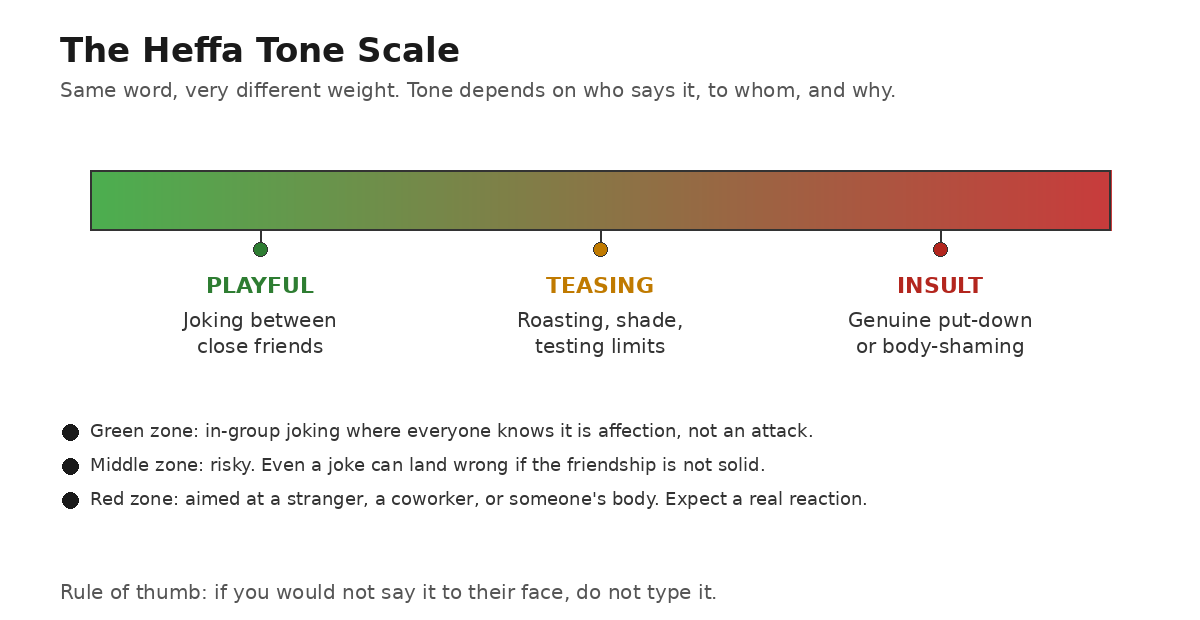
Most uses of the word fall into one of three shades, and telling them apart is the whole game. First, there is the playful shade. Two friends are joking around, one says something dramatic, and the other fires back with “okay, heffa” and a laugh. Nobody is hurt. The word is seasoning, not the main dish.
Second, there is the teasing shade. This is the roast zone. Someone is being extra, messy, or dramatic, and a friend calls them a heffa to check them. It stings a little, and that is the point, but the friendship underneath holds it together. Think of it like a sibling calling you annoying. The label is real, the affection is real too, and both people know which is which.
Third, there is the insult shade. Here the word is aimed at someone the speaker does not like, often a stranger or a rival, and it usually carries a judgment about her body or her morals. This is the use that gets people in trouble online and in real life. The same four letters, a completely different message.
Heffa meaning in text
In texting, heffa shows up as a quick label for a third person or a direct jab at the person you are messaging. “That heffa really said that?” is a classic texting line, usually sent right after someone does something shady. “You a messy heffa” is the direct version, and it reads as a callout even without an emoji to soften it.
Because texts strip away tone of voice, heffa in a message is harder to read than heffa spoken out loud. A laughing emoji or a “lol” after it signals the playful shade. No emoji, all lowercase, sent in the middle of an argument, signals the insult shade. If you are on the receiving end and you are not sure which one it is, look at the rest of the conversation. The words around it will tell you more than the word itself.
Where Did “Heffa” Come From?
Heffa comes from heifer, the old word for a young female cow, and its slang life runs through African American English, where it has been used to refer to a woman for a very long time. The spelling with an “a” at the end reflects how the word sounds in casual speech, and that spelling is now the standard one online.
The cow connection is not an accident. Calling a woman a cow or a heifer has been an insult in English for centuries, because it reduces a person to an animal and, in the insult version, to her body. The slang use keeps that history in the background even when the speaker means it as a joke. That is why the word can feel heavier than the speaker intended, and why it lands so differently depending on who hears it.
The long history of heifer as slang for a woman
Merriam-Webster notes that heifer has been used to refer to a woman or a girl since at least the late 1700s, both inside and outside of African American English, with different and often unflattering connotations. One older sense pointed at a woman considered sexually promiscuous, and there was also an older sense specific to African American English for a woman with dubious morals. The word has carried judgment for a long time, and that judgment never fully left it.
Dr. Geneva Smitherman, in her 1994 book Black Talk: Words and Phrases from the Hood to the Amen Corner, describes heifer as a reference to any female, used by males and females, and calls it a fairly neutral term in that community context. That matters, because it shows the word has lived a double life for decades: neutral or even affectionate inside the community that uses it most, and harsher when it travels outside that community or gets aimed at a stranger. Merriam-Webster makes the same point, saying contemporary uses of heffa and heifer sometimes blur the line between fairly neutral and a bit judgmental.
How heffa spread through hip hop, comedy, and memes
The word gained wider visibility in the 1990s and 2000s through hip hop, comedy, and Black television and film, where it showed up in dialogue, lyrics, and stand-up routines as a quick way to describe a messy or dramatic woman. Explain Meaning traces this same path, noting that heffa became more prominent in that era and then gained a second life through internet culture and memes in the 2010s.
Social media did the rest. Once a word is a meme format, it travels far beyond the community that raised it. Clips of comedians and creators using heffa as a punchline spread on TikTok and Instagram, and the word started showing up in comment sections written by people who had never heard it spoken in real life. That is also when the arguments about it started, because a word that means one thing in a family group chat can mean something else entirely when a stranger types it under a woman’s photo.
I have watched this pattern with a lot of slang: a word goes from in-group shorthand to mainstream meme, and somewhere along the way the context that made it safe gets left behind. Heffa is a textbook case. The people who grew up hearing it from their grandmothers use it one way, and the people who learned it from a 15-second clip use it another way, and both groups are a little confused by each other.
The 2026 revival
The word got a fresh push in 2026 when creators started posting videos arguing for a comeback of older African American Vernacular English insults, with heffa front and center. One widely shared Instagram reel from July 2026 featured a creator making the case that heffa hits harder and feels more satisfying than the usual profanity, while admitting that women hate being called it. The comments filled up with people saying they still use the word daily, often crediting their grandmothers, aunts, or mothers from the South, and describing it as a satisfying way to scold someone without escalating to a worse word.
That revival is worth knowing about because it explains why you are seeing the word more right now. It is not a brand-new term having a moment. It is an old term being dusted off and handed to a new audience, and that audience is still figuring out the rules for using it.
Heffa vs. Heifer: Is There a Difference?
Heffa and heifer are the same word in different clothes. Heifer is the standard spelling and the literal word for a young female cow that has not had a calf. Heffa is the phonetic, casual spelling that matches how the word sounds in African American English and in everyday speech, and it is the spelling people reach for when they mean the slang sense.
In practice, the spelling tells you something about the register. Heifer in a sentence usually means the animal, or it shows up in an older or more formal use of the slang. Heffa in a sentence almost always means the slang sense, and it reads as informal, spoken, and current. The same goes for heffer, a third spelling that floats around online and means the same thing.
None of the spellings changes the meaning, but the spelling you pick changes how your sentence reads. If you write “heifer” in a text, some readers will hear the farm animal first and the slang second. If you write “heffa,” the slang meaning is clear right away. That is why the slang spelling won online: it removes the ambiguity.
Quick spelling guide
Use heffa when you mean the slang word in a casual context, like a text, a caption, or a quote of someone speaking. Use heifer when you mean the actual animal, or when you are quoting an older source that spells it that way. Use heffer only if you are matching someone else’s spelling, since it is the least common of the three. And if you are writing about the slang term itself, heffa is the spelling most readers will recognize and search for.
How Is “Heffa” Used in Text and Online?
Heffa is used online as a label, a roast, or a punchline, and it shows up most in comment sections, quote posts, memes, and group chats where people are reacting to someone’s behavior. The most common patterns are “that heffa,” “this heffa,” “you heffa,” and “these heffas,” and each one points the word at a target with a different level of heat.
The classic use is the third-person callout. Someone posts a screenshot of a messy text or a dramatic video, and the comments fill with “that heffa is crazy” or “that heffa really thought she ate.” The word does two jobs at once: it identifies the woman being talked about, and it signals that the commenter disapproves of her. It is gossipy, it is fast, and it is the kind of line that gets liked because it says in one word what a whole paragraph would take to explain.
The second common use is the direct address in a joke or a roast. “Girl, you a messy heffa” is the kind of line friends trade when one of them has done something dramatic. “Not today, heffa” is a popular variation, a play on the phrase “not today, Satan,” used to shut down someone’s nonsense with a laugh. Both of these read as playful when the relationship is solid, and both can read as hostile when it is not.
Examples in real sentences
Here are the kinds of sentences you will actually see, with a note on the tone behind each one. “That heffa ain’t got no business talking about nobody else.” That is a callout, and it is meant to sting. “You know I thought I was too cute to be standing around with the rest of those heffas.” That line comes from a 1994 story by Lawanda Powell, and it shows the word being used casually among women to mean simply “those other girls,” with a little side-eye but no real venom.
“Dear God, help me keep this little heffa safe cause she clumsy as hell.” That is a real caption from a 2022 Instagram post by Zendaya’s assistant Darnell Appling, joking about Zendaya herself, and it is the playful shade at its clearest. He is not insulting her. He is roasting a friend in public, and the affection is obvious. “That is real. If a broad handles her business, she ain’t got to worry about another heffa doing it for her.” That line, from a 2007 novel, uses the word as plain shorthand for “another woman,” with the edge coming from the situation rather than the word alone.
Notice how much work the context does. The word itself stays the same. The relationship, the setting, and the sentence around it decide what it means. That is true of a lot of slang, but it is especially true here, because the gap between the playful use and the insulting use is so wide.
Heffa on TikTok, Instagram, and X
On TikTok, heffa shows up in storytime videos, reaction clips, and comedy sketches, usually in the caption or spoken in the first few seconds to set up a character. The creator is telling you who the messy person in the story is, and the word does that job fast. On Instagram, it lives in reels and comment sections, often attached to memes about dramatic behavior or messy friendships. On X, it appears in quote posts and replies, where its short length makes it a good punchline.
The word also travels in meme formats where the joke is the word itself. Creators film themselves saying “heffa” with dramatic emphasis, or they build lists of old-school insults and put heffa at the top. The 2026 revival videos are a good example: the humor comes from treating a simple word like a powerful weapon, and the audience plays along because many of them grew up hearing it from older relatives.
One thing to watch for is the comment section under these posts. You will see two reactions side by side. Some people write that they still use the word every day and that their grandmothers said it first. Others write that it is a body-shaming insult and should stay retired. Both reactions are honest, and both tell you something real about the word. It lives in that split, and any guide that pretends the split does not exist is missing the point.
Who Says It, Where, and to Whom?
Heffa is said most by Black Americans and by people steeped in African American English, and it is heard most in casual, informal settings: group chats, family gatherings, comment sections, comedy clubs, and social media. It is said to women and about women, usually by other women or by men talking about women, and it is almost never said in a formal setting like a workplace meeting or a classroom.
The usage map below breaks down the main situations. The safest zone is close friends and family who share the same background and the same sense of humor, where the word works as a joke. The middle zone is social media and public comment sections, where the audience is mixed and the joke can misfire. The riskiest zone is strangers, workplaces, and any setting where the person hearing it has no relationship with the speaker.

Who says it
Women say it to and about other women more than anyone else, and inside that group it often reads as neutral or teasing. Men say it too, usually about women, and when a man aims it at a woman the insult shade gets stronger, because the word has a long history of men using it to judge women’s bodies. Older Black speakers, especially from the South, use it as everyday vocabulary, often in the same breath as other old-school words like hussy or heathen. Younger speakers mostly learn it online, and they tend to use it as a meme word or a roast word rather than as everyday speech.
Where you hear it
You hear it in group chats, in family kitchens, in barbershops and salons, in comedy routines, and all over social media. You do not hear it in job interviews, in customer service calls, or in any room where people are being careful about how they sound. That split is a clue. The word belongs to informal, in-group spaces, and it sounds out of place the moment it leaves them.
To whom it is said
It is said to friends, to rivals, to strangers in comment sections, and sometimes to the speaker herself, as a joke: “I am such a messy heffa today.” Self-use is almost always playful, because nobody insults themselves with a word they truly find wounding. The moment it is aimed at someone who did not agree to the joke, the meaning changes, and the speaker does not get to decide how it lands. The listener does.
Heffa vs. Similar Words: The Comparison Table
Heffa sits in a crowded group of slang words for women, and people mix them up constantly. The table below compares heffa with four of the words it gets confused with most, so you can see what each one actually means, how harsh it is, where it shows up, and how it sounds in a sentence.
| Word | Meaning | Tone | Where it is used | Example |
|---|---|---|---|---|
| Heffa | A woman, often with a judgmental or teasing edge about her behavior or body | Playful to insulting, depending on context | AAVE, group chats, TikTok, Instagram, comedy | “That heffa really said that with her whole chest.” |
| Heifer | Literally a young female cow; in slang, the same sense as heffa | Older and more formal sounding, often harsher | Older speech, books, rural and Southern use | “She called her a heifer right to her face.” |
| Diva | A woman who is dramatic, demanding, or fabulous, often with confidence | Teasing to admiring, rarely a true insult | Pop culture, music, everyday compliments | “She walked in acting like a whole diva.” |
| Big back | A person who eats a lot or has a big appetite, said as a joke | Playful teasing about food, rarely cruel | TikTok, food videos, friend groups | “My big back ordered dessert and appetizers.” |
| Chopped | Someone considered unattractive, used as a blunt insult | Harsh and direct, almost never playful | TikTok, gaming chats, comment sections | “He got called chopped and the whole chat lost it.” |
The closest relative is heifer, which is the same word with the standard spelling, and the two are interchangeable in meaning. Diva is the friendly cousin: it also describes a dramatic woman, but it carries admiration or at least amusement, and it rarely lands as a real insult. If you want a deeper look at that word, our guide to diva meaning in slang breaks down its history and its many shades.
Big back is a useful contrast because it shows how a body-related joke can stay light. It teases someone about eating, not about who they are, and people often use it on themselves. Our guide to big back meaning in slang covers that word in full. Chopped, on the other hand, is the harsher end of the same family: it calls someone unattractive outright, with no playful shade to hide behind. Our guide to chopped meaning in slang explains how it is used and why it stings.
There is one more word worth mentioning in this neighborhood: foid, a term from online incel communities that reduces women to a slur and is considered deeply offensive. Heffa is not in that category. It has a real community history and a playful use that foid does not have, but the comparison is useful because it shows where the line sits. Our guide to foid slang and why it is offensive explains that term and the harm behind it.
Is “Heffa” Offensive?
Yes, heffa can be offensive, and whether it is offensive depends on who says it, who hears it, and what they meant by it. As a gendered insult with roots in calling women cows, it carries a history of body-shaming, and many women hear that history even when the speaker meant it as a joke. At the same time, many speakers use it playfully inside their own community, where it reads as a roast rather than an attack. Both facts are true at once, and that tension is the honest answer.
Merriam-Webster puts it plainly: though most current slang usage may be neutral or playful, and sometimes self-applied, heifer has also been used disparagingly in African American English and in general usage, especially to refer to women considered overweight or unattractive, which is no surprise given the offensiveness of cow when applied to a woman. The dictionary also notes that heffa can be considered similar to the b-word, a disparaging term that has been reclaimed as neutral or even positive in some contexts. That comparison is a good guide. Both words live in the same space: insulting from a stranger, affectionate from a friend, and complicated everywhere in between.
The gendered problem
The word is aimed at women almost exclusively, and that is a big part of why it stings. When a man calls a woman a heffa, the insult carries the weight of a long tradition of men judging women’s bodies and behavior in public. When a woman says it to another woman, the same history is still there, but the shared experience softens it. This is not a rule anyone wrote down. It is a pattern you can see in how people react, and it is worth respecting.
Explain Meaning makes the same point from the other side, noting that the word is generally considered offensive because it functions as an insult targeting physical appearance and social status, but that context matters a lot, and some communities use it within in-group settings with different connotations, while use by outsiders is typically seen as disrespectful. That is a fair summary, and it matches what you see in real life.
Reclamation and joking use
Reclamation is real here, but it is limited. Women who grew up with the word, and Black women in particular, often use it on themselves and their friends without any sting, the same way other insult words get reclaimed inside the group they target. The key word is inside. Reclamation works when the people using the word share the experience it describes. It does not transfer to outsiders just because they heard it in a song or a meme.
The joking use is real too. Friends roast each other, and heffa is a good roast word because it is dramatic, old-fashioned, and a little bit funny. But a roast only works when everyone in the room knows it is a roast. The moment someone is not sure, the joke has failed, and the speaker owns that failure. If you have to explain that you were joking, the word did its damage already.
Who can say it
There is no official permission slip for slang, but there is a clear pattern. People inside African American English, especially Black women using it with each other, get the most room with this word, because the word belongs to their speech community. People outside that community get less room, and people who use it to insult a stranger get none. That is not a double standard. It is how in-group language works: the people who live with a word get to decide what it means, and everyone else is a guest.
If you are not part of the community the word comes from, the safest move is to understand it, not to use it. You can recognize it in a song, laugh at it in a comedy clip, and explain it to a friend. Using it yourself, especially aimed at a real woman, is a different thing, and it is where most of the trouble starts.
When NOT to Use “Heffa”
Do not use heffa at work, in school, in any professional setting, or in any message to someone you do not know well. Do not use it to describe a stranger’s body, to insult a woman in an argument, or to score points in a public comment section. Do not use it about a coworker, a teacher, a customer, or anyone who cannot safely push back. And do not use it as a joke if you are not sure the other person will take it as one, because the cost of guessing wrong is a real hurt and a real conflict.
The simplest test is the face test. If you would not say it to this person’s face, in front of their friends and family, do not type it. A word that feels funny in a group chat at midnight can feel very different in daylight, in front of an audience, or in a screenshot that lives forever. Screenshots are the part people forget. A joke that lands fine in a private chat can become a public problem the moment someone shares it.
There is also a platform risk. Calling someone a heffa in a public comment can get your comment removed or your account flagged for harassment, depending on the platform and the context. English Grammar Lessons notes that the word is a form of body shaming and that using it online can draw backlash, which matches what many people have learned the hard way. The word is not banned anywhere, but the behavior around it can cross a line, and platforms do act on that.
What to Say Instead of “Heffa”
If you mean it playfully, there are better words that carry no baggage. “Messy” does the same job when you want to tease a friend for being dramatic: “You are so messy” lands the joke without the body-shaming history. “Extra” works when someone is being over the top: “She is being so extra today” is clear, funny, and harmless. “Drama queen” is an old standby that keeps the teasing without the gendered insult, and “wild” works when someone has done something unbelievable: “You are wild for that” is a compliment and a roast at the same time.
If you mean it as a real criticism, say what you actually mean instead of hiding behind slang. If someone was rude, say “that was rude.” If someone was dishonest, say “that was shady.” If someone hurt you, say “that hurt.” These words are clearer, they are harder to misunderstand, and they do not drag a person’s body or gender into the conversation. Direct language is almost always stronger than a coded insult, and it leaves no room for the other person to wonder what you really meant.
If you are describing a woman and you just need a neutral word, use her name, or “that woman,” or “my friend,” or whatever her actual role is. The word heffa does a lot of work in one syllable, but most of that work is judgment, and when you do not need the judgment, you do not need the word.
What to Say When Someone Calls You a Heffa
If a friend says it as a joke and you are fine with it, the easiest reply is to laugh and fire back. “Okay, and?” is a classic, because it agrees with nothing and concedes nothing. “You are one to talk” turns the roast around. “Girl, please” dismisses it with style. These replies work because they match the energy of the joke and keep the conversation light.
If it was meant as an insult, you have better options than a comeback. A calm “Do not call me that” sets a boundary and ends the conversation on your terms. “That is not funny” names what happened without escalating it. If it happened at work or in a public setting, you can simply walk away and address it later, in private, where you have more control. You do not owe anyone a clever reply to an insult, and a short, clear boundary is stronger than a witty one.
If someone says it and you are not sure what they meant, ask. “Did you mean that as a joke?” is a fair question, and it puts the responsibility back on the speaker to explain themselves. Most people will either apologize or clarify, and either answer tells you what you need to know about the relationship. And if the same person keeps doing it after you asked them to stop, that is not a joke anymore. That is a pattern, and you are allowed to treat it like one.
Myths vs. Facts About “Heffa”
Myth: Heffa is just a funny word with no real meaning
Fact: it has a long history as a judgmental term for women, going back to at least the late 1700s, and that history is part of what people hear when you say it. A word can be funny and loaded at the same time, and heffa is both.
Myth: Heffa only means an overweight woman
Fact: weight is one common use, but it is not the only one. The word also gets used for a woman who is messy, dramatic, rude, or simply disliked by the speaker. Reducing it to a weight insult misses half of how people actually use it, and it also misses why women who are not overweight still react to it.
Myth: Heffa is a brand-new TikTok word
Fact: the word is centuries old in its heifer form, and its slang life in African American English goes back decades, with documented use in books from the 1990s. TikTok gave it a new audience, not a new birth.
Myth: If Black creators use it, anyone can use it
Fact: in-group use and out-group use are different things. A word that is playful inside a community can be disrespectful outside it, and hearing a word in a video does not make it yours to use. Context and relationship decide, not the fact that you saw it online.
Myth: Heffa and heifer are completely different words
Fact: they are the same word with different spellings. Heifer is the standard spelling, heffa is the phonetic slang spelling, and the meaning does not change with the letters. The spelling tells you about the register, not about a different definition.
People Also Ask About “Heffa”
What does heffa mean in slang?
Heffa is slang for a woman, usually said with a teasing or insulting edge. It comes from heifer, a young female cow, and it can be playful between friends or a real put-down aimed at a woman’s behavior or body. The tone depends on who says it and to whom.
Is heffa offensive?
Yes, it can be. Heffa is a gendered insult with a history of body-shaming, so many women find it offensive, especially when a man or a stranger says it. Between close friends in the same community it can be a joke, but that does not make it safe in every setting. When in doubt, do not use it.
Where did heffa come from?
Heffa comes from the word heifer and its slang use runs through African American English, where it has referred to a woman for a very long time. Merriam-Webster notes that heifer has been used this way since at least the late 1700s, and Dr. Geneva Smitherman documented its use in Black speech in her 1994 book Black Talk. It spread more widely through hip hop, comedy, and social media.
What is the difference between heffa and heifer?
There is no difference in meaning, only in spelling and register. Heifer is the standard spelling and the literal word for a young female cow. Heffa is the casual, phonetic spelling that matches how the word sounds in speech, and it is the spelling people use for the slang sense online. Heffer is a third spelling with the same meaning.
Can guys be called a heffa?
Rarely, and almost always as an extra insult. The word is aimed at women, so calling a man a heffa borrows a female-coded insult to sting more. It happens in roasts and jokes, but it is not the normal use, and it usually says more about the speaker’s intent to insult than about the man himself.
Is heffa the same as the b-word?
Not exactly, but the two words live in similar territory. Both are gendered insults for women that have also been reclaimed as neutral or even affectionate in some in-group contexts. Merriam-Webster draws the same comparison. The main difference is strength: the b-word is more widely recognized as profanity, while heffa sounds older and softer, which is part of why some people use it as a substitute. Softer does not mean harmless, though, and heffa can still land as a real insult.
What does “not today, heffa” mean?
“Not today, heffa” is a playful way to shut someone down, modeled on the phrase “not today, Satan.” It means “I am not dealing with your nonsense right now,” said with humor rather than anger. It works best between friends who joke this way, and it can sound hostile if it is aimed at a stranger.
Sources and Further Reading
The definition, history, and examples in this guide come from sources that were opened and checked while writing. Merriam-Webster traces the slang use of heffa and heifer through African American English and quotes Dr. Geneva Smitherman on the term, and it also supplies the examples from Zendaya’s assistant, Lawanda Powell, and other writers used above. Explain Meaning covers the quick definition, the 1990s and 2000s rise, and the question of whether the word is offensive. English Grammar Lessons covers the heffer spelling, the Urban Dictionary history, and the body-shaming angle. The 2026 revival details come from a widely shared Instagram reel by Kam Coleman, which shows how the word is being discussed right now.
- Merriam-Webster: HEFFA Slang Meaning
- Explain Meaning: Heffa Meaning, Definition, Origin and Examples
- English Grammar Lessons: Heffer, Meaning, Origin and Usage
- Instagram: Kam Coleman on bringing back the word heffa
For related words, start with our guide to BBW meaning in slang, which covers another body-related term with its own history and rules, and our guide to British slang insults if you want to see how other English-speaking cultures handle the same kind of word.